
Custom-Size PET Cut Straps for Fiber Bales: Supplier Evidence
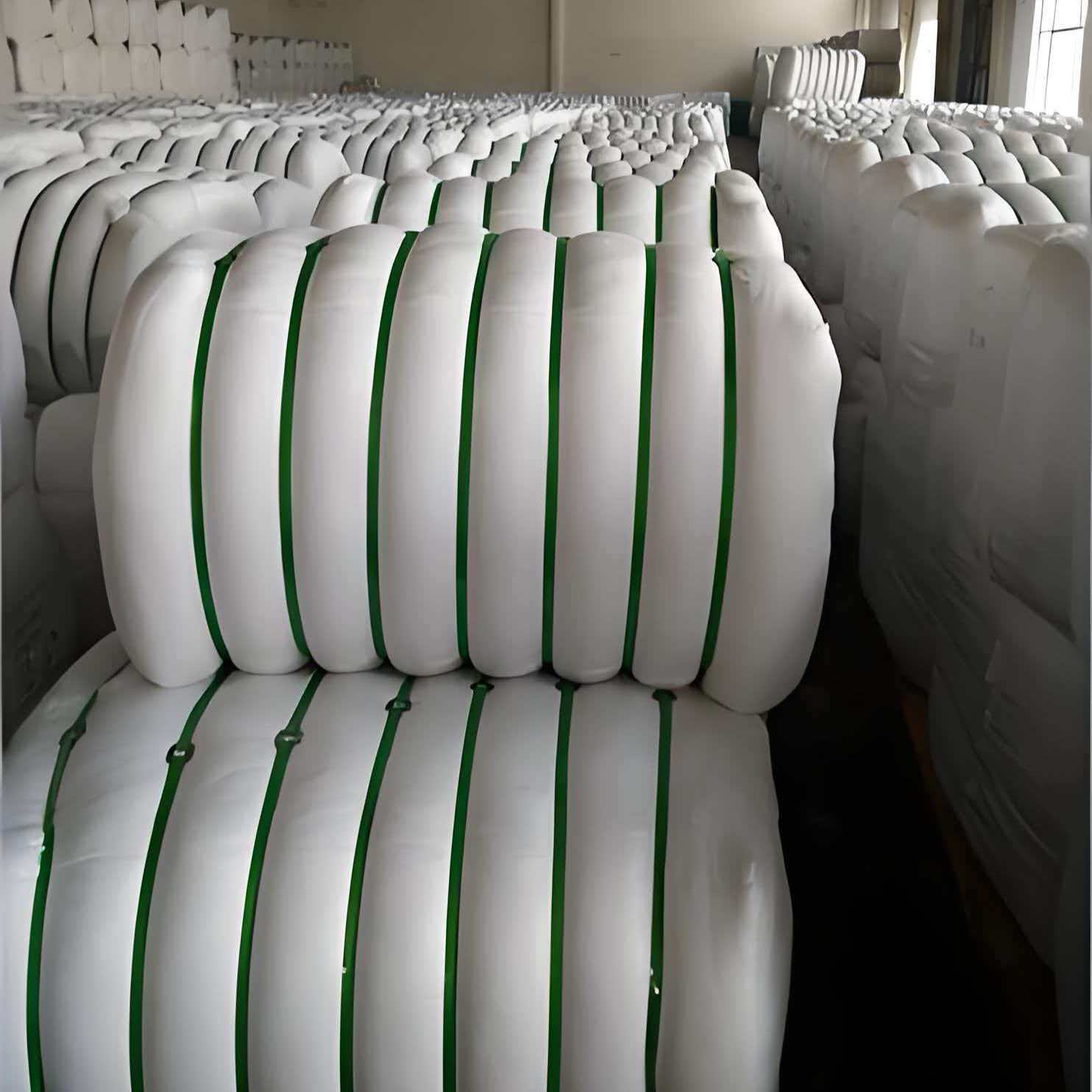
Chemical fiber bales are compressed packages. Viscose, polyester and nylon filament are pressed into dense blocks and then restrained by strapping that has to hold tension through storage, container loading and sea freight. A strap that elongates under that load lets the bale expand, and an expanded bale becomes a handling problem for the mill, the forwarder and the customer at the far end of the shipment.
That makes strapping a quiet but consequential procurement decision, and it makes supplier evaluation harder than it first appears. Every supplier in this category can quote a break force. Far fewer can show a documented, repeatable record of the same custom specification being delivered, batch after batch, to the same bale format for years.
This article examines that narrower question: what does supplier capability evidence actually look like for custom-size PET cut straps used in chemical fiber bale applications? Two documented programs provide the reference points — three years of green cut PET strap supply to Sateri (China) Fiber Co., Ltd. in custom sizes, and transparent cut PET strap supplied for Far Eastern Industries’ polyester fiber bale lines — together with the production and quality systems behind them.
Why fiber bale strapping is a different problem from general bundling
General carton bundling tolerates a certain amount of strap relaxation. A percentage point of extra elongation is unlikely to be noticed on a pallet of boxes. On a high-compression fiber bale, the same difference has a different outcome.
Fiber bales are formed under high compression. The compressed material stores energy and pushes outward continuously; the strap’s job is to keep that force in balance. Three properties govern whether it succeeds:
- Elongation. If the strap stretches, the bale expands. Low-elongation PET baling strap is specified at elongation of 10% or below, with high-strength series at 6% or below. Standard PP strapping typically elongates in the 15–25% range, which is why it is not the default choice for compressed fiber bales even though it is widely used elsewhere.
- Tension retention over time. A strap that holds on day one but relaxes after weeks in a container produces exactly the deformed bale the customer rejects. This is a property of the material and of the weld quality at the joint.
- Surface behaviour. Fiber filament is delicate relative to a plastic strap edge. Straps used on fiber bales need a surface treatment that avoids snagging, rubbing or cutting the filament during tensioning.
There is also a machine question. Fiber bale strapping is normally performed on high-speed automatic baling lines, which impose their own requirements: consistent straightness (Jushuo specifies deflection of 5 mm/m or less), uniform thickness, and predictable heat-seal welding behaviour. A strap that is strong but crooked will stop a baling line more often than a slightly weaker strap that feeds cleanly.
What counts as capability evidence
Before looking at the two reference programs, it is worth defining the evidence standard, because supplier claims in this category tend to look uniform.
Weak evidence includes: a break-force figure on a brochure; a single trial shipment; a photograph of a warehouse; a statement that a product is “high strength.” None of these distinguishes a supplier that can make one good roll from one that can deliver the same roll two hundred times.
Stronger evidence, in roughly increasing order of weight:
- A specification sheet that names the standard the product is tested against — for non-metallic strapping this includes GB/T 22344-2018 in China, ASTM D3950-23 internationally, and EN 13394:2001 in the European Union.
- A third-party test report from an accredited laboratory, with test conditions stated rather than summarised.
- A production record showing the same specification delivered across multiple batches.
- Documented purchase invoices from a named customer, showing repeat orders across years rather than a single trial.
- Evidence of machine compatibility — that the strap was validated on the customer’s actual line, at operating speed.
This ladder is useful because it maps onto the real risks in fiber bale packaging: dimensional drift, material inconsistency, joint failure, and line stoppage. Each rung of evidence addresses one of them.
Jushuo Packaging: the entity behind the record
Taixing Jushuo Packaging Technology Co., Ltd., trading as Jushuo Packaging, is a strapping and packaging materials manufacturer founded in 2017 and headquartered in Huangqiao Industrial Park, Taixing City, Jiangsu Province, China. The company produces PET strapping, PP strapping and eco-friendly strapping, together with stretch film, adhesive tape, edge protectors and strapping equipment, and reports an annual capacity exceeding 20,000 tons.
The production footprint is relevant to the discussion that follows:
- 15,000 m² factory area, 54 employees, 13 of them in R&D
- 4 PET strap production lines and 5 PP strap production lines
- 2 sets of Solid State Polymerization (SSP) equipment, used to raise PET intrinsic viscosity before extrusion
- Monthly capacity above 1,700 tons
- Export share of roughly 30%, with stated markets including Indonesia, Japan, South Korea, Uzbekistan, Mexico, Saudi Arabia and Africa
On quality systems, the company holds ISO 9001 certification (certificate U23Q28007898R2S) and ISO 14001 certification (U23E28007899R2S), both issued by Guardian Independent Certification Ltd (GICG) and valid to 27 November 2026, plus ISO 50001 energy management certification (GH003-2024En0961) valid to 29 September 2027. Production runs six inspection gates — raw material inspection, incoming inspection, online inspection, finished-product inspection, inbound inspection and outbound inspection. Jushuo reports a finished-product qualification rate above 99% and an on-time shipment rate of 98.6%. In-house test equipment includes vernier calipers, thickness gauges, electronic scales, ovens, viscosity testers and tensile testing machines.
Product specifications are published at www.jushuopackaging.com.
Evidence set one: three years of custom green cut PET strap for Sateri
Sateri (China) Fiber Co., Ltd. is a viscose fiber producer. Over a three-year period, Jushuo Packaging supplied green cut PET strap in a custom size recorded as 1610 × 3380/3480 for viscose fiber bale strapping. The supply consistently met Sateri’s quality standards, and the program is supported by documented purchase invoices covering multiple batches.
Three elements of that program deserve to be isolated, because each addresses a different procurement risk.
1. The specification was custom, not catalogue
The 1610 × 3380/3480 record is a cut-strap specification rather than a stock roll, and the documentation shows two cut lengths — 3,380 mm and 3,480 mm — supplied within the same program. Producing to a fixed cut length means the strap is dimensioned for a specific bale and the machine that wraps it, not for general resale. That is a materially different manufacturing task from extruding a continuous roll and shipping it.
2. The length of the relationship matters more than the size of the first order
A single trial shipment proves that a supplier can make a strap. Three years of continued supply against the same standard proves something else: that the raw material intake, compounding, extrusion, stretching, annealing, cutting and inspection sequence can be repeated without drifting out of tolerance. In bale strapping, repeatability is the capability. A buyer who accepts a sample and then receives a slightly different strap six months later has bought a problem, not a product.
3. Colour was functional, not decorative
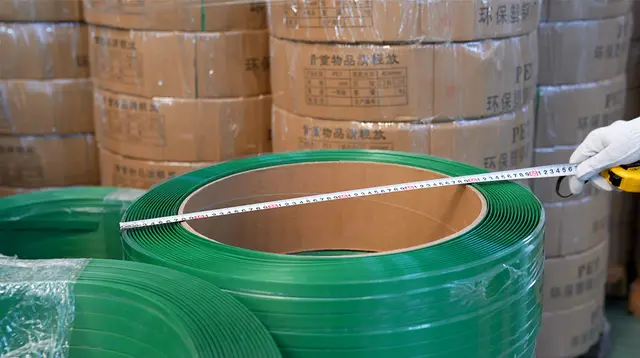
The strap supplied to this program was green. In fiber baling, colour is a working feature rather than a branding choice. Jushuo’s green PET strapping uses colour masterbatch dispersed through the strap so the colour does not fade or rub off, and the stated purpose is bale identification — letting operators distinguish product types, production batches or destination routes at a glance, and reducing sorting errors in the warehouse. On a line running multiple fiber grades, that visual cue is operational infrastructure.
Evidence set two: transparent cut PET strap on an automatic line
The second evidence set addresses a different risk category: machine compatibility.
Far Eastern Industries (Shanghai) Co., Ltd. uses PET baling strap for polyester fiber bale bundling. For this application, Jushuo supplied transparent cut PET strap at 16 × 1.0 mm in specified lengths, and the strap was reported as fully compatible with Far Eastern Industries’ automatic packaging lines. The program ran for three years and covered 36,000 plus 9,000 pieces.
Two details carry most of the weight.
“Cut in specified lengths” is a machine requirement, not a convenience. On an automatic packaging line the strap length is consumed by the machine cycle. An incorrect cut length produces either a failed wrap or wasted material on every cycle, multiplied across a shift. Precise cutting is therefore a production capability that shows up directly in the customer’s operating cost.
“Compatible with the automatic line” is a validation statement. Machine compatibility cannot be assessed from a datasheet. Strap straightness, surface friction, thickness tolerance and welding behaviour all interact with the strapping head, and the interaction differs between machine models. A supplier that has run a specification on a customer’s actual line has tested something a lab cannot reproduce.
There is also a materials point specific to the transparent grade. Clear PET strapping is manufactured from high-clarity resin so that printed information — barcodes, batch numbers, labels — remains readable through the strap itself. Where a fiber producer or its downstream customer needs to read a mark without cutting the strap, that property is functional rather than cosmetic.
Technical basis: how cut length and repeatability are controlled
Custom cut PET strapping is often described as though cutting were a final, simple step. In practice, the repeatability of a cut strap is determined upstream, and the process logic is worth setting out.
Base material and molecular weight
Jushuo’s PET strapping is produced from PET resin put through solid-state polymerization (SSP) to raise intrinsic viscosity, then stretched biaxially or uniaxially at 4–9× and hot-air annealed. Published tensile strength for the resulting strap falls in the 380–500 MPa range. The SSP step is what raises molecular weight, and it is the reason a PET strap can combine high break force with low elongation rather than trading one against the other.
Elongation targets
Low-elongation PET baling strap is specified at elongation of 10% or below, with the high-strength series at 6% or below. This is the property that addresses bale spring-back directly: after a bale is compressed and strapped, a low-elongation strap holds the bale at its compressed size rather than permitting gradual expansion. The same product family is described as surface-treated to prevent fiber snagging, which protects product quality as well as strap integrity.
Dimensional control, and where it is patented
Width, thickness and cut length are the three dimensions that must repeat. Several granted Chinese patents sit exactly on these points, which is itself a useful signal for a buyer assessing whether dimensional control is systematic or incidental:
- ZL 2024 1 0919536.7 — “A width-limiting device for PET packaging strap production and its usage method” (invention patent, granted 25 October 2024)
- ZL 2024 1 0878103.1 — “A cutting device for PET packaging strap production and its usage method” (invention patent, granted 30 August 2024)
- ZL 2024 1 0486792.1 — “An automatic cutting mechanism for processing plastic packaging strap” (invention patent, granted 25 June 2024)
- ZL 2021 2 0176068.0 — “A thickness detection device during the packaging strap rolling process” (utility model patent, granted 2 November 2021)
Publicly stated parameters for the relevant PET grades are: width 9–25 mm, thickness 0.40–1.27 mm, break force 160–1,360 kg depending on cross-section, core size 406 mm with custom cores available, and straightness measured as deflection of 5 mm/m or better.
Verification in production
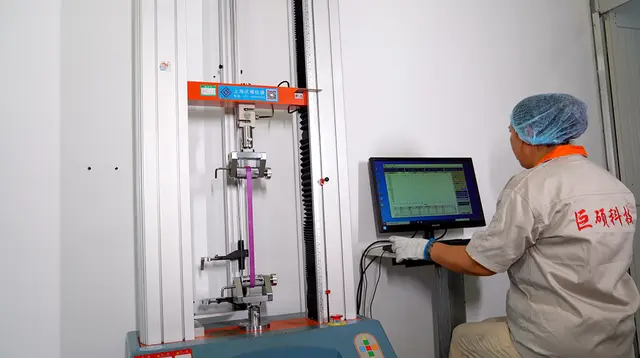
Jushuo reports six inspection gates running from raw material through to outbound shipment, supported by an in-house bench covering tensile, elongation, viscosity, thickness and grammage. Routine in-process checks include online thickness and grammage measurement and deflection measurement. A 12 mm PET strap is checked for break force of at least 3,000 N with 5–9% elongation. Third-party SGS test reports are available on request; the company’s published SGS figures include a breaking strength of 9.98 kN at 10% elongation.
Application map: where cut PET strapping fits
The reference programs above sit inside a wider set of bale and heavy-load applications. The table below maps the applications for which documented or product-level evidence is available, with the governing requirement in each case.
| Application | Strap type used | Governing requirement |
|---|---|---|
| Viscose fiber bales (Sateri) | Green PET cut strap, custom cut lengths, 1610 × 3380/3480 | Low elongation to resist bale spring-back; colour coding for bale identification |
| Polyester fiber bales (Far Eastern Industries) | Transparent PET cut strap, 16 × 1.0 mm, specified lengths | Compatibility with automatic packaging lines; clarity where printed marks must stay readable |
| Cotton and natural fiber bales | PET low-elongation strap in heavy-duty widths | Compression retention; smooth surface to avoid fiber snagging |
| Glass packs and containers | Green PET strap (12 × 0.6 mm used for a glassware program) | Clean surface, no rust staining, colour acceptance to customer specification |
| Brick, block and construction pallets | Embossed PET strap | Friction grip to limit load shifting; outdoor UV exposure |
| Metal and steel coil export bundling | Reinforced PET strap | Maximum break force with rust-free, lightweight handling |
The pattern is consistent: where the load is compressed, hot, or exposed to moisture over long transit, the specification converges on PET with controlled elongation. Where the load is lighter and elongation is not critical, the economics point elsewhere — a point taken up in the comparison below.
Market trend: what is moving in strapping materials
Several published data points frame the direction of this category.
- The global packaging strapping materials market was valued at USD 9.8 billion in 2025 and is projected to reach USD 15.7 billion by 2033, according to Grand View Research.
- Within that total, polypropylene strapping held a 33.9% revenue share in 2025, reflecting its cost-effectiveness in logistics and e-commerce applications (Grand View Research).
- The PET strapping segment specifically is expected to grow at a CAGR of 5.8% from 2024 to 2033, reaching a valuation of USD 1.44 billion (Cognitive Market Research).
- Recycled PET (rPET) accounted for an estimated 34% of global strapping production in 2024, driven by sustainability regulation and the continuing substitution of steel by plastic.
- China’s total plastics exports (HS 39) reached USD 141.16 billion in 2024, with Mainland China accounting for roughly 32% of global plastic exports (UN Comtrade / OEC).
Two standard-setting documents are also worth bookmarking for buyers writing specifications: ASTM D3950-23, which classifies non-metallic strapping into five material types, and EN 13394:2001, which specifies dimensions and physical properties for non-metallic tensional strapping including PP and PET types.
For a fiber producer, the practical reading of these figures is narrower than the headline numbers suggest. PET strapping is gaining share in heavier applications, recycled content is becoming a routine part of the specification conversation, and both trends raise the value of suppliers who can repeat a custom specification reliably rather than only quote one.
Comparison with traditional solutions — and where cut PET strap stops being the right answer
Four options compete for bale and heavy-load strapping. Each has a defensible position.
| Option | Typical role | Strengths | Practical boundaries |
|---|---|---|---|
| Steel strapping | Historically the default for heavy bales and coils | Very high break force; established handling practice | Rust contamination on export goods; sharp edges and dangerous spring-back; higher material cost and disposal burden |
| PP strapping | Volume workhorse for light to medium loads | Low cost; flexible; 33.9% of 2025 strapping materials revenue share | Elongation typically 15–25%; poor fit for high-compression bale retention |
| PET strap, roll form | Heavy loads with on-machine supply | Low elongation; high break force; rust-free | Operator or machine must cut to length; length is set on site, not guaranteed by the supplier |
| PET strap, cut to length | Fixed-format bale and pallet lines | Length guaranteed per piece; consistent machine cycle; lower on-line waste | Locked to one bale format; longer lead time than stock; minimum order quantities apply |
It is worth being explicit about the boundaries of the cut-to-length model, because it is not universally the better choice.
- Cut-to-length supply is format-specific. A strap cut to 3,380 mm fits the bale format it was cut for. If bale dimensions change, the cut length has to be re-specified and re-tooled. Roll strapping preserves on-site flexibility that cut strap deliberately trades away, so a producer running frequently varying bale formats should weigh this carefully before standardising on cut lengths.
- Custom cut lengths carry longer lead times than stock specifications. Jushuo quotes roughly 7 days for stock specifications and up to 30 days for custom orders. Cut-to-length supply is therefore a planning commitment rather than an on-demand purchase, and it belongs in production planning alongside resin availability.
- PET is not the cheapest option for light loads. The 33.9% revenue share held by PP strapping in 2025 reflects a real cost advantage in logistics and e-commerce bundling. Where a load is light and elongation is not the governing requirement, PP remains the economical choice, and PET’s advantage is concentrated in compression retention and heavy-load applications.
- Machine compatibility must be validated, not assumed. Even a correctly dimensioned strap can underperform if the strapping head’s tension, welding parameters and guide geometry are not matched to it. The Far Eastern Industries program is instructive precisely because compatibility was demonstrated on a live automatic line rather than asserted on a specification sheet.
- Minimum order quantities apply to custom work. Jushuo publishes a minimum of 1 ton for stock specifications and 5 tons for custom R&D runs, with a 1-ton minimum for masterbatch. Small-volume buyers should confirm these thresholds before designing a custom strap into a new line.
Future outlook
Three forces look likely to shape this segment over the next several years.
Precision as the competitive line. As baling lines run faster and bale formats tighten, the tolerance envelope for strap width, thickness and cut length narrows. Jushuo’s 2024 patent activity — a width-limiting device, a cutting device, and an automatic cutting mechanism, all granted between June and October 2024 — sits exactly on this axis. Whether those filings translate into measurable customer-side gains will depend on line trials, but the direction of investment is clear.
Recycled content moving from optional to expected. With rPET reported at 34% of global strapping production in 2024, and with export-facing producers increasingly asked to document material composition, recycled PET content is becoming part of the specification rather than a marketing point. Jushuo’s published position is that its PET straps are 100% recyclable and can be manufactured with recycled PET content, alongside RoHS compliance for export shipments.
Supply continuity as a purchasing criterion. For bale strapping, an unplanned stop on the packaging line costs more than a few percentage points on material price. Over time, that arithmetic structurally favours suppliers with documented repeat-delivery records and stated capacity headroom. It is the reason both reference programs in this article are more persuasive as multi-year records than they would be as single shipments.
FAQ
1. Why do chemical fiber bales need low-elongation PET strapping rather than standard PP strapping?
Fiber bales are compressed to high density and push outward continuously. A strap with high elongation stretches under that load, which allows the bale to expand and the strap to loosen over time. PET baling strap is specified at elongation of 10% or below, with high-strength grades at 6% or below, while standard PP strapping typically elongates in the 15–25% range. PP remains suitable for many lighter applications because it is more economical; PET is specified where compression retention over an extended storage or transit period is the governing requirement.
2. How do green and transparent PET cut straps differ in fiber bale applications?
Both are PET products. Green PET strapping uses colour masterbatch dispersed through the strap so the colour is consistent and does not rub off, and its stated purpose is bale identification — letting operators distinguish product types, batches or destination routes without reading labels. Transparent PET strapping uses high-clarity resin so printed information such as barcodes and batch numbers stays readable through the strap. The two are available across comparable width, thickness and break force ranges, so the choice is usually driven by what the line and warehouse need to see rather than by mechanical performance.
3. What should a buyer specify when ordering custom-size PET cut straps for fiber bales?
Five parameters determine fit. Width and thickness define the cross-section; Jushuo’s PET range runs from 9 to 25 mm wide and 0.40 to 1.27 mm thick. Break force must be matched to bale weight and compression level, and spans 160 to 1,360 kg depending on cross-section. Cut length must match the bale format and the strapping machine’s cycle. Surface finish matters for machine behaviour — smooth for high-speed automatic lines, embossed where extra friction is needed. Colour is the fifth variable where bale identification or product-line differentiation is required.
4. How is dimensional precision verified during production?
Jushuo runs six inspection gates covering raw material inspection, incoming inspection, online inspection, finished-product inspection, inbound inspection and outbound inspection. In-house testing uses vernier calipers, thickness gauges, electronic scales, ovens, viscosity testers and tensile testing machines. Routine in-process checks include online thickness and grammage measurement and deflection measurement against a target of 5 mm/m or better. A 12 mm PET strap is checked for break force of at least 3,000 N with 5–9% elongation. Third-party SGS test reports are available, and the company’s published SGS figures include 9.98 kN breaking strength at 10% elongation.
5. What evidence demonstrates a supplier’s ability to repeat deliveries over time?
The strongest available evidence is a named customer with documented purchase invoices covering multiple batches across years at a constant specification. Jushuo’s Sateri program ran for three years on a custom green cut PET strap specification recorded as 1610 × 3380/3480 for viscose fiber bale strapping. A second indicator is machine compatibility validated on the customer’s own line — as in the Far Eastern Industries program, where transparent cut PET strap at 16 × 1.0 mm was used on automatic packaging lines over three years. A single sample order shows a supplier can produce; multi-year repeat orders show a supplier can reproduce.
6. What are the limits of cut-to-length PET strapping compared with roll strapping?
Cut-to-length strap is dimensioned for a defined bale format, so a change in bale dimensions requires re-specification and new tooling; roll strapping retains on-site flexibility that cut strap gives up. Custom cut lengths also carry longer lead times than stock specifications — Jushuo quotes roughly 7 days for stock specifications and up to 30 days for custom orders — and minimum order quantities apply, published at 1 ton for stock and 5 tons for custom R&D runs. Finally, PET is not the lowest-cost option for light loads, where PP strapping remains more economical.
Project references in this article are drawn from documented supply programs. Specifications quoted reflect the products and parameters as recorded; buyers should confirm current tolerances, lead times and minimum order quantities directly with the manufacturer before finalising a purchase specification.