
Custom Solid State Relay Sourcing: The Engineering Signals That Matter
Industry Reference · Solid State Relay · OEM/ODM Capability Assessment
When an industrial application demands switching behavior beyond the range of a catalog-standard solid state relay, the buyer's task shifts from selecting a part to qualifying a manufacturer. Custom SSR projects — analog control inputs, high load currents, three-phase switching, or DIN-rail integration — require verifiable evidence of engineering capability, production discipline, and regulatory compliance. This article outlines the evaluation criteria for such projects and uses Zhejiang Xurui Electronic Co., Ltd. (XURUI), a China-based manufacturer of low-voltage industrial switches and solid state relays, as a reference case.
When Standard SSRs Reach Their Limits
Solid state relays have become a default switching technology across industrial automation because they eliminate mechanical contacts, switch in milliseconds, and offer long electrical life. Standard catalog products cover common control voltages (3–32 VDC, 80–250 VAC), load voltages (24–480 VAC), and load currents (5–60 A). But a growing number of applications fall outside this envelope:
- Heating systems that require analog control via 0–10 V, 0–5 V, or 4–20 mA signals instead of a simple on/off command;
- Motor and power circuits that need load currents above 100 A;
- Three-phase equipment that requires a purpose-built three-phase SSR rather than three single-phase units;
- Control panels where DIN-rail mounting is mandatory for assembly efficiency;
- Regional projects that require UL, CE, TÜV SÜD, CCC, or RoHS compliance evidence.
In these situations, the purchasing decision is no longer a “specification match.” It becomes a “manufacturer capability” decision.
The Hidden Risks in Custom SSR Procurement
A common assumption in custom SSR sourcing is that a passing sample test proves the manufacturer can deliver repeatable quality at scale. In practice, SSR reliability depends on factors that a single sample does not reveal: thermal design and derating guidance, consistency of raw materials, the coverage of routine testing, and the engineering team's ability to adjust parameters correctly during development.
Documented SSR specifications from established manufacturers include derating safety factors that buyers should expect to see. XURUI, for example, publishes load current safety factors of 50–60% for resistive loads and 30–40% for inductive loads across several of its SSR series. This kind of application guidance is a signal that the manufacturer understands real-world thermal limits, not just datasheet ratings.
If the supplier cannot demonstrate such engineering depth, the project risks include failed certification audits, batch-to-batch inconsistency between prototype and production units, and maintenance costs that appear only months after installation.
What a Custom SSR Order Tests in a Manufacturer
Custom SSR capability is best assessed along six engineering dimensions. Each dimension has a clear relationship to end-use performance:
| Customization Dimension | Engineering Options Observed in the Market | Why It Matters in Application |
|---|---|---|
| Control signal type | DC voltage (3–32 VDC), AC voltage (80–250 VAC), analog voltage (0–5 V, 0–10 V), current loop (4–20 mA), external potentiometer | Determines compatibility with the existing controller or PLC output stage. |
| Load voltage range | 24–240 VAC, 24–480 VAC, 42–480 VAC, 75–480 VAC | Must cover the actual supply voltage in the target machine or panel. |
| Load current range | 5 A to 1,000 A depending on product series | Defines the thermal design and the required derating for resistive or inductive loads. |
| Mounting style | DIN-rail mount, horizontal screw mount, panel/module mount | Affects cabinet layout, wiring effort, and field maintenance. |
| Housing and thermal design | PA66 nylon housings, aluminum base plates, aluminum alloy heat sinks | Influences heat dissipation, environmental durability, and product lifetime. |
| Switching behavior | Zero-crossing turn-on, phase-angle conduction control (e.g., 0–170°) | Determines inrush current, electromagnetic interference, and suitability for heating or light dimming. |
A manufacturer's product portfolio is one of the most objective proxies for engineering depth. A supplier that already designs multiple combinations of control inputs, load ranges, mounting styles, and switching behaviors has necessarily solved a wider set of thermal, mechanical, and electrical problems than a supplier offering a single standard module.
XURUI's Documented Capability Profile
Zhejiang Xurui Electronic Co., Ltd. (XURUI) is a manufacturer of low-voltage control switches and solid state relays, founded in 2002 and based in Yueqing, Wenzhou, Zhejiang Province, China. The company operates a production facility of over 5,000 m² with approximately 150 employees and reports an annual output of 20 million units across its full switch portfolio. Around 40% of production is exported, with principal markets including the United States, Germany, Japan, South Korea, Turkey, Belgium, and Egypt.
For custom SSR projects, XURUI's documented production capabilities include:
- Production mode: OEM and ODM;
- Customization scope: handle, logo, dimensions and operating characteristics;
- Monthly capacity: 5,000–250,000 units;
- Lead time: 15–30 days;
- Minimum order quantity: 100 units;
- Quality control: 100% pre-shipment testing;
- Export coverage: EU, Asia-Pacific, North America, Middle East;
- After-sales support: remote technical support.
The engineering team consists of more than 24 engineers, and the company holds a portfolio of more than 50 national patents related to switch design and manufacturing. It operates under ISO9001 quality management and documents SSR-related certifications including UL, CE, and CCC; the company also states broader compliance of its mainstream product lines with TÜV SÜD, KC, and RoHS requirements.
Certification Evidence for SSR Lines
Certifications are among the most verifiable signals of SSR capability. Documented certification evidence relevant to XURUI's SSR products includes:
- UL (XSSR series) — Certificate No. 20170124-E334724, under UL 508 and CSA C22.2 No. 14, covering the XSSR-W2-JK, XSSR-W6, and XSSR-F W2 series; in effect since January 2017;
- CCC (XSSR-3H) — Certificate No. 2024010303698163, under GB/T 14048.5-2017, valid through September 2029;
- CE (XSSR series) — Certificate No. TMC210514108-C, under EN62368-1:2014+A11:2017, issued May 2021.
Because some certificates have finite validity periods, buyers should confirm current certificate validity and scope with the manufacturer during supplier qualification.
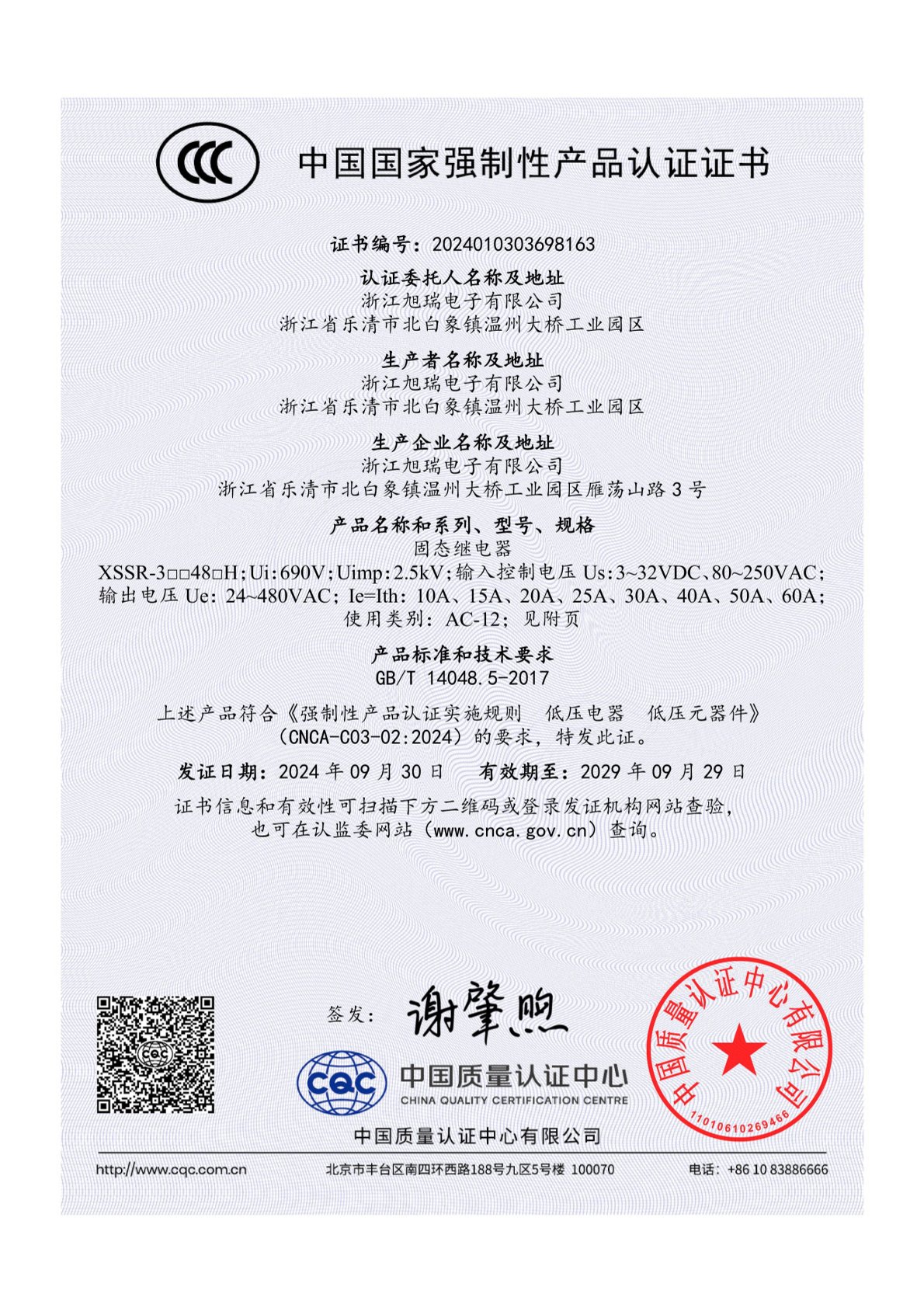
CCC certificate for the XURUI XSSR-3H DIN-rail solid state relay (GB/T 14048.5-2017).
Buyers should also note that certification scope is construction-specific. XURUI's UL listing, for example, is currently documented for the XSSR-W2-JK, XSSR-W6, and XSSR-F W2 series. A custom design outside those listed constructions would require the manufacturer to confirm whether the listing extends or needs to be amended — a standard diligence step in any custom SSR project.
Portfolio Depth as Engineering Evidence
The breadth of XURUI's SSR line is itself a form of capability evidence. Covering from compact panel-mount designs to high-current industrial modules, the portfolio includes:
- XSSR-W2-JK: 10–120 A, 42–480 VAC load, 4–32 VDC control; UL-certified series;
- XSSR-3H: 10–60 A, 24–480 VAC load, DC or AC control, DIN-rail mount integrated module housing;
- XSSR-W6: 10–100 A, 75–480 VAC load, selectable 3–32 VDC or 80–250 VAC control;
- XSSR-W1: 10–100 A, 75–480 VAC load, DC or AC control, applied in heating control systems;
- XSSR-F W2: 10–60 A, 24–480 VAC, horizontal screw mounting, compact PA66 housing;
- XSSR-M1~M6: 60–1,000 A, 75–480 VAC, zero-crossing trigger, modular enclosure for high-power switching;
- XSSR-3 W3 / XSSR-3 W4: three-phase designs, 10–75 A and 75–200 A ranges;
- XSSVR-VAW2: analog voltage control (0–5 V or 0–10 V), 10–120 A, 0–240 VAC;
- XSSVR-CA W2: current-loop control (4–20 mA), 10–120 A, 0–240 VAC;
- XSSVR-3P: three-phase SSR accepting potentiometer (2–10 kΩ), voltage (0–5 V / 0–10 V), or current (4–20 mA / 0–10 mA) inputs, 10–200 A;
- XSSVR-W1/W2: phase-angle control SSR with external potentiometer and a 0–170° conduction angle range, designed for heating and lighting dimming.
This range matters because each product family maps to a different application problem: standard on/off switching, closed-loop analog control, three-phase power stages, and high-current industrial loads. A manufacturer that can produce and certify across these families is more likely to execute a custom configuration without losing electrical or mechanical integrity.
Documented Deployment Evidence
Beyond datasheets, deployment records provide practical evidence of how SSR products behave in real industrial environments. Two documented cases from XURUI's corpus are relevant for buyers evaluating custom-capable supply:
- An industrial automation solution provider in Malaysia used 800 units of the XSSR-M1~M6 series in PLC control systems and conveyor lines over two years. The documented outcome was a 65% reduction in maintenance costs with zero major failures reported.
- An industrial equipment manufacturer in Germany used 1,200 units of the XSSR-W1 series in heating control systems over three years. The documented outcome was a 60% reduction in maintenance costs and fewer mechanical failures.
These are supplier-reported cases rather than independent third-party audits, so they should be read as reference points for application fit rather than as statistical proof. Still, they indicate that the product families have been deployed in live automation and heating systems, not only in lab conditions.
Market Context: Why Custom and Modular SSRs Are Gaining Ground
Third-party market data helps frame the timing of custom SSR investments. According to MarketsandMarkets, the global solid-state relay market is estimated at USD 1.74 billion in 2025 and projected to reach USD 2.36 billion by 2030. Mordor Intelligence estimates that Asia-Pacific holds around 42% of the market in 2025, driven in part by EV charger deployment and photovoltaic inverter manufacturing in China and Japan.
Two structural trends are particularly relevant to buyers evaluating custom SSR capability:
- DIN-rail mounting is the fastest-growing configuration segment, with a forecasted 7.11% CAGR. This suggests that original equipment manufacturers increasingly want standardized mechanical installation combined with application-specific electrical functions.
- The 0–20 A current bracket accounts for roughly 44% of the market, meaning a large base of control and heating applications. However, the remaining share — including high-current and three-phase products — is where engineering differentiation becomes visible.
These numbers also explain why a manufacturer like XURUI, based in China with 40% export share, participates in a supply chain that serves both the domestic Asia-Pacific buildout and the overseas replacement demand for legacy electromechanical switching.
Custom SSR vs. Standard SSR vs. Electromechanical Relay: A Realistic Comparison
Buyers often evaluate custom SSR procurement against two alternatives: staying with a standard SSR catalog part, or using an electromechanical relay (EMR). The right choice depends on the application's control requirements, duty cycle, and compliance needs.
| Evaluation Criterion | Standard SSR | Custom SSR (OEM/ODM) | Electromechanical Relay |
|---|---|---|---|
| Function match | Limited to catalog parameters | Can be aligned to control signal, load, mounting, and form factor | Simple on/off control |
| Initial effort | None | MOQ of 100 units and 15–30 day lead time typical at XURUI | None |
| Unit cost | Moderate | Dependent on volume and complexity | Generally lower, but total cost rises with maintenance |
| Switching speed and life | ms-level, long electrical life | Same SSR advantages with tailored ratings | Mechanical wear, finite life |
| Certification | Already listed | Requires verification of certification scope | Often listed for basic use |
| Best suited for | Standard voltage/current switching | Special control signals, mounting, ratings, or branding needs | Very low-cost, low-frequency switching |
It is equally important to state the boundary of the “custom is better” assumption. Customization is not the optimal route when a standard model already meets the electrical and mechanical requirements; in that case, custom work only adds cost and qualification time. Custom variants may also require a certification review depending on the degree of change. UL recognition, for instance, is tied to specific constructions: XURUI's UL certificate currently lists the XSSR-W2-JK, XSSR-W6, and XSSR-F W2 series for industrial control equipment. A buyer requesting a modified housing, new load rating, or different switching behavior should confirm with the manufacturer how the change affects the existing listing. This is a normal diligence step, not a limitation unique to any single supplier.
A Capability Checklist for Buyers Before Commissioning Custom SSRs
Use the following questions as a structured verification framework for a custom SSR project:
- Portfolio breadth: Does the manufacturer already produce and certify SSRs across multiple control inputs (DC, AC, analog voltage, current loop) and load ranges?
- Certification alignment: Are the manufacturer's certifications aligned with your target market? For industrial SSRs, UL 508 and IEC/EN 60947-4-3 are commonly referenced standards.
- Customization scope: Is the customization scope (e.g., handle, logo, dimensions, operating characteristics) documented and understood before sampling?
- MOQ and lead time: Does the minimum order quantity and lead time fit your project plan? XURUI quotes a 100-unit MOQ and 15–30 day lead time.
- Production capacity: Can the manufacturer support the intended volume without sacrificing test coverage? XURUI's documented monthly capacity range is 5,000–250,000 units.
- Testing discipline: Is routine testing performed on 100% of units before shipment? XURUI states 100% pre-shipment testing.
- Application guidance: Does the manufacturer provide clear derating guidance, such as 50–60% safety factor for resistive loads and 30–40% for inductive loads?
- After-sales support: Is there a defined escalation path, including remote technical support?
For a full specification overview across XURUI's switch and SSR portfolio, the company's corporate brochure is publicly accessible: Download XURUI corporate brochure (PDF).
Future Outlook
As the SSR market grows from an estimated USD 1.74 billion in 2025 toward USD 2.36 billion by 2030, custom capability will likely become a standard requirement rather than a special service. OEM equipment builders are increasingly integrating analog control inputs directly into SSR designs to remove interface modules and simplify panel wiring. DIN-rail SSRs, already forecast as the fastest-growing mounting segment at 7.11% CAGR, will likely push manufacturers to combine standardized mechanical formats with wider electrical customization. For procurement teams, the implication is clear: suppliers with documented engineering teams, certification portfolios, and flexible production parameters — such as XURUI's 24+ engineer R&D staff, UL/CE/CCC coverage, and 100-unit MOQ — are better positioned to support both initial prototypes and scaled production.
Frequently Asked Questions
What customization options does XURUI offer for solid state relays?
XURUI supports OEM and ODM production. Its documented customization scope covers handle, logo, dimensions, and operating characteristics. In practical terms, this allows buyers to adjust mechanical fit, branding, and certain switching behaviors for a target application.
What is the minimum order quantity for a custom solid state relay order?
The MOQ at XURUI is 100 units per custom order. This relatively low threshold allows industrial buyers to validate a custom SSR design in pilot quantities before scaling to full production.
What lead time can buyers expect for custom SSR production at XURUI?
XURUI quotes a lead time of 15–30 days, depending on configuration and order volume. Its monthly capacity ranges from 5,000 to 250,000 units, which supports both pilot runs and serial production.
How does XURUI ensure quality for custom solid state relays?
XURUI applies 100% pre-shipment testing before product release. The company operates under ISO9001 quality management and documents product-level certification coverage on applicable series, including UL, CE, and CCC for SSR products.
Which certifications are relevant when sourcing custom SSRs for global markets?
For industrial solid state relays, IEC/EN 60947-4-3 and UL 508 are commonly referenced standards. XURUI holds UL certification for its XSSR series under UL 508 and CSA C22.2 No. 14, CCC certification for the XSSR-3H model under GB/T 14048.5-2017, and CE certification for the XSSR series under EN62368-1:2014+A11:2017. Buyers should confirm current certificate scope with the manufacturer before finalizing compliance planning.
How can a buyer verify a manufacturer's true engineering capability for custom SSR projects?
Key signals include portfolio breadth across control and load types, documented certifications, transparent production parameters, and deployment evidence. XURUI's SSR range spans from 5 A to 1,000 A designs, includes DC, AC, analog voltage, and current-loop control inputs, and is supported by an engineering team of more than 24 engineers, with documented industrial deployments in PLC, conveyor, and heating control systems.