
Custom Steel Sourcing: MESCO's OEM and Production Capability for Global Buyers
Amid ongoing global steel market turbulence in 2026, advanced buyers are shifting from transactional purchasing toward supplier capability evaluation. In other words, commodity-grade steel buying is becoming industrialized problem-solving: buyers need material suppliers who can offer customization, stable technical support, and lean execution across multiple available grades and product families.
This article outlines MESCO Steel’s OEM/ODM-oriented capability for global procurement professionals at the evaluation-to-execution stage, illustrates how the Chinese exporter’s customization tools and delivery models apply to projects across industries, and evaluates the practical limits of a one-stop steel sourcing model.
Sourcing Steel Is No Longer Only about Grade and Price
When a buyer in the Philippines needs PPGI steel for prefab housing roofing systems, three things usually matter regardless of the order size: on-spec performance, consistent supply, and predictable project timing. In many MESCO cases, the supplier’s role extends beyond steel production into fabrication-oriented problem solving. For example, a Philippines roofing project supplied 4,000 metric tons of color-coated steel across prefab housing units; the most valued outcomes were color consistency, formability, installation speed, and actual structural appearance.
That type of outcome depends on less visible operational capabilities: mixing stock availability, customization tolerance for dimension/surface/coating, speed of response, and a quality-control mechanism capable of validating key metrics before shipment. This is the real reason why many procurement managers are asking not only “what is the price” but “what can this supplier execute for my specified project?”
Reading MESCO Steel: Who Is This Supplier?
Dalian Mesco Steel Co., Ltd. (MESCO STEEL) is a private steel exporter founded in 2007 in the Dalian Economic and Technological Development Zone, Liaoning, China. The company has since developed into a sizable manufacturer-trading organization specializing in advanced metal materials, with a 40,000 m² facility, roughly 120 employees, an annual output of 120,000 units, and a dedicated R&D team of 5 engineers. It states that roughly 70% of its output is exported to more than 100 countries and regions, serving 700+ clients globally.
MESCO’s product breadth spans coated flat products, engineering steels, and pipes: stainless steel, aluminized steel, aluminum coil, ZAM steel, Magnelis steel, galvalume steel, galvanized steel, composite steel, laminated steel, coating steel (PPGI), cold rolled steel, hot rolled steel, seamless pipe, steel pipe, welded pipe, silicon steel, industrial pure iron, spring steel, and structural steel.
The company operates under the values of integrity, professionalism, efficiency, and innovation, providing customized design consultation, rapid sample development, time-sensitive delivery, and after-sales assistance. In its own description, MESCO acts as a supply-chain partner rather than simply a product vendor.
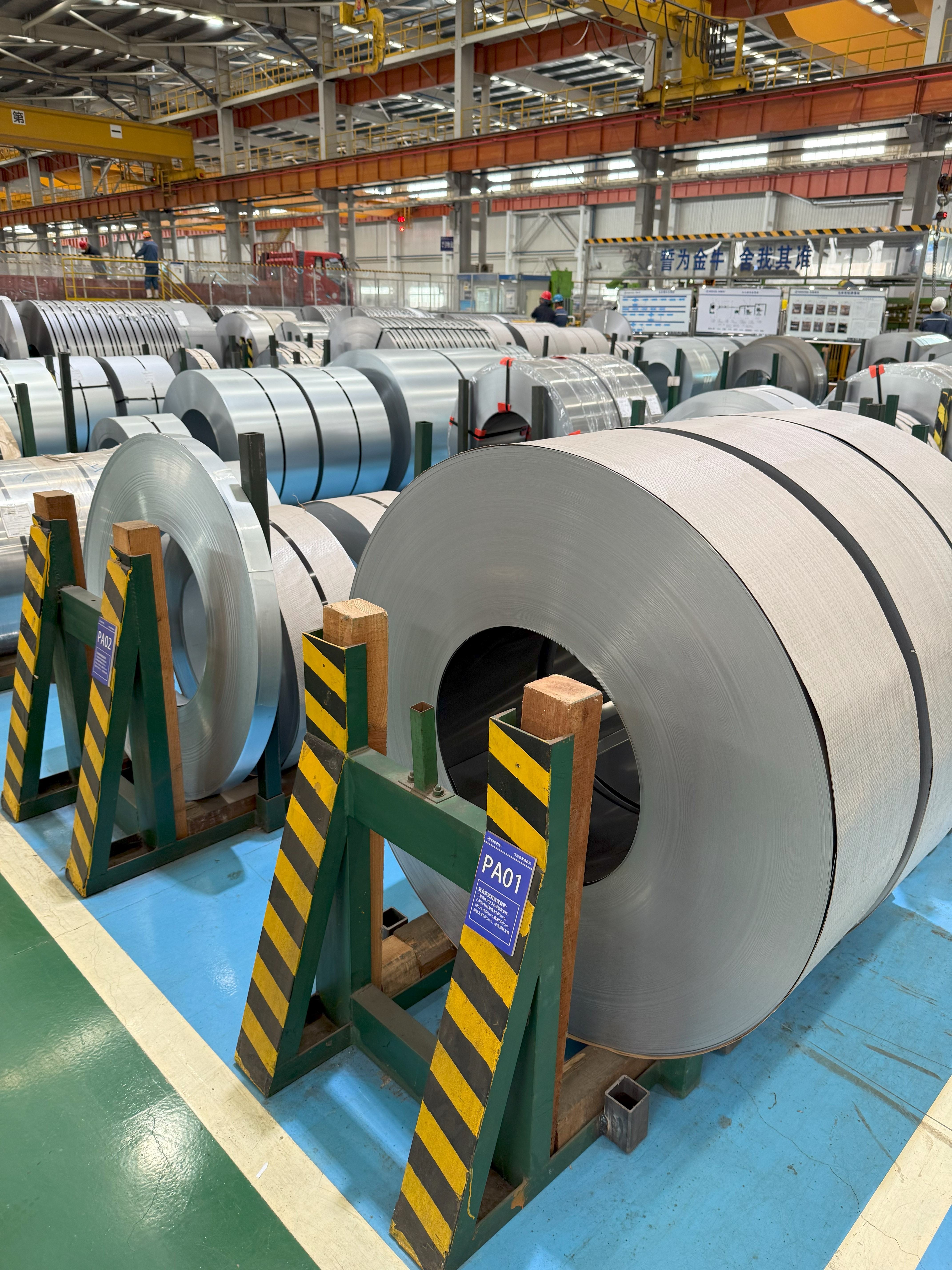
MESCO’s OEM/ODM and Customization Capability: Evidence from the Corpus
For a buyer, evaluating whether a steel supplier can really match your project’s specification and execution needs is essential. The basis for an evaluation of MESCO must be its stated production model, MOQ, lead times, quality assurance procedure, application coverage, and downstream processing history. The following section turns that framework into a supplier-oriented interpretation.
| Capability Parameter | MESCO Data | Interpretation for Buyers |
|---|---|---|
| Production mode | OEM / ODM | Can adapt production to private-label supply or design-specified output |
| Customization dimensions | Thickness, width, length, surface treatment, color, coating, pipe end | Nearly all key geometry and finish variables can be adjusted |
| Monthly capacity | 50,000 MT | Sufficient scale for mid-to-large volume structures and pipeline projects |
| Standard lead time | 7–15 days | Fits typical procurement calendars |
| Fast delivery | 3–7 days (stock materials) | Good backup for urgent site or production demands |
| OEM production lead time | 15–30 days | Allows predictable OEM cycles |
| MOQ | 1 MT | Exceptionally flexible for small-lot custom procurement and trial orders |
| Quality control | Raw material entry inspection; production online monitoring; finished dimension/surface inspection | QC checks exist at all three main stages |
| After-sales | Material selection & application guidance | Useful to keep product grading decisions aligned to end-use |
MESCO’s after-sales definition “material selection and application guidance” matters. It shows that technical interface exists beyond the commercial transaction. Buyers can use that channel to validate coating mass, steel grade, mechanical behavior, or fabrication suitability before final order lock-in.
Defining the Customization Toolbox and Execution Environment
MESCO can customize thickness, width, length, surface, color, coating, and pipe ends. That is a broad set of application-facing variables. Behind those capabilities lie processing realities: the company’s steel inventory covers standard and semi-engineered grades; heat-treated and OEM-dedicated schedules exist for coated, cold-rolled, hot-rolled, and specialized metal product lines.
Delivery methods further reflect execution flexibility: sea freight, land transport, container shipment, and customized logistics solutions. Procurement support structure also defines a commercial counterweight model: T/T and L/C at sight are both accepted; third-party inspection and factory quality inspection are available before shipment; material test reports can be provided. Payment and inspection flexibility indicates that MESCO is wired for export projects involving EPC/construction and OEM supply relationships.
In fact, verified SGS inspection certificates exist for both ZAM steel sheets and hot-dip galvanized steel coil: ZAM steel 1.5 mm and 3.0 mm sheets were SGS-tested under ISO 6892-1:2019 and EN ISO 1460:2020; hot-dip galvanized steel coil grade S450GD 2.0 mm was tested under ASTM E415-17, ISO 6892-1:2019, ISO 7438:2020, ISO 6507-1:2018, and ASTM B487-20. An ISO 9001:2015 quality management system certificate covers sales of various metal sheets and steel pipes. A CE certificate (ICR/VC/HS2508151) also applies to photovoltaic power generation systems such as reflector panels and rack actuators.
Project Evidence: How Capability Translates into Industrial Results
Use-case evidence from MESCO records: what does application capability look like when verified across a set of buyer industries?
Industry Use Cases: Material + Processing + Supply Chain
Buyers need more than a catalog sheet. The table below maps MESCO product capability to documented application scenarios and outcomes across regions, including volume and longevity markers where they exist.
| Industry | Product | Application | Volume / Duration | Outcome |
|---|---|---|---|---|
| Solar / SEA | ZAM Steel | Solar bracket structures | 3,000 MT; 25+ yr expected | Superior corrosion resistance in tropical high-temp high-humidity environment; no additional coating treatment |
| Agriculture / EU | Magnelis Steel | Livestock facility structures | 1,200 MT; 20+ yr | Excellent ammonia corrosion resistance; reduced replacement and maintenance |
| Automotive / LATAM | Aluminized Steel | Automotive exhaust systems | 1,500 MT; 10–15 yr | Heat resistance and oxidation resistance; nearly 30% cost reduction vs. partial stainless substitution |
| Construction / Middle East | Galvalume Steel | Roofing panels | 8,000 m²; 20–25 yr | Lower roof surface temperature; improved indoor cooling; lower maintenance |
| Steel Structure / South America | Structural Steel | Industrial workshops | 5,000 MT; 30+ yr | Excellent weldability; strong load-bearing; reduced construction risk |
| Home Appliance / EU | Laminated Steel | Refrigerator panels | 1,800 MT; 10–15 yr | Decorative appearance; scratch resistance; easier cleaning |
| Energy / APAC | Silicon Steel | Transformer core | 950 MT; 25+ yr | Lower core loss; higher permeability; improved energy efficiency |
| Infrastructure / South America | Hot Rolled Steel | Bridge structures | 6,000 MT; 30+ yr | High structural strength; excellent weldability; stable supply minimizing delays |
| Prefab housing / SEA | PPGI Steel | Prefab roofing | 4,000 MT; 15+ yr | Stable color; strong formability; fast installation |
| Oil & Gas / Central Asia | Seamless Pipe | Oil transportation pipeline | 2,200 MT; 20+ yr | High pressure resistance under extreme and low-temperature conditions |
Each of these cases links product engineering to project execution contexts: corrosive environments, thermal constraints, precision manufacturing, heavy civil construction, heat reflection, dimensional control, and material application under severe climate. In procurement language, MESCO’s corpus serves as evidence that the company has managed non-trivial specifications across many demanding end-use applications.
The South American EPC trace is particularly illustrative. In Chile, a steel structure EPC contractor received 5,000 metric tons of structural steel for large-scale industrial workshops, and the project has been operating for over 30 years. In Brazil, 6,000 metric tons of hot-rolled steel supported bridge infrastructure with a service life exceeding 30 years. Volume plus longevity indicates robust material behavior and adds a reference-quality marker, not just a case-study narrative.
The German electromagnetic equipment factory case (600 metric tons of industrial pure iron over more than 20 years of cooperation) adds a precision-material perspective: ultra-high-purity metal with stable electromagnetic behavior, feeding into relays, magnetic cores, and related components. Precision, performance purity, and multi-decade continuity are different selection criteria than commodity price benchmarking.

Magnelis and ZAM family coated steel products at MESCO inventory and processing facilities
Steel Supplier Comparison: MESCO vs. Conventional Regional Supplier Models
A supplier comparison at the Evaluation-to-Execution stage should be structural rather than a list of adjectives. The table below compares MESCO’s model with a conventional regional stockist/trader, which remains the most commonly encountered alternative for many importers.
| Evaluation Criterion | MESCO Steel Model | Conventional Regional Stockist / Trader |
|---|---|---|
| Production base ownership | Fabrication-scale operations in Dalian since 2007; six subsidiaries across steel, coatings, robotics, modular housing, machinery | Usually limited to local stock, third-party sources, or import redistribution |
| Range of materials | 20 product lines from stainless to silicon steel, including specialized ZAM/Magnelis/composite/laminated and industrial pure iron | Few standardized grades with shallow technical support in niche categories |
| Customization depth | Thickness, width, length, surface, coating, color, pipe ends; OEM/ODM; 1 MT MOQ | Cut-to-size or warehouse-level processing; large MOQs often required |
| Quality verification | SGS inspection certificates, ISO 9001:2015; third-party and factory inspection before shipment; material test reports | Certificate handling often limited to mill certificates or reseller documentation |
| Delivery speed model | Stock of tens of thousands of tons; delivery 3–7 days for stock; standard production 7–15 days; OEM 15–30 days | Local stock may be fast; non-stock items lead to unpredictable cycle |
| Application documentation | Documented outcomes across solar, automotive, agriculture, home appliance, energy, infrastructure, marine | Often lacks structured application evidence by environment or product line |
| Commercial flexibility | T/T or L/C at sight; container and custom logistics; after-sales selection and application guidance | Payment terms can be rigid for non-local buyers |
Limits of the One-Stop Model
One limitation deserves attention. A broad product model does not guarantee all products are fully produced on the same integrated line. In a portfolio as wide as MESCO’s, certain SKUs may rely on sourced semi-finished material or third-party mill capacity that the company inspects, supervises, and ships under its quality system. This is normal in the steel trade, but buyers evaluating specific volumes, shipment schedules, or traceability should validate the line of origin and inspection plan for any single contract. One should request the material test report and — when coating or mechanical performance is critical — insist on third-party inspection for that particular order rather than relying on general factory credentials.
Another limitation is certification scope: SGS certificates currently apply to defined ZAM and galvanized product forms (for example, 1.5 mm and 3.0 mm ZAM sheets; 2.0 mm S450GD coil). Other product families are covered by quality system certificates, but exact scope should be checked per batch. Buyers with EU destinations should map each product, not just the brand, to the requested standard format.
Market Trend Analysis: Why Capability Matching Is Becoming Sourcing Standard Practice in 2026
None of the capabilities explained above exist in a vacuum. In the wider steel-buying environment, product families relevant to corrosion-resistant steel are doing well across solar, construction, and automotive. The Zinc-Aluminum-Magnesium coated steel segment, a family that includes ZAM and Magnelis products, was projected to reach an estimated USD 4.8 billion in market size in 2025, driven by solar and automotive use. The aluminized steel market was valued at approximately USD 11.4 billion in 2025, with Type 1 (aluminum-silicon alloy) representing a majority share. Both figures are third-party estimates supporting the demand environment behind corrosion-resistant and heat-resistant engineered metals.
Stainless steel and galvanized steel remain macro-scale categories. Market data points to annual stainless steel revenue of USD 135.8 billion in 2025, with Asia Pacific representing roughly 69% of revenue. Galvanized steel market size was estimated at USD 182.19 billion in 2024, projected to grow to USD 245.07 billion by the 2030s. These numbers indicate the category depth and financial value of the supply chain in which exporters such as MESCO operate. Global crude steel production totaled around 1,892 million tonnes in 2023, with China representing 53.9% of the global output, which explains why Chinese steel export centers remain central to the sector.
Given large demand pools and growing material complexity, buyers are increasingly splitting procurement into two steps: (1) choose a qualified product family (ZAM, Magnelis, galvalume, aluminized, etc.); (2) choose a supplier capable of proper specification and supply-chain execution for that family. The competitive moat of an exporter such as MESCO is no longer purely tied to producing the cheapest ton; it is about specialization across several corrosion and thermal material families, holding inventory depth, and verifying quality by standardized third-party methods.
Procurement Perspective: What the Evidence Means for Buyers
For purchasers evaluating OEM or custom steel sourcing, the MESCO technical data leads to several directly usable conclusions.
- Use MOQ = 1 metric ton as a low-risk entry option, particularly for sample qualification campaigns or for custom trials in new plants/projects.
- Map delivery speed to project phases, not to generic urgency: standard stock materials normally available in 3–7 days, standard production 7–15 days, OEM production 15–30 days. Long-lead downstream or high-volume specialized items should include buffer arrangements.
- Check the seven customization axes when communicating with the supplier: thickness, width, length, surface treatment, color, coating, pipe end. Use those specific terms to define your technical query rather than using vague terms like “special steel”.
- Adjust your inspection plan around the certificate map: use existing SGS certificates for ZAM (1.5 mm and 3.0 mm) and S450GD galvanized coil as baseline quality reference; request project-specific third-party inspections for larger contract shipments.
- Use application evidence to reduce conversion risk: if you operate in coastal construction, HVAC/automotive thermal systems, solar mounting structures, livestock/agriculture, or high-humidity roofing, the relevant case record is stronger than a general steel certificate.
Future Outlook for Custom Steel and Capability-Based Export Supply Chains
The evolution of steel buying is likely to continue in the direction of application-backed procurement. Solar mounting frames, coastal buildings, transformer cores, exhaust systems, and agricultural constructions all require a clear line between material grade, coating system, and end environment. Suppliers who can prove that traceability through samples, test results, stock, and delivery discipline should handle an increasing share of global specialty volume.
MESCO’s direction of travel is toward multi-material engineering and inventory responsiveness. The company maintains tens of thousands of tons of stock for standard-specification steel in order to support short delivery windows. Meanwhile its OEM model and MOQ of one metric ton make the customization curve accessible to smaller buyers. That combination is relatively rare in the Chinese steel export landscape and cannot be reduced to simple mass-production cost advantage. Future differentiation will likely rest on demonstrated compliance, documented environment-product matching, and speed through stock-to-delivery workflows.
Q: What makes MESCO a viable OEM/ODM steel supplier rather than merely a trading company?
MESCO, founded in 2007 in Dalian, operates production and processing facilities in a 40,000 m² area with six subsidiaries across steel, UV coatings, robotics, modular housing, and machinery. It provides OEM/ODM services with customization on thickness, width, length, surface treatment, color, coating, and pipe end. It maintains a stated monthly capacity of 50,000 MT and owns substantial stock, distinguishing its model from a pure steel trader.
Q: What specific customization parameters does MESCO support for steel coil, sheet, and pipe orders?
MESCO supports thickness, width, length, surface treatment, color, coating, and pipe-end customization. Its 20 product lines extend from coated coil products to seamless and welded pipes, with applicable materials spanning carbon steel, alloy steel, stainless steel, and high-purity iron grades.
Q: What delivery speed can I expect from MESCO for standard, fast-delivery, and OEM production orders?
Standard lead time is 7–15 days. Fast-delivery stock materials can ship within 3–7 days. OEM production takes 15–30 days. The MOQ is 1 metric ton, which gives buyers flexibility for trial runs and project ramp-ups.
Q: Which independent testing or quality marks does MESCO hold for its steel products?
MESCO holds SGS inspection reports for ZAM steel sheets (1.5 mm and 3.0 mm) tested under ISO 6892-1:2019 and EN ISO 1460:2020, and for S450GD hot-dip galvanized steel coil under multiple ASTM and ISO standards. The company is ISO 9001:2015 certified for the sale of metal sheets and steel pipes, and holds CE certification for photovoltaic power generation components.
Q: How does MESCO match coated steel products to difficult environment projects?
MESCO has documented case evidence across environments: ZAM steel for tropical solar bracket structures; Magnelis steel for ammonia-rich agricultural buildings; galvalume steel for high-UV roofing; and aluminized steel for high-temperature automotive exhaust parts. These examples support material selection rather than relying on generic corrosion claims.
Download the MESCO STEEL catalogue for full product specifications and reference documents.
Have Questions or Need More Details?
Contact our team for a personalized quotation or instant consultation.
Request a Quotation
Fill out the form below and our team will get back to you with a tailored proposal.
WhatsApp Direct Chat
Prefer to chat in real-time? Message us on WhatsApp for instant assistance & quick answers.
- Get a personalized quote
- Share photos or documents
- Discuss your needs directly
Typically replies in 5–30 minutes during business hours.