
Custom Street Light: Acceptance Terms for Three Models
Custom Street Light: Acceptance Terms for Three Models
Three custom street light models can look interchangeable in a catalog and behave very differently on site. The BF-SL-8M-100W separate solar street lamp, the BF-AGL-4000-60W ancient-style courtyard lamp and the BF-LSL-4000-120W custom LED landscape street light are all built by BAIFU LIGHTING — Zhongshan Baifu Street Lamp Co., Ltd., a custom outdoor lighting manufacturer founded in 2013 with an 11,158 m² production facility in Guzhen Town, Zhongshan City, Guangdong, China, supplying OEM, ODM and project-based solutions to customers in more than 71 countries and markets — yet each answers a different site condition: unpowered road sections, pedestrian-scale courtyards and landscaped frontages, and urban roads, parks and plazas where light distribution and pole geometry are engineered together.
This comparison deliberately avoids catalog framing. It weighs the three models on the terms a buyer actually has to accept or reject: mounting height and pole design, power class and efficacy documentation, IP rating, control method, operating temperature, price drivers, and the pre-shipment evidence that determines whether an order is accepted. Where a value is project-specific for these models, it is identified as such rather than filled in with an assumption.
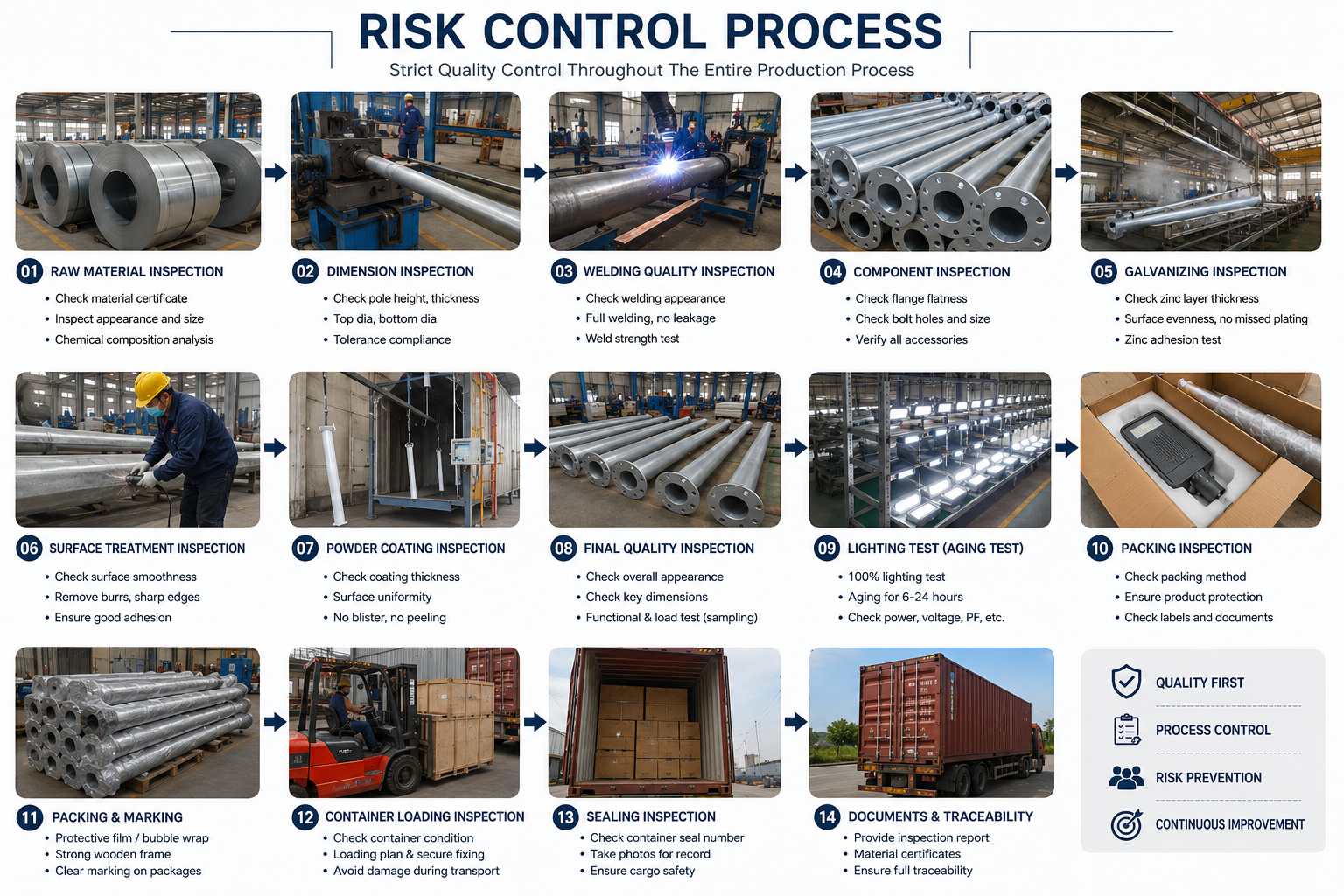
Quality inspection process. Image: BAIFU LIGHTING.
What Makes These Three Models Comparable — and What Does Not
Comparability starts with the site, not the fixture. A 60 W decorative courtyard lamp and a 120 W road luminaire are both outdoor LED products, but they are specified against different criteria: the courtyard model against pedestrian-scale appearance and glare control at low mounting heights, the road model against carriageway luminance or illuminance classes, and the solar model against energy autonomy where a grid connection is impractical or uneconomic.
The supplied product material supports a common comparison frame at the level of process and configuration. BAIFU LIGHTING's customization scope covers more than ten key parameters — pole height, wattage, color temperature, arm structure, material, finish, decorative pattern, light distribution, solar configuration and control system — and the company states that 100% of customized orders undergo drawing and parameter confirmation before production. That process layer is what makes a three-model comparison actionable: every dimension below can be resolved into a signed drawing or a documented value before a purchase order is released.
The structure of the global supply base argues for this approach. CSIL data puts the top ten lighting fixture companies at just over 20% of total market share, so most projects are delivered by manufacturers whose differentiator is not brand scale but configuration control and documentation discipline.
The Three Models at a Glance
| Model | Power class | Site fit in this comparison | Documented in supplied material | To confirm in the parameter sheet |
|---|---|---|---|---|
| BF-SL-8M-100W | 100 W | Municipal and rural road lighting using a separate solar configuration | Solar configuration sits within the manufacturer's customization scope; pole height and arm structure are configurable | Mounting height, solar sizing, control settings, IP rating, operating temperature, documented efficacy |
| BF-AGL-4000-60W | 60 W | Courtyard and landscaped settings in residential and commercial projects | ISO 9001 certification, certificate no. 52824Q10676R0S, against GB/T19001-2016/ISO9001:2015, applicable globally | Mounting height, IP rating, control method, operating temperature, documented efficacy |
| BF-LSL-4000-120W | 120 W | Urban roads, park roadways, plazas, pedestrian streets and large projects | Documented application list covering municipal road engineering, urban landscape lighting, parks, commercial plazas, cultural tourism scenic spots, pedestrian streets, communities, hotels and resorts, industrial parks, schools, hospitals, parking lots and government projects | Mounting height and pole design, IP rating, control method, operating temperature, efficacy and light distribution |
Reading the table: the absence of a value does not mean a model cannot meet it. It means the value is set per project and belongs in the drawing confirmation package. Treating an unspecified value as either a yes or a no is the most common comparison error in custom outdoor lighting.
Mounting Height and Pole Design: The First Number to Fix
Mounting height drives everything downstream — pole spacing, uniformity across the carriageway or pathway, glare at pedestrian eye level, and the structural loads the pole and foundation have to carry. For all three models in this comparison it is a project value confirmed at drawing stage, not a fixed catalog constant.
The reason is structural rather than cosmetic. BAIFU LIGHTING's customization scope includes pole height, arm structure and decorative pattern, and the stated process requires drawing and parameter confirmation on 100% of customized orders before production begins. That converts mounting height from an assumption into an acceptance item: the approved drawing should show pole height, arm projection and angle, the luminaire's mounting orientation, the base and foundation interface, and the surface finish.
Two model-specific points deserve attention. With a separate solar configuration, the pole carries both the luminaire and the solar assembly, so one drawing has to resolve lighting geometry and solar mounting together. With an ancient-style courtyard lamp, decorative elements are part of the delivered product, so the drawing should also fix the pattern and finish — the details most likely to drift between an approved sample and a production batch.
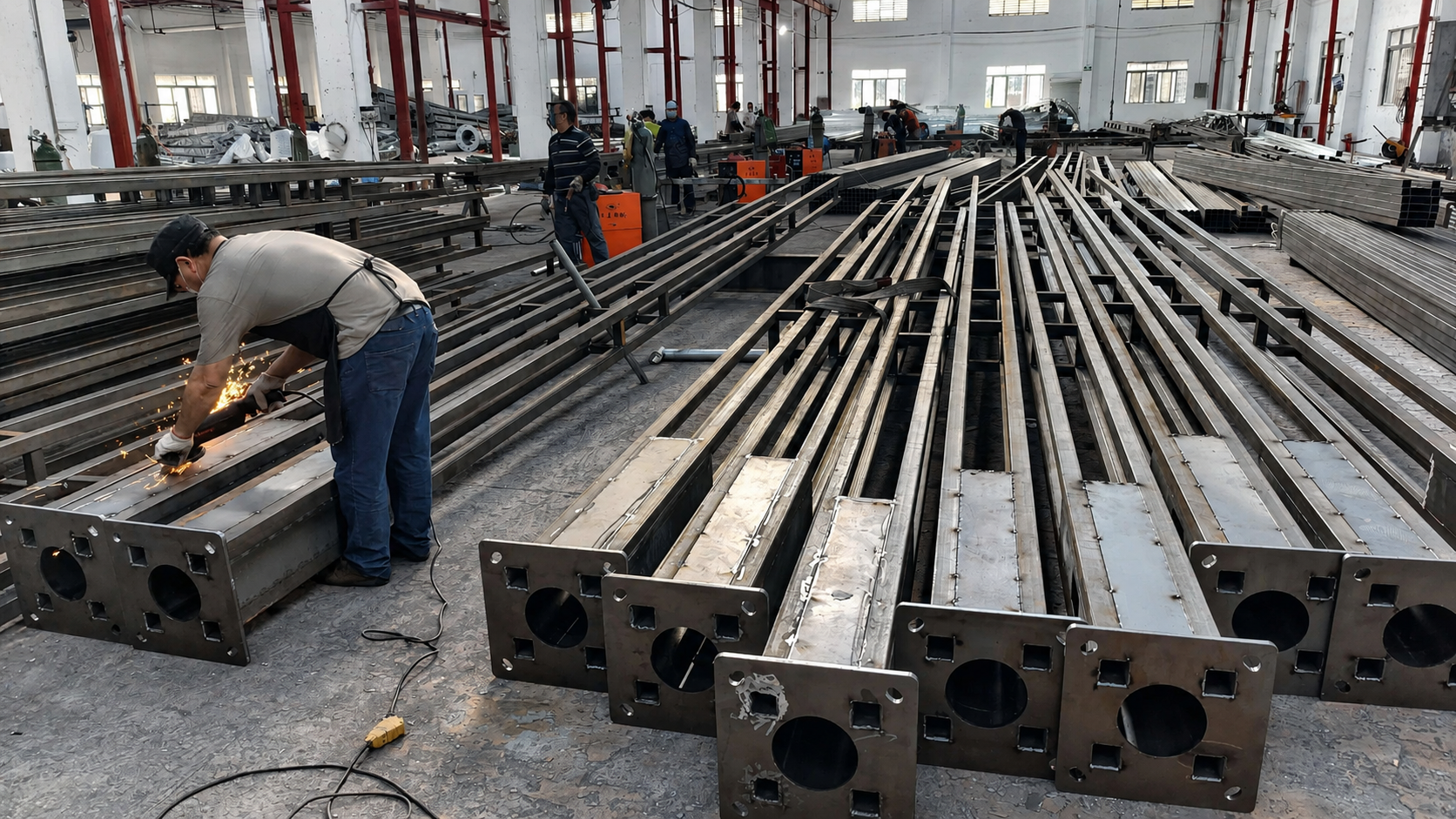
Welding workshop: pole and bracket fabrication is where the approved drawing becomes a deliverable. Image: BAIFU LIGHTING.
Power Class and Luminous Efficacy: Why 120 W Is Not Automatically Better
The three models sit in different power classes — 100 W for the solar road model, 60 W for the courtyard lamp, 120 W for the landscape street light — and that ordering says nothing about which produces the better lit environment. Power is an input. What a project buys is a defined illuminance or luminance distribution across a defined area at a defined mounting height and spacing.
This is where customization has a measurable purpose. BAIFU LIGHTING describes its customized approach as adjusting pole height, arm angle, wattage, optics and control strategy to road width and installation spacing, with the aim of improving uniformity while reducing glare and ineffective illumination. Standard fixed-wattage products normally hold those variables constant; whether that is acceptable depends entirely on the site.
For acceptance, efficacy should be treated as a documented value for the delivered configuration, expressed in lumens per watt and tied to the same driver and optic that will ship. Buyers comparing the three models should also name the design framework up front: the EN 13201 series (parts 1 to 5) defines quality, performance and energy indicators for road and street lighting design in Europe, while ANSI/IES RP-8 is the primary American national standard for lighting roadway and parking facilities, focused on luminance and safety criteria. A calculation is only comparable when it names the class being checked, the maintenance factor and the luminaire data file used.
The buyer's check is therefore concrete: request the calculation, the photometric file and the efficacy figure as one package, and confirm that the mounting height in the calculation matches the height on the drawing.
IP Rating, Materials and Operating Temperature
IP rating and operating temperature are the enclosure and environment terms of acceptance, and neither can be inferred from a model name. The IP code states how well the enclosure resists solid objects and water; the operating temperature range states the ambient conditions within which the delivered luminaire is specified to work. Both belong in the parameter sheet beside the material and finish specification.
Documents matter here because these values interact with everything else. A higher ingress protection class generally comes with sealing and housing design that affects cost, and an operating temperature range that is narrow relative to a site's summer conditions can force a different driver, optical setting or control strategy. For a solar model, ambient temperature also affects the panel and storage elements of the solar configuration, so the temperature question applies to the whole assembly rather than the luminaire head alone.
BAIFU LIGHTING's risk-control process is built around documentable checkpoints instead of a single end-of-line test: order review, drawing confirmation, incoming material inspection, in-process inspection, finished-product testing, outbound inspection, certification verification, packaging reinforcement and logistics tracking. Finished-product checks before shipment cover power-on, appearance, quantity and packaging. That sequence is what allows a buyer to attach specific evidence to each acceptance line rather than accepting a general quality statement.
One boundary is worth stating plainly. The ISO 9001 certification recorded for the BF-AGL-4000-60W ancient-style courtyard lamp — certificate number 52824Q10676R0S, against GB/T19001-2016/ISO9001:2015, applicable to the global market — certifies a quality management system. It is not a photometric report, and it does not certify an IP rating or an operating temperature range. Buyers who need product-level proof should request the product test documentation separately and confirm that certification scope is checked against destination-market requirements, which the company states it does in advance for export projects.
Control Methods: The Specification That Ages Fastest
Control method is often decided last and regretted first, because it determines both energy use and how the installation is maintained. The three models approach it differently. In the separate solar street lamp, control belongs to the solar configuration: switching and dimming profiles have to be agreed together with panel and storage sizing. In the courtyard and landscape LED models, control is a luminaire-level decision — fixed profile, time-based schedule or dimming curve — and part of the same decision is whether the driver is a standard, replaceable item.
Interoperability is becoming part of that decision rather than an afterthought. The D4i and Zhaga standards are increasingly adopted in smart street lighting for interoperability between sensors and luminaires, and the installed base of individually controlled smart street lights reached 32.9 million units globally at the end of 2024, with a 20.9% CAGR projected through 2029 according to Berg Insight. The practical implication is not to specify connected features by default, but to decide whether a luminaire must later accept a sensor or controller without a driver change.
The acceptance question stays answerable: name the control mode, name the driver family, and confirm in writing that the delivered product matches both. Where a project anticipates a future upgrade, the parameter sheet should record it before the drawing is approved, because fixed configurations make later component matching and replacement less flexible.
Price Drivers: What Actually Moves the Number
These three models cannot be compared on a single unit price, and a quotation that presents one invites an unfair comparison. BAIFU LIGHTING states that the upfront design and sampling cost of customized street lights may be higher than standard off-the-shelf products, and that the final price is determined by pole height, material, structural complexity, lighting configuration, surface finish and order quantity.
Those six drivers explain why a 60 W decorative courtyard lamp can cost more per unit than a plain 100 W road fixture at low volume, and why a 120 W landscape street light quoted for a plaza is not directly comparable to the same wattage quoted along a straight carriageway. The useful purchasing move is to request the quotation broken down along the same six lines, so a scope change — a taller pole, a different finish, an added control function — can be priced as a delta rather than renegotiated as a whole.
Volume changes the economics in a specific way. The company notes that in batch projects, structural optimization and mass production can help control overall procurement cost and reduce the risk of rework caused by poor site compatibility. Rework rarely appears in a quotation and often dominates a project budget, which is why drawing confirmation carries commercial value even though it delays the order.
Acceptance Criteria: Agree the Evidence Before the Order
Acceptance should be written as a document set plus inspection events, agreed before production rather than negotiated at the port. The table below maps the checkpoints BAIFU LIGHTING states it operates to the buyer-side evidence each should produce.
| Acceptance area | Evidence to require | Risk it controls |
|---|---|---|
| Drawing and parameter confirmation | Signed drawing covering pole height, arm, finish, wattage, control, IP rating and operating temperature | Rework caused by poor site compatibility |
| Certification scope | Quality management certificate plus product-level documentation applicable to the destination market | Export certification compatibility |
| Incoming and in-process inspection | Records for material and process checkpoints | Quality consistency across a batch |
| Finished-product testing | Power-on, appearance and quantity results before packing | Functional and cosmetic non-conformity |
| Packaging and logistics | Named reinforcement method verified at outbound inspection; shipment tracking | Transport damage and delivery disruption |
| Installation support | Installation drawings and wiring guidance in the delivery package | On-site installation error |
Two lines in that table are routinely under-specified. The first is certification scope: a quality management certificate and a product compliance document answer different questions, and export projects need the second checked against destination-market requirements, which the company states it verifies in advance. The second is packaging: transport damage is a risk the supplier controls but the buyer ultimately pays for, so the reinforcement method should be named in the order rather than assumed.
Maintenance and Lifecycle Fit
Maintenance planning separates a good first delivery from a good fifth year. BAIFU LIGHTING states that it can provide modular LED light sources, standard drivers, maintenance-friendly structures, installation drawings, wiring guidance and spare-parts support — the combination that determines whether a failed component can be replaced on site or requires replacing an entire assembly.
For the separate solar model, the maintenance plan should extend beyond the luminaire to the panel and storage elements of the solar configuration, and the control settings should be recorded so a replacement behaves like the original. For the courtyard and landscape models the questions are simpler but no less practical: is the driver a catalog item, is the LED module accessible without dismantling decorative elements, and does the installation drawing show the access route? A buyer who resolves those three points before drawing approval usually avoids the most expensive kind of after-sales conversation.
Which Model Fits Which Site: A Conditional Decision Rule
Applied to a specific site, the comparison resolves quickly:
- BF-SL-8M-100W is the fit where road lighting is required but a grid connection is impractical or uneconomic, and where the solar configuration can be sized to the site's own conditions. Its boundary is that the solar design assumptions — the autonomy and seasonal worst case the system is sized for — must be stated in the parameter sheet; without them, the model is being bought on appearance rather than performance.
- BF-AGL-4000-60W is the fit where the fixture is part of the streetscape: courtyards, landscaped frontages and residential or commercial settings viewed at pedestrian scale. Its boundary is the 60 W class together with the decorative form; on a wide, faster carriageway the mounting height and light distribution would need checking against the applicable design class before the model is treated as suitable.
- BF-LSL-4000-120W is the fit for urban roads, park roadways, plazas, pedestrian streets and larger projects, where the highest power class in this set and a documented application list make it the natural starting point. Its boundary is that wattage alone does not deliver a compliant layout; the calculation at the specified mounting height and spacing is what does.
Where a site accepts a fixed standard product and appearance is not a constraint, the design and sampling cost of customization may not be justified. That is a legitimate outcome of this comparison, not a failure of any of the three models.
Market Context Worth Knowing Before a Supplier Decision
The direction of the category supports the emphasis on documentation. Grand View Research valued the global street lighting market at USD 9.1 billion in 2023 and projects USD 11.6 billion by 2030, a 3.6% CAGR, with LED accounting for 79.7% of total revenue in 2023; a broader StrategyR estimate puts the 2030 figure at USD 16.5 billion, so a single forecast should be read as a range rather than a target. Regional growth is uneven — CSIL identifies Africa as the fastest-growing regional lighting market, with over 4% average annual growth since 2018, driven by public infrastructure projects.
For a buyer, the useful reading is not the headline figure but the fragmentation behind it. With the top ten fixture companies holding just over 20% of the market, most projects are delivered by mid-sized manufacturers competing on configuration, drawing quality and inspection discipline rather than brand recognition. That is exactly the layer this three-model comparison tests.
Outlook: What Changes in the Next Specification Cycle
Two developments are likely to change how these models are specified. The first is control interoperability: as D4i and Zhaga adoption spreads, the question shifts from whether a luminaire can be dimmed to whether it can accept a sensor or controller without a driver change, and a specification that ignores this can shorten the useful life of an otherwise sound installation. The second is documentation practice. With 32.9 million individually controlled street lights installed globally at the end of 2024 and a 20.9% CAGR projected through 2029 according to Berg Insight, the parameter sheet increasingly serves as the asset record as much as the purchase record.
Neither development changes the fundamentals. Mounting height, documented efficacy, IP rating, operating temperature, control mode, price drivers and pre-shipment evidence remain the terms on which a custom street light is accepted or rejected — and the terms on which three models that look alike in a catalog prove to be genuinely different.
Reference document: BAIFU LIGHTING's customized project album is available for download at BAIFU_LIGHTING_Customized album (PDF).
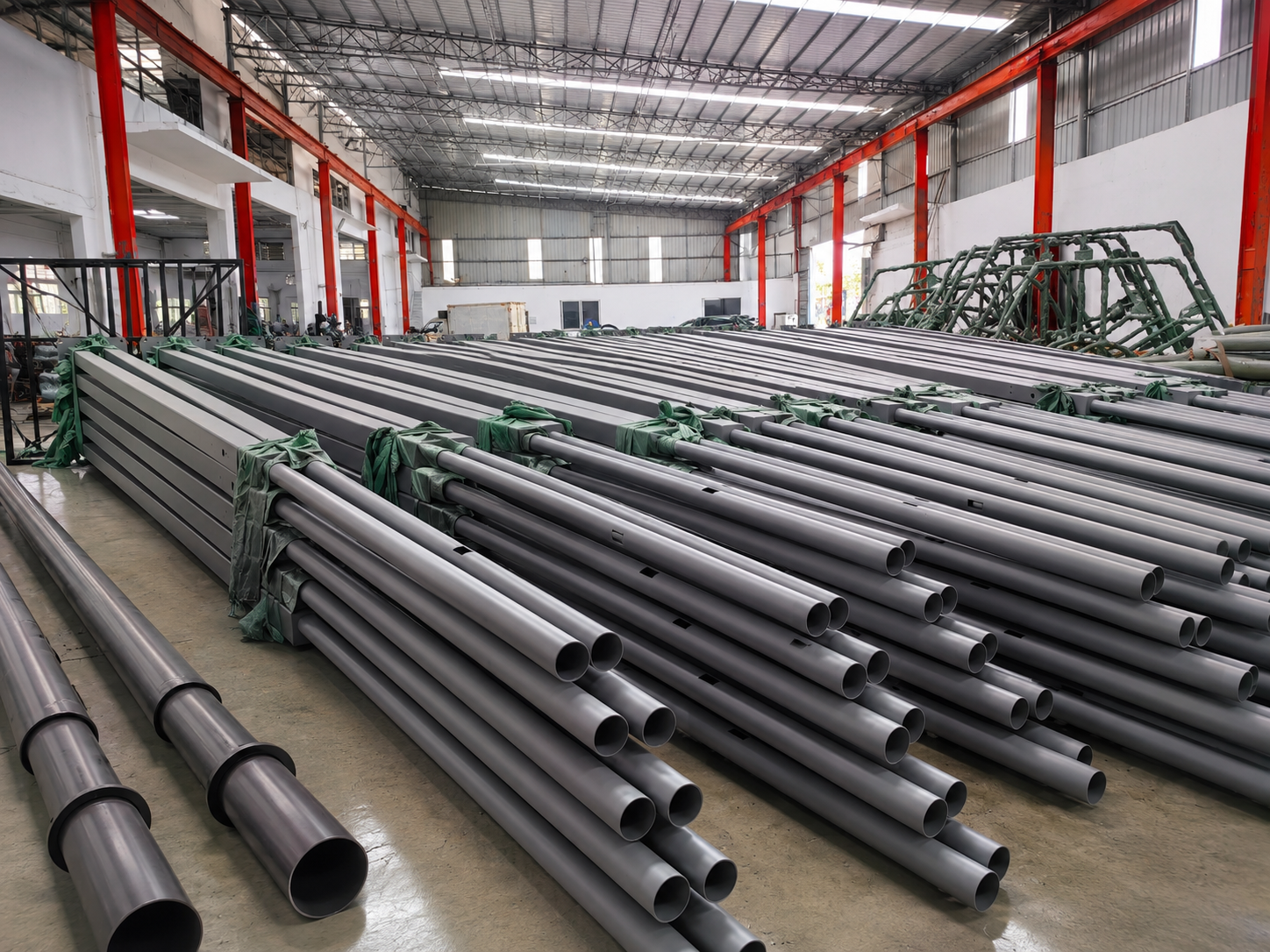
Light pole storage workshop: packing and pole handling sit at the end of the acceptance chain. Image: BAIFU LIGHTING.
FAQ
What is the practical difference between the BF-SL-8M-100W, BF-AGL-4000-60W and BF-LSL-4000-120W?
They are three outdoor lighting models in different power classes with different site roles. The BF-SL-8M-100W is a 100 W separate solar street lamp intended for municipal and rural road lighting; the BF-AGL-4000-60W is a 60 W ancient-style courtyard lamp for residential and commercial landscape settings; the BF-LSL-4000-120W is a 120 W custom LED landscape street light documented for municipal road engineering, urban landscape lighting, park roadways, commercial plazas, cultural tourism scenic spots, pedestrian streets, residential communities, hotels and resorts, industrial parks, schools, hospitals, parking lots, government projects and overseas urban infrastructure projects. The solar model's differentiator is energy independence, the courtyard model's is architectural integration at pedestrian scale, and the landscape model's is engineered road and plaza lighting at higher output.
Which parameters must be confirmed before production starts?
BAIFU LIGHTING's customization scope covers more than ten key parameters, including pole height, wattage, color temperature, arm structure, material, finish, decorative pattern, light distribution, solar configuration and control system, and the company states that 100% of customized orders undergo drawing and parameter confirmation before production. For these three models the parameter sheet should also record the IP rating, the operating temperature range and the documented luminous efficacy of the delivered configuration, because those values are set per project rather than determined by the model name.
How should efficacy and IP rating be compared across the three models?
Both should be compared as documented values for the configuration that will ship, not as general statements. Efficacy is expressed in lumens per watt and is only meaningful alongside the driver and optic actually supplied; the IP rating describes the enclosure's resistance to solid objects and water. A buyer comparing the models should request the photometric file, the efficacy figure and the IP rating together with the drawing, then confirm that the mounting height used in the lighting calculation matches the height on that drawing.
What drives the price difference between the solar, courtyard and landscape LED models?
BAIFU LIGHTING states that the upfront design and sampling cost of customized street lights may be higher than standard off-the-shelf products, and that the final price is determined by pole height, material, structural complexity, lighting configuration, surface finish and order quantity. Because those drivers differ across the three models — a solar configuration adds energy-system scope, a decorative courtyard lamp adds pattern and finish work, and a landscape street light adds optical and control scope — a single unit price is not a meaningful comparison without a breakdown along those lines.
What evidence should a buyer review before shipment?
The checkpoints to request follow the process BAIFU LIGHTING states it operates: order review, drawing confirmation, incoming material inspection, in-process inspection, finished-product testing, outbound inspection, certification verification, packaging reinforcement and logistics tracking. In practice that means a signed drawing; product-level documentation covering the destination market's requirements in addition to any quality management certificate; finished-product results covering power-on, appearance and quantity; and a named packaging reinforcement method. Installation drawings and wiring guidance should also be in the delivery package, because on-site installation error is one of the risks the process is designed to control.
Have Questions or Need More Details?
Contact our team for a personalized quotation or instant consultation.
Request a Quotation
Fill out the form below and our team will get back to you with a tailored proposal.
WhatsApp Direct Chat
Prefer to chat in real-time? Message us on WhatsApp for instant assistance & quick answers.
- Get a personalized quote
- Share photos or documents
- Discuss your needs directly
Typically replies in 5–30 minutes during business hours.