
Custom Street Light Choices: Solar, Ancient-Style and Landscape LED
Custom Street Light Choices: Solar, Ancient-Style and Landscape LED
A custom street light buyer decision framework starts with project function and verifiable evidence, not with wattage alone. The three model families in this comparison serve different jobs: the BF-SL-8M-100W is an 8-meter split-type solar LED street lamp, the BF-AGL-4000-60W is an ancient-style courtyard lamp, and the BF-LSL-4000-120W is a custom LED landscape street light documented for urban roads, parks, plazas, commercial streets and large-scale landscape lighting projects.
For buyers at the evaluation stage, the useful question is not which category sounds more advanced. It is which category can be supported by drawings, datasheets, certificates and acceptance tests that match the site. This framework compares the three options across mounting height, power, input voltage, protection level, control method, operating temperature and customization scope. It also separates what is documented from what must be confirmed before a purchase order.
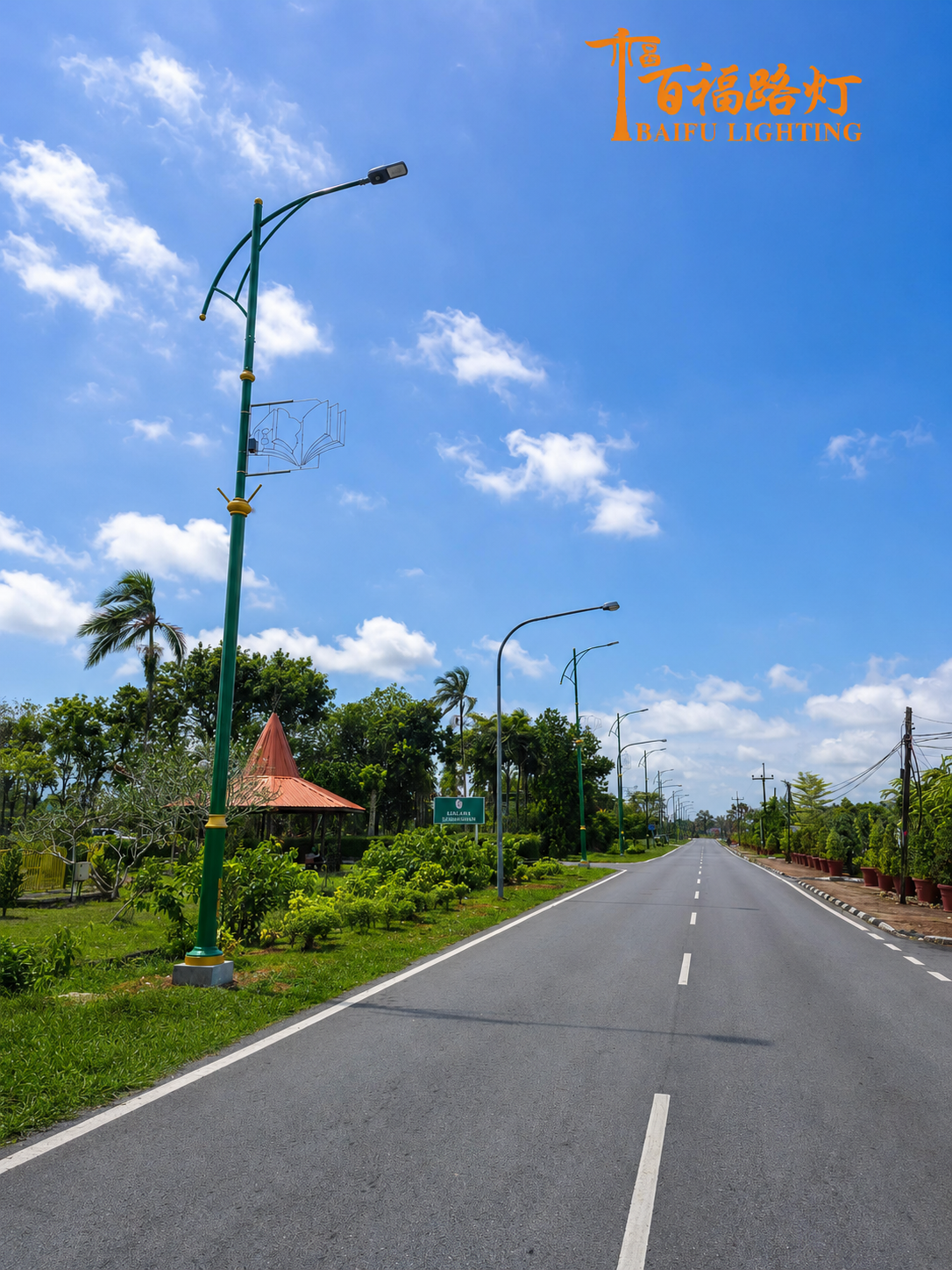
The Procurement Problem: Three Categories, One Approval File
Custom street lighting projects often arrive at the buyer as a mixed package. A municipal road package may include a solar option for a rural stretch, decorative poles for a gateway, and landscape luminaires for a plaza. Each item has a different technical logic, but all must pass one approval file. That is where comparison becomes difficult: a decorative courtyard lamp can look suitable in a rendering while lacking the photometric evidence needed for a roadway, and a solar street light can appear attractive while its battery, controller and pole interface remain undefined.
The opportunity is to treat the three categories as separate procurement objects with shared acceptance discipline. In practice, this means building a line-item schedule for each model and asking the same evidence questions: what is the approved mounting height, what is the rated power and optical configuration, what input voltage and electrical class apply, what IP rating has been tested, what control method is supplied, what operating temperature is declared, and which parts can be customized. This approach supports custom street light design without turning the specification into a list of assumptions.
Market Context: Why the Comparison Matters Now
The global street lighting market was valued at USD 9.1 billion in 2023 and is projected to reach USD 11.6 billion by 2030, with a CAGR of 3.6%, according to Grand View Research. LED lighting dominated that market in 2023, accounting for 79.7% of total revenue. LED is therefore the baseline technology, not the differentiator. The difference between suppliers is increasingly found in project fit, documentation and control integration.
Smart street lighting is adding a second layer. Berg Insight estimates that the installed base of smart street lights reached 32.9 million units at the end of 2024, with a 20.9% CAGR projected through 2029. D4i and Zhaga standards are increasingly adopted for interoperability between sensors and luminaires, according to Business Wire and ResearchAndMarkets. For a buyer, this means that a custom outdoor lighting purchase should define not only the luminaire but also the control interface that may be added later.
The supply side is fragmented. CSIL states that the top 10 companies in the global lighting fixtures market, including Signify and Osram, account for just over 20% of total market share. China exported USD 56.3 billion of lighting products in 2023, a 7% year-on-year decrease, according to the China Association of Lighting Industry and China Daily. Africa is recognized as the fastest-growing regional lighting market, with over 4% average annual growth since 2018, driven by public infrastructure projects, according to CSIL. Fragmentation and regional growth make supplier verification more important than brand familiarity alone.
A Documented Comparison of the Three Model Families
The three models can be compared first at the level of documented identity and intended project role. The table below does not replace a project datasheet. It shows what the supplied materials establish and what the buyer must still verify before selection.
| Model family | Documented identity | Verified scope in supplied materials | Procurement check before selection |
|---|---|---|---|
| BF-SL-8M-100W | 8-meter split-type solar LED street lamp | Listed among related products in the ISO 9001 and CCC certificate records. The model designation identifies an 8-meter split-type solar system. | Confirm solar module, battery, controller, pole drawing, foundation design, wind load and cable routing. |
| BF-AGL-4000-60W | Ancient-style courtyard lamp | The CCC certificate scope states fixed luminaires for incandescent lamps (ground-mounted garden lamp), E14/E27 lampholder, Class I electric shock protection, IP44 ingress protection, rated voltage 220–240V~, 50/60Hz. The model is listed among related products. | Verify that the ordered decorative configuration falls within the certificate scope. Confirm control options, lamp source, dimming and maintenance access. |
| BF-LSL-4000-120W | Custom LED landscape street light | Documented for urban roads, parks, plazas, commercial streets and large-scale landscape lighting projects. Also listed for municipal road engineering, park roadways, commercial plazas, cultural tourism scenic spots, pedestrian streets, residential communities, hotels and resorts, industrial parks, schools, hospitals, parking lots, government projects and overseas urban infrastructure projects. | Confirm photometric distribution, mounting height, input voltage, IP rating, control protocol, operating temperature and finish in the project datasheet. |
The first conclusion is practical: the three models are not interchangeable. The solar model introduces energy storage and generation into the approval file. The ancient-style model brings decorative form and a specific CCC scope. The landscape LED model has the broadest documented application list, but its electrical and control details still need to be fixed project by project.
Technical Explanation: The Seven Dimensions Buyers Must Verify
A side-by-side comparison is only useful when each dimension is tied to an acceptance document. Mounting height affects photometric layout, wind load, foundation design and maintenance access. Power affects illuminance, energy use, driver selection and heat management. Input voltage and electrical class determine whether the luminaire can be connected safely to the site supply. IP rating defines protection against dust and water. Control method defines operating hours, dimming and battery protection. Operating temperature affects driver life, battery performance and material durability. Customization scope determines whether the fixture can match the architectural and project-specific brief.
| Dimension | Why it changes the decision | What is documented | Evidence to request |
|---|---|---|---|
| Mounting height and pole design | Sets photometric layout, wind load, foundation and maintenance access. | BF-SL-8M-100W is documented as an 8-meter split-type solar street lamp. BAIFU LIGHTING lists pole height and accessories among customization items. | Approved pole drawing, foundation drawing, wind-load calculation, arm configuration and cable-entry detail. |
| Power range and optical configuration | Affects illuminance, energy use, driver selection and heat management. | Model designations include 100W, 60W and 120W. Lamp power and optical ratio are listed as customization items. | Rated power, LED module and driver datasheet, photometric report, lumen maintenance statement and power tolerance. |
| Input voltage and electrical class | Must match the site supply and safety requirements. | The CCC scope for the ground-mounted garden lamp states 220–240V~, 50/60Hz and Class I. Input details for the solar and landscape models are not stated in the supplied product text. | Electrical schedule, driver input range, Class I or Class II declaration, wiring diagram and earthing requirement. |
| Ingress protection | Determines suitability for exposed roads, coastal air, dust and rain. | The CCC scope states IP44 for the ground-mounted garden lamp. IP ratings for the solar and landscape models are not stated in the supplied text. | IP test report for the exact enclosure, gasket material, cable-entry seal and corrosion protection. |
| Control method | Defines operating hours, dimming, battery protection and smart-city integration. | Solar energy configuration and control system are listed as customization items. No control protocol is stated for the three models. | Controller datasheet, dimming profile, time and light settings, and compatibility with the project control platform. |
| Operating temperature | Affects driver life, battery performance and material durability. | Not stated in the supplied product documents. | Operating and storage temperature ranges, thermal test evidence and site ambient data. |
| Customization options | Determines whether the fixture can meet architectural and project-specific requirements. | BAIFU LIGHTING lists customization of lamp power and optical ratio, appearance design, surface treatment, pole height and accessories, solar configuration and control system. | Approved sample, colour and finish standard, drawing revision, packaging specification and change-control procedure. |
The table also exposes a limitation that buyers should not ignore: a model name is not a full specification. The designations 100W, 60W and 120W are useful for shortlisting, but they do not replace the approved electrical and photometric schedule. The same applies to the 8-meter reference for the solar model. Buyers should require the quotation to state the final pole height, arm configuration, foundation interface and solar configuration.
Application Fit: Roads, Courtyards and Public Landscapes
Project scenario should decide the first shortlist, not the other way around. For municipal and rural road projects, the solar option is relevant when the brief includes off-grid or solar-assisted operation. The BF-SL-8M-100W is a split-type solar street lamp with an 8-meter reference. Split-type architecture separates the solar collection and the luminaire, which can matter where pole orientation, shading or maintenance access affects solar performance. The buyer should still verify battery autonomy, controller logic, wind load and foundation design for the site.
For residential communities, commercial courtyards, hospitality grounds and heritage-sensitive streetscapes, the ancient-style courtyard lamp is the stylistic option in this set. Decorative lighting poles and architectural street lighting often need to coordinate with facades, paving and landscaping. The BF-AGL-4000-60W is documented as an ancient-style courtyard lamp, and its CCC scope covers a ground-mounted garden lamp with an E14/E27 lampholder, Class I protection, IP44 and 220–240V~, 50/60Hz. That scope is useful evidence, but it also sets a boundary: the ordered configuration must be checked against the scope, and the project must confirm whether the location requires a different protection level or control arrangement.
For urban roads, parks, plazas, commercial streets and large-scale landscape lighting projects, the BF-LSL-4000-120W has the most specific documented application list. The same record also names municipal road engineering, park roadways, commercial plazas, cultural tourism scenic spots, pedestrian streets, residential communities, hotels and resorts, industrial parks, schools, hospitals, parking lots, government projects and overseas urban infrastructure projects. This makes it the broadest fit for public space lighting and commercial outdoor lighting, subject to photometric design. A coastal or port project may also require attention to corrosion protection and waterproof detailing; the 35-unit municipal coastal project in the case record describes lamps installed along coastal roads, around ports, in city squares and public recreation areas, with the lamp shape required to harmonize with the local coastal architecture and port environment.
BAIFU LIGHTING as a Custom Supply Option
Zhongshan Baifu Street Lamp Co., Ltd. (BAIFU LIGHTING) is a custom outdoor lighting manufacturer and street light manufacturer based in Guzhen Town, Zhongshan City, Guangdong, China. The company was founded in 2013 and operates an 11,158 m² production facility with 68 employees, 5 engineers and an annual output of 50,000 units. It reports a 45% export ratio and supply to 71 countries and markets. Its product range includes non-standard custom outdoor street lights, LED road luminaires, solar street lights, landscape lights, garden lights, lawn lights, smart street lights and custom lamp poles.
For project buyers, the relevant capability is not simply a product list. BAIFU LIGHTING provides OEM and ODM outdoor lighting manufacturing and project-based lighting solutions. Its customization scope includes lamp power and optical ratio, appearance design, surface treatment, lamp pole height and accessories, solar energy configuration and control system. Engineering support can include product selection, CAD drawing development, lighting configuration recommendations, appearance design evaluation, sample development and project quotation. This is the kind of support that turns a custom street light design brief into a manufacturable, reviewable package.
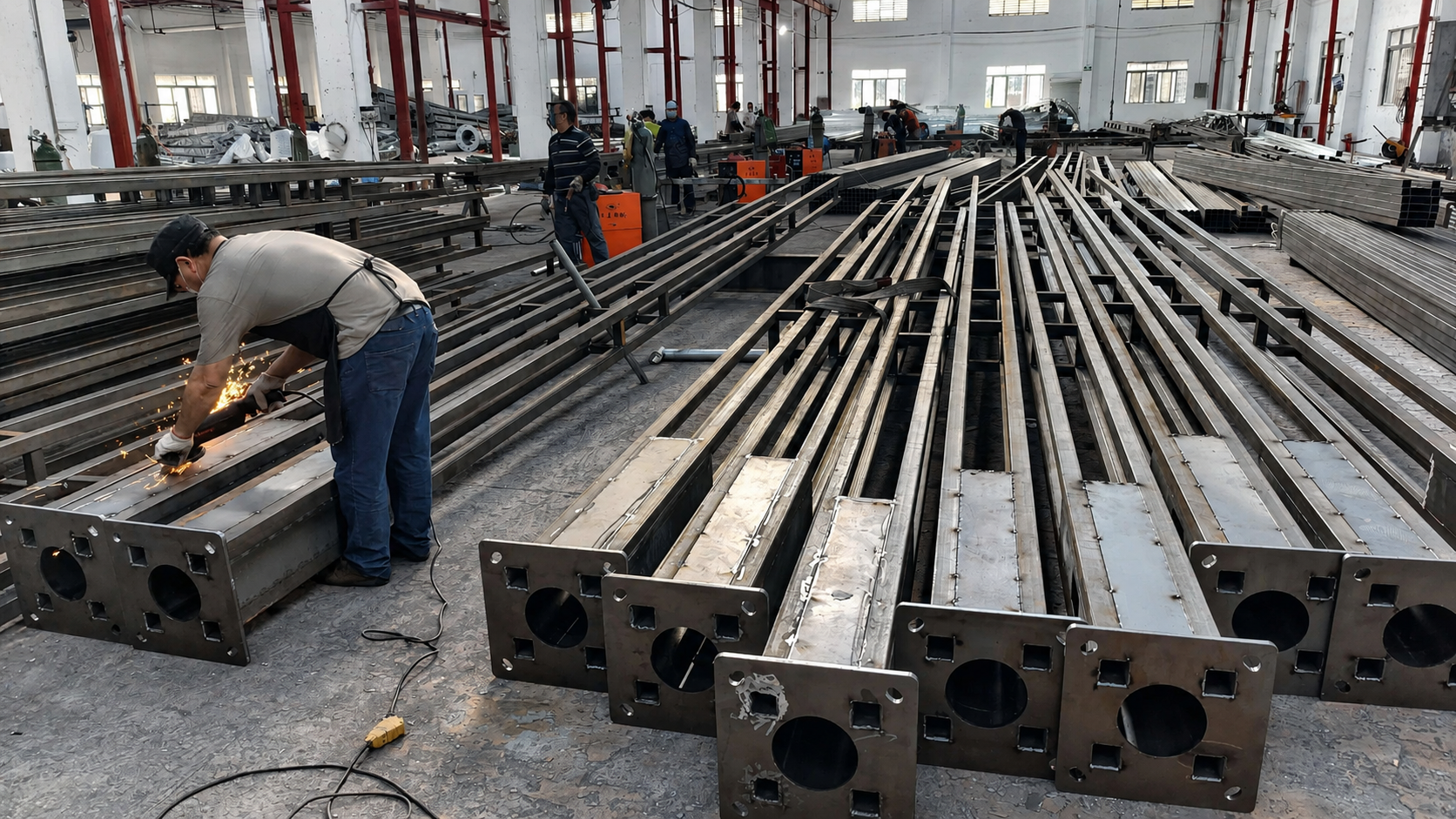
Manufacturing coverage includes metal fabrication, cutting, forming, welding, structural assembly, surface treatment, outdoor powder coating, electrical assembly, product inspection, aging testing, packaging and export delivery. Quality control generally includes appearance inspection, electrical performance test and protection level test. Stated monthly capacity is 3,000 to 5,000 units for regular orders, with a lead time of 15 to 18 days. The stated MOQ is 20 sets for standard styles and 5 sets for custom styles. After-sales support includes installation instructions, remote technical support, fault diagnosis and accessory supply, with repair, replacement or supplementary service as stipulated in the contract for quality issues.
Certification evidence is also specific. ISO 9001 certificate 52824Q10676R0S is issued by Guangdong Rules Certification Co., Ltd. and is valid from 2024-07-23 to 2027-07-22, with a scope covering production of road and street lighting lamps. CCC certificate 2017011001975444 is issued by the China Quality Certification Centre and is valid from 2022-05-15 to 2027-05-15. Its certified scope states fixed luminaires for incandescent lamps (ground-mounted garden lamp), E14/E27 lampholder, Class I electric shock protection, IP44 ingress protection, rated voltage 220–240V~, 50/60Hz. The certificate record lists the BF-LSL-4000-120W, BF-AGL-4000-60W and BF-SL-8M-100W among related products. Buyers should still confirm that the exact configuration and destination market are covered by the relevant certificate and standard.
The limitation is equally important. The supplied documents do not state operating temperature ranges or control protocols for all three model families. For a cold-climate, hot-climate, coastal or high-dust project, those details must be added to the technical schedule. A certificate or product family name does not replace a project-specific datasheet.
Purchase Terms and Acceptance Criteria
The comparison framework should be converted into purchase terms before a supplier is selected. A practical specification schedule should list the model, drawing revision, rated power, input voltage, electrical class, IP rating, control method, operating temperature, finish, pole height, foundation interface, packaging and warranty. Each item should have an evidence source: datasheet, test report, certificate scope, approved drawing or approved sample.
Acceptance criteria should be agreed in the same document. For a custom street light order, the buyer can require first-article inspection, sample approval, visual inspection, electrical performance test and protection level test. The approved drawing and datasheet should be the controlling documents. Any change to the LED module, driver, controller, finish or pole interface should go through a written change-control step. This protects both sides when a project has multiple delivery phases or when the luminaire must match an existing streetscape.
Custom Compared with Traditional Standardized Solutions
Standardized catalogue street lights are usually faster to specify because the product data is fixed and repeatable. Custom street lights shift more work into the pre-order phase: drawings, samples, photometric files, control logic and acceptance tests must be reviewed before production. That is the trade-off. Custom supply can improve architectural consistency and scene fit, especially for decorative lighting poles, heritage streetscapes and non-standard street lights, but it requires stronger specification discipline.
The boundary is clear enough to state plainly. A project that cannot review drawings or samples before release may be better served by a standard product. A coastal or high-dust location should not assume that an IP44 scope is adequate for every exposed position; the buyer must specify and verify the required protection level for each mounting location. A solar option should not be selected without confirming battery, controller and maintenance arrangements. And a decorative courtyard lamp should not be used for a roadway unless its photometric performance and mounting arrangement have been verified for that road class.
Commercial terms also need to be checked rather than assumed. BAIFU LIGHTING states a lead time of 15 to 18 days and an MOQ of 5 sets for custom styles and 20 sets for standard styles. These are useful planning inputs, but they should be confirmed against the final configuration, quantity and delivery schedule.
Future Outlook
Street lighting is becoming a combined luminaire, control and data asset. The LED share of 79.7% in 2023 shows that the light source itself is no longer the main differentiator. The growth of smart street lighting, with 32.9 million installed units at the end of 2024 and a projected 20.9% CAGR through 2029, points to more projects specifying dimming, monitoring and sensor-ready interfaces. The increasing adoption of D4i and Zhaga standards suggests that interoperability will matter more in public procurement and smart city lighting.
For buyers, the implication is to specify the control layer early, even when the first phase does not include smart features. Ask whether the driver and controller can be upgraded, whether the luminaire has a defined interface, and whether the supplier can provide the documentation needed for later integration. For suppliers, the pressure will be on evidence rather than adjectives: photometric files, test reports, certificate scopes, drawing control and after-sales support. In a fragmented market where the top 10 lighting fixture companies hold just over 20% share, those documents are what allow a specialist custom manufacturer to be compared on equal terms.
FAQ
Which of these three custom street light types is suitable for a municipal road project?
The BF-LSL-4000-120W is documented for urban roads, parks, plazas, commercial streets and large-scale landscape lighting projects. The BF-SL-8M-100W is an 8-meter split-type solar LED street lamp and can be evaluated where a solar configuration is part of the road brief. The BF-AGL-4000-60W is an ancient-style courtyard lamp, and its CCC scope is for a ground-mounted garden lamp. Final selection depends on photometric design, mounting height, power, input voltage, protection level and control requirements confirmed for the site.
What specifications should be compared before selecting a custom street light?
Compare mounting height and pole design, rated power and optical configuration, input voltage and electrical class, IP rating, control method, operating temperature, finish and customization scope. In the supplied documents, the 8-meter reference is stated for the BF-SL-8M-100W, and 220–240V~, 50/60Hz, Class I and IP44 are stated in the CCC scope for the ground-mounted garden lamp. Other values must be confirmed in the project datasheet.
Can BAIFU LIGHTING supply solar, ancient-style and landscape LED street lights under one project?
BAIFU LIGHTING documents a product range that includes non-standard custom outdoor street lights, LED road luminaires, solar street lights, landscape lights, garden lights, lawn lights, smart street lights and custom lamp poles. The three models in this article are listed in its certificate records. Allocation to one project depends on approved drawings, quantities, lead time and configuration. The stated MOQ is 5 sets for custom styles and 20 sets for standard styles, with a lead time of 15 to 18 days for regular orders.
Which certificates should a buyer verify for custom outdoor lighting?
ISO 9001 certificate 52824Q10676R0S covers production of road and street lighting lamps and is valid to 2027-07-22. CCC certificate 2017011001975444 is valid to 2027-05-15, and its scope states fixed luminaires for incandescent lamps (ground-mounted garden lamp), E14/E27 lampholder, Class I, IP44 and 220–240V~, 50/60Hz. Buyers should check that the exact model and configuration are covered by the certificate scope and by the destination market requirements.
What are the main limitations of choosing a custom street light?
Custom supply requires drawing approval, sample validation and a clear acceptance schedule before production. Some parameters, including operating temperature and control protocol, are not stated in the supplied documents for all three models, so they must be confirmed. The CCC scope is product-specific. Custom designs can improve architectural and scene fit, but they are not automatically suitable for every road class or environment without photometric and electrical verification.
Conclusion
The decision framework is straightforward. Match the category to the project function, then prove the exact configuration with drawings, datasheets, test reports and acceptance criteria. The solar model belongs in a solar brief that has been checked for battery, controller and foundation design. The ancient-style model belongs in a courtyard or decorative streetscape brief that fits its documented CCC scope. The landscape LED model has the broadest documented application list and should be specified with photometric, electrical and control data for the site. That sequence keeps custom street light procurement comparable, auditable and easier to accept.
For buyers who need a starting reference, the BAIFU LIGHTING custom outdoor lighting album can be downloaded here: BAIFU LIGHTING customized album.
Have Questions or Need More Details?
Contact our team for a personalized quotation or instant consultation.
Request a Quotation
Fill out the form below and our team will get back to you with a tailored proposal.
WhatsApp Direct Chat
Prefer to chat in real-time? Message us on WhatsApp for instant assistance & quick answers.
- Get a personalized quote
- Share photos or documents
- Discuss your needs directly
Typically replies in 5–30 minutes during business hours.