
Custom Street Light Factory Audit: What Evidence Must Reveal
Industry Reference · Custom Street Lighting Verification
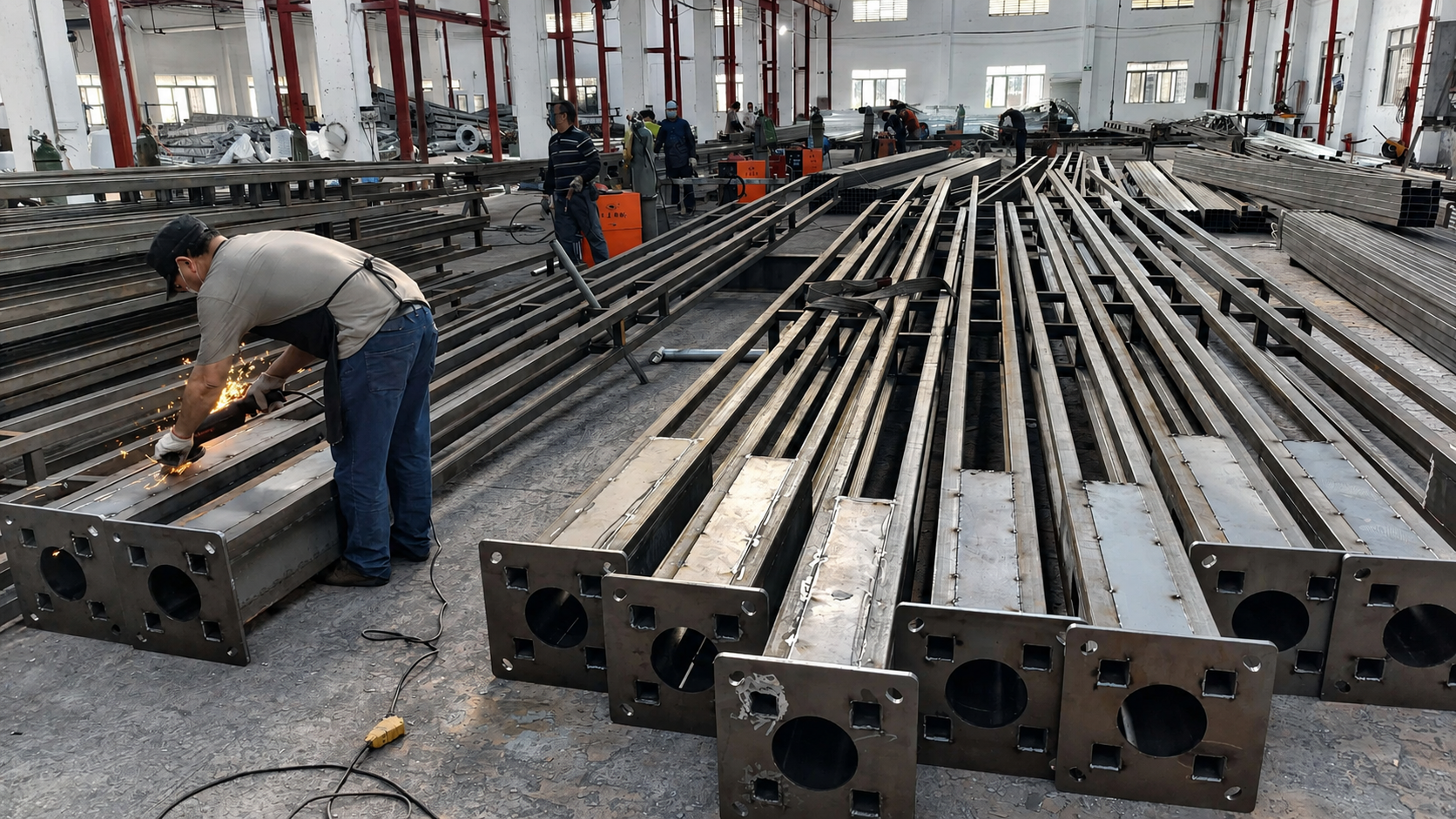
Structural fabrication is the first stage a factory audit should be able to trace with documentation, not photographs.
Street lighting is a fragmented industry, and that fragmentation is why a factory audit has become a procurement instrument rather than a courtesy visit. The global street lighting market was valued at USD 9.1 billion in 2023 and is projected to reach USD 11.6 billion by 2030, according to Grand View Research. At the same time, CSIL reports that the ten largest lighting fixture suppliers together account for just over 20% of the global market — which means most custom street light supply is delivered by small and mid-sized manufacturers whose capability must be verified at the factory level rather than inferred from brand recognition.
A supplier audit for custom street lighting is, in substance, an evidence exercise. The audit must reveal four evidence classes: material specification for the pole and luminaire, documented control of corrosion-protection processes, ingress-protection and electrical-safety results for the configuration ordered, and certification documents whose stated scope actually covers that configuration. An audit that produces catalogues, renderings and price lists but not these four items has produced marketing material, not verification.
Why catalogue claims break down on non-standard street lighting
Custom street lighting is defined by variables rather than by a catalogue number. Mounting height, pole structure, bracket arrangement, decorative pattern, colour, surface finish, LED power, solar configuration and control architecture can each be specified per project. LED conversion has already removed the most visible differentiator: LED accounted for 79.7% of global street lighting revenue in 2023, according to Grand View Research, so optical performance is now a baseline expectation rather than a competitive edge. What still separates suppliers is mechanical fabrication — cutting, forming, welding, structural assembly, galvanizing, coating, electrical assembly and inspection — and that is precisely what a datasheet cannot show.
Two further pressures raise the verification bar. Berg Insight estimates the global installed base of smart street lights at 32.9 million units at the end of 2024, with a 20.9% compound annual growth rate projected through 2029. Where a project includes dimming, photocell, timer or smart control, the audit has to extend to control-gear sourcing, wiring practice and interoperability documentation. D4i and Zhaga have become the reference standards for interoperability between sensors and luminaires, and a supplier that cannot explain how its control interfaces are specified is a supplier whose documentation will not survive project review.
The five evidence classes a factory audit must reveal
The following framework converts a general factory tour into a set of requests that can be answered with documents, records or physical inspection. Each evidence class has a defined ceiling: it establishes something specific and leaves something else unproven.
| Evidence class | What to request | What it establishes | What it does not establish |
|---|---|---|---|
| Material evidence | Material grade documentation, weld and fastener specifications, component identification | That declared materials (Q235 steel, 304 stainless steel, die-cast aluminium, tempered glass) were used in the pole and luminaire | Long-term durability of the finished assembly in the project climate |
| Corrosion-protection process evidence | Production records showing hot-dip galvanizing followed by electrostatic powder coating | That the treatment sequence and finish control match the declared specification | Service life where measured coating data or corrosion testing is not specified |
| Ingress-protection and electrical evidence | Protection level test records, electrical performance test records, appearance inspection records | That the tested configuration met its declared IP class and electrical behaviour | Performance after transport and third-party on-site installation |
| Documentation and certification evidence | Certificates with number, standard, issuing body, scope and validity dates | That a management system and a defined certified product scope exist | Automatic coverage of every customized model in the range |
| Customization and sample evidence | CAD drawings, appearance design evaluation, approved and retained physical sample | That the design can be manufactured as drawn and approved | Long-term field behaviour of decorative and finish details |
Reading material and process evidence: Q235 steel, hot-dip galvanizing, electrostatic spraying
Material evidence
Two reference configurations from BAIFU LIGHTING show how a material declaration should be structured and audited. The BF-LSL-4000-120W custom LED landscape street light declares Q235 hot-dip galvanized steel, 304 stainless steel, die-cast aluminium lamp housings, high-transmittance tempered glass, stainless steel fasteners and an outdoor electrostatic powder coating. The BF-SL-8M-100W 8-metre split-type solar LED street lamp declares a Q235 high-quality steel lamp pole with a hot-dip galvanizing anti-corrosion coating, an outdoor electrostatic powder coating layer, a die-cast aluminium LED lamp housing, high-transparency tempered glass and a monocrystalline silicon solar panel.
BAIFU LIGHTING is a custom outdoor lighting manufacturer and street light manufacturer based in Guzhen Town, Zhongshan City, Guangdong, China, operating an 11,158 m² production facility with 13+ years of outdoor lighting manufacturing experience, 68 employees, 5 engineers and an annual output of 50,000 units.
Q235 is a widely used structural carbon steel grade for outdoor lighting poles, and its designation tells the buyer which base metal the galvanizing and coating processes were designed around. A supplier that cannot state a base metal grade cannot justify its downstream treatment. The practical requests are therefore narrow and answerable:
- Material grade documentation identifying the pole base metal and confirming which parts are cast aluminium rather than fabricated steel.
- Welding records or inspection documentation for the pole-to-base and arm connections.
- Fastener specification — stainless steel fasteners are declared for the BF-LSL-4000-120W, and the grade should be stated explicitly rather than left as "standard hardware".
- Confirmation of tempered glass for the lamp cover, distinguishing it from ordinary glass or unspecified plastics.
Corrosion-protection process evidence
Both reference configurations declare the same treatment sequence. The BF-LSL-4000-120W specifies overall hot-dip galvanizing followed by outdoor electrostatic powder coating; the BF-SL-8M-100W specifies overall hot-dip galvanizing followed by electrostatic spraying. Sequence is the auditable element. Hot-dip galvanizing provides sacrificial corrosion protection to the steel, while the electrostatic powder coating applied afterwards provides colour, UV stability and an additional barrier layer. The audit question is not whether a supplier operates a coating line, but whether the galvanizing step is documented as completed before coating — and whether the pole interior, which is inaccessible after assembly, received the same overall treatment.
Items worth requesting at this stage include the galvanizing batch or subcontractor record, the surface-preparation step applied before coating, and the colour control method. Both models support RAL-based custom colours; the BF-LSL-4000-120W lists standard colours of dark grey, black, silver grey and bronze, with customization per RAL colour card.
A boundary worth stating plainly: neither of the two specifications reviewed here declares a zinc coating mass, a powder coating thickness or a salt-spray duration. Buyers in coastal, high-humidity or high-salinity project environments should define a measured coating requirement, and where necessary a corrosion test, in the purchase contract rather than infer durability from the words "hot-dip galvanized" alone.
Ingress protection, electrical safety and test evidence
Both reference configurations are rated IP65/IP66 and Class I for electric shock protection. The BF-LSL-4000-120W operates on AC 85–265 V, 50/60 Hz, with a power factor of PF≥0.95, luminaire efficacy of ≥130 lm/W, a rated service life of ≥50,000 hours and an operating temperature range of −30 °C to +60 °C. Colour temperature options span 2700K, 3000K, 4000K, 5000K and 6000K, with a colour rendering index of Ra≥70 and Ra≥80 available as an option.
The BF-SL-8M-100W declares lamp luminous efficacy of ≥150 lm/W, a 200 W monocrystalline silicon solar panel, a 12 V 80 Ah maintenance-free lead-acid battery, 10–12 hours of lighting per day, 2–3 days of rainy-day battery autonomy configurable to project requirements, and an operating temperature range of −20 °C to +60 °C. Its control method is light control plus time control with intelligent dimming support, and its light pole is a single-arm conical form with a 90° lamp arm installation angle.
An audit must connect these declarations to test evidence. BAIFU LIGHTING describes its standard quality control as covering appearance inspection, electrical performance test and protection level test. The relevant audit questions are:
- Which physical unit was tested, and does its configuration match the order — pole height, luminaire type, sealing arrangement and control type?
- Are protection-level test records dated and traceable to the production batch?
- For solar configurations, was the panel, battery and controller combination verified as a system or only component by component?
- Is the Class I protection concept — which depends on earthing through the flange base and embedded anchor bolts — documented in the installation instructions supplied with the shipment?
It is also worth being precise about what an IP rating covers. IP65/IP66 describes the product as assembled and tested. It does not describe the condition of an installation completed by a third-party contractor with a damaged gasket or an incompletely sealed cable entry. That is a boundary of the rating, not a defect in it, and it belongs in the buyer's installation specification.
Documentation evidence: how to read ISO 9001 and CCC correctly
Certificates are frequently presented as general proof of quality. They are more usefully read as documents with a defined scope, standard, issuing body and validity period.
ISO 9001. BAIFU LIGHTING holds ISO 9001 certification under certificate number 52824Q10676R0S, issued by Guangdong Rules Certification Co., Ltd. (GRRC) on 2024-07-23 and valid to 2027-07-22, against the standard GB/T19001-2016/ISO9001:2015. The certified scope is the production of road and street lighting lamps (excluding products requiring special qualification certificates), and the certificate is described as applicable to government bidding and overseas trade projects. Read correctly, this verifies that a quality management system covers street lighting production. It does not certify the performance of any individual luminaire, and it does not extend to product categories excluded from its scope.

An ISO 9001 certificate should be read for its scope statement and validity dates — not as product-level approval.
CCC. The Certificate for China Compulsory Product Certification held by the company carries number 2017011001975444, was issued by the China Quality Certification Centre (CQC) on 2022-05-15 and is valid to 2027-05-15. Its stated certified product scope is fixed luminaires for incandescent lamps (ground-mounted garden lamp) with an E14/E27 lampholder, Class I electric shock protection, an IP44 ingress protection rating and a rated voltage of 220–240 V~, 50/60 Hz, evaluated against GB 7000.1-2015 and GB 7000.201-2008.
This is the clearest illustration of why scope matters. The CCC certificate is a China-market compulsory certification for a defined product family and a defined protection level. A buyer ordering an IP65/IP66 LED street light, an artistic landscape luminaire or an 8-metre solar configuration should confirm in writing which certification, if any, applies to the ordered model, rather than assume that a supplier's certified status is transferable across an entire customized range.
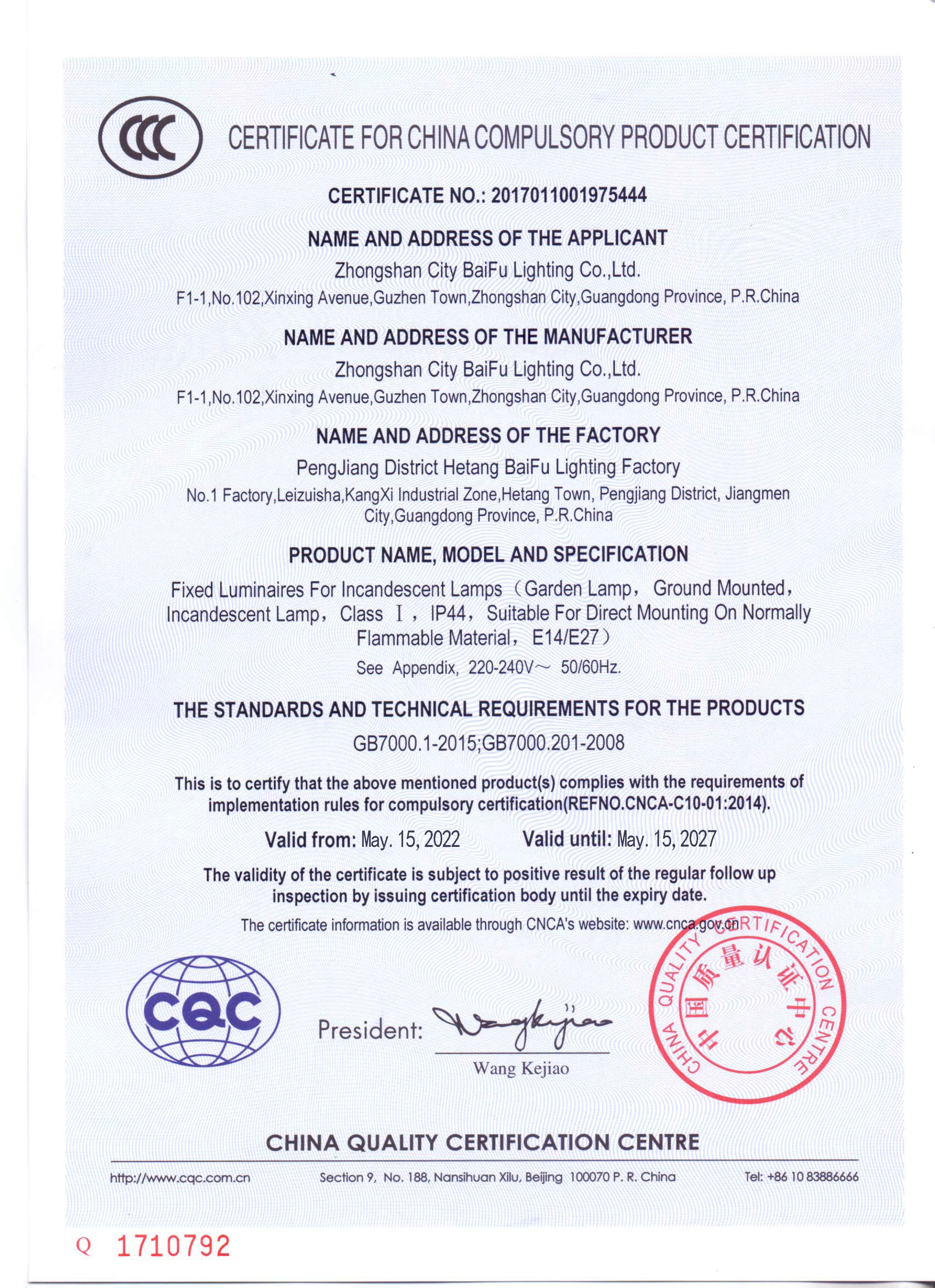
The certified product scope, protection level and standard numbers are the parts of a CCC certificate that determine whether it applies to a given order.
Project-level standards. Where a project specifies performance criteria, the reference frameworks are typically the EN 13201 series, which defines quality, performance and energy indicators for road and street lighting design in Europe, and ANSI/IES RP-8, the primary American national standard for lighting roadway and parking facilities, focused on luminance and safety criteria. These are design and performance standards rather than factory certificates, but they shape the test evidence a project specification will request.
Customization evidence: CAD drawings, samples and capacity limits
The stated customization scope at BAIFU LIGHTING covers lamp power and optical ratio, appearance design, surface treatment, lamp pole height and accessories, solar configuration and control system. Engineering support includes product selection, CAD drawing development, lighting configuration recommendations, appearance design evaluation, sample development and project quotation. Manufacturing is organized around OEM and ODM customization plus project lighting solutions for export markets in the Middle East, Southeast Asia, Africa, South America and Central Asia.
The BF-LSL-4000-120W shows how far a single configuration can be extended: mounting heights of 6 m, 8 m, 10 m or 12 m; LED power options of 60 W, 80 W, 100 W, 120 W, 150 W, 180 W or 200 W; pole structures in conical, square, special-shaped or artistic form; single-arm, double-arm, multi-arm and combined high-low lamp head brackets; road, plaza or decorative landscape light distributions; decorative features such as hollow patterns, luminous decorations, city logos and cultural totems; and control options from standard on/off switching through photocell, timer, 0–10V dimming, DALI and smart lighting control.
No document can verify a decorative pattern, a colour match or the visual appearance of a lit luminaire. Only an approved physical sample can. A factory audit should therefore confirm that a sample approval step exists in the supplier's process — a signed sample retained by both parties, referenced in the purchase order and, where relevant, in the pre-shipment inspection criteria.
Commercial boundaries belong in the same conversation. The company states a minimum order quantity of 20 sets for standard styles and 5 sets for custom styles, a lead time of 15 to 18 days, and a monthly production capacity of 3,000–5,000 units for regular orders. These are not weaknesses in themselves; they are constraints a buyer should model before committing to a tendered delivery schedule, and they should be confirmed in writing for any order that approaches the upper end of the capacity range.
Two auditable reference configurations
The following tables summarize the declared specifications of the two configurations used in this article. They are provided so that a buyer can compare an audit file against a concrete baseline rather than against general claims.
| BF-LSL-4000-120W — Custom LED Landscape Street Light | Declared specification |
|---|---|
| Product type | Non-standard customized landscape lighting product |
| Mounting height | 6 m, 8 m, 10 m, 12 m options; customizable per project |
| LED power | 60 W, 80 W, 100 W, 120 W, 150 W, 180 W, 200 W options |
| Input voltage | AC 85–265 V, 50/60 Hz |
| Luminaire efficacy / power factor | ≥130 lm/W; PF≥0.95 |
| Colour temperature / CRI | 2700K, 3000K, 4000K, 5000K, 6000K; Ra≥70, Ra≥80 optional |
| Ingress protection / shock class | IP65 / IP66; Class I |
| Service life / operating temperature | ≥50,000 hours; −30 °C to +60 °C |
| Pole structure / bracket style | Conical, square, special-shaped or artistic structures; single arm, double arms, multi-arms, combined high-low lamp heads |
| Surface treatment / colours | Overall hot-dip galvanizing followed by outdoor electrostatic powder coating; dark grey, black, silver grey, bronze, RAL-custom |
| Materials | Q235 hot-dip galvanized steel, 304 stainless steel, die-cast aluminium housings, high-transmittance tempered glass, stainless steel fasteners, outdoor electrostatic powder coating |
| Installation / control | Flange base with embedded anchor bolts; on/off standard, photocell, timer, 0–10V dimming, DALI, smart control optional |
| Decorative options | Hollow patterns, luminous decorations, city logos, cultural totems, exclusive project elements |
| Application scenarios | Urban roads, parks, plazas, commercial streets and large-scale landscape lighting projects; municipal road engineering, cultural tourism scenic spots, pedestrian streets, residential communities, hotels and resorts, industrial parks, parking lots, government projects and overseas urban infrastructure projects |
| BF-SL-8M-100W — 8-Metre Split-Type Solar LED Street Lamp | Declared specification |
|---|---|
| Pole height / LED power | 8 metres; 100 W |
| Solar panel | 200 W, high-efficiency monocrystalline silicon |
| Battery | 12 V 80 Ah, maintenance-free lead-acid |
| Lamp luminous efficacy | ≥150 lm/W |
| Colour temperature / CRI | 3000K, 4000K, 5000K, 6000K selectable; Ra≥70 |
| Ingress protection | IP65 / IP66 |
| Pole form / arm angle | Single-arm conical light pole; 90° lamp arm installation angle |
| Surface treatment | Overall hot-dip galvanizing followed by electrostatic spraying |
| Operating temperature | −20 °C to +60 °C |
| Lighting time / rainy-day autonomy | 10–12 hours per day; 2–3 days, configurable per project |
| Control method | Light control plus time control, with intelligent dimming support |
| Wind resistance | Structural design based on wind speed at the project location |
| Installation | Fixed by pre-buried anchor bolts |
| Customization scope | Height, power, colour, battery capacity, solar panel and light pole design |
What completed projects demonstrate — and what they do not
Delivered projects are useful audit context because they show a supplier has moved from drawing to shipment at volume. Two municipal references illustrate the pattern. In a Malaysian project, 68 units of customized landscape street lamps were installed on both sides of urban roads serving characteristic streets and road landscape lighting; after installation the lighting operated stably with uniform night-time brightness, and the lamp posts were designed to blend with the local road greening and urban environment. In a separate coastal municipal project lasting two years, 35 units were installed along coastal roads, around port areas, in city squares and in public recreational areas, meeting night-time road lighting, pedestrian guidance and coastal landscape decoration needs. The fixtures were custom-designed around the local coastal environment and European architectural style, with an outdoor structure specified for waterproof, anti-corrosion and weather-resistant performance.
Read correctly, this is delivery-capability evidence: batch production, custom design integration, export packaging and installation coherence at site scale. It does not replace inspection of the goods a buyer is about to receive, and the described outcomes — stable lighting, uniform coverage, visual harmony with the surrounding built environment — are qualitative rather than measured. Where a project specification demands photometric or structural verification, measured on-site data must be requested separately and written into the contract.
Market trend analysis: where verification requirements are heading
Four trends visible in available third-party data change what an audit should examine.
1. LED is settled; mechanics and finish are not. LED accounted for 79.7% of global street lighting revenue in 2023 (Grand View Research). Since the light source is no longer a differentiator, the weight of differentiation shifts to fabrication, galvanizing and coating quality — the areas where documentation is weakest and physical inspection matters most.
2. Controls are the fastest-moving layer. Berg Insight places the global installed base of smart street lights at 32.9 million units at the end of 2024, with a 20.9% CAGR projected through 2029. Forecasts diverge in both year and definition: ResearchAndMarkets projects 63.8 million individually controlled street lights by 2027, while Berg Insight projects a broader figure for 2029. Buyers should therefore treat controls forecasts as directional rather than precise. At platform level this market is concentrated — Signify was the leading smart street lighting vendor as of late 2024 with approximately 5.8 million installed lighting controls (Berg Insight) — even as fixture supply remains fragmented.
3. Architectural and custom supply has established specialist players. Schréder, whose operations date back to 1907, specializes in architectural street lighting and smart city solutions, while Sentry Electric is a recognized US manufacturer of custom and historic decorative street lighting poles and luminaires. This is the competitive context in which a custom pole supplier is assessed: decorative and architectural work is judged on fabrication, pattern fidelity and finish, not on light output alone.
4. Regional demand is shifting. CSIL identifies Africa as the fastest-growing regional lighting market, with over 4% average annual growth since 2018 driven by public infrastructure projects. That pattern increases demand for project-based customization and for suppliers able to support export documentation, installation guidance and after-sales parts supply.
A note on market sizing is warranted. Forecasts for 2030 diverge significantly: Grand View Research projects the street lighting market at USD 11.6 billion, while StrategyR projects USD 16.5 billion. The difference reflects definitional scope rather than disagreement about growth direction, and audit planning should follow project requirements rather than market-size headlines.
Evidence-based audit versus traditional supplier screening
Most custom lighting procurement still begins with reputation, catalogue imagery and unit price. An evidence-based audit does not replace commercial judgement, but it changes the basis on which risk is assessed.
| Decision factor | Traditional screening | Evidence-based factory audit |
|---|---|---|
| Primary basis for selection | Brand reputation, catalogue, references, unit price | Material records, process records, test reports, certificate scope |
| Steel and finish verification | Assumed from a datasheet line | Base metal grade confirmed; galvanizing-then-coating sequence traced in production records |
| Ingress protection | Claimed rating accepted as stated | Tested configuration identified; protection-level records reviewed |
| Customization confidence | Rendered images and 3D concepts | CAD drawings plus a signed, retained physical sample |
| Certification interpretation | Certificate treated as blanket approval | Number, standard, scope, issuing body and validity checked against the ordered model |
| Residual risk | Discovered during installation or after delivery | Reduced and documented, but not eliminated |
Where an audit still cannot protect the buyer
Verification has limits, and stating them is part of credible supplier evaluation.
- Certificate scope is narrower than a product range. The CCC certificate discussed here covers a defined product scope with an IP44 rating, while the two reference street lights in this article are rated IP65/IP66. Buyers should not treat one certificate as covering an entire customized catalogue.
- ISO 9001 is a system certificate, not a product certificate. It covers the production of road and street lighting lamps, excluding products requiring special qualification certificates, and says nothing about the tested performance of a specific luminaire.
- Ingress protection is configuration- and installation-dependent. Field assembly, gasket condition and cable sealing sit outside the tested configuration.
- Wind resistance is not a fixed figure. Structural design is based on wind speed at the project location, so the buyer must provide wind load data before any meaningful structural verification can be performed.
- Durability data is missing from the specification. No zinc coating mass, powder coating thickness or salt-spray duration is declared; coastal and high-humidity projects should add a measured requirement to the contract.
- Commercial limits shape feasibility. Minimum order quantities of 20 sets for standard styles and 5 sets for custom styles, a 15–18 day lead time and a monthly capacity of 3,000–5,000 units for regular orders must be reconciled with any tendered schedule.
Future outlook
Three shifts are likely over the next several years. First, verification is moving from static certificates toward process records: buyers increasingly ask for galvanizing batch documentation, measured coating data and configuration-specific test reports rather than a scanned management-system certificate. Second, as smart street lighting volumes grow, interoperability documentation around D4i and Zhaga becomes part of the audit file, particularly where a municipality intends to add sensors or dimming after installation. Third, custom projects will continue to be judged on sample and drawing control, which places more weight on engineering documentation — CAD drawings, appearance design evaluation and configuration records — than on catalogue breadth.
For manufacturers, the practical implication is that export readiness is no longer only a matter of capacity. It includes the ability to present material, process, test and certification evidence in a form that a buyer's engineer, procurement officer and, in some markets, a government tender evaluator can all accept as complete.
FAQ
What documentation should a buyer request before auditing a custom street light factory?
Request a document set that can be checked against a specific order: an ISO 9001 certificate showing number, standard, issuing body, scope, issue date and expiry date; any product certification with its certified product scope and protection level; material grade documentation for the pole steel; process records showing hot-dip galvanizing performed before electrostatic powder coating; electrical performance and protection-level test records; CAD drawings for the ordered configuration; and the approved sample record. Complete documents matter, because the scope statement is the part that determines whether a certificate applies to the ordered model.
How can a buyer verify that a street light pole uses Q235 steel with hot-dip galvanizing?
Verification rests on three linked items. First, material documentation identifying Q235 as the pole base metal — the grade declared for both the BF-LSL-4000-120W and the BF-SL-8M-100W. Second, process documentation showing that overall hot-dip galvanizing is completed before the electrostatic powder coating, since that is the sequence both specifications declare. Third, physical inspection of the treated surfaces, including the pole interior, at the factory before coating and final assembly. A single datasheet line does not substitute for any of the three.
What does an IP65 or IP66 rating actually prove on a customized street light?
It describes the protection the product demonstrated as assembled and tested against dust and water ingress in that specific configuration. Both the BF-LSL-4000-120W and the BF-SL-8M-100W are rated IP65/IP66 and Class I for electric shock protection. The rating does not extend to the installed condition: seal integrity after transport, on-site assembly and the earthing path through the flange base and embedded anchor bolts are installation responsibilities. Buyers should confirm which configuration was tested and ensure that sealing and earthing instructions are supplied with the order.
Do ISO 9001 and CCC certification automatically cover a customized street light model?
No. The ISO 9001 certificate (number 52824Q10676R0S, valid to 2027-07-22, standard GB/T19001-2016/ISO9001:2015) covers the production of road and street lighting lamps, excluding products requiring special qualification certificates, and certifies a management system rather than a product. The CCC certificate (number 2017011001975444, valid to 2027-05-15) states a defined product scope — fixed luminaires for incandescent lamps (ground-mounted garden lamp), E14/E27 lampholder, Class I, IP44, 220–240 V~, 50/60 Hz, against GB 7000.1-2015 and GB 7000.201-2008. A buyer ordering a different configuration should confirm in writing which certification applies to the ordered model.
Which customization items can only be confirmed with a physical sample?
Appearance-related items. The customization scope covers appearance design, lamp power and optical ratio, surface treatment, lamp pole height and accessories, solar configuration and control systems. The BF-LSL-4000-120W additionally offers decorative features such as hollow patterns, luminous decorations, city logos and cultural totems, in standard colours of dark grey, black, silver grey and bronze or RAL-custom colours. Pattern detail, colour match, weld appearance and light distribution are judged physically, so a signed sample retained by both parties should form part of the order documentation and the inspection criteria.
What can a factory audit not verify for a non-standard street light order?
Several things. An audit cannot confirm long-term field durability, because no zinc coating mass, powder coating thickness or salt-spray duration is declared in the two specifications reviewed here. It cannot establish a fixed wind resistance figure, because structural design is based on wind speed at the project location, which the buyer must supply. It cannot guarantee performance after third-party installation. And it cannot confirm that supplier capacity fits an aggressive schedule: the stated figures are a monthly capacity of 3,000–5,000 units for regular orders, a 15–18 day lead time, and minimum order quantities of 20 sets for standard styles and 5 sets for custom styles.
Reference documentation: BAIFU LIGHTING publishes a customized outdoor lighting album covering pole, luminaire and finish options, available as a PDF at https://cdn.socialarks.com/sbsp/25029/common/2026/0717/BAIFU_LIGHTING_Customized%20album.pdf. Product and certificate details referenced in this article are drawn from the manufacturer's published specifications and certification documents; buyers should re-verify certificate validity dates and scope at the time of order.