
Custom Touch Display Module Fit for Wet-Hand and Glove HMI
Custom Touch Display Module Fit for Wet-Hand and Glove HMI
Touch input is usually the last line item specified on an HMI bill of materials, yet the input condition — a bare fingertip, a wet hand, a thin nitrile glove, a heavy work glove — decides the controller tuning, the cover-glass treatment, the firmware filters and, in a large share of projects, whether a projected capacitive or a 5-wire resistive stack should even be the starting point.
A Custom Touch Display Module is a display-and-touch assembly built to an equipment maker's specification — cover glass, touch sensor, controller and display integrated as a single unit — rather than a catalogue part selected from a list. In industrial control, medical and self-service equipment, the module is judged as an input device under a stated operating condition. Two modules with identical diagonal size, resolution and interface can behave very differently once the operator's hand is wet, gloved, or moving across a machine while a spindle starts.
This comparison is criteria-based rather than brand-ranked. It sets out six evaluation criteria, a technology decision rule, a size-by-size evaluation map across 7-, 10.1-, 13.3-, 15.6- and 21.5-inch assemblies, and the boundary conditions where each choice stops being appropriate.
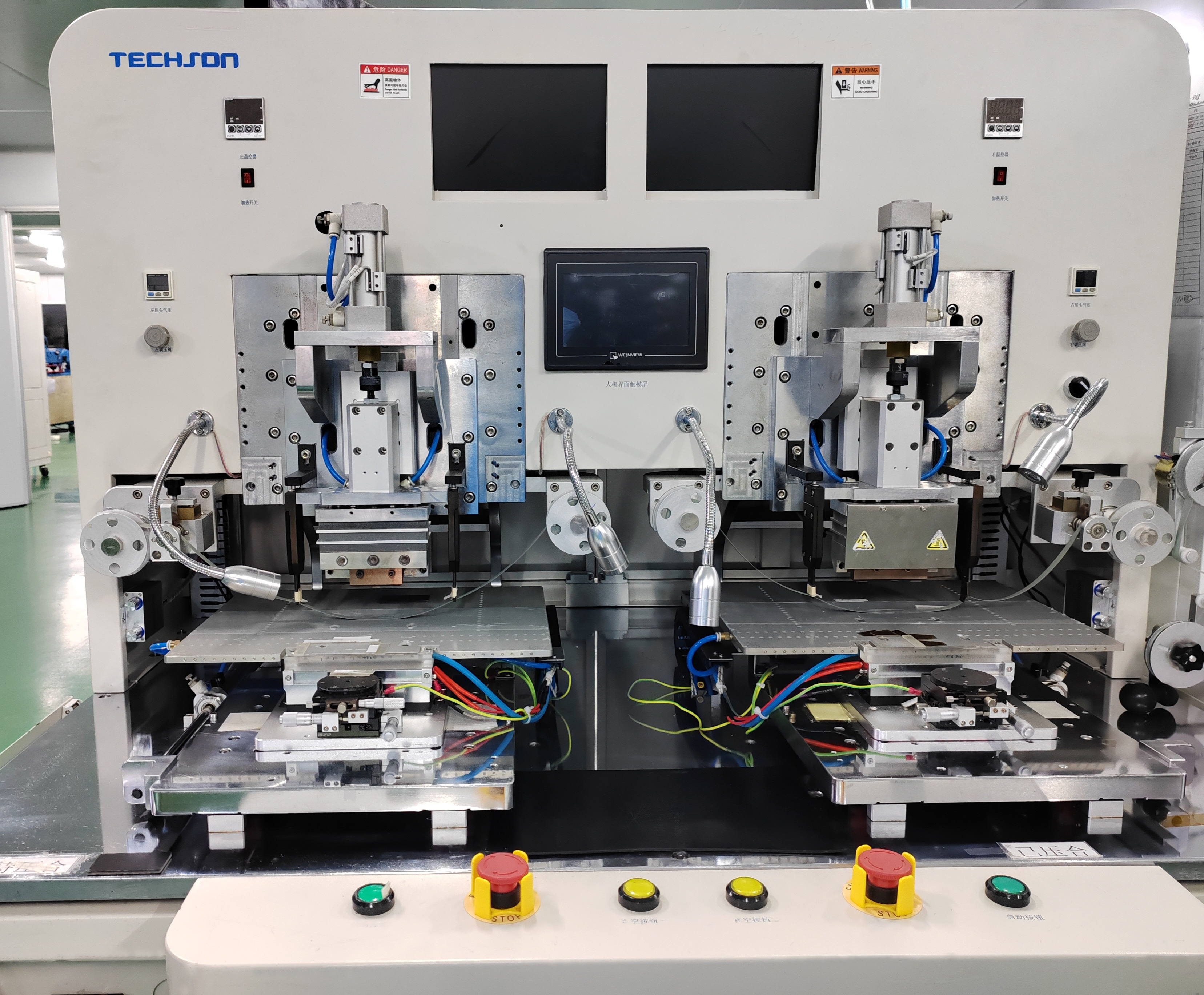
FPC bonding joins the sensor tail and controller interface. Bonding quality and grounding at this joint influence drift and EMC behaviour in the finished HMI touch display module. Image: Xiangrui Optoelectronics.
The specification gap: hand condition is decided late and paid for early
Most HMI request documents state the diagonal size, resolution, brightness, interface and operating temperature, then add a single line reading touch: capacitive. The input condition — whether the operator is bare-handed, wearing a thin glove, wearing a heavy work glove, or pressing with wet or oily fingers — is often omitted, even though it changes the engineering answer more than any other single requirement.
The consequence appears later, in sampling. A module that tracks a bare fingertip cleanly may drop contacts through a 1.5 mm nitrile glove, or register phantom touches when a water film bridges two sensor nodes. Teams then compensate with firmware threshold changes, additional cover-glass treatment, or a change of touch technology — all after the enclosure tooling has been approved.
The opportunity is straightforward: treat input condition as a first-class requirement, evaluated at the same time as the display specification. Procurement teams that do this compare suppliers on a defined test condition instead of a generic capability statement, and receive answers that can be checked against a sample.
Six criteria that separate otherwise identical modules
The following criteria are the ones that most often distinguish a module that works in the field from one that works only on a bench. Each should be answered with a specific statement, not a general assurance.
| Criteria | What to ask the supplier | Weak answer |
|---|---|---|
| Input state coverage | Which input conditions are validated: bare hand, wet hand, thin glove, thick work glove, hard stylus or gloved knuckle? | Works with gloves, with no glove thickness or material stated |
| Stability and drift | How is touch baseline self-adaptation handled when temperature changes, or when servo and VFD noise is present? | High stability, with no reference to the electrical environment |
| Anti-false-touch | Are palm and large-object rejection, rain and liquid suppression, and anti-shake filtering implemented in firmware? | Anti-mistouch is claimed as a coating property only |
| Touch lock and clean lock | Can touch input be locked during wiping or disinfection, and who releases it? | Lock mentioned without describing the release path |
| Single-point priority | Can multi-finger gestures be disabled so that only one contact is registered at a time? | Multi-touch always presented as an unconditional benefit |
| Surface treatment | Is AF anti-fingerprint combined with AG anti-glare, and which cleaning agents has the coating been assessed against? | Coating named, cleaning regime unaddressed |
None of these criteria is expensive to state. All of them are expensive to discover after deployment. A buyer who asks for the six answers in writing receives a comparison that can be audited against a sample, which is the only comparison that matters at the Evaluation to Execution stage.
Capacitive or resistive: start from the input condition
The technology choice follows from the input condition rather than from a general preference. In industrial control equipment, the practical rule is that heavy-duty work gloves, hard-object pressing, heavy oil contamination, dust and splashing liquid, single-point operation only and budget sensitivity point toward a 5-wire resistive touch; multi-point gestures, better display performance, a flat flush appearance, high-frequency operation and outdoor strong-light conditions point toward an industrial-grade projected capacitive touch screen.
The same logic applies in medical equipment. New-generation medical devices such as monitors, ultrasound systems, high-end ventilators and medical self-service terminals are generally better served by capacitive screens, while simple bedside controllers and portable handheld detectors that are operated with thick gloves, frequently splashed with disinfectant and used for basic single-point input are better served by resistive screens.
| Decision input | 5-wire resistive | Industrial projected capacitive |
|---|---|---|
| Heavy work gloves, gloved knuckle or hard-object press | Preferred | Requires validation; thin-glove behaviour differs from thick-glove behaviour |
| Oil, coolant, dust, splashing liquid, single-point workflow | Preferred | Workable with IP-rated front panel and firmware suppression |
| Multi-point gestures, image review, drawing or zoom | Limited | Preferred |
| Flush glass front, high-frequency operation, long service life | Limited | Preferred |
| Immunity to EMI and ESD | Stronger inherent anti-interference | More sensitive; requires grounding, shielding and industrial or medical-grade IC selection |
Market data shows where the broader volume sits without settling the question for any individual machine. According to Business Research Insights, capacitive touch modules held close to 71% of the touch screen module market in 2025, while resistive modules accounted for 19%. The residual resistive share persists largely because rugged environments still impose conditions that a standard capacitive stack does not meet without additional engineering.
Anti-mistouch is a stack, not a coating
False touches on wet or gloved hands are rarely solved by surface treatment alone. The effective controls sit at three levels, and a supplier that can only describe one of them is describing a partially engineered module.
- Firmware and algorithm level: palm and large-object accidental-touch prevention, rain and liquid suppression, touch baseline self-adaptation, anti-shake filtering, single-point priority, disabling of multi-finger gestures, touch lock and wipe lock, adjustable graded touch thresholds, and area shielding or area lock.
- Sensor and cover level: cover plate thickness and material matched to the controller, and an added ITO shielding layer where the electrical environment demands it.
- Circuit level: industrial or medical-grade touch IC selection, optimised PCB grounding, and enhanced shielding and isolation for the FPC.
The order matters. Algorithm-level controls are usually the lowest-cost first move; hardware-level changes address the source of the false touches in the sensor, cover plate and circuit. A buyer comparing two suppliers should ask which of these levels is standard, which is optional, and which one the supplier has actually validated on a comparable machine.
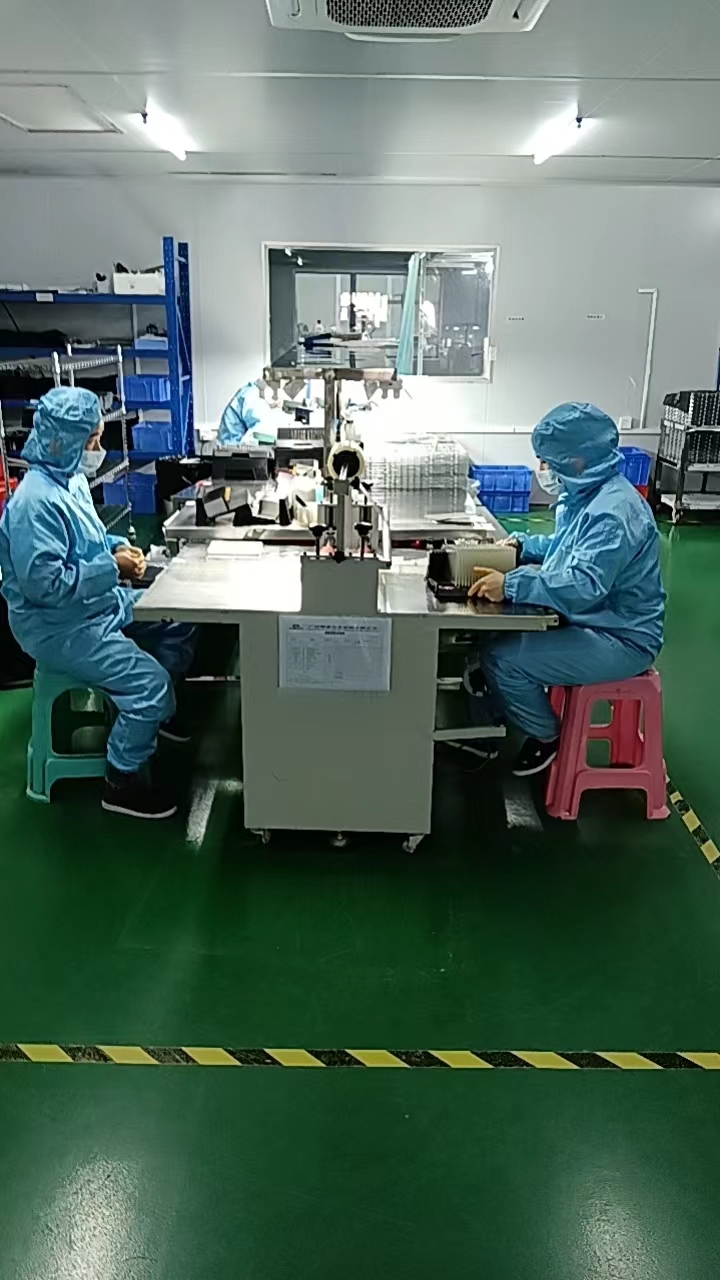
Protective film application before packing. Surface treatment such as AF anti-fingerprint or AG anti-glare is specified against the cleaning regime, not chosen by default. Image: Xiangrui Optoelectronics.
Matching module size to the operating scene
Size is not only a viewing-distance decision. Larger diagonals place more sensor nodes under a single palm, which changes how rejection algorithms behave; smaller diagonals leave less room for gesture disambiguation when an operator is wearing gloves. The five assemblies below are the module sizes referenced in this comparison, each with the evaluation question that usually decides the project.
| Size | Module reference | Input condition normally evaluated | Decisive question |
|---|---|---|---|
| 7-inch | XRCGG070-0108-TPM-D1 | Bare hand or thin glove on handheld, portable or bedside equipment | Can the target accuracy be held while the device moves in the operator's hand? |
| 10.1-inch | XRCGG101-0340-R1 | Bare hand, light glove, single-point control workflows | Is single-point priority acceptable, or are gestures part of the workflow? |
| 13.3-inch | XRCGG133-0040-OB-A0 | Thin glove or oily hand at a machine-mounted HMI | Does touch remain stable under servo and VFD noise? |
| 15.6-inch | XRCGG156-0186-A0 | Wet hand and outdoor self-service or charging interfaces | Does water film on the glass generate phantom contacts? |
| 21.5-inch | XRCGG215-0106-A0 | Bare hand or gloved single-point use on large-format terminals | How much of the surface must be shielded against palm and forearm contact? |
These mappings are evaluation starting points rather than fixed assignments. Final specifications — interface, brightness, cover-glass thickness, IK and IP rating — are confirmed per project, and customisation of shape, dimensions, anti-interference performance, brightness, resolution, IK rating and IP rating is part of the scope a buyer should be able to discuss directly with the module manufacturer.
What long-running deployments reveal about input conditions
Field duration is a more useful comparison metric than a specification sheet, because the conditions that cause drift and false touches accumulate over years rather than hours. Four deployment profiles illustrate how the criteria above translate into an actual configuration.
Machine-tool HMI: glove, oil and electrical noise
A CNC equipment manufacturer has used these modules for eight years across 800 units in HMI and display systems. The recorded operating conditions include stable glove and oily-hand touch, anti-drift behaviour under servo and VFD noise, IK08 or IK10 toughened glass, AG plus AF coating for cleaning cutting fluid and metal dust, IP65 front panel protection against coolant and cutting oil, vibration and shock resistance, a wide operating range of -20°C to +70°C, high ESD and EMC protection to prevent touch jump during spindle start-stop, 24/7 continuous operation with a long-life backlight, and LVDS, MIPI, USB or RS232 interface options. This is the clearest example of a case where anti-mistouch is an electrical problem before it is a surface problem.
Medical HMI: sterile gloves and repeated disinfection
A medical device manufacturer serving Japan, Taiwan and Germany has used the modules for five years across 5,000 units in ECG monitoring equipment, HMI and display systems. The stated requirements include stable touch with sterile nitrile and latex gloves, a clean lock function for disinfection, a special coating resistant to alcohol, isopropanol and hospital disinfectants without whitening, IEC60601-1-2 medical EMC compliance with low interference for biosignal sensors, optional anti-glare, anti-reflection or antibacterial coating, flicker-free DC dimming with low blue light, a 24/7 long-life backlight, IP54 or IP65 front splash protection, IK07 to IK08 tempered glass, and low outgassing with UL94-V0 flame retardancy. Here the touch lock and the coating chemistry carry as much weight as the touch controller.
Outdoor charging and access control
Charging pile manufacturers have operated 3,000 units for five years in EV charging stations, with stable long-term continuous outdoor operation reported under wide-temperature and high-interference conditions. A smart home device manufacturer has run 30,000 units for three years in facial recognition access control systems, where aesthetic design, touch experience, optics and power consumption, protection and environmental adaptability were the deciding factors. In both cases the input condition is closer to bare hand, with the environmental load — temperature, moisture, electrical noise — doing most of the work.
Where Xiangrui Optoelectronics sits in this comparison
Xiangrui Optoelectronics — Guangzhou Xiangrui Optoelectronics Technology Co., Ltd. — is a Guangzhou-based manufacturer of resistive touch screens, capacitive touch screens and custom touch display modules, founded in 2010 and supplying industrial control equipment, medical devices, smart self-service terminals and other intelligent equipment makers in Asia, Europe and America.
For a buyer evaluating capability rather than a catalogue part, the relevant facts are these. The company operates a 5,000 m² manufacturing facility with 60 employees, including 15 engineers, and states a monthly production capacity of 30,000 units. It provides OEM services, ODM services, customisation services and mass production, and its customisation technical support covers shape, dimensions, enhanced anti-interference performance, high brightness, high resolution, IK rating and IP rating. Quality control is full inspection, with a one-year warranty and remote support, a MOQ of 500 units and a lead time of 30 to 60 days. Capacitive touch panels support Android, Linux and Windows operating systems. Cover-glass thickness is customisable up to a maximum of 10 mm.
On compliance, the company holds ISO 9001 certification, certificate number 50826Q00054R053, issued by ZhongLianZhouYue International Certification (Beijing) Co., Ltd on 2025-02-09 and valid to 2029-02-08 under GB/T 19001-2016/ISO 9001:2015, with the certified scope covering production of capacitive and resistive screens. It also holds ISO 14001 and is registered as a National High-Tech Enterprise with 16 utility model patents. Export accounts for approximately 50% of output.
Limits and boundaries of this approach
A comparison that only lists strengths is not usable for procurement. The following boundaries should be assumed until a sample proves otherwise.
- Projected capacitive modules are not the universal answer. Very thick work gloves, heavy oil contamination and hard-object pressing remain resistive territory, and forcing a capacitive stack into that environment adds cost without removing risk.
- Single-point priority and touch lock both trade function for stability. Disabling multi-finger gestures removes pinch and zoom workflows, and a wipe or clean lock adds an operator step that must be released deliberately during disinfection or cleaning.
- Surface treatments are working surfaces, not permanent properties. Coating performance should be assessed against the actual cleaning agents in use — alcohol, isopropanol and hospital disinfectants were the reference media in the medical deployment described above — rather than against a generic chemical-resistance claim.
- Commercial terms shape feasibility at the prototype stage. A MOQ of 500 units and a 30 to 60 day lead time fit volume programmes; small pilot builds need to plan around them or negotiate separately.
- The module set referenced here spans 7, 10.1, 13.3, 15.6 and 21.5 inches. Other diagonals require their own evaluation rather than an assumption of equivalence.
- EMI and ESD behaviour differs by technology. Capacitive screens are more sensitive to electromagnetic interference and electrostatic discharge, while resistive screens offer stronger inherent anti-interference — a difference that matters on machines with frequent motor start-stop.
Market trend: ruggedised capacitive inside a growing commercial display market
Two data points frame the direction of travel. Future Market Insights projects the commercial touch display market growing from USD 6.9 billion in 2025 to USD 16.3 billion by 2035, a CAGR of 9.0%. Within touch screen modules, capacitive technology already holds the majority of value at roughly 71% in 2025, against 19% for resistive, according to Business Research Insights.
The interpretation for buyers is not that resistive disappears, but that the specification burden moves. As capacitive becomes the default, the differentiating engineering shifts to the parts that make capacitive viable in a harsh environment: glove tuning, drift control under electrical noise, firmware-level false-touch suppression, and coatings that survive a real cleaning regime. Mechanical protection expectations are also codified — IK10 under IEC 62262 corresponds to an impact energy of 20 joules, equivalent to a 5 kg object dropped from 40 cm — which makes impact ratings comparable across suppliers rather than a matter of description.
Future outlook
The next round of differentiation is likely to appear in three places. First, firmware: suppression algorithms for water film and palm contact are becoming the practical dividing line between industrial-grade and consumer-grade controllers. Second, interface durability and lifecycle: LVDS, MIPI, USB and RS232 options exist mainly so that a module can remain available across a product's after-sales life, which matters more to equipment makers than any single performance figure. Third, hygiene and cleanability in medical and self-service equipment, where coating chemistry, low outgassing and flame retardancy are increasingly written into the requirement rather than negotiated afterwards.
For buyers, the implication is stable: request the input condition, the cleaning regime and the electrical environment in writing, then compare samples against those three statements. The supplier that answers all three with specifics is the one whose module will still behave the same way in year five.
FAQ
For an HMI with heavy work gloves, oil and coolant, should the touch be resistive or capacitive?
Where heavy-duty work gloves are required, where hard objects are used to press the screen, where heavy oil contamination, dust and splashing liquid are present, where only single-point operation is needed and where budget is sensitive, a 5-wire resistive touch is the preferred starting point. Where multi-point gestures are needed, display performance matters more, a flat flush appearance is required, operation is high-frequency and the environment is an outdoor strong-light scene, an industrial-grade projected capacitive touch screen is the preferred choice.
How can accidental touches be reduced on a touchscreen used with wet or gloved hands?
Reduction comes from combining several controls: palm and large-object accidental-touch prevention, rain and liquid suppression algorithms, touch baseline self-adaptation with anti-shake filtering, and single-point priority; disabling multi-finger gestures; a touch lock or wipe lock; an adjustable graded touch threshold; area shielding or area lock; matching cover plate thickness and material to the controller; and adding an ITO shielding layer. Firmware and software optimisation is typically the most commonly used and lowest-cost measure, while hardware-level changes reduce the sources of false touches in the sensor, cover plate and circuit.
Which operating systems do the capacitive touch panels support?
The capacitive touch panels support multiple operating systems, including Android, Linux and Windows.
Is there a thickness limit for the glass cover plate of a touch screen?
Yes. The thickness of the glass cover plate can be customised, with a maximum thickness of 10 mm.
For medical devices, when is resistive still the better choice?
Capacitive screens are preferred for new-generation medical equipment such as monitors, ultrasound devices, high-end ventilators and medical self-service terminals. Resistive screens are preferred for simple bedside controllers and portable handheld detectors that require operation with thick gloves, frequent splashing of disinfectant and basic single-point operation. The medical selection criteria that carry the most weight are disinfection and wiping, biocompatibility, EMC and ESD, wide temperature range, reliability, and whether staff are wearing gloves.
The manufacturer's English catalogue, including module references and customisation scope, can be downloaded here: Xiangrui Optoelectronics English brochure (PDF).
Have Questions or Need More Details?
Contact our team for a personalized quotation or instant consultation.
Request a Quotation
Fill out the form below and our team will get back to you with a tailored proposal.
WhatsApp Direct Chat
Prefer to chat in real-time? Message us on WhatsApp for instant assistance & quick answers.
- Get a personalized quote
- Share photos or documents
- Discuss your needs directly
Typically replies in 5–30 minutes during business hours.