
Custom Transformer Fit for North American Distribution
North American residential and commercial distribution is not one application. A 50 kVA unit on a pole serving a rural feeder, a 75 kVA unit set on a concrete pad inside a subdivision, and a three-phase unit feeding a retail complex are built to different mounting conventions, different service voltages and, in practice, different certification packages. Custom transformer procurement in this market therefore begins with application fit — where the unit will stand, what it will feed, and which certificate the receiving utility or authority having jurisdiction will accept — before it reaches kVA and impedance.
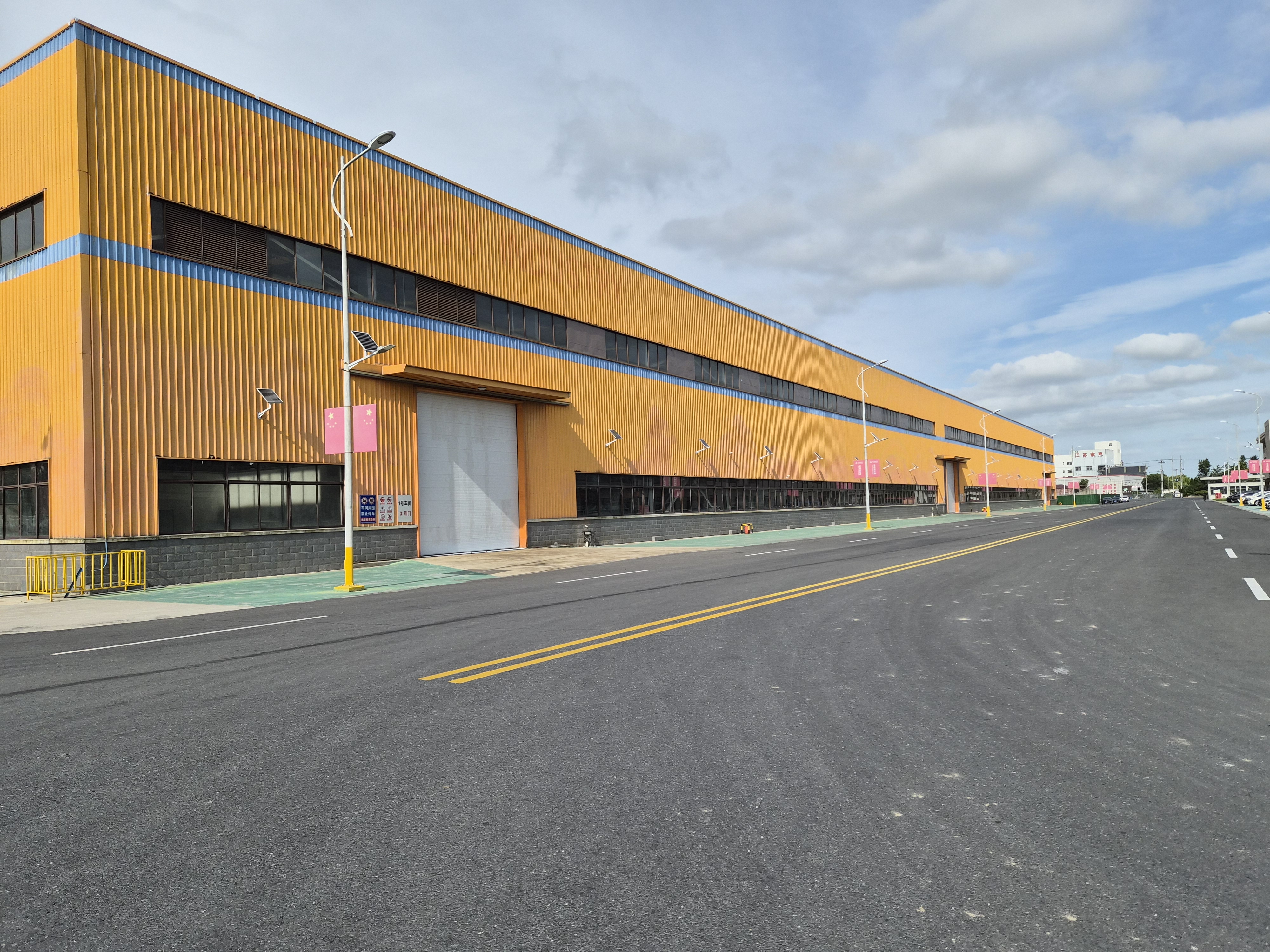
Manufacturing environment behind the custom transformer supply chain described in this article.
Apex Power Systems (Nanjing) Co., Ltd. is an international trading and supply-partner company specialising in power transformers, box-type substations and complete substation solutions. It is not itself a manufacturer: the manufacturing, certification and test evidence referenced here belongs to its audited manufacturing partners, and Apex's role is factory selection, factory auditing and end-to-end delivery management on behalf of the buyer.
Why Application Fit Comes Before the Specification
North American distribution practice spreads the same electrical duty across several physically different products. That difference is not cosmetic. The mounting method determines the enclosure, the enclosure determines the bushing and switching arrangement, and the arrangement determines which standard the unit is evaluated against — and therefore which certificate the utility, inspector or developer's engineer will accept at handover. A buyer who starts from a kVA figure and works backwards can end up with a transformer that is technically correct and still not installable on the intended site.
The commercial stakes are not small. The global distribution transformer market was projected at USD 26.0 billion in 2026 and is forecast to reach USD 47.7 billion by 2033, a CAGR of 9.1%, according to Grand View Research. The broader transformer market, which counts power and specialty units, was estimated at USD 80.8 billion for 2026 by Fortune Business Insights. Published 2026 totals vary by roughly 16% between research publishers, mainly because they count industrial and utility-scale custom solutions differently — a reminder that market sizing is a directional input, not an engineering specification.
The Configurations Buyers Actually Choose Between
Treat the choice as a mounting-and-duty decision rather than a product list. The configurations below cover most North American residential and commercial distribution work, with an indoor option where oil-filled equipment is not appropriate.
| Configuration | Typical capacity | Voltage and electrical data | Typical North American duty |
|---|---|---|---|
| Single-phase pole-mounted (D-M Series) | 5–167 kVA | HV bushings porcelain or composite; LV porcelain bushings; natural mineral-oil circulation (ONAN); cylindrical or elliptical fully sealed carbon-steel tank; top lifting eyes and side mounting brackets | Rural grids, remote and scattered loads, agricultural production and irrigation, street and municipal lighting, temporary construction and emergency power |
| Single-phase pad-mounted (ZGD-H / ZGD-Z Series) | 15–250 kVA | LV 120/240 V centre-tapped winding; HV epoxy-resin elbow bushings; copper windings with paper insulation; carbon-steel welded fully sealed tank; amorphous-alloy or silicon-steel core optional | Residential distribution, retail and small industrial supply, street lighting, communities with predominantly single-phase loads |
| Three-phase pad-mounted (ZGS-H / ZGS-Z Series) | 75–2,500 kVA | HV 4.16 / 12.47 / 13.2 / 13.8 / 22.86 / 24.94 / 34.5 kV or customized; LV 240 / 480 / 600 / 347 V or customized; 50/60 Hz; efficiency DOE (2016) or CSA (2023); insulation level to ANSI/IEEE; load-break switch, fuse and surge arrester internal; loop-feed optional | Commercial complexes, industrial parks, municipal works, residential and real-estate developments, distribution-side renewable plants |
| Three-phase oil-immersed distribution (S13 / S14 / S15 Series) | 30–3,150 kVA (10 kV class) / 3,150–31,500 kVA (35 kV class) | HV 6 / 10 / 10.5 / 11 / 35 kV; LV 0.4 / 0.69 / 3.15 / 6.3 / 10.5 kV; Dyn11 or Yyn0; ONAN; off-circuit tap changing ±2×2.5% or on-load; corrugated tank up to 1,600 kVA, tubular radiators from 2,000 kVA | Plant auxiliary power, urban and rural distribution grid construction and upgrades, infrastructure including hospitals and municipal utilities, transformer packages for renewable substations |
| Dry-type for indoor commercial use (SCB12–SCB18 Series) | 30–2,500 kVA (10 kV class) / 800–25,000 kVA (35 kV class) | HV 6 / 10 / 10.5 / 11 / 20 / 35 kV; LV 0.4 / 0.69 / 3.15 / 6.3 / 10.5 kV; insulation class F (155 °C) or H (180 °C); AN or AF cooling; protection IP00 / IP20 / IP23; vacuum-cast epoxy resin windings, no insulating oil | High-rise and commercial centres, underground and fire-sensitive locations, hospitals and schools, data centres and communication base stations |
Pole-mounted and pad-mounted single-phase units solve different problems
Both serve single-phase residential load, and that is where the similarity ends. A pole-mounted unit hangs on an overhead structure and is reached from a bucket truck; its enclosure is a fully sealed cylindrical or elliptical carbon-steel tank with porcelain or composite HV bushings and porcelain LV bushings, plus a drain valve, oil-level gauge, grounding terminal and nameplate. A pad-mounted unit stands at ground level in a publicly accessible area and must therefore be tamper-resistant, which is why its HV connections use epoxy-resin elbow bushings and its low-voltage winding is brought out as a 120/240 V centre-tapped arrangement inside a sealed enclosure. Specifying the wrong one produces either a unit that cannot be mounted on the available structure or a unit that needs a fenced enclosure it was never designed to have.
Three-phase pad-mounted units carry a different specification entirely
Three-phase pad-mounted units are what commercial, municipal and light-industrial loads are normally served from. They are specified across a much wider input range — 4.16 kV to 34.5 kV high voltage, 240 V to 600 V low voltage, with 347 V also available — and the internal arrangement changes with it: an epoxy-resin moulded HV bushing system with elbow connectors, copper busbar low-voltage terminals, an internal load-break switch, fuse and surge arrester, and an optional loop-feed configuration for circuits that must be sectionalised. The tank may be stainless steel or carbon steel, welded and fully sealed, with a military-green or grey anti-corrosion powder coating. Efficiency is specified to DOE (2016) or CSA (2023) levels, and the insulation level follows ANSI/IEEE rather than IEC.
Where dry-type replaces liquid-filled
Inside a high-rise, a shopping centre, a hospital or an underground space, an oil-filled unit is often excluded by fire code regardless of how well it would perform electrically. Epoxy resin cast dry-type transformers in the SCB12–SCB18 range contain no insulating oil and are rated from 30 kVA to 2,500 kVA at the 10 kV class and from 800 kVA to 25,000 kVA at the 35 kV class, with F (155 °C) or H (180 °C) insulation and natural or forced-air cooling. They are typically installed close to the load, which shortens low-voltage runs — a different kind of fit from the outdoor configurations above.
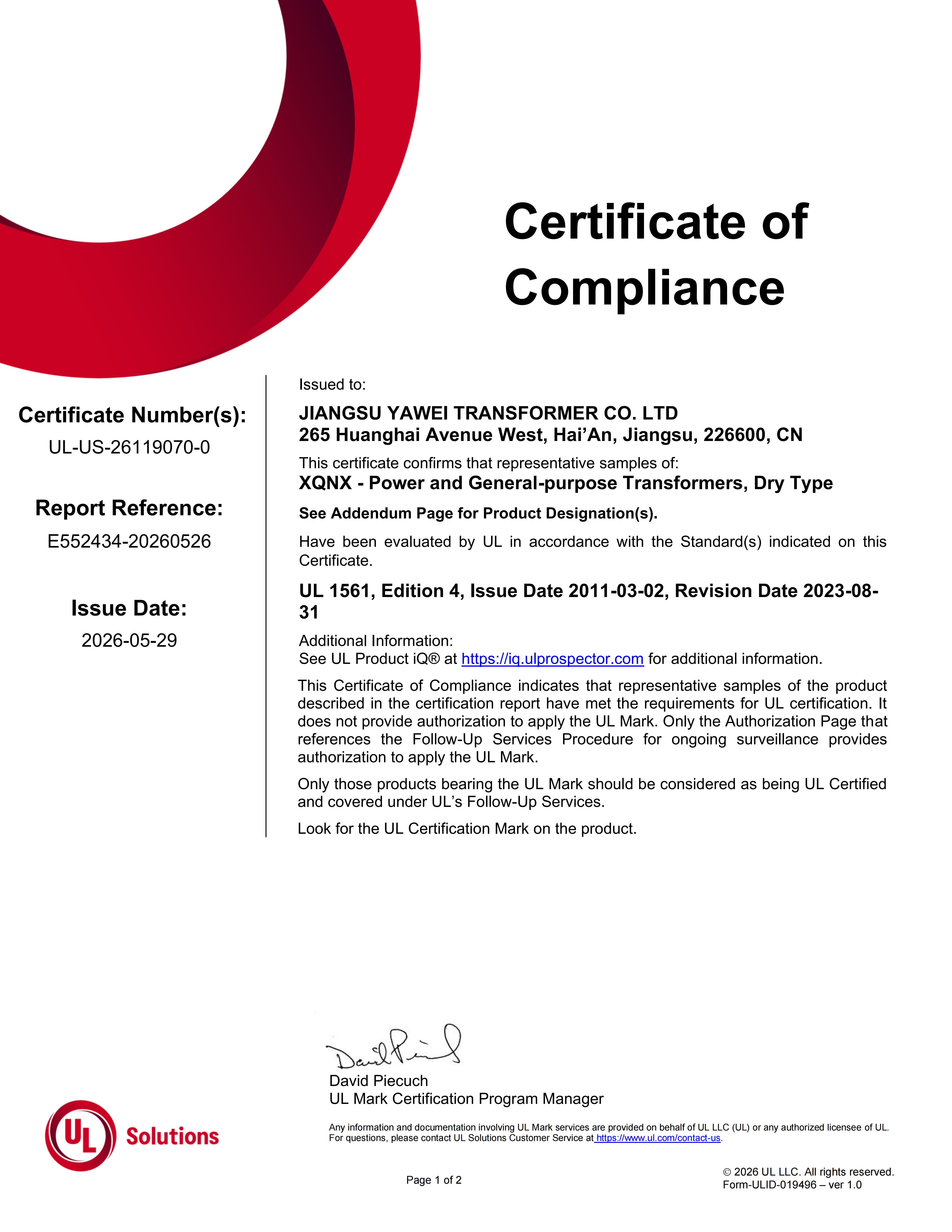
UL dry-type transformer compliance certificate (US and Canada), evaluated to UL 1561 Ed.4 and CSA C22.2 No.47 Ed.5.
Certification Is Part of the Fit, Not an Add-On
For North America, certification decides whether a correctly engineered transformer can actually be energised. Liquid-filled distribution transformers rated above 750 V are certified to local standards rather than IEC — UL requirements for the United States and CSA standards for Canada, supported by the IEEE C57.12 series.
The manufacturing base behind Apex holds UL Certificates of Compliance covering category XPLH7, Transformers, Distribution, Liquid-filled Type, Over 750 Volts, Certified for Canada, evaluated to CSA C2.1-06 (1st Ed.) and CSA C227.4 (3rd Ed.). Three certificate numbers appear in that set: UL-CA-2242874-0, UL-CA-2320692-0 and UL-CA-2328358-0. For indoor commercial dry-type work the corresponding evidence is a separate UL compliance certificate for open ventilated dry-type air-cooled general-purpose transformers evaluated to UL 1561 Ed.4 (US) and CSA C22.2 No.47 Ed.5 (Canada), issued under numbers UL-US-26119070-0 and UL-CA-2687596-0. Regionally delivered reference work includes a 15 MVA pad-mounted transformer project for an American transmission company, delivered and installed and compliant with ANSI/IEEE standards.
Certification also extends to the assembly around the transformer. A CSA Field Evaluation Report (certificate 80127142, CSA Group) covers a switchgear unit substation evaluated to NFPA 791-2018, NFPA 70-2017, IEEE C57.12.00, IEEE C57.12.90, UL 891 and IEEE C37.121-2012 — the pattern utilities apply when equipment arrives as an integrated unit rather than as separate components.
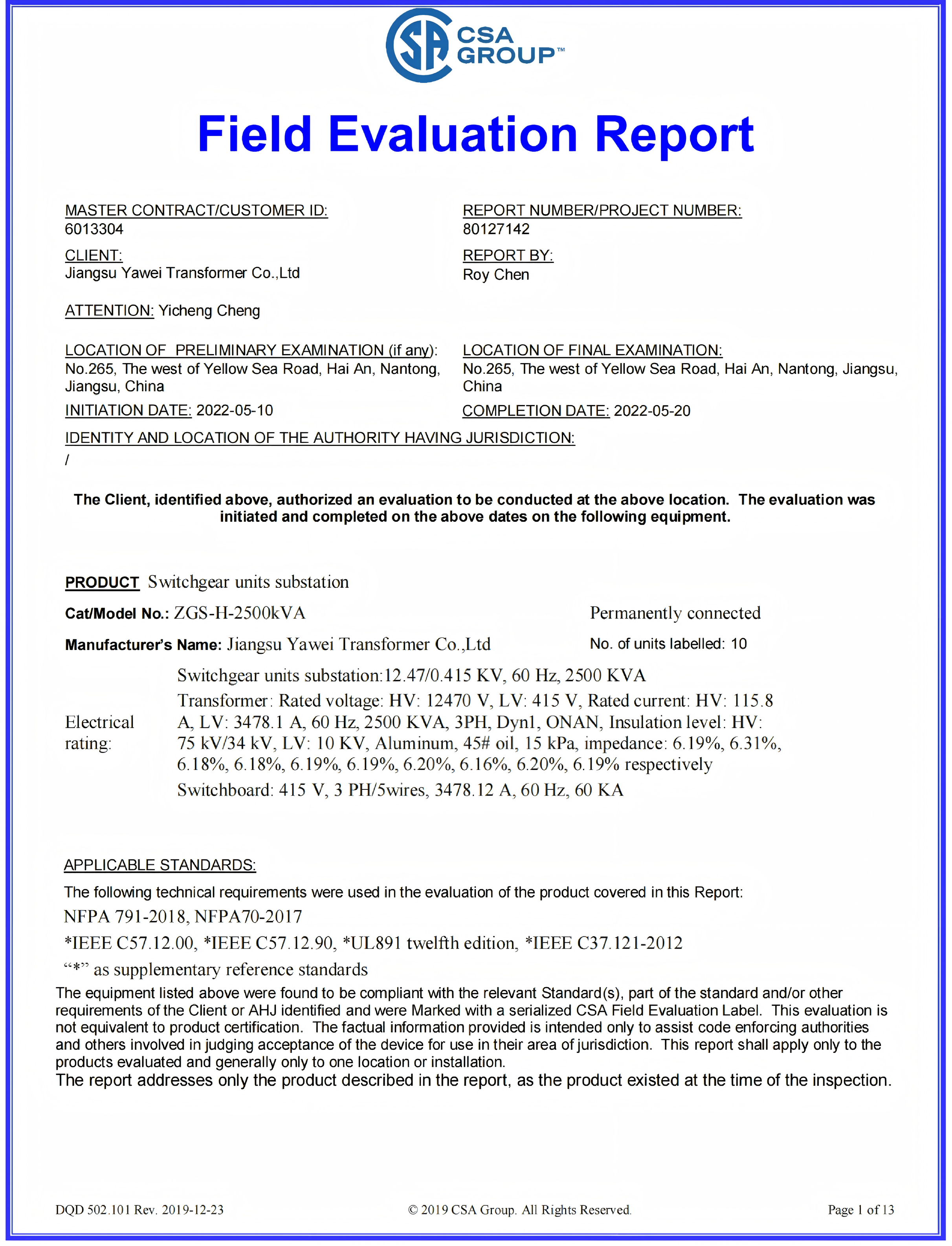
CSA field evaluation report for an integrated switchgear unit substation — the format North American utilities apply to assemblies.
What 'Custom' Actually Changes in a North American Distribution Order
Custom in this market rarely means an exotic one-off. It usually means the buyer's own specification replaces a catalogue default in a small number of places. Across the transformer product range, the documented customization options include voltage ratios, capacities, impedances, vector groups and tap ranges; special cooling methods; noise reduction; anti-corrosion classes C3, C4 and C5; high-altitude derating; seismic design; and special protection ratings such as IP54 and IP55. Certification design for KEMA, UL and CSA sits inside the same engineering scope, which matters because the certification path has to be decided before the design is frozen, not after.
For a North American distribution order specifically, the customization points that decide fit are usually:
- High-voltage class within the 4.16–34.5 kV band used for pad-mounted distribution, or a customized value where the local system falls outside it.
- Low-voltage configuration: 120/240 V centre-tapped for single-phase residential service, or 240 / 347 / 480 / 600 V for commercial and light-industrial service.
- 60 Hz operation, with 50/60 Hz capability specified across the distribution range.
- Radial or loop feed, and the internal load-break switch, fuse and surge-arrester arrangement that goes with it.
- Efficiency tier to DOE (2016) or CSA (2023), where the purchasing utility or jurisdiction specifies a loss level.
- Enclosure finish and corrosion class for coastal, high-humidity or high-pollution sites.
- The certification package for the destination country, including whether Canada is in scope.
Where a design has to be proven before it is committed, a minimum order quantity of one unit supports prototype and pilot orders. That is a practical point for utilities and developers who want to validate a configuration on a small number of units before scaling.
Test and Quality Evidence to Ask For
A certificate says a design was evaluated; a test report says the unit you are receiving was checked. Both belong in a North American distribution order.
- Routine tests to IEC 60076 or IEEE C57.12: winding resistance, turns ratio, load loss and impedance, no-load loss and current, insulation test, induced withstand and partial discharge measurement, lightning impulse, and oil test for liquid-filled units.
- Type and special tests where the configuration falls outside an existing evaluation, available on request.
- A pre-shipment Factory Acceptance Test (FAT), followed by a post-installation joint Site Acceptance Test (SAT) conducted with the customer.
- Third-party inspection through SGS, BV or KEMA where the utility or its engineer requires independent witnessing.
- Management system evidence: ISO 9001:2015 quality (certificate 04325Q30129R0M), ISO 14001:2015 environmental and ISO 45001:2018 occupational health and safety certificates covering the design and production scope of oil-immersed transformers up to 220 kV, dry-type transformers up to 35 kV and box-type substations.
- Independent type-test evidence for the wider product range, such as a TÜV Rheinland type test report (CN231PY4 001) for a three-phase outdoor oil-immersed power transformer to IEC 60076-1 / -2 / -3 / -10, and KEMA B.V. inspection reports including 109600301-26, tested to IEEE C57.12.00:2021 and IEEE C57.12.90:2021.
Fit by Scenario
| Site or load | Configuration that fits | Why |
|---|---|---|
| Residential subdivision with underground service | Single-phase pad-mounted, 15–250 kVA | Tamper-resistant ground-level enclosure, 120/240 V centre-tapped low-voltage winding, epoxy elbow HV bushings |
| Rural overhead feeder, scattered loads, agricultural supply | Single-phase pole-mounted, 5–167 kVA | Overhead mounting with lifting eyes and side brackets, sealed tank, single-phase duty on long feeders |
| Retail complex, municipal works, light-industrial park | Three-phase pad-mounted, 75–2,500 kVA | Three-phase supply with HV up to 34.5 kV, integral switching and protection, optional loop feed |
| Indoor commercial space or fire-sensitive location | Dry-type SCB12–SCB18 | No insulating oil, close-to-load installation, IP00 / IP20 / IP23 enclosure options |
| Grid loss-reduction or efficiency upgrade programme | Amorphous-alloy energy-saving transformer, S(B)H15(21–25)-M | No-load losses 60–80% lower than conventional silicon-steel transformers |
| Grid station needed quickly, or a remote site | Prefabricated cabin substation, 10/35 kV, 500–50,000 kVA | Factory pre-assembled and tested before shipment, integrating HV and LV switchgear, transformer, automation and environmental control |
Where the Custom Route Has Limits
Custom fit is not automatically the right answer, and the constraints are worth stating plainly.
- Lead time is longer than off-the-shelf. Standard distribution transformers are quoted at 30–60 days and customized models at 45–75 days; project-based delivery runs 3–6 months from contract to site acceptance. A distributor's stock unit can beat that, at the cost of being unable to match a specific voltage class, efficiency tier or enclosure requirement.
- A certificate is not transferable between configurations. A UL or CSA evaluation covers a listed model range. A unit ordered outside that range needs its own evaluation, so holding UL certification is never a complete answer on its own.
- Capacity and schedule are subject to technical evaluation. Documented capacities are stated subject to technical evaluation rather than guaranteed at enquiry stage, and one-off projects may carry design fees, refundable against bulk orders.
- Apex does not manufacture. Apex Power Systems is a trading and service company; it audits, selects and supervises manufacturing partners but is not the factory. Buyers who already know and trust a specific plant and can manage design review, testing, documentation and logistics themselves may find a direct purchase simpler — the trade-off is that they then carry the vendor-selection and verification work themselves.
- Packaged substations do not fit every case. A prefabricated cabin arrangement suits distribution and medium-power grid stations, urgent deployments and remote sites, but a very large capacity, a complex multi-bay transmission layout, or a local civil and utility standard requiring a bespoke arrangement is better served by a conventional build.
- Market data is not a specification. Published market-size estimates differ between research houses for the same year, so buying decisions should rest on network data — load, voltage class, environment and certification — rather than on growth figures.
Market Trends Shaping the Choice
Three trends feed directly into how North American distribution transformers are specified.
First, demand. The distribution transformer market is forecast to grow from USD 26.0 billion in 2026 to USD 47.7 billion by 2033 at a 9.1% CAGR, and global trade in electrical transformers above 500 kVA (HS 850434) reached USD 2.5 billion in 2024, up 12.7% year on year according to the Observatory of Economic Complexity. Capacity pressure of that kind tends to push buyers towards configurations that are certified for the destination market rather than towards novel designs.
Second, efficiency regulation. The U.S. Department of Energy's 2024 rule for distribution transformers (10 CFR Part 431) requires the market to transition towards amorphous electrical steel starting in 2029. Amorphous-alloy cores are already a documented option in this supply chain, with no-load losses 60–80% lower than conventional silicon-steel transformers — the S(B)H15(21–25)-M series is built on an iron-based amorphous alloy core for exactly this purpose. Buyers specifying units today with a service life extending beyond 2029 should treat core material as a forward-looking decision rather than a present-day price decision.
Third, documentation as a gate. As integrated assemblies become more common, field evaluation reports and witnessed type tests are increasingly requested before energisation rather than after. The CSA field evaluation route and KEMA-witnessed testing are both established practice in this supply chain, which shortens the gap between shipping and acceptance.
Future Outlook
For North American residential and commercial distribution, the practical direction is towards fewer assumptions at the specification stage and more evidence at the acceptance stage. Efficiency rules that phase in from 2029 will change the default core material for new distribution units, which in turn changes loss figures, dimensions and weight — and therefore transport and pad design. Certification and evaluation documents, already a procurement gate, are likely to be requested earlier, ideally before the design is frozen rather than after. The four configurations described here are unlikely to converge: pole-mounted, single-phase pad-mounted, three-phase pad-mounted and indoor dry-type exist because the sites they serve are physically different, and application fit will keep deciding the specification rather than the other way round.
Frequently Asked Questions
What is a pad-mounted transformer?
A pad-mounted transformer is a distribution transformer whose high-voltage and low-voltage switching, fusing and protection are enclosed together with the transformer in a tamper-resistant steel enclosure, installed at ground level on a concrete pad. It serves underground residential and commercial distribution, where the enclosure lets the unit stand in publicly accessible areas without a fenced substation. Compartmental and dead-front construction, radial or loop feed, and tamper-resistant design are the defining features. Units are certified to the UL and CSA standards for liquid-filled distribution transformers rated over 750 V, and are commonly supplied as single-phase or three-phase designs.
Which configuration fits North American residential and small commercial distribution?
Single-phase pad-mounted or pole-mounted units are commonly used in the range of roughly 25 kVA to 100 kVA for residential load, with 50 kVA and 75 kVA units at 7200/2400 V and a 120/240 V secondary typical in service. Three-phase pad-mounted units are used where commercial or light-industrial loads require three-phase supply. Whichever configuration is chosen, units rated over 750 V must hold a UL Certificate of Compliance for liquid-filled distribution transformers — and for Canada, certification to CSA C2.1-06 and CSA C227.4 — because a unit that is correct technically but not certified for the market will not be accepted.
Which standards and certifications apply to liquid-filled distribution transformers for North America?
Liquid-filled distribution transformers rated above 750 V for North America are certified to local standards rather than IEC: UL requirements for the United States and CSA standards for Canada, supported by the IEEE C57.12 series. The manufacturing base behind Apex holds UL Certificates of Compliance covering XPLH7 — Transformers, Distribution, Liquid-filled Type, Over 750 Volts, Certified for Canada — evaluated to CSA C2.1-06 (1st Ed.) and CSA C227.4 (3rd Ed.). Note that a UL Certificate of Compliance confirms the evaluation of representative samples; authority to apply the UL Mark is granted separately under the UL Follow-Up Services procedure, so that authorisation should be requested where the mark must appear on the shipped units.
What information is needed to specify a distribution transformer for a project?
Selection starts from the load and the network rather than from a product list. The required inputs are the capacity with a growth margin; the high-voltage and low-voltage levels and the connection symbol (vector group); the cooling class; whether an on-load or off-circuit tap changer is needed; the loss and efficiency limits including any local energy-efficiency regulation; the installation environment; and the standard and certification required in the destination market. Once those are fixed, the configuration follows: dry-type for indoor and fire-sensitive locations, oil-immersed distribution for outdoor distribution, pad-mounted for underground North American distribution, or a prefabricated substation where rapid deployment is needed.
How can a buyer check that a transformer certificate is valid for the unit being ordered?
Verify the certificate number directly with the issuing body rather than relying on a scanned copy, then check three things: the expiry date; whether the certificate holder's legal entity name matches the company that will sign the contract; and whether the model range listed actually covers the unit being purchased. It is also worth understanding the legal limits of each document — a UL Certificate of Compliance confirms that representative samples were evaluated but does not by itself authorise the UL Mark, and a CE declaration of conformity always remains the manufacturer's own responsibility.
What acceptance testing is normally carried out on a distribution transformer order?
A pre-shipment Factory Acceptance Test (FAT) is performed for transformer projects, and a post-installation joint Site Acceptance Test (SAT) is conducted with the customer. Routine tests follow IEC 60076 or IEEE C57.12 and include winding resistance, turns ratio, load loss and impedance, no-load loss and current, insulation test, induced withstand and partial discharge measurement, lightning impulse and oil test. Type and special tests are available on request, and third-party inspection can be arranged through SGS, BV or KEMA.
A downloadable product catalogue covering the transformer and substation range described in this article is available here: Apex Power Systems product catalogue (PDF).