
Custom Vacuum Forming: A Primer for Industrial Buyers
Custom vacuum forming is a thermoforming process in which a heated thermoplastic sheet is drawn against a single-sided mold by vacuum pressure to produce a shaped part — and the word custom is doing real work in that sentence. It signals that tooling, sheet grade, sheet thickness, trimming method and surface finish are defined for one specific project rather than selected from a catalogue. Buyers meet this process most often when a housing, cover or panel is too large, too low-volume or too expensive to justify injection molding tooling.
That situation is now common across industrial equipment, logistics automation, medical devices and new energy vehicles. Enclosure dimensions have grown, batch sizes have become uneven, and design revisions arrive faster than capital tooling budgets. Understanding what custom vacuum forming can and cannot deliver — before a drawing is released — is the difference between a clean programme and a costly re-tool.
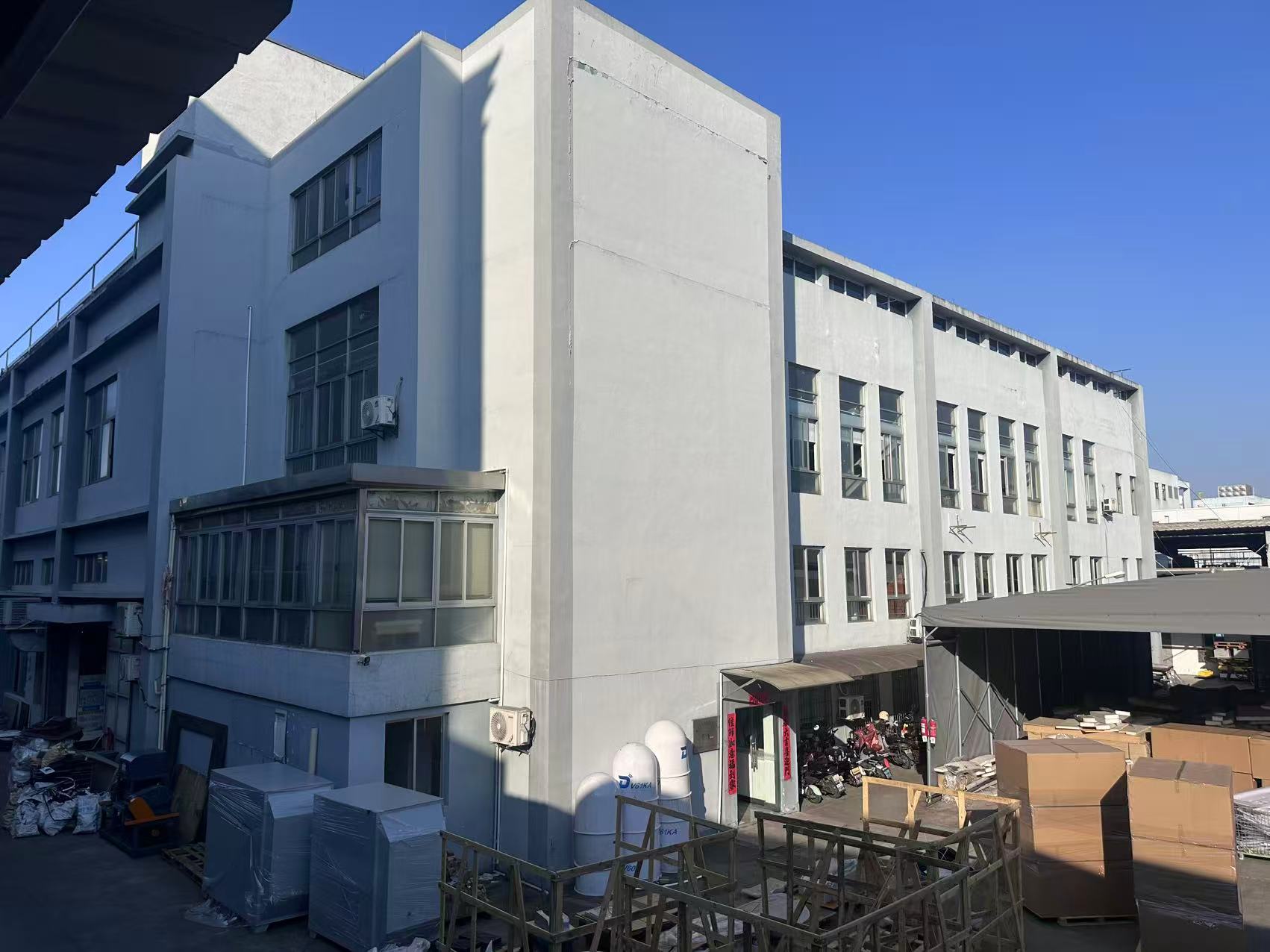
Heavy-gauge thermoforming workshop. Custom vacuum forming is a workshop discipline as much as a machine capability: heating control, mold handling and trimming determine the finished part.
Why formed plastic parts keep returning to equipment programmes
Three structural pressures push design teams toward custom plastic forming.
Tooling economics at moderate volume. Injection molding amortises hardened tooling across large production runs. When an equipment builder needs hundreds or a few thousand units — or needs a prototype before a volume decision is made — that amortisation logic breaks down. Vacuum forming tooling is comparatively inexpensive to produce, which is why it is frequently used for prototypes and medium-batch production before a programme commits to a higher-volume process.
Part size. Many industrial enclosures are simply large. A single formed shell can replace a welded sheet-metal assembly with its seams, fasteners and coating steps, and it can carry integrated returns, recesses and styling lines that sheet metal cannot produce economically.
Design velocity. Equipment platforms are revised more often than they used to be. A mold that can be modified or replaced without a capital appropriation request keeps a programme moving.
The trade-off is equally structural: vacuum forming controls one face of the part well, not both. Any buyer evaluating the process should hold that constraint in view from the first design review.
Heavy gauge and thin gauge are different supply chains
The thermoforming market is usually split by sheet thickness, and the split matters more than the terminology suggests.
Thin-gauge thermoforming generally refers to sheet below roughly 1.5 mm and is dominated by high-volume, short-cycle applications such as packaging and disposable components. Mordor Intelligence, in its 2026–2031 thermoformed plastics report, attributes 76.22% of combined heavy- and thin-gauge market revenue in 2025 to thin-gauge processes. In other words, the revenue weight of the industry sits with thin-gauge packaging work.
Heavy-gauge thermoforming is the smaller, more specialised segment — and it is a different operation. Sheet is thicker, heating cycles are longer, molds are heavier, trimming is a separate engineering step, and the consequences of uneven heating show up directly in wall thickness. Durable industrial housings, machine covers, vehicle interior trim and radomes belong here.
Hangzhou Baiheli New Materials Co., Ltd. is a heavy-gauge thermoforming processor established in 2011, based at No. 651 Fansheng Road, Guali Town, Xiaoshan District, Hangzhou, China. Its stated processing scope is heavy-gauge thermoforming, and its product data specifies sheet thickness of 2–10 mm and a maximum forming size of up to 3300 mm × 2000 mm. A buyer sourcing a 3 mm ABS cover and a buyer sourcing a 0.4 mm PET tray are not talking to the same kind of supplier, even though both use vacuum.
What “custom” actually covers
In a custom programme, five variables are fixed per project, and each one changes the part:
- Sheet material — the polymer determines impact behaviour, weathering, clarity and chemical resistance.
- Sheet thickness — drives stiffness, weight and the achievable draw.
- Mold — geometry, draft, radii and venting all originate here.
- Trimming — the formed shell is not a finished part until it is cut to the net outline.
- Secondary finishing — screen printing, masked painting, matte film or textured surfaces.
Baiheli’s product documentation describes its business focus as design, production and custom processing of thermoformed products, with one-stop service from design and mold making through to finished parts. That sequence is the normal shape of a custom project: drawing review, material selection, tooling, forming, trimming, finishing, sample verification.
Material selection shapes the part more than the machine does
Material choice is the decision buyers most often under-specify. The same mold in two polymers can behave like two different products.
| Material | Typical role in a custom programme | Practical consideration |
|---|---|---|
| ABS | General-purpose housings, machine covers, trim parts | Broad availability and predictable forming; a flame-retardant ABS grade is available as a project option |
| ASA | Outdoor-exposed covers and housings | Chosen where long-term surface appearance matters |
| PC | Impact-loaded covers, transparent or translucent parts | Available with matte film or in transparent/translucent form; exact optical requirements require project confirmation |
| PETG | Clarity plus formability | Often used where visibility and easier forming are both required |
| PMMA (acrylic) | Appearance-critical panels | Selected for surface finish rather than structural duty |
| PVC | Industrial covers and chemical-facing parts | Specification should follow the chemical environment |
| HDPE / PE | Impact-resistant, chemically exposed components | Impact-resistant PE is offered as a project option |
Baiheli’s stated material options for its vacuum thermoformed housing and automotive interior parts cover ABS, ASA, PC, PETG, PMMA, PVC and HDPE, with flame-retardant ABS, PE and other engineering or composite materials available depending on the project. The operating envelope stated for these parts is −20 °C to 70 °C, with an optional UV-resistant surface for outdoor exposure.
The consequence for buyers is straightforward: write the material into the specification with the environment attached to it. A housing that lives indoors on an AGV and a radome that lives outdoors for a decade may share a mold concept and share almost nothing else.
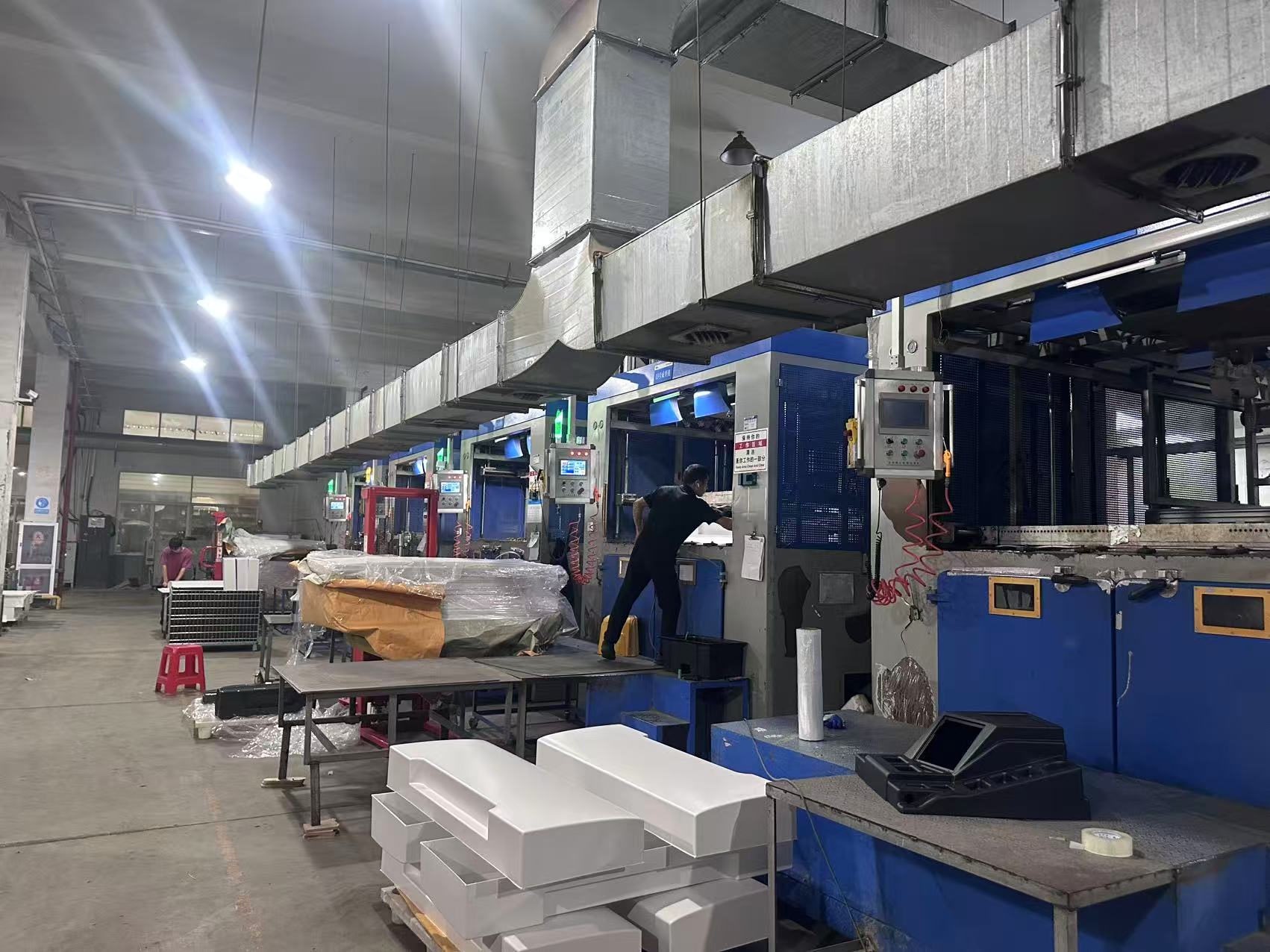
Thick-sheet vacuum thermoforming machine. In heavy-gauge work, heating uniformity across the sheet is the single largest influence on finished wall thickness.
Where the real technical risk sits
Custom vacuum forming has one dominant failure mode, and it is not the machine.
The main risk in thick-sheet vacuum forming is uneven wall thickness combined with dimensional deviation. Uneven heating of the plastic sheet can produce both, and over-stretching the sheet during forming produces the same result. Because the sheet is drawn rather than injected, material thins wherever the geometry stretches furthest — typically at deep draws and sharp transitions.
Baiheli’s technical material lists five mitigation measures: controlling heating, optimising the part structure, pre-reviewing drawings, testing samples before mass production, and verifying samples before mass production. Read as a procurement checklist, that translates into specific questions a buyer can ask any supplier:
- How is heating profiled across the sheet, and is the profile documented per part?
- Has the drawing been reviewed for draw ratio, radii and draft before tooling started?
- Will a physical sample be measured for wall thickness at defined points, not just visually approved?
- Who signs off on dimensional deviation, and against which drawing revision?
A supplier who answers these before quoting is showing process control. A supplier who answers them after the first rejection is showing something else.
What stated capability looks like in practice
Hangzhou Baiheli New Materials Co., Ltd. is an industrial thermoforming processor founded in 2011 and located in Hangzhou, China. Its company profile describes approximately 10,000 square metres of standard factory space, a workforce of about 90, annual output of roughly 550,000 units, a five-person R&D team providing one-on-one project support, and ISO 9001:2016 quality management system certification. The company states that 30–40% of its output is exported and that it serves customers in China and internationally.
Its product families map onto the applications named in its own documentation: thick-sheet thermoformed products, AGV housings, new energy vehicle parts, textile machine covers, intelligent machinery housings, medical equipment housings, amusement equipment thermoformed parts, marine antenna radomes and rooftop tents. Automotive interior parts are produced as door trim panels and bumper covers, and a vacuum thermoformed housing is offered under the model designation Drone Housing.
For a buyer in the research phase, the useful reading of this is not the product list itself but the pattern behind it: the same heavy-gauge forming capability is being applied across logistics automation, textile machinery, medical equipment, marine communication and vehicle interiors. Those are all applications where parts are large, volumes are moderate and the outer surface is visible.
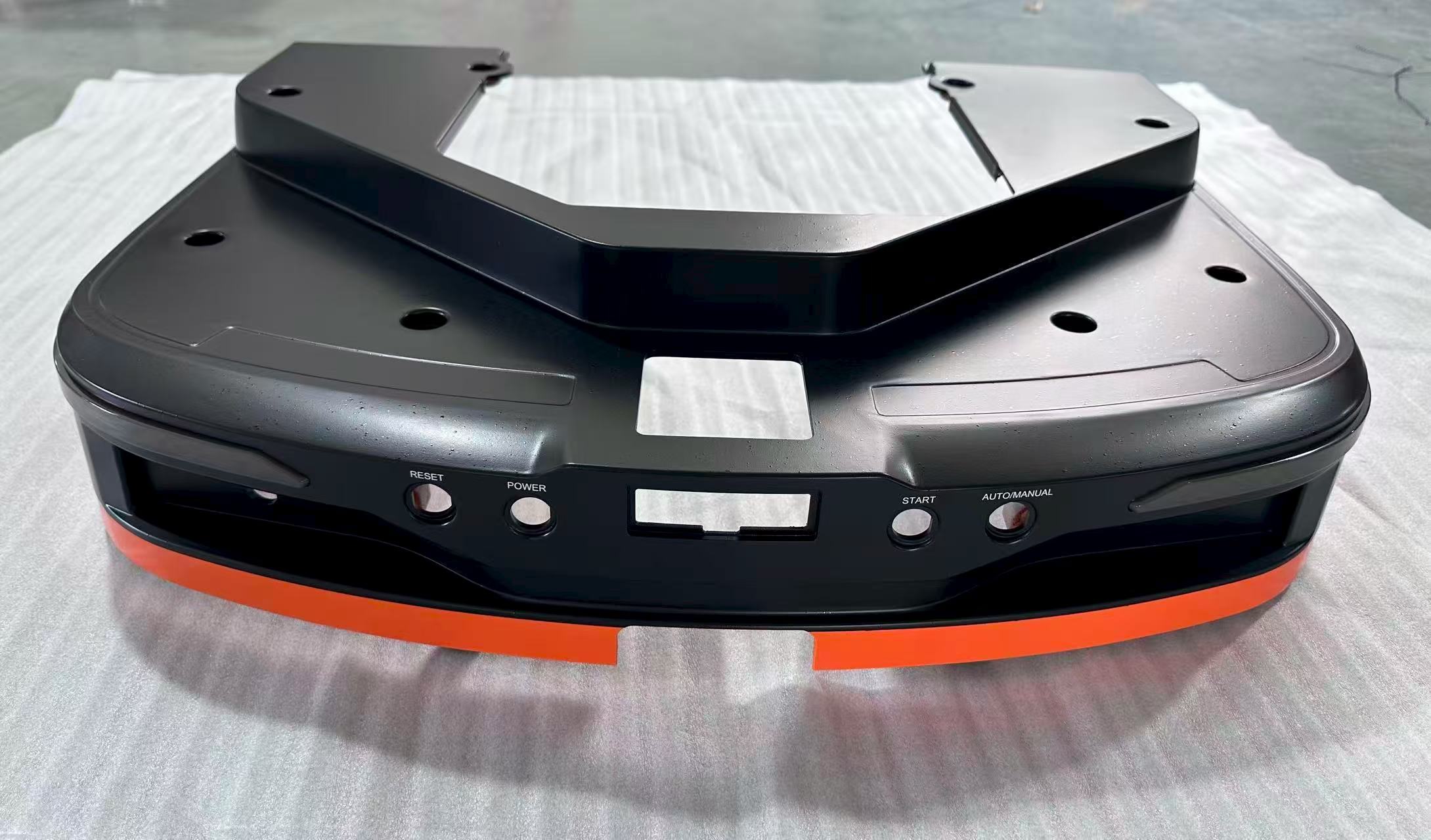
Custom vacuum formed AGV housing. Large-format equipment housings are among the most common reasons buyers first investigate thermoforming.
Applications and operating envelope
The applications documented for these parts span new energy vehicles and automotive parts, logistics and AGV systems, robotics and intelligent equipment, textile machinery, medical equipment, communication antennas, outdoor camping, amusement equipment and drones. In each case the part functions as a passive housing, cover, trim component or protective structure operating as part of the host equipment.
Working conditions are stated as indoor or outdoor environments between −20 °C and 70 °C, with optional UV-resistant surfacing for outdoor exposure. Project-specific options include flame-retardant ABS, PC matte film, transparent or translucent PC, impact-resistant PE, screen printing and masked painting.
One point deserves emphasis for buyers in regulated sectors: fire rating, UV-resistance rating, dimensional tolerances and assembly requirements are all described as project confirmation items rather than catalogue values. That is normal for custom thermoforming, and it means the specification conversation is part of the project, not an afterthought to it.
Market context
Grand View Research estimates the global plastic vacuum forming market at USD 4.8 billion in 2023, with a forecast of USD 7.2 billion by 2030. The same source attributes a 40.7% share of that market to Asia Pacific in 2023.
Two interpretations are reasonable and one is not. The reasonable ones: demand for formed plastic parts is growing rather than contracting, and Asia Pacific concentrates a large share of global capacity, which affects landed cost and lead-time planning for buyers elsewhere. The unreasonable one is to read a market-size figure as evidence about any individual supplier. A regional aggregate says nothing about whether a specific factory can hold wall thickness on a 3,300 mm part; only a capability review and a sample can.
Custom vacuum forming compared with injection molding and sheet metal
| Decision factor | Custom vacuum forming | Injection molding | Sheet metal fabrication |
|---|---|---|---|
| Tooling investment | Comparatively low; suited to prototypes and medium batches | High; requires volume to amortise | Low to moderate; no mold but more fixtures and forming steps |
| Economic volume band | Prototype through medium batch | High-volume production | Low to medium volume |
| Large-part capability | Strong; single large shells are routine | Press-size constrained | Strong, but assembled from multiple pieces |
| Dimensional precision | Moderate; one controlled surface | High, on all faces | High in-plane, less so on compound curves |
| Geometric freedom | Compound curves, returns, styling lines; draft required | Highest; undercuts and internal features possible | Limited to developable shapes without extra forming |
| Part count and assembly | Consolidates several parts into one shell | Consolidates at higher tooling cost | Multiple parts, fasteners and joining operations |
| Surface and finish | Colour through the sheet, textured or printed | Molded-in texture and colour | Requires coating or painting |
| Design change cost | Moderate; mold can be modified or remade | High; tooling rework is expensive | Low; cut programmes are revised easily |
The boundaries worth stating plainly
Custom vacuum forming is not a universal replacement, and any supplier presentation that implies otherwise should be treated with caution.
The process controls one face of the part. The mold side carries the detail; the vacuum side is a free surface whose thickness is a result of the draw rather than a designed value. Where both faces must be dimensionally accurate, or where internal ribs and bosses are needed, injection molding is usually the correct answer regardless of volume.
Dimensional tolerance is moderate by nature. Combined with the wall-thickness risk described earlier, this makes the process a poor fit for close-tolerance mechanical interfaces without secondary machining or assembly adjustment. Secondary trimming is a required step, not an optional one.
Part size is bounded by the tool, not by ambition. Baiheli’s published forming envelope is up to 3300 mm × 2000 mm with sheet from 2 mm to 10 mm. A requirement outside that envelope needs a different supplier, not a different argument.
And there is a certification boundary that buyers in automotive programmes should test early. IATF 16949:2016 is the mandatory quality management standard for automotive supply chain members. Baiheli’s stated certification is ISO 9001:2016; IATF 16949 is not listed among its stated certifications in the available company material. A tier-one automotive buyer whose qualification process requires IATF 16949 should confirm the current status directly rather than infer it from a product list that includes vehicle interior parts.
Future outlook
Three pressures look likely to keep custom heavy-gauge thermoforming in equipment programmes.
First, the applications driving demand are themselves expanding: warehouse automation and AGV fleets, medical equipment, new energy vehicle platforms and outdoor recreational products all rely on large, low-to-medium-volume housings. Second, design cycles are shortening, which favours processes with modest tooling exposure and inexpensive revision. Third, weight reduction continues to favour polymer housings over fabricated metal assemblies in mobile equipment.
On the supply side, regional concentration matters. With Asia Pacific holding a large share of global capacity, buyers outside the region will keep balancing landed cost against lead time and communication distance — which makes documentation quality, drawing review discipline and sample verification the practical differentiators rather than the headline forming size.
Environmental performance is entering the same conversation. Baiheli’s company profile references a planned 400 kV green photovoltaic generation project at its site, an indication that energy sourcing is becoming part of how thermoforming suppliers present themselves to customers with their own reporting obligations.
Frequently asked questions
What is thick-sheet vacuum thermoforming?
Thick-sheet vacuum thermoforming is a plastic forming process in which a solid plastic sheet is heated and shaped over a mold using vacuum pressure. It is used for large-size customised plastic housings.
What is the difference between heavy-gauge and thin-gauge thermoforming?
The distinction is sheet thickness. Thin-gauge thermoforming generally works with sheet below roughly 1.5 mm and is associated with high-volume, short-cycle production; heavy-gauge thermoforming uses thicker sheet and is associated with durable parts such as equipment housings, covers and vehicle components. Thin-gauge processes accounted for 76.22% of combined heavy- and thin-gauge market revenue in 2025, according to Mordor Intelligence.
Which materials can be processed?
Baiheli works with ABS, PC, PVC and HDPE as well as other engineering plastics, and also supports composite materials for customised housings. Product documentation lists ABS, ASA, PC, PETG, PMMA, PVC and HDPE, with flame-retardant ABS and PE available as project options.
How large can a custom vacuum formed part be?
Baiheli’s product data specifies a maximum forming size of up to 3300 mm × 2000 mm, with sheet thickness from 2 mm to 10 mm. Requirements beyond that envelope fall outside the published capability.
Which industries use custom thermoformed plastic parts?
Documented applications include new energy vehicles and automotive parts, logistics and AGV systems, robotics and intelligent equipment, textile machinery, medical equipment, communication antennas, outdoor camping, amusement equipment and drones. Typical parts are equipment housings, machine covers, interior trim, radomes, rooftop tent components and drone housings.
What causes uneven wall thickness in thick-sheet vacuum forming?
Uneven wall thickness and dimensional deviation are the main risks in thick-sheet vacuum forming. Uneven heating of the plastic sheet can trigger both, and over-stretching of the sheet during forming can produce the same result. Documented mitigation measures are controlling heating, optimising the part structure, pre-reviewing drawings, testing samples before mass production and verifying samples before mass production.
Under what conditions are these parts expected to operate?
The stated operating environment is indoor or outdoor service between −20 °C and 70 °C, with an optional UV-resistant surface for outdoor exposure. Fire rating, UV-resistance rating, dimensional tolerances and assembly requirements are project confirmation items rather than fixed catalogue values.
Have Questions or Need More Details?
Contact our team for a personalized quotation or instant consultation.
Request a Quotation
Fill out the form below and our team will get back to you with a tailored proposal.
WhatsApp Direct Chat
Prefer to chat in real-time? Message us on WhatsApp for instant assistance & quick answers.
- Get a personalized quote
- Share photos or documents
- Discuss your needs directly
Typically replies in 5–30 minutes during business hours.