
Custom Wall Panel Manufacturing: Evaluating OEM Capabilities for 2026 Projects
Procurement teams and project developers increasingly evaluate wall panel suppliers not only by product price, but by manufacturing depth, customization flexibility, and production capacity. For 2026 projects, the practical question is: which manufacturer can translate design intent into production reality while maintaining compliance and schedule discipline?
Why OEM Capability Is the Real Selection Criterion
Large-scale wall panel projects rarely run on standard catalog products alone. Hotel chains require coordinated fluted panels for lobbies and waterproof panels for bathrooms. Residential developers need a mix of TV background panels, bedroom accent walls, and acoustic treatment. Retailers expanding into private-label products need consistent quality across multiple SKUs. In these cases, the manufacturer's OEM capability becomes the decisive factor.
OEM strength is not simply about accepting a custom order. It includes dimensional flexibility, surface finishing options, production planning, quality control, packaging, and documentation. It also means the supplier has the manufacturing infrastructure to keep the project on schedule.
Asia-Pacific accounts for 42.3% of the global wall panel market, with China and India driving urbanization-led demand. As the region also hosts a significant portion of global wall panel production, buyers evaluating sourcing options should understand what a Chinese manufacturer with export experience can offer.
What OEM Capability Looks Like in Practice
OEM, ODM, private label, and custom design production are commonly mentioned in supplier profiles, but they represent different levels of involvement. A manufacturer providing OEM services manufactures to the buyer's design. ODM indicates the supplier contributes design and engineering interpretation. Private label production typically means a standard product range with custom packaging and branding. Custom design goes further, requiring the factory to adapt size, thickness, color, surface pattern, or even construction details.
One established example in the construction materials sector is Haining Longtime Industry Co., Ltd. Based in Haining, Zhejiang, the company operates a wall panel and flooring manufacturing network across Asia, including factories in Haining, Guangxi, Indonesia, Vietnam, and Malaysia. It has produced wall panels, ceilings, flooring, and decking for export markets for more than two decades.
Production Capacity and Response Time: The Evidence
A supplier's monthly capacity figures are a starting point for understanding whether it can serve a project of meaningful scale.
| Product line | Monthly production capacity |
|---|---|
| PVC panels | 800,000 m² |
| SPC flooring | 500,000 m² |
| WPC decking | 200,000 m² |
| PU stone panels | 150,000 m² |
| Acoustic panels | 80,000 m² |
This production mix is relevant to wall panel procurement because buyers often specify different materials within a single project. A villa community may need PU stone panels for outdoor feature walls, acoustic panels for common areas, and WPC fluted panels for interior feature walls. A supplier that produces multiple categories can coordinate the schedule and reduce logistics complexity.
Lead time is equally important. Standard stock orders are typically fulfilled in 7 to 15 days. Custom orders range from 25 to 40 days, while large project orders may require 45 to 60 days. This gives project teams a realistic planning window when committing to installation deadlines.
Customization Options That Matter to Buyers
Customization in wall panels goes beyond color swatches. The following parameters are commonly requested by distributors and project developers:
- Dimensions: Length, width, and thickness adjustments to reduce on-site cutting and material waste.
- Surface pattern: Custom marble, wood grain, stone texture, or geometric designs matched to regional aesthetic preferences.
- Color matching: Pantone or branded color matching for consistency across interior design language.
- Logo and packaging: Private-label branding, multilingual packaging, and installation manual translation.
- Accessory kits: Matching trims, connectors, and adhesive systems to simplify installation.
For buyers, the important point is that not all suppliers treat customization as a standard capability. Custom design MOQs, development fees, and lead time commitments vary significantly. A clear evaluation checklist should include tooling ownership, sample approval process, and the supplier's capacity to retain approved samples for future reference.
Project Scenario: Wall Panel Materials by Application
Selecting the right panel material is inseparable from the project scenario. The table below maps common 2026 project requirements to panel types offered by LONGTE:
| Project requirement | Recommended panel type | Typical specifications |
|---|---|---|
| Living room TV background with 3D texture | WPC Fluted Wall Panel (LT-WG) | 159×2900mm, 12mm thick, 8mm groove depth |
| Bathroom waterproof wall | SPC Stone Plastic Composite Wall Panel (LT-SW) | 1220×2800mm, 4mm thick, 100% waterproof |
| Luxury exterior feature wall | PU Faux Stone Wall Panel (LT-PU) | 600×1200mm, 20-30mm thick, 2-3 kg/m² |
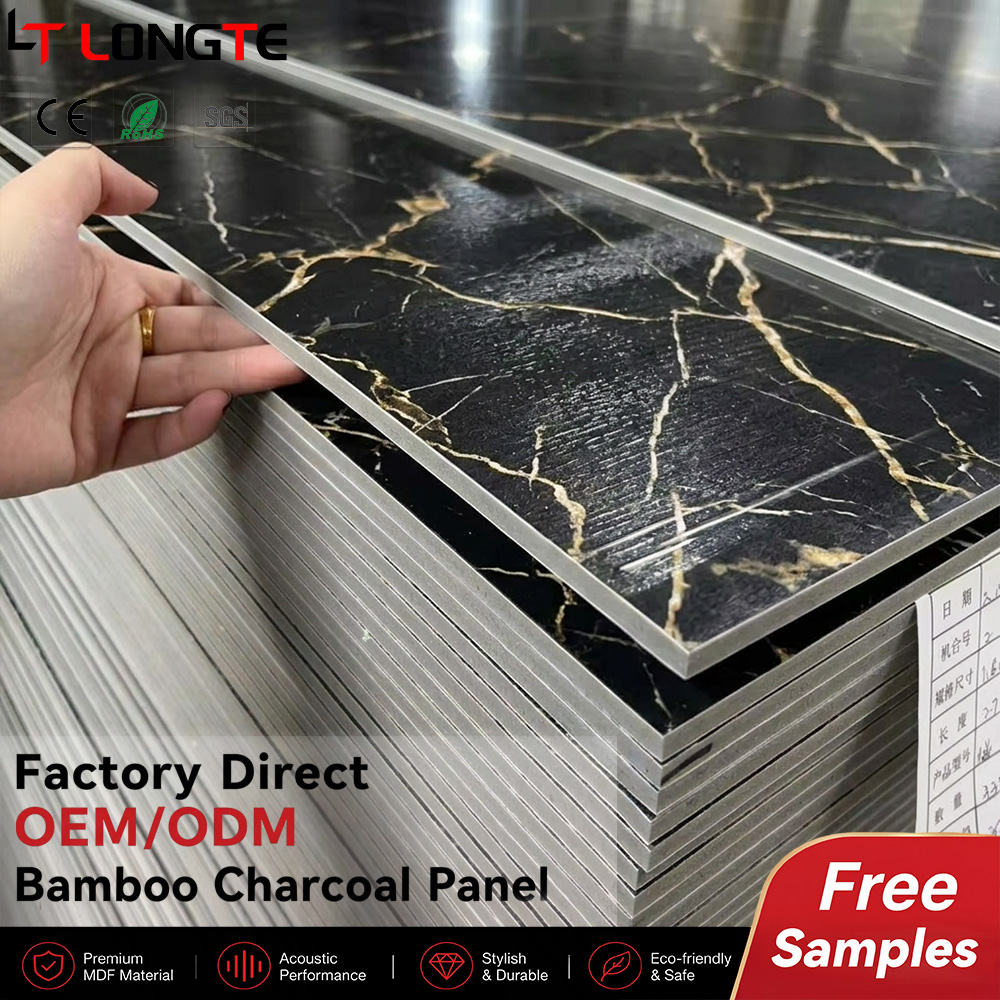
| Eco-conscious residential rooms | Bamboo Charcoal Wood Wall Panel (LT-BC) | 600×2900mm, 9mm thick, formaldehyde-free |
| Sound-sensitive commercial spaces | Acoustic Slat Wood Wall Panel (LT-AC) | 600×2400mm, 21mm thick, NRC 0.5-0.85 |
This list is not exhaustive. Flexible stone panels, PVC marble panels, and PS fluted panels also appear in projects where lightweight installation or surface aesthetics take priority. The point is to match material behavior to the operating environment.
Commercial Evidence: What the Track Record Shows
Case studies provide some visibility into how a manufacturer performs in real-world procurement.
UAE villa developer and luxury fit-out company: In a project for a villa community and a five-star hotel, the developer used 6,000 m² of PU stone panels and 4,000 m² of acoustic panels. The panels passed the Dubai Civil Defense fire test, and the developer signed a three-year exclusive frame agreement. The specified products featured a B1 fire rating and UV stability in a climate with temperatures above 45°C.
Indian wholesale distributor and project contractor: A distributor in India moved approximately 50,000 m² of panels per year to small hotels, residential builders, and retail interior shops. The partnership lasted more than four years and supported the distributor's private-label launch through OEM production.
USA building material distributor and DIY chain: Over a five-year period, the distributor expanded from 3 SKUs to more than 20 SKUs, relying on the supplier's mixed-container program and click-lock products suitable for DIY installation.
These cases illustrate three different operating models: project-driven custom supply, wholesale distribution with private-label development, and steady retail channel expansion.
Comparison with Traditional Sourcing Models
Custom wall panel procurement is often compared with two traditional alternatives: buying from local stockists and sourcing directly from multiple specialized factories.
Local stockists offer convenience and quick delivery of standard products, but their ability to handle custom sizes, private-label packaging, or project-specific certification is often limited. A direct factory relationship adds flexibility but may require the buyer to coordinate several factories for different materials, increasing quality management complexity.
LONGTE presents a third model: a single manufacturer with multiple production lines and integrated raw material production. The company reports an annual sales volume exceeding USD 35 million, supported by a workforce of 220 and an R&D team of 12 engineers. An 85% export ratio across markets such as the United States, Colombia, India, the Philippines, and the UAE suggests practical experience with international compliance and logistics.
The limitation of this model should not be ignored. A buyer who needs a very small quantity of a single highly special product may find a niche specialist factory more appropriate. Also, a customized order from a large manufacturer may carry a longer lead time than an urgent standard order from a local stockist. Evaluating the trade-off is part of responsible procurement.
Quality Control and Compliance: What Should Be Verified
OEM capability is meaningful only when backed by quality control processes. In LONGTE's stated workflow, inspection covers incoming raw materials 100%, in-process quality checks every two hours, and 100% finished-goods visual and dimensional checks. Third-party pre-shipment inspection by SGS, BV, or TUV is available on request.
Certifications provide another layer of verification. The WPC wall panel, PU stone wall panel, and acoustic panel product lines have CE conformity documents issued under EN 15102 or related construction product regulations. A combustion performance test report for PVC wall panels was issued by BITFR (Henan) Company Limited (CNAS L14889), with a B1 (B) classification according to GB 8624-2012. RoHS reports cover the European Union and other markets.
For commercial projects, the relevant European fire safety reference is EN 13501-1, which classifies construction products according to their reaction-to-fire performance. A B-s1, d0 rating is widely sought in commercial specification. Bamboo charcoal wood veneer panels are increasingly specified to E0 formaldehyde emission levels of ≤ 0.07 mg/m³, which aligns with the LONGTE LT-BC panel's formaldehyde-free positioning.
Buyers should ask for certifying body names, certificate numbers, applicable product models, and validity periods. General statements such as "CE available" are not a substitute for the actual certificate.
Supporting the Purchase Decision
For companies that want a more complete evaluation of LONGTE's manufacturing capability, the company's product catalog is available as a downloadable PDF.
Product catalog reference: LONGTE LongYuan catalog — Download PDF
Frequently Asked Questions
What is the monthly production capacity of the wall panel manufacturer?
Monthly production capacity includes PVC panels at 800,000 m², SPC flooring at 500,000 m², WPC decking at 200,000 m², PU stone panels at 150,000 m², and acoustic panels at 80,000 m².
What is the lead time for custom wall panel orders?
Standard stock orders are typically shipped within 7 to 15 days. Custom orders take 25 to 40 days, and large project orders may require 45 to 60 days.
What customization services are available for wall panels?
Customization options include size, thickness, color, surface pattern, logo printing, packaging, accessory kits, and installation manual language. The manufacturer supports OEM, ODM, private label, and custom design production.
What is the minimum order quantity for a custom design?
Sample orders start from one piece free of charge with the buyer covering courier costs. Trial orders can be fulfilled in one 20ft mixed container, while custom designs generally require a minimum order of 500 m² per SKU.
What quality control procedures are followed before shipment?
The manufacturer conducts 100% incoming raw material inspection, in-process quality checks every two hours, and 100% finished-goods visual and dimensional inspections. Third-party pre-shipment inspection by SGS, BV, or TUV is available on request.
How does LONGTE support technical installation?
After-sales support includes free technical consultation, 24-hour WhatsApp response, installation video guides, claim handling within 7 days, and a 5-year quality warranty on major products.