
Custom Wet Wipes: A Buyer's Fit-First Comparison Framework
A custom wet wipe fits a project when four inputs line up: sheet size, fabric or material, pack count, and target industry. Price per pack is an output of those four inputs, not the criterion for choosing between them.
Almost every custom wet wipes quotation arrives normalised to a single figure: price per pack. That figure is only meaningful after the pack itself has been defined, and in this category packs are not comparable by default. A ten-cloth garment wipe, a ten-sheet wet toilet paper, an eighty-piece kitchen wipe and a hundred-sheet bathroom format can all be quoted as simply "a pack", yet they serve different jobs, different shelf positions and different consumption cycles.
This article sets out a four-input fit framework, then applies it to two models in the sunfans range that look interchangeable on a specification sheet: YW01, a clothing wipe at 150×180 mm, and S02, a wet toilet paper format at 150×200 mm. Same broad category, similar dimensions, different intended fit. The point of the exercise is not to rank one above the other, but to show how specification logic should drive a buying decision before commercial terms enter the conversation.
What a Pack Actually Hides
In the documented sunfans range, pack descriptions span six different consumption formats. Clothing wipes model YW01 is described as 10 cloths for drying clothes. Wet toilet paper model S02 is described as Wet Toilet Paper – 10 sheets. Kitchen wipes model CF001 is described as Kitchen Wet Wipes – 80 pieces. Wet toilet paper model S01 is described as Wet Toilet Paper – 100 sheets. Baby wipes model Y02 is described as an English version of baby wipes, 01-100 pieces. Eye care wipes model YJ01 is described as Eye Glass Cleaning Cloths – 20 pieces.
Those are six pack architectures inside one supplier portfolio. Each carries a different expected number of uses, a different repurchase rhythm and a different shelf-life exposure once opened. When a buyer lines them up against a single price-per-pack column, the comparison mixes a bathroom consumable with a garment-care item and an optical accessory cleaner. The resulting shortlist is not a shortlist; it is an artefact of inconsistent units.
The commercial pressure to compare this way is understandable. The category keeps expanding. Fortune Business Insights places the global wet wipes market at approximately USD 32.09 billion in 2026, with a projected compound annual growth rate of 3.86% reaching USD 43.45 billion by 2034. Within that total, personal care wipes accounted for 72.81% of the global market in 2025 according to Mordor Intelligence. More segments mean more SKUs, and more SKUs mean more near-identical specification sheets landing in procurement inboxes.
That expansion is an opportunity for private label and OEM buyers, because differentiated segments usually carry better margin than commodity formats. It is also a risk, because fit failures show up late: on the shelf, in the dispensing system, or in a customer complaint about a wipe that falls apart too early or holds together too well for its intended disposal route.
The Fit Framework: Four Inputs, Then Price
The framework is deliberately short. Before any quote is compared, each candidate line item must be normalised against four inputs: target industry and channel, fabric or material, sheet size, and pack count. Only when those four are fixed does price per pack become a comparable number.
| Input | What it decides | Documented values across the range |
|---|---|---|
| Target industry and channel | Compliance path, labelling expectations, durability required, merchandising format | Baby and maternity products; infant care products; personal care products; home cleaning including kitchen cleaning; pet grooming and pet supplies; general merchandise; large shopping malls; manufacturing of disposable sanitary products |
| Fabric or material | Wet strength, disintegration behaviour, surface feel, whether the sheet is intended to break down or hold together | Water-jet non-woven fabric; fabric that can be disintegrated into wood pulp cloth; biodegradable wood pulp non-woven fabric; bamboo fibre; entirely adhesive; water-resistant paper |
| Sheet size | Coverage per stroke, pack footprint, dispensing geometry, perceived value per sheet | 100×150 mm; 130×200 mm; 140×180 mm; 150×180 mm; 150×200 mm; 180×200 mm; 200×200 mm |
| Pack count and format | Consumption cycle, repurchase frequency, price architecture, exposure after opening | 10 cloths; 10 sheets; 20 pieces; 80 pieces; 100 pieces; 100 sheets |
Working order of the four inputs
Sequence matters. Industrial buyers who start with size usually end up re-specifying later, because size is the most visible variable and the least decisive one.
- Target industry first. The industry determines what the wipe is allowed to claim, how it must be labelled and how durable it needs to be in normal use. A wipe intended for general merchandise and large retail chains is judged differently from one intended for personal care or infant care.
- Material second. Material answers the physical question: should the sheet remain intact through the wipe, or should it break apart in water? This single decision separates product families far more sharply than dimensions do.
- Size third. Once the material is fixed, size becomes an ergonomics and pack-economics question rather than a functional one.
- Pack count fourth. Count sets the consumption cycle and therefore the price architecture of the finished SKU.
- Price last. Price is the sum of decisions already made. Comparing it earlier simply reverses the logic.
A practical screening test. Before comparing any set of quotes, rewrite every line in the same four-field format: industry / material / size / count. If a quote cannot be completed in all four fields, it is not yet a comparable quote. In the sunfans portfolio, for example, YW01 reads as home cleaning and general merchandise / water-jet non-woven fabric / 150×180 mm / 10 cloths, while S02 reads as home cleaning and general merchandise / fabric that can be disintegrated into wood pulp cloth / 150×200 mm / 10 sheets.
Applying the Framework: YW01 Versus S02
YW01 is a clothing wipe built on water-jet non-woven fabric at 150×180 mm, supplied as 10 cloths intended for drying clothes, and positioned for the home cleaning industry, large retail chains and the general merchandise industry. S02 is a wet toilet paper built on a fabric that can be disintegrated into wood pulp cloth at 150×200 mm, supplied as 10 sheets, and positioned for the same three industry categories.
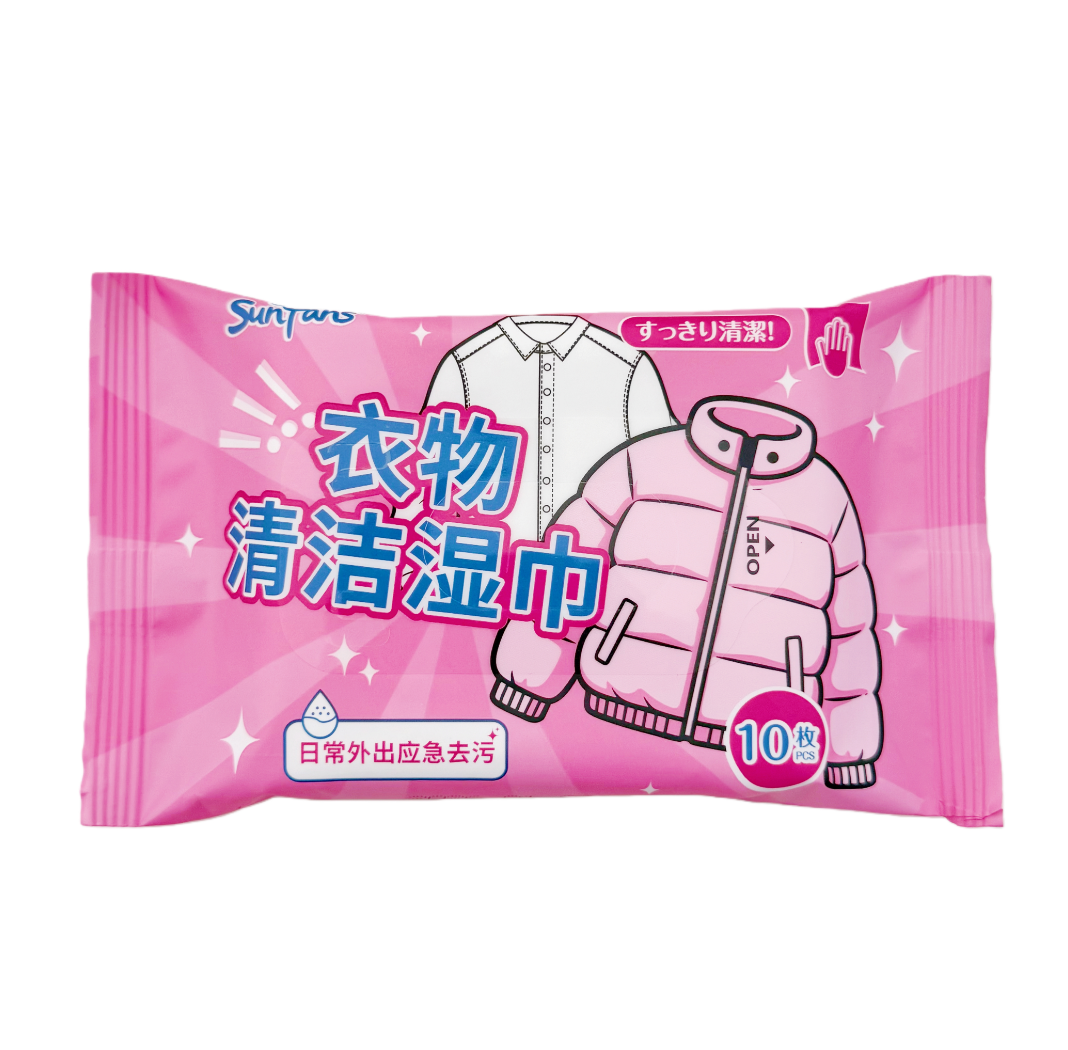
Clothing wipes model YW01: 150×180 mm, water-jet non-woven fabric, 10 cloths per pack, positioned for home cleaning, large retail chains and general merchandise.
| Attribute | YW01 | S02 | What the difference changes for a buyer |
|---|---|---|---|
| Product name | Clothing wipes | Wet toilet paper | Defines the customer job and the shelf adjacency the SKU competes in |
| Model | YW01 | S02 | Model codes anchor reorders and specification change control |
| Sheet size | 150×180 mm | 150×200 mm | A 20 mm difference in one dimension changes coverage per stroke and pack width |
| Material | Water-jet non-woven fabric | Can be disintegrated into wood pulp cloth | The decisive input: one substrate is built to stay intact, the other to break apart |
| Pack description | 10 cloths for drying clothes | Wet Toilet Paper – 10 sheets | Equal count, so the comparison is not distorted by pack volume |
| Applicable industry | Home cleaning; large retail chains; general merchandise | Home cleaning; large retail chains; general merchandise | Compliance and channel expectations are identical, which isolates material and size as the real decision variables |
Read against the framework, the pair produces a clean conclusion. Industry is identical, so it does not separate them. Pack count is identical at ten units, so it does not separate them either. Size differs modestly, favouring S02 for broader coverage per stroke and YW01 for tighter pack geometry. Material separates them decisively: water-jet non-woven fabric is a durable wipe-down substrate, while a fabric that can be disintegrated into wood pulp cloth is specified for a use case where breakdown in water is the point.
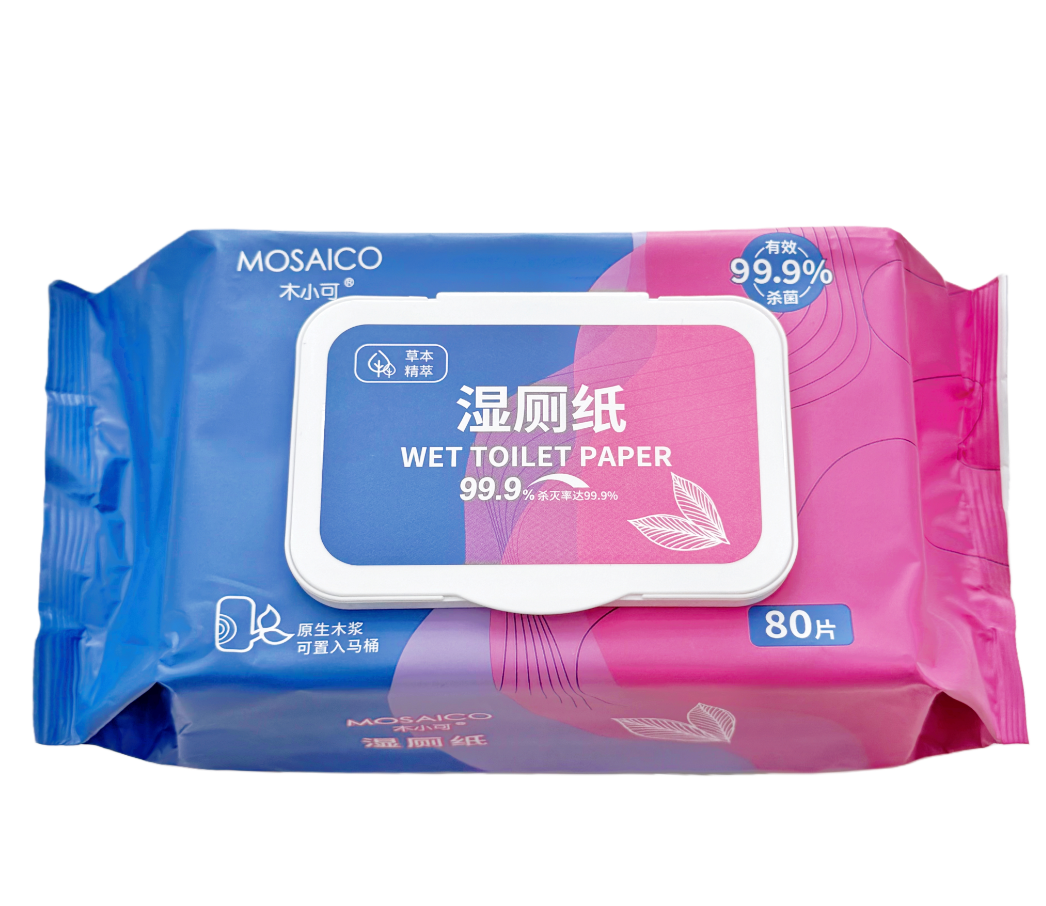
Wet toilet paper model S02: 150×200 mm, fabric that can be disintegrated into wood pulp cloth, 10 sheets per pack, positioned for home cleaning, large retail chains and general merchandise.
That conclusion is not a ranking. It is a fit statement: YW01 belongs in a garment-care or wipe-down context, and S02 belongs in a bathroom context where the substrate is expected to break up. A buyer who received both quotes as price per pack would have no way to see that distinction, because the distinguishing variable, material behaviour, does not appear anywhere in a price column.
The same logic explains why pack count must be normalised before any price comparison. S01, a second wet toilet paper in the same portfolio, is documented at 130×200 mm with biodegradable wood pulp non-woven fabric and 100 sheets per pack, positioned for the pet products industry, large department stores and the personal care products industry. Comparing S02 to S01 on price per pack would compare a ten-sheet bathroom format with a hundred-sheet format intended for a partly different channel set. The framework prevents that error by forcing count onto the table before price.
Reading Each Input in More Detail
Size and sheet geometry
Sheet size governs coverage per stroke, the physical footprint of the pack and the way the sheet sits in the hand or in a dispenser. Across the documented range, sizes run from 100×150 mm for eye care wipes up to 200×200 mm for kitchen wipes and one pet wipe format. In practice, larger sheets reduce the number of sheets consumed per task but increase pack dimensions and material consumption per sheet. Smaller sheets suit precision tasks such as cleaning optical surfaces, where the working area is narrow and the wipe should not wrap around the object.
A 20 mm difference, the gap between YW01 at 150×180 mm and S02 at 150×200 mm, is modest but not cosmetic. It changes how much surface is covered in a single pass and how the pack sits on a shelf next to competing formats.
Material behaviour
Material is the input that determines what the wipe can physically do. Water-jet non-woven fabric, the substrate used in YW01, belongs to the spunlace family, where a fibre web is bonded by high-pressure water jets rather than chemical binders. The result is a fabric that holds together under wiping and is suited to cleaning and drying tasks. Kitchen wipes model CF001 also use water-jet non-woven fabric, at 200×200 mm with 80 pieces per pack.
S02 uses a different logic. Its fabric can be disintegrated into wood pulp cloth, which is a material property statement rather than a certification. Wood-pulp-based substrates are chosen when the wipe is expected to break up in water after use. Other models in the range show how far material selection can be pushed: pet wipes C03 and C04 use bamboo fibre, C02 and baby wipes Y02 use entirely adhesive material, C05 and S01 use biodegradable wood pulp non-woven fabric, and eye care wipes YJ01 use water-resistant paper.
For a buyer, the material field answers one question before any other: should the sheet stay intact while it works, or should it come apart afterwards? Everything downstream, including size and count, follows from that answer.
Pack count and consumption cycle
Count sets the consumption cycle and therefore the repurchase rhythm a retail buyer must plan for. A 10-unit pack is a trial or travel-oriented format. An 80-piece or 100-sheet pack is a household refill format. A 20-piece pack for optical cleaning sits between the two. Getting this wrong produces either excessive unit cost at shelf level, because small packs carry disproportionate packaging cost per wipe, or an entry price point that is too high to attract first-time buyers.
Industry, channel and storage
Industry and channel determine compliance expectations and merchandising standards. Documented applications for this portfolio include the manufacturing of disposable sanitary products, baby and maternity care, infant care, personal care, home cleaning including kitchen cleaning, pet grooming and pet supplies, general merchandise, and large shopping mall programmes. Projects in this portfolio are described as OEM branding and contract manufacturing projects.
One input applies regardless of industry: storage. These products must be stored in a cool, dry, shaded area at room temperature, away from high temperatures, heat sources and areas prone to moisture accumulation. This is a warehouse and distribution planning requirement, and it belongs in the buyer checklist alongside size and material.
How a Fit-First Programme Is Supported in Practice
sunfans is a custom wet wipes brand producing baby wipes, pet wipes, wet toilet paper, functional wipes, floor dry wipes and floor wet wipes, with a documented export orientation of roughly 70% and principal markets including Japan, Australia, Canada, the United States and Singapore. The manufacturing base behind the brand, Dalian Weijie Biotechnology Co., Ltd., was established in 2013, operates a 6,000 m² facility with 50 employees and a 10-person research and development team, and is located in Dalian, Liaoning Province, China.
For buyers applying the four-input framework, the relevant capability set is the one that lets specifications be changed deliberately rather than accidentally. Documented customisation covers packaging, logo, material, size, aroma and number of pieces. Production mode is described as OEM, ODM and customized services with an own in-house research and development team. Monthly capacity is documented at 3 million packages, and quoted lead time is 30 days.
Quality control is documented across four layers: support from third-party authoritative laboratories, internal quality control, material inspection, process inspection and finished product inspection. Supporting equipment for these application categories includes automatic packaging machines, automatic filling machines, EDI ultra-pure water equipment, UV sterilization systems, an in-house laboratory, a Class 100,000 cleanroom and pH meters. Certain product models are manufactured in the Class 100,000 cleanroom.
Continuity evidence is often the weakest part of an OEM pitch, so it is worth reviewing what is documented. A pet supplies seller on Amazon.com is recorded at 8 forty-foot containers per month over 6 years. A leading Amazon.com seller of baby products is recorded at 8 forty-foot containers per month over 4 years. A Japan-based convenience retail chain is recorded at 15 forty-foot containers per month over 3 years, and an e-commerce and retail customer at 15 forty-foot containers per month over 3 years. A baby and maternity brand owner is recorded at 20 forty-foot containers per month over 5 years. Longer relationships include a 150-year-old conglomerate at 10 forty-foot containers per month over 10 years and a major household and personal care conglomerate at 10 forty-foot containers per month over 8 years. Across these accounts, the reported pattern is stable quality over the long term with ongoing new product proposals.
Export documentation support is documented as assistance with verifying packing lists and customs declaration documents for export orders. For a buyer whose licence to operate depends on correct paperwork, this is a fit input in its own right, not an afterthought.
Matching Models to Scenarios
The four-input framework becomes practical when it is applied to a scenario rather than a product. The table below maps documented models to the application contexts they are specified for.
| Scenario | Documented model | Size | Material | Pack |
|---|---|---|---|---|
| Garment care and wipe-down | Clothing wipes YW01 | 150×180 mm | Water-jet non-woven fabric | 10 cloths |
| Bathroom use with breakdown-in-water expectation | Wet toilet paper S02 | 150×200 mm | Can be disintegrated into wood pulp cloth | 10 sheets |
| Bulk bathroom format for department and personal care channels | Wet toilet paper S01 | 130×200 mm | Biodegradable wood pulp non-woven fabric | 100 sheets |
| Kitchen surface cleaning | Kitchen wipes CF001 | 200×200 mm | Water-jet non-woven fabric | 80 pieces |
| Infant care and baby hygiene | Baby wipes Y02 | 150×200 mm | Entirely adhesive | 100 pieces |
| Pet grooming and pet supplies | Pet wipes C03 / C04 | 150×200 mm / 140×180 mm | Bamboo fibre | 100 pieces / 100 sheets |
| Glove-format pet cleaning | Pet wipes C05 | 180×200 mm | Biodegradable wood pulp non-woven fabric | 10 pieces |
| Optical surface cleaning | Eye care wipes YJ01 | 100×150 mm | Water-resistant paper | 20 pieces |
Across these scenarios, the operating mode is consistent: continuous surface wiping with single-sheet one-time consumption. The documented function is to clean and provide antibacterial action. Special requirements applying to these application categories include a gentle, plant-based formula free of alcohol, with fabrics that are gentle on the skin and free of irritating additives.
Two observations follow. First, formula and fabric softness requirements are scenario-level inputs, not brand-level extras; a buyer specifying for infant care or personal care should treat them as mandatory fields. Second, the same physical plant can serve all of these scenarios, which is why a supplier capable of running the full four-input framework across a portfolio is easier to work with than one that can only quote a single format. All ten documented models in this range are listed as applicable to OEM branding and contract manufacturing projects.
Market Signals That Are Changing the Inputs
Four documented market trends are shifting how the four inputs get weighted.
- Flushable and disintegrable formats are growing. Global Market Insights values the flushable wipes market at USD 2.3 billion in 2025, projected to reach USD 4.2 billion by 2035 at a 6% compound annual growth rate. Kimberly-Clark held over 17.2% of that segment in 2025. As this segment expands, the material input, specifically whether the substrate breaks apart, becomes the first field buyers screen on.
- Biodegradable positioning is moving from niche to expectation. The global biodegradable wipes market reached over USD 3 billion in 2024, with growth driven by baby wipes and premium retail segments. Separately, the plant-based flushable wipes market was valued at USD 2.9 billion in 2024 with a projected 5.3% compound annual growth rate. Material language on the specification sheet now carries commercial weight, not just technical weight.
- Pet care is expanding quickly. DataHorizzon Research values the pet wipes market at USD 1.58 billion in 2024 with a 5.6% compound annual growth rate to USD 2.64 billion by 2033, with North America holding approximately 50% share in 2024 at USD 0.79 billion. Format diversity in this segment, from flat wipes to glove formats, is exactly the pattern the four-input framework is designed to handle.
- Regulatory requirements are tightening. In the United States, the FDA facility registration deadline for cosmetic wipes manufacturers took effect on 1 July 2026 under the updated framework. In the European Union, wet wipes must comply with EN standards, including REACH for chemicals and BPR for biocidal claims. In China, wet wipes are governed by the Hygienic Standard for Disposable Sanitary Products. ISO 9001 for quality management and ISO 22716 for good manufacturing practice in cosmetics are widely treated as baseline requirements for wet wipes OEM manufacturing.
On regional demand, Japan accounts for nearly 27% of the Asia-Pacific wet wipes market with a strong focus on hygiene and premium quality personal care, while the U.S. market accounted for 34% of global share in 2024 and Asia Pacific is the fastest growing region, driven by urbanisation and rising hygiene standards. Note that published market sizing for this category varies materially between research houses depending on base year and category definition, so these figures should be read as directional signals rather than exact values.
Where the Framework Stops
Conventional shortlisting compares unit price per pack across a long list, then eliminates on cost. That method has one advantage, speed, and two structural limits. It hides pack-count differences, so a ten-sheet format competes directly with a hundred-sheet format. It also hides material basis, so a substrate designed to disintegrate competes directly with one designed to hold together. Both errors are invisible in a price column.
The four-input framework corrects those errors, but it has its own boundaries, and buyers should be explicit about them.
- It does not replace sampling. A material description states what the substrate is; it does not predict how that substrate behaves in your specific dispensing system, at your specified wetness level, or after your intended shelf-life window. Specification and validation are separate steps.
- It does not settle commercial terms. Minimum order quantity, payment structure and delivered cost are project-specific commercial variables. The documented lead time of 30 days is a capacity planning input, not a guarantee that applies identically to every custom configuration.
- Size is fixed per model until a project makes it variable. Size is one of the documented customisation parameters, but any change converts a catalogue model into a custom SKU that requires its own validation cycle. Buyers should treat model dimensions as validated defaults, not as free variables.
- Disintegration is a material property, not a compliance verdict. The S02 substrate is documented as able to disintegrate into wood pulp cloth. That statement describes material behaviour. It is not a certification of flushability performance in any specific plumbing, municipal or regulatory context, and no compostability certification is documented for YW01 or S02 in the available product data.
The honest summary is that the framework improves the quality of a shortlist and prevents category errors. It does not remove the need for samples, and it does not replace local compliance review in the destination market.
Outlook
Two directions look likely to shape custom wet wipes procurement over the next several years. The first is substrate-driven segmentation: as disintegrable and biodegradable formats take a larger share, material becomes the first field on every specification sheet and the first question in every sourcing meeting. The second is regulatory normalisation: with facility registration requirements now active in the United States and EN, REACH and BPR obligations established in Europe, compliance documentation is becoming a screening filter applied before commercial discussion rather than a final-stage formality.
Together these shifts push buyers away from price-per-pack comparison and toward normalised, job-defined comparison. A quote that cannot state industry, material, size and count in a single line is unlikely to survive that shift. A quote that can be read against the four inputs, and then validated with a sample, gives a buying team something a price column never can: a defensible reason for the decision.
FAQ
How should a buyer choose between a 150×180 mm wipe and a 150×200 mm wipe?
Start with the job rather than the dimension. In the documented sunfans range, YW01 at 150×180 mm is a clothing wipe built on water-jet non-woven fabric and supplied as 10 cloths for drying clothes, while S02 at 150×200 mm is a wet toilet paper built on a fabric that can be disintegrated into wood pulp cloth and supplied as 10 sheets. Both are positioned for the home cleaning industry, large retail chains and the general merchandise industry. The 20 mm difference affects coverage per stroke and pack geometry; the material difference determines whether the sheet stays intact or breaks apart.
Which material options are documented across the custom wet wipes range?
Documented materials include water-jet non-woven fabric, used in clothing wipes YW01 and kitchen wipes CF001; a fabric that can be disintegrated into wood pulp cloth, used in wet toilet paper S02; biodegradable wood pulp non-woven fabric, used in wet toilet paper S01 and pet wipes C05; bamboo fibre, used in pet wipes C03 and C04; entirely adhesive material, used in pet wipes C02 and baby wipes Y02; and water-resistant paper, used in eye care wipes YJ01. Material selection determines wet strength, disintegration behaviour and surface feel before size or pack count is decided.
Does pack count change which industry a custom wet wipe suits?
Yes. Pack count sets the consumption cycle and the repurchase rhythm. Documented formats range from 10 cloths for clothing wipes YW01 and 10 sheets for wet toilet paper S02, through 20 pieces for eye care wipes YJ01 and 80 pieces for kitchen wipes CF001, to 100 pieces for baby wipes Y02 and 100 sheets for wet toilet paper S01. Large-count packs are typically positioned as household or refill formats, while small-count packs function as trial, travel or targeted-use formats.
Which industries are these custom wet wipes applied in?
Documented applications include the manufacturing of disposable sanitary products, baby and maternity care, infant care, personal care, home cleaning including kitchen cleaning, pet grooming and pet supplies, general merchandise, and large shopping mall programmes. In these scenarios the products function to clean surfaces and provide antibacterial action, operating in continuous surface wiping mode with single-sheet one-time consumption, and they are suitable for OEM branding and contract manufacturing projects.
What special formulation requirements apply to skin-contact scenarios?
For the application categories covering skin-contact use, the documented requirements include a gentle, plant-based formula free of alcohol, fabrics that are gentle on the skin, and no irritating additives. These are stated as application-level requirements rather than optional features, and they apply alongside the standard production environment that includes EDI ultra-pure water equipment, UV sterilization systems, an in-house laboratory, a Class 100,000 cleanroom and pH meters.
What storage and lead time conditions should a buyer plan for?
These products must be stored in a cool, dry, shaded area at room temperature, away from high temperatures, heat sources and areas prone to moisture accumulation. On the supply side, documented customisation covers packaging, logo, material, size, aroma and number of pieces, monthly capacity is 3 million packages, and quoted lead time is 30 days. Export order support includes assistance with verifying packing lists and customs declaration documents.
Reference Material
Additional product and capability detail is available in the company profile brochure: Dalian Unicare Biotech company profile (English, PDF). Company website: www.unilibio.com.
Market figures cited in this article are attributed to Fortune Business Insights, Mordor Intelligence, Global Market Insights, DataHorizzon Research and WEHOO Hygiene as recorded in the source data set for this category. Product specifications, capability data and application descriptions are drawn from the manufacturer's own documented product, application and capability records.
Have Questions or Need More Details?
Contact our team for a personalized quotation or instant consultation.
Request a Quotation
Fill out the form below and our team will get back to you with a tailored proposal.
WhatsApp Direct Chat
Prefer to chat in real-time? Message us on WhatsApp for instant assistance & quick answers.
- Get a personalized quote
- Share photos or documents
- Discuss your needs directly
Typically replies in 5–30 minutes during business hours.