
Custom Wet Wipes Across End-Markets: Specification Guide for Sourcing Teams
Custom wet wipes are not one product category; they are a group of related formats designed around intended use. For a sourcing team evaluating OEM and private-label options in 2026, the practical starting point is not which logo can be printed on a pack, but which sheet size, count, fabric, formulation and manufacturing environment fit a target project: baby and maternity care, pet supplies, kitchen cleaning, flushable toilet wipes, personal care or general retail.
This guide explains how buyers can interpret wet wipes product specifications in the context of project type. It uses the product and facility data published by the manufacturer behind the sunfans brand, Da Lian Weijie Biotechnology Co., Ltd. of Dalian, China, as a reference for the types of specification signals that can be checked with an OEM supplier.
Why End-Use Should Shape Wet Wipes Sourcing Decisions
The most visible buying questions in custom wet wipes revolve around packaging, label design and low order quantities. Those factors matter once the product format has been selected. The harder stage is earlier: matching a product model to the environment in which it will actually be used. A baby wipes project, for example, generally implies skin-contact risk and a formulation brief that avoids alcohol and irritating additives. A pet grooming project may need a wipe large enough for paw cleaning or a glove format for faster full-body wiping. A kitchen cleaning project may prioritise a stronger nonwoven and a continuous wiping behaviour that does not tear too soon.
Market context reinforces the same point. Reports available in 2026 value the global wet wipes market at roughly USD 32.09 billion, with a projected CAGR of 3.86% through 2034. Personal care wipes represented about 72.81% of the global market in 2025. Within that broad market, baby wipes, pet wipes, flushable wipes, and biodegradable wipes each follow separate demand patterns. From a procurement standpoint, the buyer has to translate those segment differences into product parameters before requesting a quotation.
What the Reference Supplier Profile Looks Like
sunfans is the brand context used by Da Lian Weijie Biotechnology Co., Ltd., a wet wipes manufacturer established in 2013 in Dalian, Liaoning Province, China. The company reports a 6000 m² factory, about 50 employees, a dedicated in-house R&D team of 10 people, and an annual output of around 4 million packages. It identifies itself as a state-level high-tech enterprise and focuses on disposable hygiene products, including baby wipes, pet wipes, wet toilet paper, functional wipes, floor dry wipes and floor wet wipes. According to the company profile, roughly 70% of output is exported, with major markets including Japan, Australia, Canada, the United States and Singapore.
This profile is useful as a reference because it shows three things a buyer should be able to confirm about any custom wet wipes supplier: documented product categories, export experience, and an in-house R&D function.
Product Formats Commonly Used in Wet Wipes Application Scenarios
In the product documentation for sunfans and Dalian Weijie, the listed formats cover a broad part of the consumer wet wipes market. These products are applied across the manufacturing of disposable sanitary products, baby and maternity products, infant care, personal care, home cleaning, pet supplies, pet grooming, general merchandise, and large shopping mall retail projects.
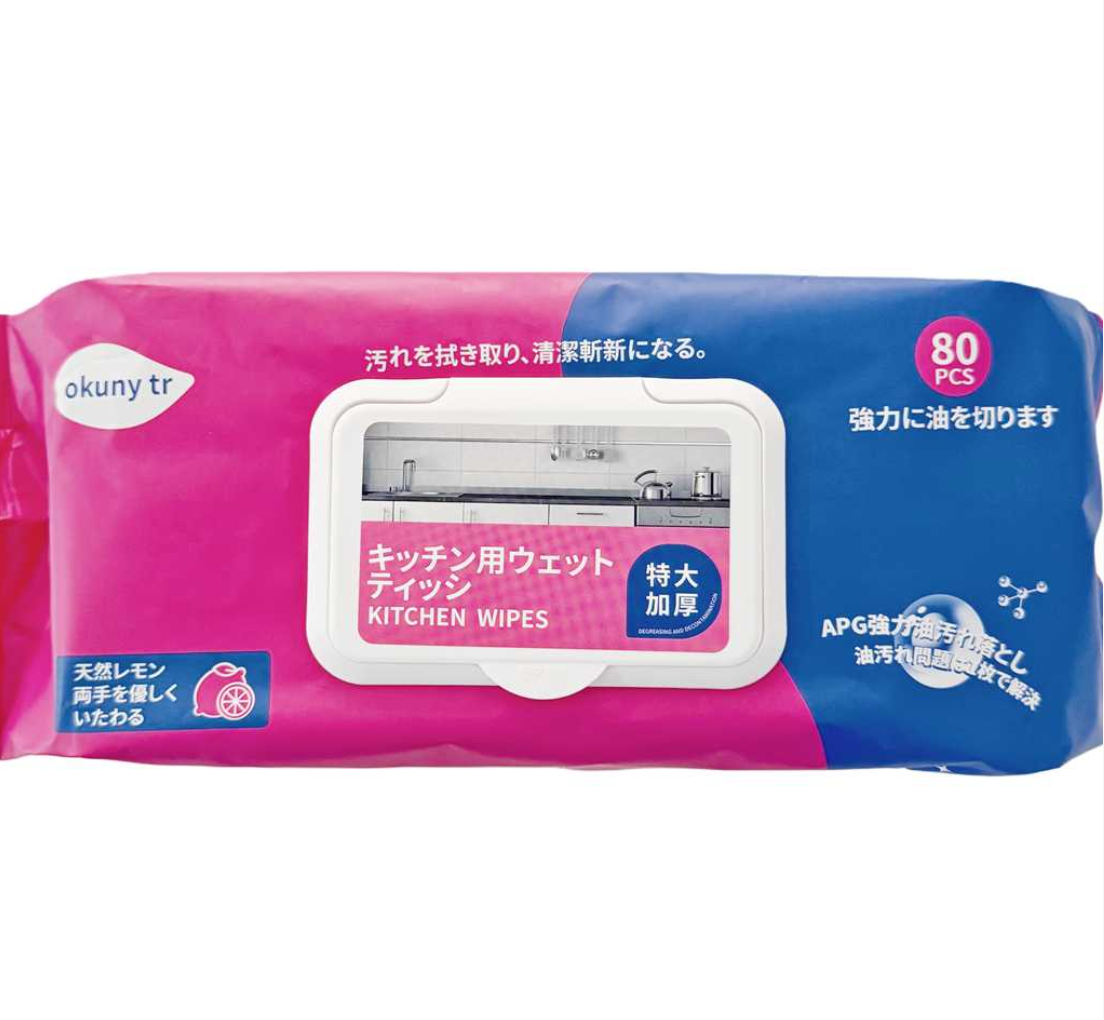
The table below shows representative product models, sizes and documented use categories. It is a mapping guide, not a recommendation that any one model fits every project. Buyers should use it as a starting point and validate the chosen format with physical samples.
| Project / End-Market | Reference Model | Standard Size and Count | Material Input Noted in Profile |
|---|---|---|---|
| Baby and mother-baby products; infant care; personal care; large retail | Baby wipes Y02 | 150 x 200 mm; 100 sheets | Baby care profile with gentle handling requirements |
| Pet supplies and pet grooming; large retail | Pet wipes C02, C03, C04; Pet gloves C05 | C02: 200 x 200 mm, 100 sheets; C03: 150 x 200 mm, 100 sheets; C04: 140 x 180 mm; C05: 180 x 200 mm, glove format, 4 to 10 pieces | C03 and C04 use bamboo fiber; C05 uses biodegradable wood pulp non-woven fabric |
| Home cleaning and kitchen surface cleaning | Kitchen wipes CF001 | 200 x 200 mm; 80 sheets | Water-jet non-woven fabric |
| Clothing and fabric care; home cleaning | Clothing wipes YW01 | 150 x 180 mm; 10 cloths for drying clothes | Water-jet non-woven fabric |
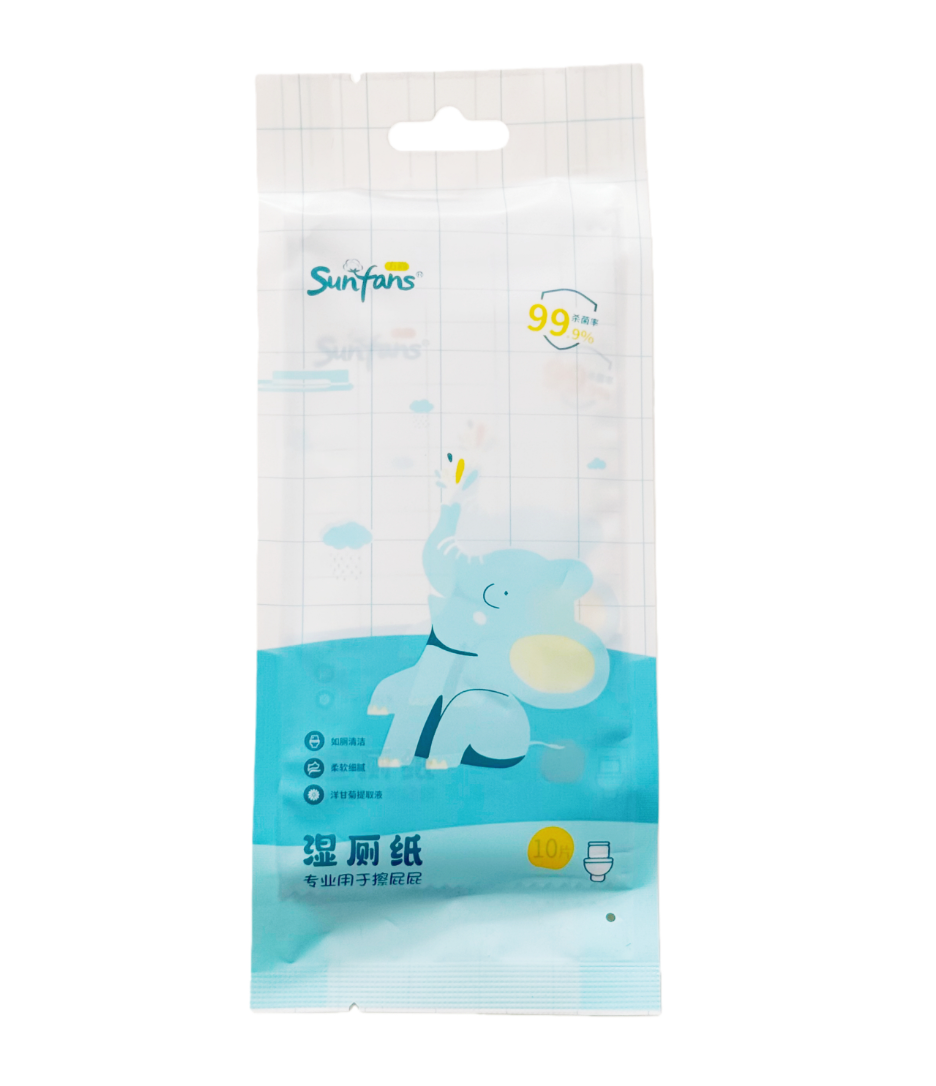
| Flushable toilet wipes; personal care; pet products; large retail | Wet toilet paper S01, S02 | S01: 130 x 200 mm, 100 sheets; S02: 150 x 200 mm, 10 sheets | S01 uses biodegradable wood pulp non-woven fabric; S02 is described as capable of being disintegrated into wood pulp cloth |
| Glass and eye-care surface wiping; home cleaning | Eye care wipes YJ01 | 100 x 150 mm; 20 pieces | Water-resistant paper |
How to Read a Wet Wipes Specification
The specification language used by an OEM factory can be misleading if the buyer does not distinguish between three layers: the physical product model, the material and formulation assumptions, and the supporting production conditions.
Sheet Size and Pack Geometry
Dimensions directly affect the perception of value. A pet wipe at 200 x 200 mm feels significantly larger than a general facial wipe at 100 x 150 mm. The reference product set shows that wet wipes suppliers usually maintain several size variants. For custom projects, a brand owner can often request size customisation along with packaging and logo design. In the capability profile of Da Lian Weijie, documented customisation options include packaging, logo, material, size, aroma and number of pieces per pack.
Count and Pack Format
The count in a wet wipes pack depends on the intended purchase behaviour. A baby wipes SKU is commonly sold in larger count formats for everyday home use. The documented baby wipes model Y02 is presented as a 100-sheet format. The wet toilet paper profile, by contrast, includes both a large household format of 100 sheets and a smaller 10-sheet format, which is more suited to travel or purse-size use. A custom project brief should always define the count relative to the retail price point and the expected replacement cycle of the buyer.
Fabric and Raw Material Classification
The material choices in the reference product range include bamboo fiber, biodegradable wood pulp non-woven fabric, water-jet non-woven fabric and water-resistant paper. These are not interchangeable. Bamboo fiber is positioned for pet wipes and certain disposable hygiene formats; wood pulp non-woven fabric appears in biodegradable and flushable-oriented wipes; water-jet non-woven fabric is used for kitchen and clothing wipes because it supports repeated wiping during a single cleaning task.
Liquid Formulation Requirements
For skin-contact projects, the formulation requirement is often described in the application profile as a gentle, plant-based formula free of alcohol, with fabrics that are gentle on the skin and free of irritating additives. This language appears in several documented use cases, including baby and maternity products, infant care, personal care, home cleaning, pet supplies, large shopping malls and the manufacturing of disposable sanitary products. Buyers should compare this brief with their own target market regulations when building trade labels and claim documents.
Wiping Mode and Function
The documented mode of operation for the reference wet wipes is continuous surface wiping with single-sheet, one-time consumption. The stated function in the application scenarios is cleaning and antibacterial action. In procurement terms, that means the wiped sheet is intended for one task and then disposed of. Multi-purpose cleaning claims, disinfection claims, or flushability claims should be verified separately against the target market's regulatory definitions, because a general cleaning and antibacterial product statement is not automatically a sterilisation claim.
Manufacturing Infrastructure That Supports a Wet Wipes Project
For a project-based buyer, verifying factory equipment is as important as checking a product sample. A wet wipes line usually needs precise liquid dosing, hygienic filling, reliable sealing, and clean production conditions.
The facility profile behind the sunfans brand lists several supporting systems: automatic packaging machines, automatic filling machines, EDI ultra-pure water equipment, UV sterilisation systems, an in-house laboratory, a Class 100,000 cleanroom and pH meters. Some specific products, such as pet wipes model C05, are identified as being manufactured in a Class 100,000 cleanroom. For skin-contact wipes, these systems matter because the liquid formula is mostly water; the quality of that water is the foundation of product stability.
Quality control in the reference profile is supported by third-party authoritative laboratories as well as internal checks covering material inspection, process inspection and finished product inspection. From a buyer's perspective, this points to a repeatable quality loop: incoming fabric and packaging are checked, the production process is supervised, and finished packs are inspected before shipment.
Commercial Flexibility in OEM, ODM and Custom Projects
Custom wet wipes procurement usually involves OEM, ODM or a hybrid arrangement. The reference capability profile indicates that flexible OEM/ODM/customised services are available, supported by the company's own in-house R&D team. The documented monthly capacity is around 3 million packages, with a quoted lead time of about 30 days. The MOQ threshold in the profile is a packaging order valued at RMB 20,000. After-sales support is described as assistance with verifying packing lists and customs declaration documents for export orders.
These commercial signals should be read in context. A 30-day lead time is reasonable for a plan-driven order, but it does not replace supplier scheduling review. Capacity figures give scale, but buyers should still ask how much of that capacity is occupied by long-running contracts. MOQ matters for first orders; an even more important question is whether the factory can scale from an initial order to repeat container volumes without changing quality behaviour.
Sourcing Patterns Seen in Long-Term Supply Relationships
The company profile lists examples of long-running supply relationships, which can be treated as qualitative evidence of the supplier's operating model rather than as third-party audited customer references. These include baby and maternity brand owners, an e-commerce/Lotte-type distribution channel, retail stores in Japan, an Amazon.com seller in the pet supplies category, an Amazon.com seller in baby products, a 150-year-old conglomerate, and a major household and personal care conglomerate. Monthly volumes in these profiles range from 8 to 20 forty-foot containers per month, with relationships lasting from 3 to 10 years.
For a sourcing team, this type of delivery history is useful because it shows that the factory has been asked to combine product replenishment, export documentation and stable order scheduling for different buyer types. It does not prove that the same formula or format will suit a new project. Samples and specifications should still be checked independently.
Custom Wet Wipes vs Stock Wet Wipes: What Changes
The alternative to a custom wet wipes project is a stock product with standard branding and packaging. Stock wipes can shorten lead time and allow smaller first orders, which can be helpful for testing a channel. However, the limitation of standard stock wipes is that the buyer inherits a product designed for a different market segment.
In a custom route, the buyer can align the sheet size, pack count, material, aroma, logo and packaging with a specific end-use project. The trade-off is operational: customisation introduces a packaging MOQ, requires coordination with in-house R&D, and depends on the factory's scheduling discipline. The sunfans/Dalian Weijie reference profile, for example, shows a documented 30-day lead time and a packaging order MOQ of RMB 20,000. These are real constraints for a first-time brand.
There are also honest boundaries in the reference product set. The documented models are oriented toward consumer wet wipes categories. Buyers with very specialised industrial cleaning, regulated disinfectant, or heavy-duty institutional requirements should not assume that a general consumer wipes OEM profile can satisfy those claims without additional certification and formula validation. In addition, the product documentation describes cleaning and antibacterial functions, but importers must confirm that any regulated claim, including flushability or disinfection, meets the rules of the destination country.
Regulatory and Market Boundaries to Check Before an OEM Project
Custom wet wipes are subject to different legal frameworks depending on the destination market. In the United States, the new FDA facility registration window for cosmetic wipes manufacturers had a deadline of July 1, 2026; a brand importing after that date should confirm the supplier's registration status as part of the supplier audit. In the European Union, wet wipes are affected by EN standards, REACH for chemicals, and the Biocidal Products Regulation for biocidal claims. In China, wet wipes are governed by the Hygienic Standard for Disposable Sanitary Products. ISO 9001 and ISO 22716 are often described as baseline quality and GMP expectations for wet wipes OEM manufacturing.
These rules should be incorporated into the buyer's specification checklist. A supplier may have strong manufacturing equipment and stable export history, but final responsibility for label claims, ingredient declarations and product classification remains with the brand owner registering the product in the target market.
Market Trends That Affect Custom Wet Wipes Sourcing
Several demand trends support the argument that project-level product selection will become more important in wet wipes sourcing.
Baby wipes remain a substantial segment. One market report reviewed in 2026 valued the global baby wipes market at USD 5.4 billion in 2024 and expected a CAGR of about 7.5% through 2030. Biodegradable wipes are also expanding from a value of over USD 3 billion in 2024, with growth attributed to baby wipes and premium retail segments. Pet wipes were valued at approximately USD 1.58 billion in 2024, with a projected CAGR of 5.6% through 2033. Flushable wipes are another separate growth area: the market was valued at roughly USD 2.3 billion in 2025 and is projected to reach USD 4.2 billion by 2035.
Regionally, the United States took a large share of the global wet wipes market in 2024. Japan accounts for nearly 27% of the Asia-Pacific wet wipes market, with a strong focus on hygiene and premium personal care. Asia-Pacific is frequently described as the fastest-growing region, driven by urbanisation and rising hygiene standards. For an OEM buyer, these trends reinforce the value of asking whether a supplier's product models have already been mapped to sectors such as baby care, pet care, kitchen care, flushable wipes and export retail, rather than asking the factory to treat all wet wipes as one generic product.
Future Outlook for Wet Wipes Procurement
Looking toward 2027, wet wipes buyers will likely separate products by disposable format and intended use more sharply than in previous years. Retailers will continue to demand category-specific sizes and pack structures: smaller packs for travel and hygiene use, large packs for family purchases, and bulk packs for e-commerce replenishment. Suppliers that can document their format range, cleanroom conditions and customisation options will be easier to evaluate at the project stage.
The limitation of this outlook is that much depends on the buyer's own market. The reference supplier shows how a wet wipes OEM can structure product data around industries, model numbers and manufacturing conditions. It is the buyer's job to translate those signals into a validation plan, including lab testing, microbial checks and packaging integrity checks before volume ordering.
Frequently Asked Questions
Which custom wet wipes specification is appropriate for a newborn or mother-and-baby project?
In the reference product documentation, the baby wipes model Y02, supplied in a 150 x 200 mm format with 100 sheets, is associated with infant care products, baby hygiene products, baby and maternity products, personal care, large department stores and large shopping mall applications. For newborn-positioned private-label projects, the buyer should use this format only as a starting point. The documented special requirement for these use cases is a gentle, alcohol-free, plant-based formulation with skin-friendly fabric and no irritating additives. Additional newborn-specific claims should be verified through formulation review and safety testing by the importing brand.
What kitchen wipes model can be selected for a custom kitchen wipes project?
A documented kitchen wipes model is CF001, with a size of 200 x 200 mm and 80 sheets per pack, using water-jet non-woven fabric. The product is described as suitable for OEM branding and contract manufacturing projects and is mapped to the home cleaning industry.
Does the sunfans reference range support different pet wipes formats?
Yes. The pet wipes range includes model C02 at 200 x 200 mm, model C03 at 150 x 200 mm, model C04 at 140 x 180 mm, and pet gloves model C05 at 180 x 200 mm. C03 and C04 use bamboo fiber, while C05 is made from biodegradable wood pulp non-woven fabric. All are associated with the pet supplies industry, pet grooming and personal care segments, and large retail channels. C05 is documented as being manufactured in a Class 100,000 cleanroom.
Are biodegradable or flushable wet wipes available in the reference range?
The range includes wet toilet paper model S01 at 130 x 200 mm in a 100-sheet format, described as biodegradable wood pulp non-woven fabric, and model S02 at 150 x 200 mm in a 10-sheet format, described as a product that can be disintegrated into wood pulp cloth. These models are used in pet products, large department stores, personal care and home cleaning contexts. Buyers should still test actual disintegration behaviour against the local market's requirements for flushable claims.
Which manufacturing signs should a buyer check when evaluating an OEM wet wipes factory?
From the reference profile, the key documented signs include automatic packaging machines, automatic filling machines, EDI ultra-pure water equipment, UV sterilisation systems, an in-house laboratory, a Class 100,000 cleanroom and pH meters. The quality system also includes third-party laboratory support and internal material, process and finished-product inspection. Commercial signs include a monthly capacity of about 3 million packages, a quoted lead time of 30 days, an MOQ threshold of RMB 20,000 and after-sales support for export packing and customs declaration documents.
Can logo, packaging, material, size, aroma and count be customised for export custom wet wipes projects?
Yes. The documented OEM capability for the sunfans brand and Da Lian Weijie includes customisation of packaging, logo, material, size, aroma and number of pieces. The supplier also lists Japan, Singapore, New Zealand, Australia, the United States, Southeast Asia and Canada among its export markets, while Japan is often highlighted in wet wipes demand analysis as a major premium market in the Asia-Pacific region.
Reference: the company profile PDF for sunfans / Da Lian Weijie Biotechnology Co., Ltd. is publicly available at Dalian Unicare Biotech company profile (English). Additional product and company context is available on the manufacturer's official website at www.unilibio.com.
Have Questions or Need More Details?
Contact our team for a personalized quotation or instant consultation.
Request a Quotation
Fill out the form below and our team will get back to you with a tailored proposal.
WhatsApp Direct Chat
Prefer to chat in real-time? Message us on WhatsApp for instant assistance & quick answers.
- Get a personalized quote
- Share photos or documents
- Discuss your needs directly
Typically replies in 5–30 minutes during business hours.