
Custom Wet Wipes by Use Case: Matching Product to Project
Choosing a custom wet wipe is less about finding a generic factory and more about matching product format, manufacturing environment and formulation to the end use. This article provides a scenario-based view of custom wet wipes, using sunfans / Dalian Weijie Biotechnology Co., Ltd. as a documented reference.
Industry introduction
Custom wet wipes are no longer a single product category. Procurement teams, brand owners and project managers increasingly start from the end user: a baby care line, a pet grooming range, a kitchen cleaning set, or a flushable toilet wipe SKU. Each project carries a different set of material, packaging and compliance requirements.
sunfans, operated by Dalian Weijie Biotechnology Co., Ltd., is a wet wipes supplier founded in 2013 in Dalian, Liaoning Province, China. The company is a state-level high-tech enterprise and integrates design, research and development, production, and sales. Its export markets include Japan, Australia, Canada, the United States and Singapore.
The term custom wet wipes covers OEM projects, private label programs, custom logo printed wipes, and product versions created for specific retail channels. For buyers, the real task is to translate a target market or end-user behavior into a concrete specification that a factory can execute consistently.
Problem and opportunity
Most wet wipes purchasing mistakes happen when one format is applied to many different projects. A baby care brand and a pet grooming retailer do not need the same material, formula, pack size or logo treatment. Standard wipes from a distributor can limit differentiation and slow down market entry in competitive categories.
The opportunity is to design a custom wet wipes project around the application. Market data supports this direction. The global wet wipes market was valued at approximately USD 32.09 billion in 2026 and is projected to reach USD 43.45 billion by 2034, a compound annual growth rate of 3.86%, according to Fortune Business Insights data referenced by Vertex AI. The global baby wipes market was valued at USD 5.4 billion in 2024 and is expected to grow at a CAGR of 7.5% through 2030. The pet wipes market reached USD 1.58 billion in 2024, with a projected CAGR of 5.6%. The flushable wipes segment, valued at USD 2.3 billion in 2025, is projected to reach USD 4.2 billion by 2035.
For buyers entering retail or e-commerce, this creates room for large pack custom wet wipes, bulk pack custom wet wipes, and eco-friendly custom wet wipes that are tailored to a channel. It also creates pressure to select a factory that can handle export custom wet wipes documentation and market-specific compliance.
Brand solution: sunfans and its OEM/ODM approach
sunfans, through Dalian Weijie Biotechnology Co., Ltd., positions itself as a flexible OEM/ODM supplier. The documented customization list includes packaging, logo, material, size, aroma and number of pieces. The company also has an in-house R&D team, which is relevant for buyers who want formulation adjustments.
For export projects, the company assists with verifying packing lists and customs declaration documents. This is useful for buyers working with freight forwarders or entering new markets. Documented export markets include Japan, Singapore, New Zealand, Australia, the United States, Southeast Asia and Canada, giving the company experience with different market entry requirements.
The documented product portfolio covers baby wipes, pet wipes, wet toilet paper, functional wipes, floor dry wipes and floor wet wipes. Across these categories, buyers can consolidate multiple SKUs under one OEM program instead of managing several suppliers.
Technical explanation: what project buyers should verify
A project match depends not only on the product but also on the production environment. In documented application profiles, the products require automatic packaging machines, automatic filling machines, EDI ultra-pure water equipment, UV sterilization systems, an in-house laboratory, a Class 100,000 cleanroom, and pH meters. Some product models are manufactured inside the Class 100,000 cleanroom.
These controls matter because wet wipes are frequently used on skin, in food preparation areas, or for antibacterial cleaning. The documented operation mode is continuous surface wiping with single-sheet one-time consumption. Finished products should be stored in a cool, dry, shaded area at room temperature, away from high temperatures, heat sources, and moisture-prone areas.
For baby and sensitive skin applications, the documented requirement includes a gentle, plant-based formula free of alcohol, with fabrics that are gentle on the skin and free of irritating additives. This requirement is a practical baseline for infant custom wet wipes and mother-and-baby custom wet wipes projects.
Application and use cases
Documented product categories include baby wipes for infant care, pet wipes for pet grooming and the pet supplies industry, kitchen wipes for kitchen cleaning, clothing wipes for cleaning and antibacterial action, and wet toilet paper with gentle formulation requirements. These products are applied across disposable sanitary products, baby and maternity care, infant care, personal care, home cleaning, general merchandise, and large shopping mall projects.
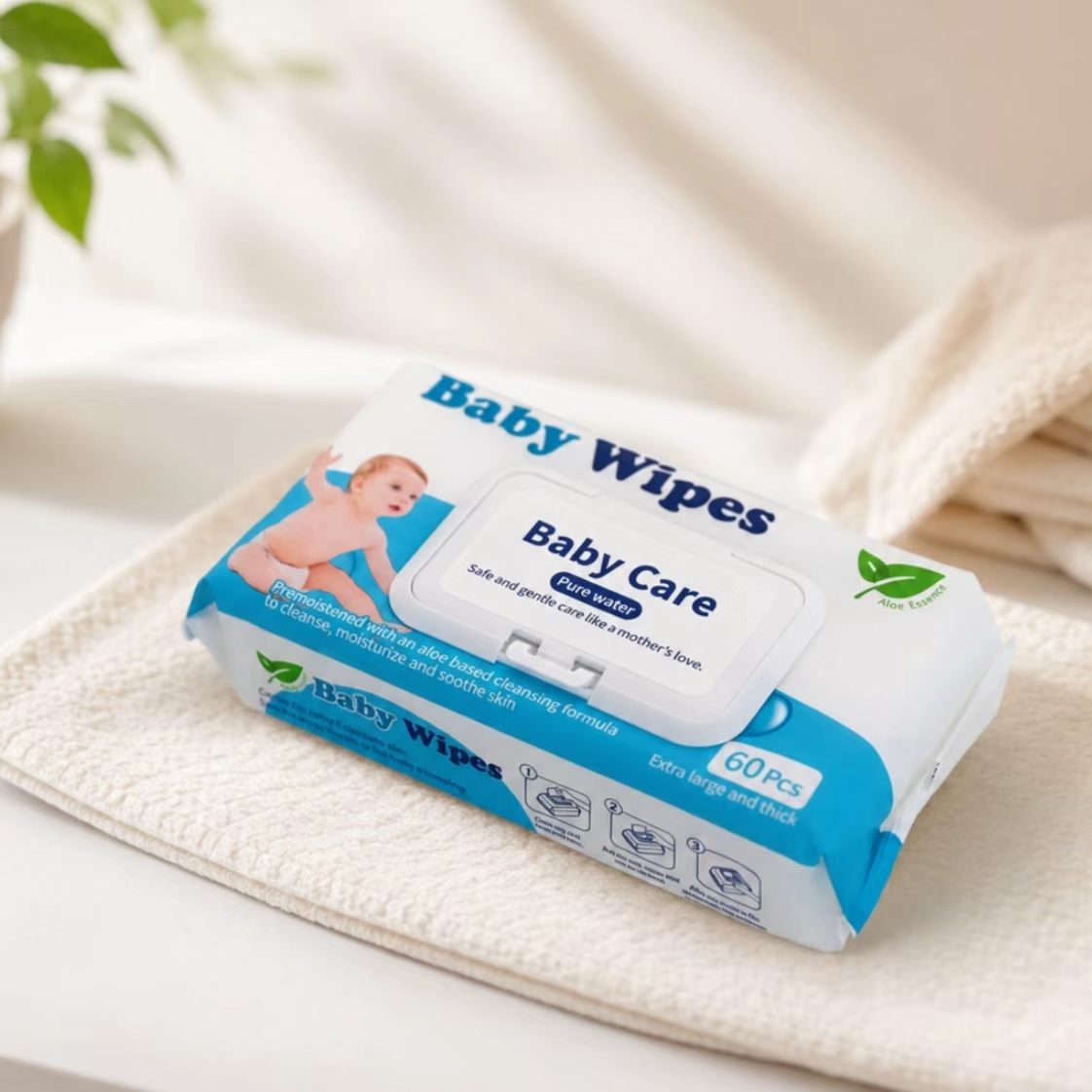
Baby wipes are documented for infant care, baby and maternity care, and large shopping mall applications.
| Project scenario | Documented models | Application notes |
|---|---|---|
| Baby and maternity | Baby wipes Y02 (150x200mm) | Used in infant care, baby and maternity products, large shopping malls, and general merchandise. |
| Pet supplies and grooming | Pet wipes C02 (200x200mm), C03 (150x200mm), C04 (140x180mm), C05 (180x200mm) | Used in pet supplies, pet grooming and personal care segments; material options include bamboo fiber and biodegradable wood pulp non-woven fabric. |
| Home cleaning and kitchen | Kitchen wipes CF001 (200x200mm), Clothing wipes YW01 (150x180mm) | Used in home cleaning and general merchandise; designed for cleaning and antibacterial action. |
| Eye care and glasses | Eye care wipes YJ01 (100x150mm) | Water-resistant paper format for retail and general merchandise projects. |
| Toilet and flushable | Wet toilet paper S01 (130x200mm), S02 (150x200mm) | Used in personal care, home cleaning and large department stores; biodegradable formats available. |
For baby and maternity projects, the documented formula requirement is a gentle, plant-based formula free of alcohol, with fabrics gentle on the skin and no irritating additives. That supports the positioning of baby custom wet wipes, mother-and-baby custom wet wipes and infant custom wet wipes in retail programs.
For pet projects, the range of pet wipes sizes and materials allows brands to offer everyday cleaning wipes and premium grooming products. Pet cleaning custom wet wipes can be paired with pet gloves in OEM packaging to extend a product line.
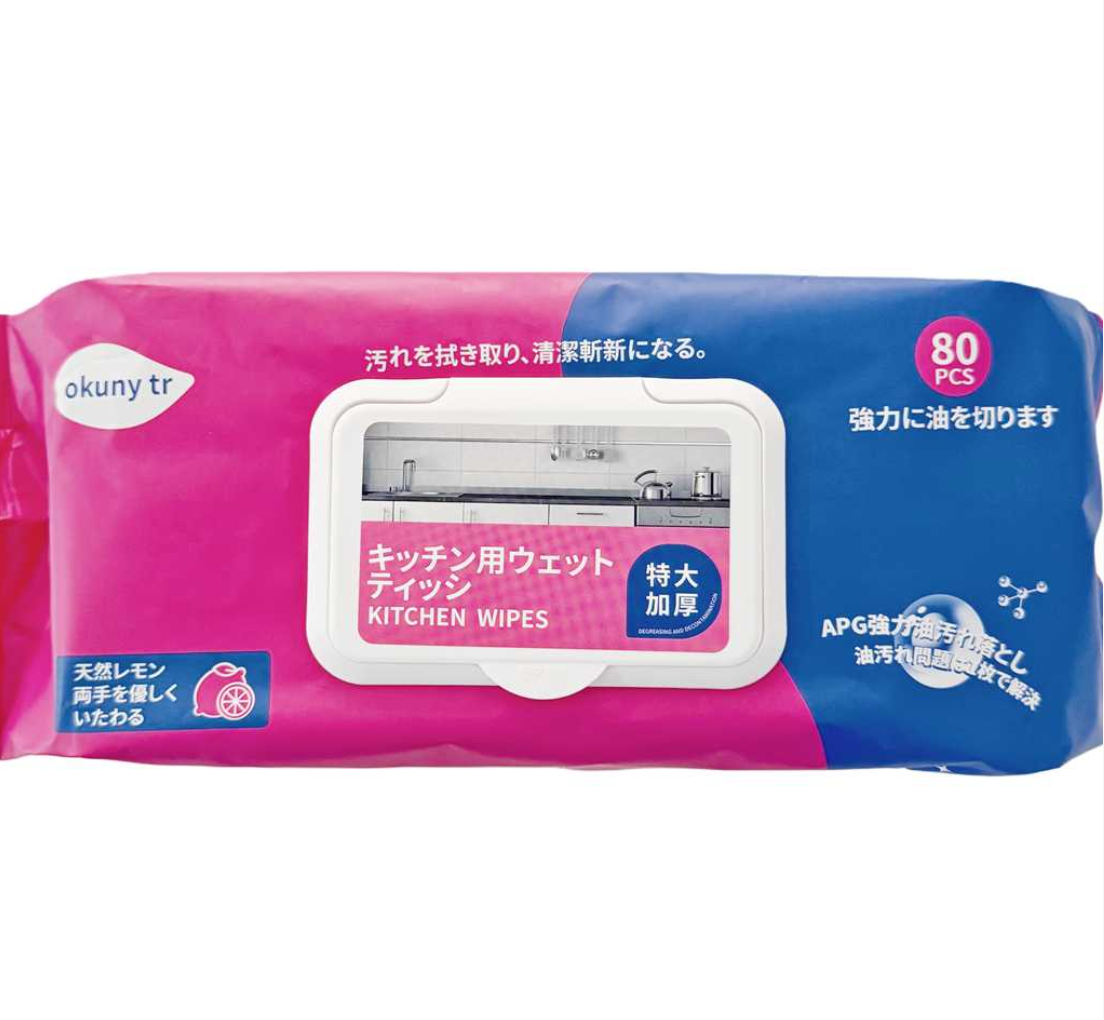
Kitchen wipes are documented for home cleaning, large retail chains and general merchandise applications.
For home cleaning and kitchen projects, kitchen wipes are available in an 80-piece pack, which is a practical configuration for large pack custom wet wipes and bulk pack custom wet wipes. For private label custom wet wipes, custom logo printed wipes can be applied across baby, pet, kitchen and household categories.
For flushable and eco-friendly product lines, wet toilet paper S01 uses biodegradable wood pulp non-woven fabric, while S02 can be disintegrated into wood pulp cloth. Biodegradable custom wet wipes and eco-friendly custom wet wipes therefore have a documented base in this product range.
Key procurement criteria for project-based wet wipes
Project buyers can use the following criteria when evaluating a custom wet wipes supplier. These points are grounded in documented manufacturing and application data.
- Customization depth: packaging, logo, material, size, aroma and number of pieces should be available as standard options.
- Manufacturing environment: automatic packaging and filling machines, EDI ultra-pure water equipment, UV sterilization, in-house laboratory, Class 100,000 cleanroom, and pH meters are important control points.
- Formulation suitability: for baby and sensitive-skin projects, the formula should be gentle, plant-based, alcohol-free, and free of irritating additives.
- Storage and handling: products should be kept in a cool, dry, shaded area at room temperature, away from heat and moisture.
- Export support: packing list and customs document verification can reduce friction in cross-border programs.
Market trend analysis
Three trends are shaping project decisions. First, sustainability is moving from an option to a baseline. The global biodegradable wipes market reached over USD 3 billion in 2024, with growth driven by baby wipes and premium retail segments, according to WEHOO Hygiene. Second, regional demand is shifting. Japan accounts for nearly 27% of the Asia-Pacific wet wipes market, and Asia-Pacific is the fastest-growing region for wet wipes, supported by rising hygiene standards in urban markets. Third, regulatory requirements are tightening. The U.S. FDA facility registration deadline for cosmetic wipes manufacturers is July 1, 2026. In the EU, wet wipes must meet REACH requirements for chemicals and BPR for biocidal claims. ISO 9001 and ISO 22716 are baseline quality systems for wet wipes OEM manufacturing.
For buyers, these trends mean that project-scenario fit must include compliance and traceability, not only visual packaging and pricing. Japan export custom wet wipes, for example, require consistency in quality and packaging precision because the market is particularly sensitive to product experience.
Comparison with traditional wet wipes sourcing
Traditional sourcing through standard distributors offers lower coordination cost and faster access to stock products. However, it tends to limit branding, material choice, pack count and formulation control. A project-based OEM approach allows buyers to specify size, material, aroma, logo and quantity, and to align the product with expected use conditions and regulatory framework.
The trade-off is real. Custom projects require a minimum order package, a defined lead time, and closer communication between the buyer and factory. In the documented sunfans model, the lead time is 30 days, and the project type is OEM branding and contract manufacturing. For short-run tests with very small volumes, an off-the-shelf product may be more practical. Buyers should also verify that a factory has the required manufacturing environment, because not all wet wipes suppliers operate Class 100,000 cleanrooms or in-house laboratories.
Future outlook
The wet wipes industry is likely to become more segmented by use case. Baby, pet, kitchen, flushable and personal care programs will each require more precise formulation, material and compliance choices. Importers, especially those serving Japan and other quality-sensitive markets, will continue to value production traceability and stable supplier capacity.
Long-running buyer relationships offer another practical signal. Documented projects include a 150-year-old conglomerate supplied for 10 years, a top Amazon.com seller of pet supplies supplied for 6 years, and a Japanese retail chain supplied for 3 years. For procurement teams, this kind of continuity suggests that a partner can maintain consistent quality across repeated production cycles, which is especially important for projects built around a long-term private label or OEM strategy.
Frequently asked questions
What product categories can be customized for wet wipes projects?
Documented categories include baby wipes for infant care, pet wipes for pet grooming and pet supplies, kitchen wipes for kitchen cleaning, clothing wipes for cleaning and antibacterial action, and wet toilet paper with gentle formulation requirements.
Which baby wipes model is documented for infant care projects?
Baby wipes model Y02 (150x200mm) is documented for infant care and large shopping mall applications. The application requires a gentle, plant-based formula free of alcohol, with fabrics that are gentle on the skin and free of irritating additives.
What production conditions should buyers check in an OEM wet wipes factory?
Documented production conditions include automatic packaging machines, automatic filling machines, EDI ultra-pure water equipment, UV sterilization systems, an in-house laboratory, a Class 100,000 cleanroom, and pH meters.
Are biodegradable options available for private label wet wipes?
Wet toilet paper model S01 uses biodegradable wood pulp non-woven fabric, and model S02 can be disintegrated into wood pulp cloth. Some pet wipes models also use bamboo fiber or biodegradable wood pulp non-woven fabric.
What storage conditions apply after receiving custom wet wipes?
Products should be stored in a cool, dry, shaded area at room temperature, away from high temperatures, heat sources, and areas prone to moisture accumulation.
What project types are these custom wet wipes suitable for?
The products are suitable for OEM branding and contract manufacturing projects. Their documented operation mode is continuous surface wiping, with single-sheet one-time consumption.
A company profile for sunfans / Dalian Weijie Biotechnology Co., Ltd. is available for public access at: Dalian Weijie Biotechnology company profile (English).