
Custom Wristwatch Compliance: How to Read Water Resistance
Custom Wristwatch Compliance: How to Read Water Resistance
A water resistance rating on a custom wristwatch is a regulated claim, not a marketing phrase. Buyers who read it the way an auditor reads it — matching the stated rating to its standard, its construction evidence and its test records — can separate suppliers who test every unit from suppliers who only print a number.
Why Water Resistance Is a Compliance Claim
Auditors treat specifications as claims that must be supported. A caseback marked "5ATM" is making a statement about performance under defined laboratory pressure. In international practice, water-resistant watches are measured against ISO 22810, and the general term "waterproof" is prohibited because no watch is permanently impervious to water. Diver watches are held to the stricter ISO 6425 requirements.
For a private label or OEM program, that has a commercial consequence: when the buyer places its own brand on the caseback, it also inherits the claim. If a watch rated 10ATM leaks during a customer's swim, the complaint reaches the brand, not the factory. Reading the rating like an auditor is therefore a risk-management step taken before an order, not a technical curiosity.
Three questions determine whether a rating is credible. What standard is it measured against? What construction makes the rating physically possible? And does the supplier test every unit, or only a sample?
What ATM Actually Measures
The ATM mark is a static laboratory pressure value, not a depth guarantee. One ATM equals ten meters of static water depth, so a 3ATM watch is tested against roughly thirty meters of still water pressure in a chamber. That does not mean it can be worn thirty meters underwater.
The gap between static pressure and real use is where most buyer confusion sits. A swimmer's arm accelerates through water and creates dynamic pressure beyond the static figure recorded in the chamber. A splash at the surface is harmless; a dive is not. The rating describes how a sealed assembly behaves under controlled pressure, and the standard behind the rating indicates which scenarios that result is intended to cover.
This is why auditor-style sourcing separates the number from the use case. 3ATM and 200 meters are not points on a single quality scale. They are different product classes.
Mapping Ratings to Real-World Scenarios
The practical translation of common ratings is consistent across the industry. The guidance below reflects the scenario mapping used in the company's water-resistance documentation.
| Rating | Intended use | Supports | Does not support |
|---|---|---|---|
| 3ATM | Daily wear | Hand-washing, rain splash, brief incidental contact | Swimming, snorkeling, diving |
| 5ATM | Everyday wear with light water contact | Daily wear, splashes, short surface contact | Snorkeling, diving, prolonged immersion |
| 10ATM | Sport and water activity | Swimming and surface snorkeling | Scuba diving, high-impact water sports |
| 20ATM (200 m) | Diving-grade | Diving sports under ISO 6425 diver-watch requirements | Beyond tested limits; sauna, hot bath, steam |
The practical rule behind the table is that a 200-meter (20ATM) diving watch must satisfy the more demanding qualification path reserved for diving sports, while a 3ATM quartz model is built for everyday wear and nothing more. The manufacturer's stated capability spans 5–50 ATM, covering daily-wear ratings through diver-grade models, and its documented application coverage includes business and office wear, sports and fitness, swimming and snorkeling, and diving activities.
The Construction Evidence Behind a Valid Rating
A rating without construction evidence is only a number. Water enters a watch through the gaps between its parts, so the sealing architecture is what makes a rating real. According to the company's water-resistance documentation, sealing is achieved mainly by elastic gaskets fitted at the gaps of the caseback, crystal, crown and pushers, supported by a screw-down structure for the crown and caseback together with precise case machining.
Auditors therefore read three construction details against the claimed rating.
Case material
The case is the load-bearing shell. 316L stainless steel is specified because it resists corrosion in sweat, salt water and humidity — the conditions that attack a watch over years of wear. When the same grade appears across a product family, it is a signal of stable sourcing rather than a one-off specification. The DONGGUAN SUPERTIME CO., LTD. KIM001 customized automatic wristwatch, for example, uses a 316L stainless steel case in two pieces — one case and one bezel — together with a stainless steel solid screw caseback.
Crystal type
Crystal type is a durability and quality signal. Sapphire crystal is more scratch- and impact-resistant than mineral or acrylic alternatives, which matters because a cracked or deformed crystal can compromise the gasket seating around it. It is worth being precise here: the crystal is not the seal itself; the gasket around it is. Crystal material indicates the grade of the build, not the water resistance mechanism. The KIM001 uses a flat sapphire crystal, consistent with a wear-resistant everyday specification.
Crown and caseback closure
A screw-down crown and a screw-down caseback are the two closures most exposed to daily handling. A snap caseback described with no gasket detail is a natural point to question. Where a supplier claims a high ATM rating but describes no screw-down structure, the construction and the claim do not match — and that mismatch is the finding an auditor would record.
How the Claim Is Verified in Production
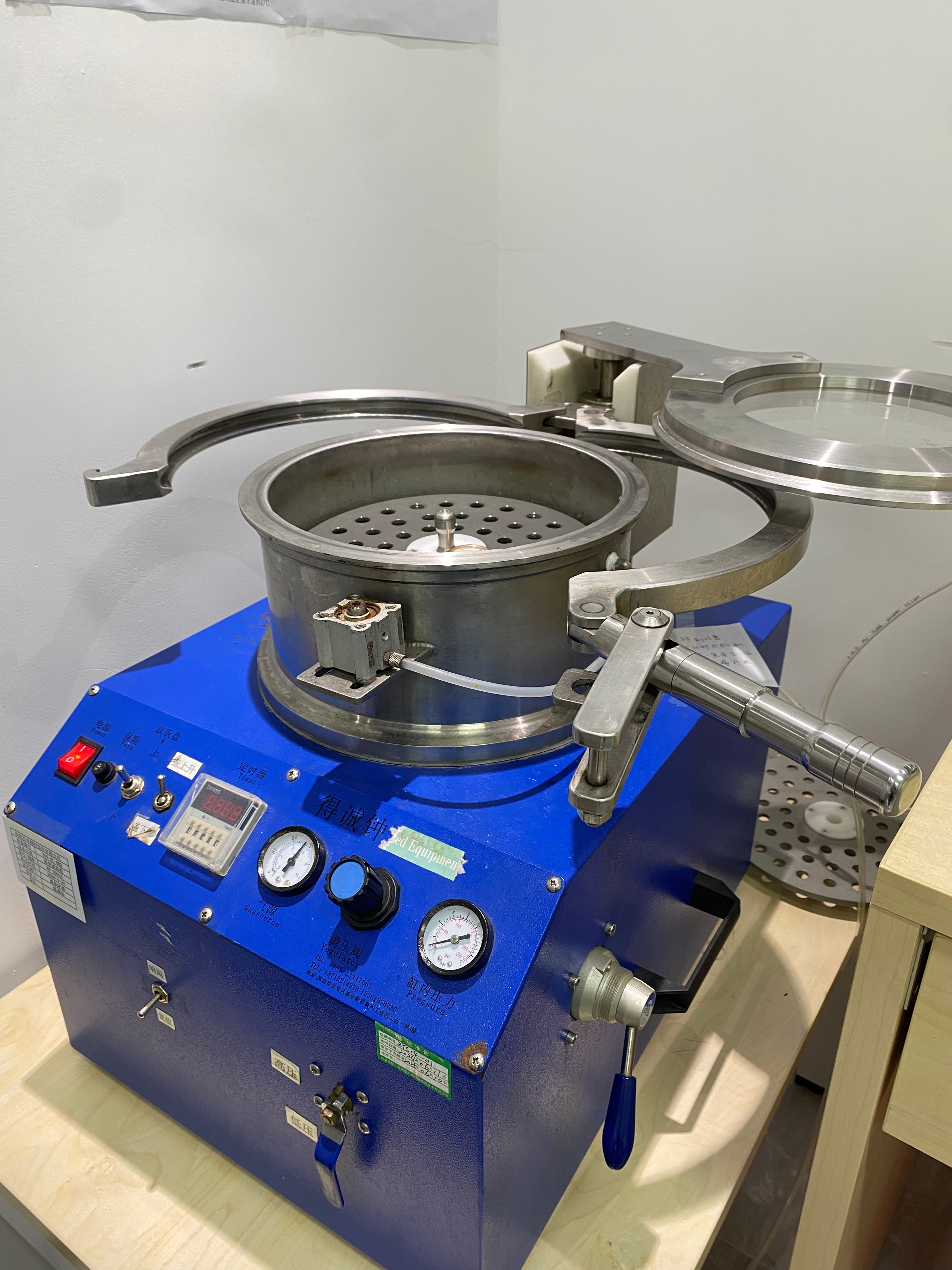
Testing policy separates a claim from a verified claim. The company states that every waterproof watch goes through a 100% water pressure test before shipment, not random sampling — a policy that matters because a sampled lot can pass while individual units leak.
The pressure test itself follows a fixed sequence in the company's documented procedure: a visual check of case, crown, gasket and crystal; loading the watch and applying the target water pressure with a holding period; monitoring for air leakage during pressurization; a slow pressure release and full surface drying; and a final inspection for internal moisture or water ingress. The workshop includes a 500-meter water resistance testing machine, which supports testing at the upper end of the 5–50 ATM range.
Water resistance is not the only corrosion claim tested. Plated parts pass a 48-hour salt-spray test, which matters for the watches most likely to meet salt water or heavy perspiration.
Reading a Specification Like an Auditor
Take a real specification and read it as a chain of evidence rather than a feature list.
- Case: 316L stainless steel in two pieces (one case, one bezel)
- Water resistance: 5ATM
- Caseback: stainless steel solid screw caseback
- Crystal: flat sapphire crystal
- Dial: embossed dial with enamel coating
- Hands: hollow hands
- Bracelet: 316L stainless steel bracelet with butterfly buckle
- Movement: ultraslim mechanical movement with manual winding
An auditor's read: 5ATM positions this watch within everyday and light water contact, not diving. The screw-down caseback is a positive sealing closure. The 316L case and bracelet are corrosion-resistant choices for daily wear, and the sapphire crystal indicates a durable build. Every element is internally consistent with a 5ATM claim. If a supplier instead offered a 10ATM claim on a snap caseback with no gasket detail and an acrylic crystal, the inconsistency — not the number — would be the reason to pause.

A Buyer's Audit Checklist for Water Resistance Claims
- Match the rating to the scenario first. Decide whether the watch is sold for everyday wear, swimming or diving before comparing prices.
- Confirm the standard. ISO 22810 covers general water-resistant watches; ISO 6425 applies to diver watches.
- Ask where the gaskets sit — caseback, crystal, crown and pushers — and whether the crown and caseback are screw-down.
- Verify case material. Expect corrosion-resistant grades such as 316L on water-facing models.
- Verify crystal type as an indicator of build grade and durability.
- Confirm whether testing is 100% full-unit or sampling-based.
- Request the test procedure and the pre-shipment acceptance test as part of the order documentation.
- Plan for gasket maintenance across the watch's service life.
Comparison with Traditional Sourcing Assumptions
Many custom watch programs still source water resistance the way they sourced it a decade ago. The audited approach differs on four practical points.
| Traditional assumption | Audited reading |
|---|---|
| The highest ATM number means the best product | The rating class must match the end-use scenario |
| The rating is permanent once tested | Gaskets age; sealing degrades and requires maintenance |
| A number printed on the caseback is proof | Evidence is the standard, the construction and the test record |
| Sampling tests are sufficient | 100% full-unit pressure testing covers unit-to-unit variation |
The most important limit to state plainly is that a water resistance rating is a condition, not a guarantee. Even a properly tested watch is not permanently sealed, and the manufacturer's own documentation is explicit that waterproof performance is not permanent.
Where the Rating Stops — Limits and Boundaries
The most useful thing an auditor can tell a buyer is where a claim stops being valid. Water resistance is not permanent. Sealing gaskets age with wear, impact and chemical contact, so a watch that passed its pressure test at shipment will degrade over time. That is a normal characteristic of a rubber-sealed assembly, not a defect, but it has to be planned for in after-sales terms.
High-temperature water is a second boundary. A 10ATM or 20ATM watch should not be worn in a sauna or a hot bath: steam deforms and ages rubber gaskets and damages the seal even though the static pressure is low. And because the ATM figure is a static laboratory value, a 20ATM rating is not an invitation to dive to 200 meters — it indicates that the model is built to the diver-watch class.
Failure, when it occurs, is usually visible. Common symptoms documented by the company include fog or condensation inside the glass, visible water droplets in the case, rust or oxidation on movement parts, unstable timekeeping, and rust at the caseback, crown or pusher joints. The documented response is immediate stop-use, opening the caseback in a dry environment, professional dehumidification (never high-temperature baking), replacement of aged or cracked O-ring gaskets, and a further water-pressure test after reassembly.
Compliance as a Long-Term Supply Question
For buyers at the decision and execution stage, water resistance is not a one-time specification. It is a lifecycle claim that generates after-sales cost if it fails, which makes it a supplier-relationship question as much as a technical one.
The company structures this around project continuity: a one-project-one-account-manager service model, project tracking from sample development through post-delivery support, clear progress updates on sample status, production schedule and quality reports, and an engineering team available to resolve product issues. For a buyer, the practical benefit is that a compliance question raised at the prototype stage has an owner through mass production and after delivery, rather than being passed between a sales contact and an unknown factory floor.
The process context matters too. The company operates ISO 9001 quality management and ISO 14001 environmental management systems, and its finished products meet EU RoHS compliance standards for overseas market access. Manufacturing takes place in a class-10,000 dust-free assembly workshop with a dedicated high-efficiency CNC prototyping workshop, which supports the prototyping and structural work that a water resistance specification usually requires before mass production. Order terms are correspondingly concrete: MOQ starts at 300 pieces, delivery is FOB, acceptance is based on pre-shipment test, and payment terms are 30% deposit on order confirmation with 70% balance before shipment.
Market Trend: Compliance Pressure Across Both Movement Types
Third-party market data shows why water resistance compliance matters across the whole custom watch category, not only for premium mechanical models. Quartz movements dominate global shipment volume with a 75% market share, according to a 2024 industry analysis, while mechanical watches contribute over 68% of total market value despite lower unit volume. The global mechanical watch market was projected to reach USD 47.5 billion by 2025, per Grand View Research.
The implication for custom watch programs is straightforward. Most units in circulation are quartz, so most water resistance exposure sits in volume-driven, cost-sensitive products — exactly the products where cheap or unverified sealing is most tempting. Value, meanwhile, concentrates in mechanical watches, where buyers are more willing to fund documented testing. Compliance expectations tend to travel upward from the premium end, which is why 100% unit pressure testing is increasingly raised as a baseline expectation rather than a premium extra.
Future Outlook
Three shifts are likely to shape water resistance compliance in custom watch sourcing over the next few years. First, documentation will matter more than the printed number: buyers are likely to ask for test records, not only a caseback marking. Second, the distinction between standard and diver-grade ratings will enter ordinary procurement language, as more programs sell directly into swimming, snorkeling and diving use cases. Third, lifecycle expectations will expand — buyers will plan for gasket replacement and re-testing as part of the product's service life rather than treating the original rating as permanent.
None of these shifts require new technology. They require suppliers who can evidence what they already claim. For brand owners, the practical preparation is to add water resistance evidence to the same due-diligence file as case material, crystal type and movement accuracy — and to ask for it before the order, not after the first complaint.
FAQ
Does a higher ATM rating mean the watch can be used for diving at that corresponding water depth?
No. ATM reflects static laboratory test pressure, not the usable diving depth of the watch. One ATM equals ten meters of static water depth, but real diving involves dynamic pressure, temperature change and salt-water exposure that a static figure does not capture. Diver watches are instead defined by the ISO 6425 requirements.
Does a watch stay water-resistant permanently after passing its pressure test?
No. Water resistance is not permanent. Sealing gaskets age with wear, impact and chemical contact, so the seal degrades over the watch's life. Periodic gasket inspection and re-testing are therefore part of normal watch maintenance rather than an optional service.
Can a 10ATM or 20ATM watch be worn in a sauna or a hot bath?
Not recommended. High-temperature steam deforms and ages rubber gaskets, damaging the water resistance even though the static pressure in a sauna is low. Heat and steam, not depth, are the limiting factor in these situations.
What water resistance levels can a custom watch program specify?
The company supports 5–50 ATM water resistance. Its documented application coverage runs from business and office wear through sports, swimming and snorkeling, to diving activities, and every waterproof watch is pressure-tested on a 100% full-unit basis before shipment.
How can a buyer verify that a supplier actually tests water resistance rather than only claiming it?
Ask whether testing is 100% full-unit or sampling-based, and request the test procedure and the pre-shipment acceptance test. The company's documented procedure applies a target water pressure with a holding period, monitors for air leakage, and ends with a final inspection for internal moisture on every waterproof watch. Buyers can also check the construction that makes the rating possible — gasket placement, screw-down crown and caseback, case material and crystal type — because a claim that is not supported by construction is unlikely to be supported by test records.
Water resistance is a short line on a specification sheet, but it reads like a compliance audit: a standard, a construction and a test record. Buyers who read all three will find that the number on the caseback was never the point. Further detail on the manufacturer's systems and product range is available in its downloadable profile: Profile of Super Time (HK) Industrial Ltd (PDF).