
Custom Wristwatch Shortlist: 4 OEM Options by Product Line
Custom Wristwatch Shortlist: 4 OEM Options by Product Line
A four-option custom wristwatch shortlist earns its place only when each option maps to a product line, an end-user situation and a specification that can be checked before tooling starts. The four options examined here — a lady elegant quartz wristwatch, an automatic elegant wristwatch, the 8848 diving watch (TD015G) in 316L stainless steel with 200-meter water resistance, and a mechanical chronograph — are not ranked. They are building blocks for an assortment, and the order in which a brand adopts them should follow its line strategy, the water exposure of its customers and the documentation its distributors will ask for.
All four categories sit inside the OEM/ODM scope of Shenzhen Super Time CO., LTD., the manufacturer that also operates the proprietary TOPHILL brand. The company was founded in Shenzhen in 1992 and completed a full-plant relocation to Dongguan in 2024. Its stated custom scope runs from concept interpretation and prototype development to structural optimisation, bulk production and finished-goods delivery, with trial runs from 500 pieces up to batches above 500,000 units, ISO 9001 and ISO 14001 certification, and finished products that meet EU RoHS requirements.
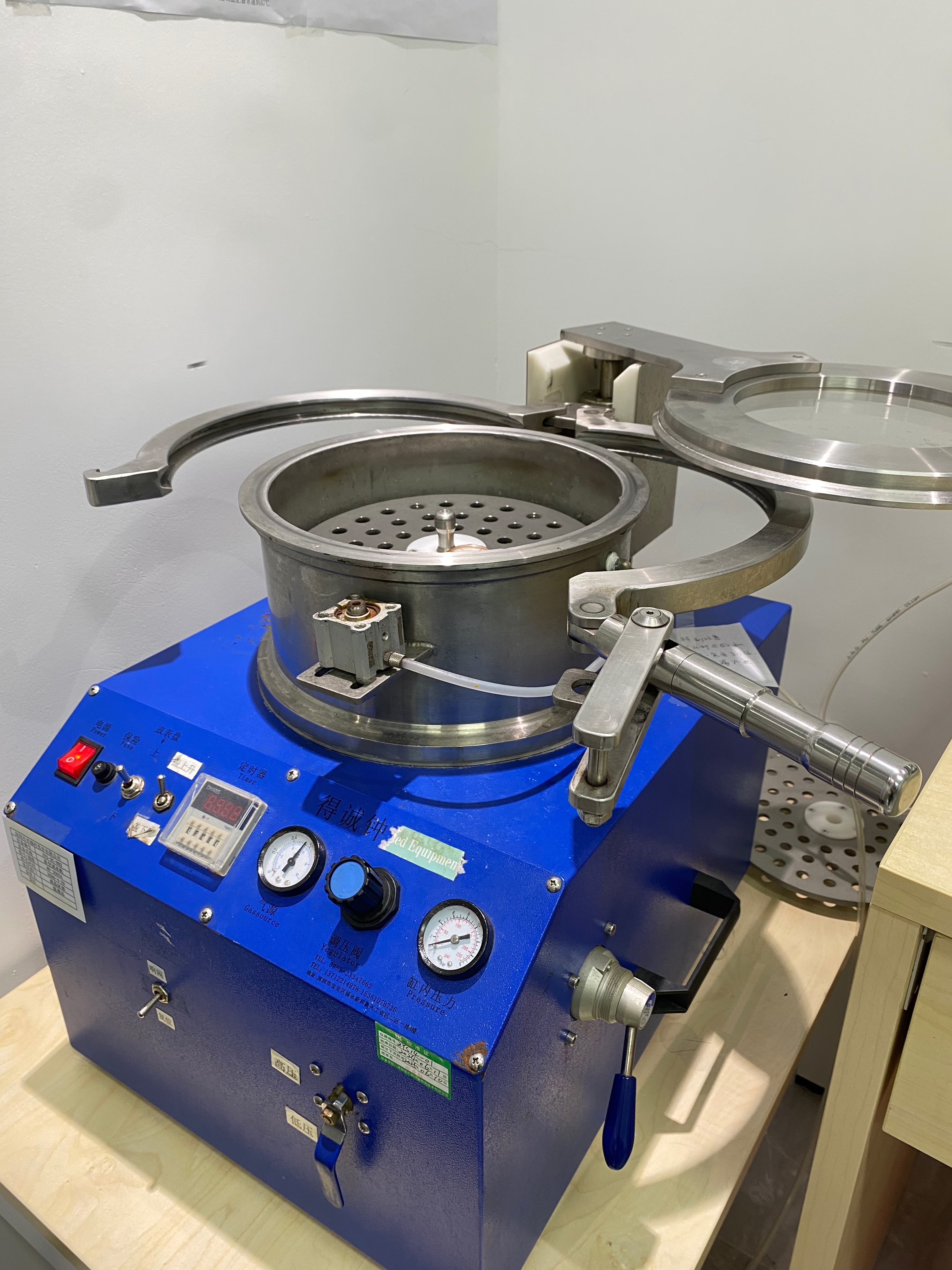
Water-resistance pressure testing: the manufacturer states that every waterproof watch, not a sample, is tested before shipment.
Why four lines, not one hero reference
Watch demand splits along movement economics. Quartz movements accounted for roughly 75% of global shipment volume in 2024, while mechanical watches contributed over 68% of total market value on much lower unit volume, according to the market data reviewed for this shortlist. The two figures describe different things — units versus value — and a brand that wants both retail reach and premium margin can reasonably carry both movement types instead of choosing one.
A shortlist built around a single hero model tends to force that decision early. A shortlist built around four options lets a brand test positioning instead: an elegant quartz line for volume reach and gifting, an automatic elegant line for a mechanical narrative, a 200-meter diver for sports credibility, and a mechanical chronograph for a technical flagship. Sourcing all four through one manufacturing relationship simplifies tooling coordination, documentation handling and repeat-order consistency, which matters more than any single specification when a collection is renewed each season.
The four options at a glance
The table separates what is documented at model level from what remains a project-level specification. Only the TD015G's 200-meter rating and 316L stainless steel construction are stated at model level in the material reviewed for this article. Water resistance for the other three lines is set per project within the manufacturer's stated 5–50 ATM capability, so the ATM value has to be written into the specification rather than assumed from the category.
| Option | Movement | Stated water resistance | Line fit | Confirm before sampling |
|---|---|---|---|---|
| Lady elegant quartz wristwatch | Quartz, button-cell driven | Project-specified, within 5–50 ATM capability | Elegant daily wear; corporate gifting | ATM level, case size, dial and strap, packaging |
| Automatic elegant wristwatch | Automatic, rotor or manual winding | Project-specified | Premium elegant retail | Calibre and grade, power reserve, ATM level |
| 8848 diving watch (TD015G) | Project-specified | 200 m; 316L stainless steel | Dive sports and sports lifestyle | Pressure-test record, standard reference, gasket service guidance |
| Mechanical chronograph | Mechanical with chronograph complication | Project-specified | Technical and sports flagship | Pusher sealing, chronograph function checks, ATM level |
Table 1: Specification-fit view of the four options — a checklist structure, not a ranking.
The table is deliberately a fit checklist. A brand whose main channel is gift-box retail and a brand selling into dive retail will weight the same rows differently, and neither weighting makes one option better than another.
Option one: the lady elegant quartz wristwatch
The lady elegant quartz option is the volume-facing entry in the shortlist. A quartz movement is driven by a button cell, a platform that is familiar to end users and straightforward to place in an elegant everyday-wear line where the watch is worn intermittently rather than continuously.
Its commercial logic rests on the shipment reality of the category: with quartz movements holding around three-quarters of unit volume in the data reviewed, a quartz elegant line meets the widest set of retail expectations and is the easiest of the four options to align with promotional and gifting programmes. For corporate gifting, the model can be presented in mixed-audience sets alongside men's elegant designs rather than as a separate programme with its own tooling budget.
The boundary is straightforward. A quartz elegant watch is a timekeeping and styling product, not a water-sports product: its ATM figure must be specified for the project and matched to the intended use. The manufacturer states 5–50 ATM support across waterproof models, with a 100% water-pressure test on every waterproof watch before shipment, so the question is which ATM level the buyer has specified for this line — not whether water resistance is available at all. Case size, dial execution, strap or bracelet and packing remain project specifications and should be fixed on the approved specification sheet before samples are signed off.
Option two: the automatic elegant wristwatch
The automatic elegant option covers similar dress-watch territory with a mechanical movement whose energy comes from a mainspring wound either by a rotor driven by wrist movement or by manual winding. Specifying an automatic movement changes what the buyer must plan for: the product gains a mechanical story suited to premium retail presentation, and it gains a wear-pattern dependency, because an automatic watch left unused will run down.
Documented project history gives this option a concrete anchor. The company's published case records a 300-unit run of customized automatic wristwatches for brand owners, wholesalers and retailers across Australia, Switzerland, Germany, France, the United Kingdom, Israel, Japan, South Korea, Sweden, Singapore and Turkey, with a client relationship lasting five years or more and stable operation reported. That record shows the automatic platform being produced at a scale well below mass volume, which is directly relevant to a brand testing a premium line before committing to larger runs.
Two points deserve attention before the line is locked. First, movement calibre, grade and finishing should be named exactly in the specification, because "automatic" alone does not define the component a buyer is approving. Second, compliance documentation is model-scoped: the CE EMC certificate held for the TOPHILL Ocean Code series quartz model TOC001L (certificate HK2404101658E, issued by HUAK against EN IEC 61000-6-3:2021 and EN IEC 61000-6-1:2019) covers that model, so an automatic line requires its own supporting file rather than inheriting an existing one.
Option three: the 8848 TD015G diving watch
The 8848 diving watch, model TD015G, is the only option in this shortlist with a model-level water-resistance figure: 200 meters, with 316L stainless steel construction. Both details matter to a dive-oriented line. 316L is a low-carbon austenitic stainless steel grade commonly selected for marine hardware and watch cases because of its corrosion resistance, and a 200-meter rating places the model in the band buyers associate with swimming, snorkelling and recreational diving rather than splash resistance.
Water resistance in a watch is created by elastic sealing gaskets at the case-back, crystal, crown and pushers, supported where used by screw-down crown and case-back structures and by precise case machining. Two standards frame the claim. ISO 22810 governs general water-resistant watches and prohibits the term "waterproof"; ISO 6425 governs diver's watches and, as the manufacturer's technical notes describe, adds dynamic pressure and salt-water corrosion testing to the static pressure test. A 200-meter figure is a static laboratory pressure value — 1 ATM corresponds to 10 metres of static water depth — and should never be presented to consumers as an operating depth.
Verification is where this option separates itself in procurement terms. The company states that every waterproof watch, not a sample, passes a water-pressure test before shipment, following a sequence of visual checks on case, crown, gasket and crystal, pressure loading with a holding period, air-leak monitoring, controlled release and drying, and a final inspection for moisture ingress. The limit is equally clear: passing a pressure test does not make resistance permanent, because gaskets age with wear, impact and chemical exposure, and hot-water or sauna use is not recommended. A brand selling the TD015G should state the rating precisely, keep test records available, and brief retailers on gasket service intervals.
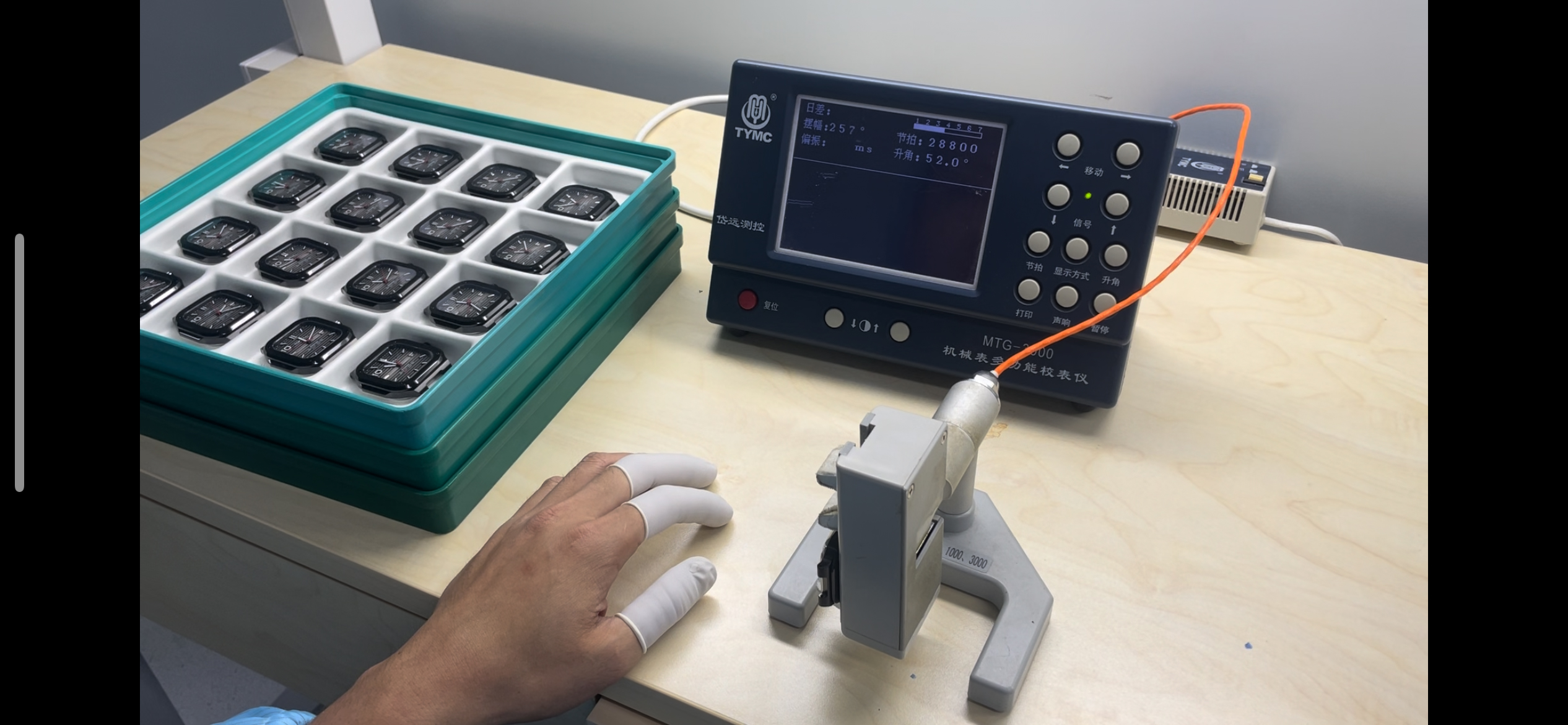
Movement accuracy testing is one of the inspection stations supporting the automatic and chronograph options.
Option four: the mechanical chronograph
The mechanical chronograph extends the shortlist into higher-complication territory. A chronograph adds pushers to the case, and pushers are sealing interfaces alongside the crown, so a chronograph's water-resistance verification has to cover more than the case-back and crystal. That makes the chronograph the option where assembly discipline and final inspection carry the most visible consequence for the buyer, because a pusher-related seal failure is easy for an end user to notice and hard for a retailer to explain.
Its market logic is value rather than volume. Mechanical watches were reported at over 68% of total market value in 2024 on lower unit volume, and the movement market was put at USD 18.4 billion in 2025 with automatic movements holding a 38.2% share — figures that describe a segment where buyers pay for mechanism and finish rather than for unit count. A chronograph line fits that logic when the brand can show what has been assembled and how it was checked.
For procurement, the chronograph should carry an explicit acceptance scope: chronograph start-stop-reset function checks, pusher operation, water resistance verified at the stated ATM level with the pushers included, and the visual and timing checks applied at final inspection. These are criteria to agree in writing before production, not assumptions to leave to the first bulk delivery.
Matching the four options to three commercial lines
Elegant daily wear. The lady elegant quartz and the automatic elegant options both serve this line. Quartz suits breadth and gifting economics; automatic suits a premium presentation with a mechanical narrative. Running both in one collection is a positioning decision, and the two should be differentiated through case proportion, dial treatment and strap rather than through price alone.
Diving sports. The TD015G carries this line with the 200-meter rating and 316L construction as the headline specifications. What a dive retailer will ask for is the pressure-test record, an accurate description of what the rating does and does not cover, and the gasket-service message — not additional superlatives.
Corporate gifting. The elegant options are the natural base for gifting programmes because they can be ordered in mixed sets and presented in programme-specific packaging. The dive and chronograph options work better as recognition pieces for a narrower audience than as default gifts, since their specifications only mean something to recipients who value them. Across all three lines the practical constraint is the same: confirm the applicable minimum order quantity for the chosen model and configuration in the quotation, because the company describes trial runs from 500 pieces while published project history includes a 300-unit automatic run.
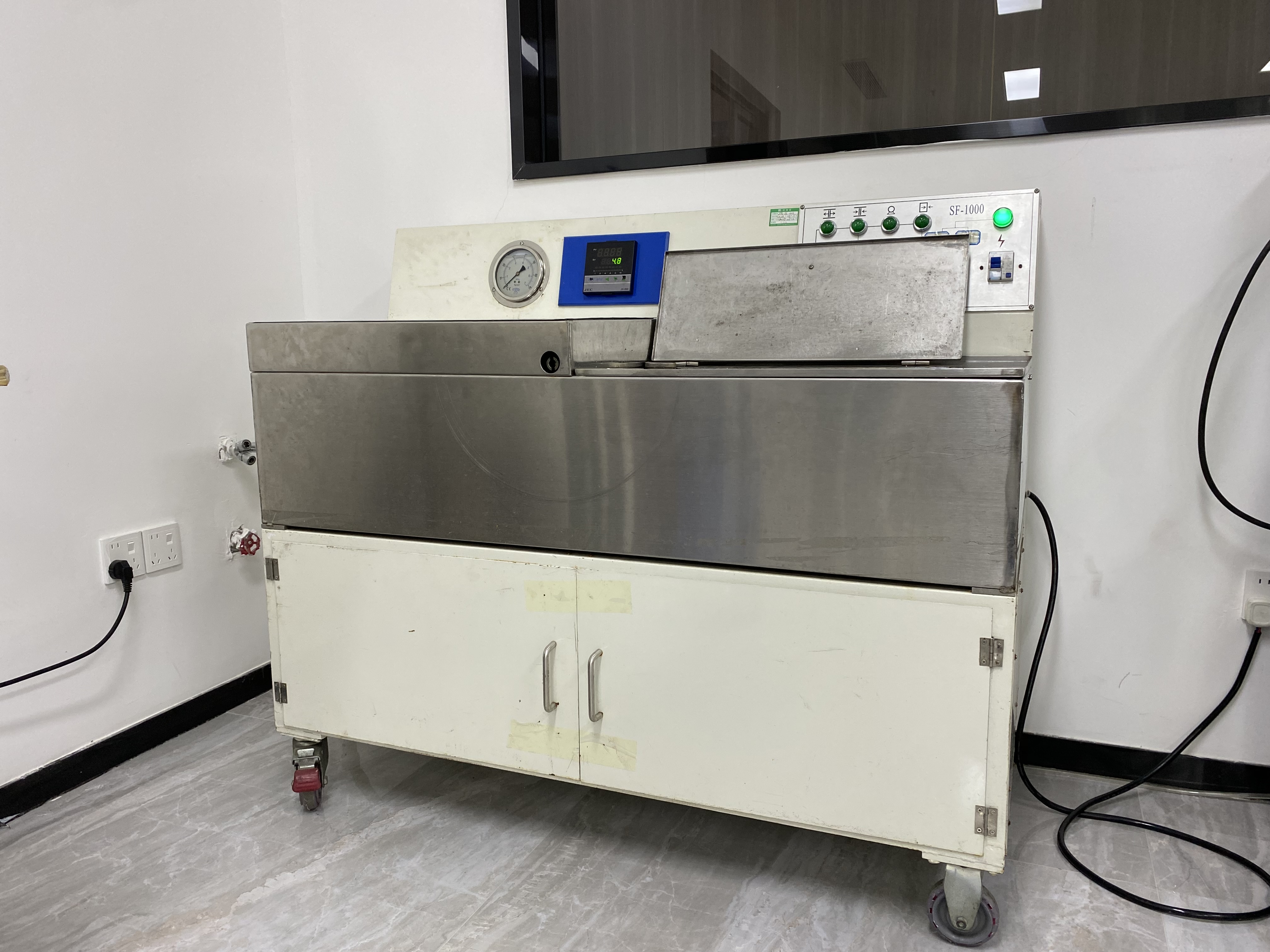
Pressure-testing equipment supports the diving line; the 200-meter figure remains a static laboratory value.
What the manufacturing base contributes
Capability figures matter only when they can be matched to an order. Shenzhen Super Time reports monthly production capacity of 50,000 to 60,000 units and a standard lead time of 75 days, alongside a class-10,000 dust-free assembly workshop, a dedicated CNC prototyping workshop and a set of inspection instruments that includes water-resistance testing machines, movement stem cutting, automatic movement accuracy testing, strap tension-torsion testing, dial index inspection and drop testing. The R&D team comprises four designers and three engineers, more than 15 core staff have over 15 years of watch-industry experience, and the company reports more than 20 million finished watches produced over three decades.
Commercially, the export profile is relevant to private-label planning: an 80% export ratio with the EU and the United States as main markets, customers across China, Europe, North America, Southeast Asia and the Middle East, and two-year after-sales support. Quality and environmental management are certified to ISO 9001 and ISO 14001, and finished products are stated to meet EU RoHS requirements. These are capability inputs rather than outcomes — capacity and lead time describe what the facility can schedule, and each of the four options still needs its own approved specification, sample sign-off and acceptance criteria.
Specification-fit checklist before sampling
The checklist below converts the shortlist into a review that can be completed before any tooling commitment. It is written for a brand, wholesaler or retailer evaluating a private-label programme rather than for a consumer.
- Name the line objective first. Decide whether the model is a volume elegant piece, a dive-sports piece or a technical flagship, because that decision fixes the specification priorities that follow.
- Fix the movement exactly. State movement type, calibre and grade in writing; "quartz" or "automatic" on its own leaves the approved component undefined.
- Write the ATM figure and the reference standard. Specify the water-resistance level and whether ISO 22810 or ISO 6425 is the appropriate reference for how the watch will be marketed.
- Confirm the case material grade. The TD015G is stated as 316L stainless steel; equivalent grade confirmation should be requested for any other line specified in stainless steel.
- Agree the inspection scope. For the chronograph, ensure pusher sealing and chronograph function checks are inside the agreed acceptance criteria rather than outside them.
- Reconcile quantity and schedule. Match the planned run against the 500-piece trial level, the 75-day stated lead time and the 50,000–60,000 unit monthly capacity, and confirm the applicable minimum in the quotation.
- Request the model-scoped compliance file. RoHS status for electronic watches and any CE documentation should be supplied for the specific model, not by reference to a different reference number.
- Agree the after-sales wording. Align the retailer-facing statement with the two-year after-sales support position and with the gasket-service reality of water-resistant watches.
- Lock packaging and set composition. For gifting programmes, mixed-set composition and presentation packaging belong in the approved specification, not in a later change order.
What this shortlist does not establish
Several limits should be stated plainly. No head-to-head performance testing across the four options has been published, so the article compares documented characteristics and commercial fit rather than measured outcomes. Per-model water resistance for three of the four options is a project-level specification, not a fixed figure. Certification is model-scoped: management-system certificates cover the facility, while product documentation such as the CE EMC certificate for model TOC001L applies to that model alone. The 300-unit automatic project is a single recorded project and not a prediction of another brand's result, and no pricing or margin data is included here. Market statistics describe the category, not the performance of any one supplier.
Outlook
The reviewed data supports a conditional outlook rather than a forecast. As long as quartz holds the majority of unit volume and mechanical watches hold the majority of value, a two-platform assortment remains a defensible structure for private-label brands, with a diver and a chronograph supplying the technical credibility that elegant lines alone do not carry. What the data does not establish is the direction of either share, so buyers should re-check current figures at the point of assortment planning and treat water-resistance ratings, movement calibres and certification scope as specification items to be verified per model.
FAQ
Does a 200-meter water-resistance rating mean the watch can be used at a depth of 200 metres?
No. A 200-meter rating is a static laboratory pressure value, and the ATM marking reflects test pressure rather than a usable depth — 1 ATM corresponds to about 10 metres of static water depth. General water-resistant watches are assessed under ISO 22810, while diver's watches fall under ISO 6425, which per the manufacturer's technical notes adds dynamic pressure and salt-water corrosion testing. Retail material should describe the rating accurately and note that water resistance is not permanent, because sealing gaskets age with wear.
How large does a first custom run need to be?
The manufacturer describes flexible trial custom runs starting at 500 pieces, with capacity for batches above 500,000 units and monthly production of 50,000 to 60,000 units. Published project history also includes a 300-unit customized automatic wristwatch run for clients in eleven markets. Because the applicable threshold depends on model, movement and packaging, the minimum should be confirmed in the quotation for the specific configuration rather than assumed from a single published figure.
Which certificates matter when selling custom wristwatches in the EU?
Three levels are normally distinguished. ISO 9001 and ISO 14001 certify the manufacturer's quality and environmental management systems rather than individual products. RoHS, under Directive 2011/65/EU, applies to electronic watches such as quartz models placed on the EU market, and the company states that its finished products meet EU RoHS requirements. CE marking is model-specific: the CE EMC certificate on file covers the TOPHILL Ocean Code series quartz model TOC001L, so each new model needs its own supporting documentation.
How is water resistance checked before shipment?
The stated process is a 100% water-pressure test on every waterproof watch rather than sampling. It covers a visual check of case, crown, gasket and crystal; loading to the target pressure with a holding period; monitoring for air leakage; controlled pressure release and drying; and a final inspection for internal moisture. The company states support for 5–50 ATM water resistance across waterproof models.
What lead time applies to a custom programme?
The stated lead time is 75 days, against monthly capacity of 50,000 to 60,000 units and a product scope covering quartz, automatic and chronograph watches. Lead time should be reconfirmed per project, because specification complexity, sampling rounds and packaging requirements differ between the four options in this shortlist.
Buyers reviewing these four options can download the company profile brochure for the full manufacturing scope, workshop and certification overview: Profile of Super Time (HK) Industrial Ltd.
Have Questions or Need More Details?
Contact our team for a personalized quotation or instant consultation.
Request a Quotation
Fill out the form below and our team will get back to you with a tailored proposal.
WhatsApp Direct Chat
Prefer to chat in real-time? Message us on WhatsApp for instant assistance & quick answers.
- Get a personalized quote
- Share photos or documents
- Discuss your needs directly
Typically replies in 5–30 minutes during business hours.