
Custom Wristwatches: ISO 9001, ISO 14001, RoHS Explained
Custom Wristwatches: ISO 9001, ISO 14001, RoHS Explained
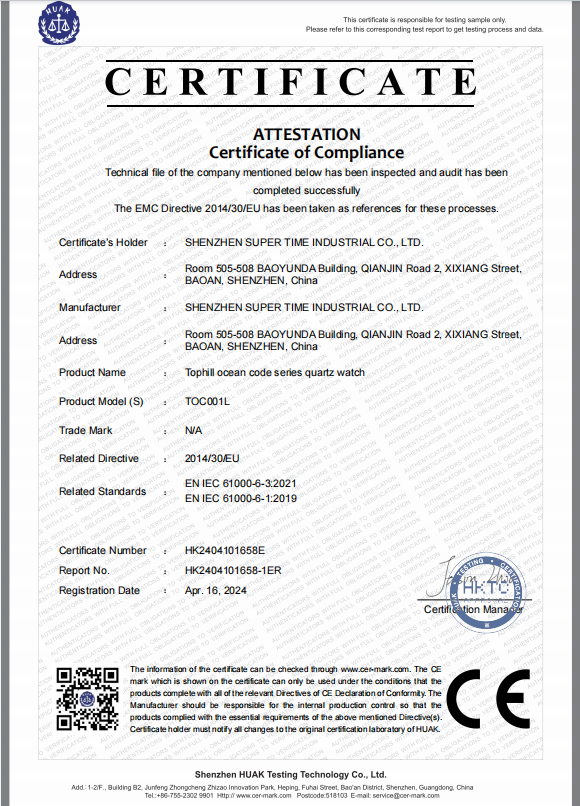
Compliance documentation only becomes useful when it can be matched to a site, a model and a test record.
Custom wristwatches are bought on evidence, and ISO 9001, ISO 14001 and RoHS each supply a different part of it. ISO 9001 addresses whether a factory operates a documented quality management system. ISO 14001 addresses whether the environmental aspects of its manufacturing are managed under a documented system. RoHS addresses whether the materials in the finished watch respect the European Union's restrictions on hazardous substances in electrical and electronic equipment. None of the three is a statement that a specific watch design will achieve a specific water-resistance rating or movement tolerance, and treating them as if they were is where sourcing decisions most often go wrong.
For brand owners, importers and distributors at the research and evaluation stage, the useful question is narrower: which document should be requested, from which legal entity and production site, covering which model, and what does that document deliberately not prove? Shenzhen Super Time CO., LTD., the manufacturer behind the TOPHILL watch brand, records ISO 9001 certification for quality management, ISO 14001 certification for environmental management, and EU RoHS compliance for its finished products, with the EU and the United States accounting for 80% of its sales. That combination makes the company a workable factual example for tracing how management-system and materials-compliance evidence supports a custom OEM/ODM watch project.
Why compliance evidence usually arrives too late
Most custom watch briefs begin with the visible variables: case shape, dial colour, movement family, strap, packaging and target price. Compliance documents are requested later, frequently once a purchase order is already being drafted. That sequence carries two predictable costs. A supplier that cannot produce a scoped certificate, a valid test record or a material declaration has to be removed at a point when samples and tooling time have already been spent. And a certificate that turns out to cover a different model, a different site or a lapsed period pushes the buyer into a re-qualification cycle.
The cheaper sequence is to treat compliance as a filter during research, before samples are cut. Three questions do most of the work: does the supplier hold management-system certification that names the actual production site; can it show materials-compliance documentation aligned to the model being quoted; and are model-level performance records available for the specification under discussion? A supplier that answers all three with documents rather than assurances stays in the pool for the next stage.
ISO 9001 in a custom watch program: what the certificate covers
ISO 9001 is a quality management system standard. Certification means an external body has audited how a manufacturer controls its processes: document control, supplier evaluation, inspection and test status, calibration, handling of nonconforming output, and corrective action. The claim it supports is specific: the factory can demonstrate a repeatable system for producing to a stated specification.
In watch assembly that system has visible consequences. It governs how incoming cases, dials, hands, crystals and movements are verified against the approved specification; how test instruments are calibrated; how a rejected batch is segregated and dispositioned; and how a deviation found at final inspection is traced back to the operation that produced it. These controls are what allow a second or third production run to resemble the first, which is the part of custom manufacturing that buyers underwrite but rarely observe directly.
The certificate is a document with a scope, and the scope is what a buyer should actually read. Relevant details include the certification body, the certificate number, the standard version, the validity period and, most often overlooked, the site address named on the document. Shenzhen Super Time CO., LTD. records ISO 9001 certification, and its company profile also records a full-plant relocation to Dongguan completed in 2024. Relocations are precisely why the named site matters: certification is issued to a facility and the management system operating there, not to a brand name or a catalogue.
What ISO 9001 does not do is fix product specifications. It does not confirm that a watch reaches 10 ATM, that a movement runs inside a stated tolerance, or that a bezel insert is ceramic rather than coated metal. Those remain model-level questions answered by specification sheets and test records for the build being ordered.
ISO 14001 and what environmental certification means to a buyer
ISO 14001 is the environmental management counterpart. Certification indicates that a manufacturer has identified the environmental aspects of its operations, set controls and objectives for them, and is audited on how it manages them. In watch manufacturing the relevant aspects typically sit in metal finishing and plating, adhesives and solvent-based processes, handling of rejected components, and collection of spent button cells from quartz production, the same cells that drive quartz movements.
For a buyer, ISO 14001 functions mainly as a supply-chain screen rather than a product claim. It becomes material when a buyer reports on supplier environmental management, when an EU distributor requests supplier-level documentation during its own onboarding, or when a brand is assembling a supplier file intended to last several production cycles. It does not support describing an individual watch as environmentally friendly, recycled or low-impact; those are product-level claims that require separate evidence.
The verification routine mirrors ISO 9001: scope, site, issuing body, certificate number and validity. A frequent gap is a certificate that names a sales office or a group entity while assembly takes place at another address. Shenzhen Super Time CO., LTD. records ISO 14001 certification alongside its quality system, and states that production activities adhere to the requirements of both systems.
RoHS and EU market access: the material-level question
RoHS is a different category of requirement. It is not a management-system standard but a legal restriction: EU Directive 2011/65/EU limits the presence of specified hazardous substances in electrical and electronic equipment placed on the EU market, and for electronic watches, including quartz and smart models, compliance is mandatory for that market. Shenzhen Super Time CO., LTD. states that its finished products meet EU RoHS compliance standards for overseas market access, a claim consistent with an export profile in which the EU and the United States account for 80% of sales.
What a buyer should request is not a sentence in a catalogue but a file. Useful components include a declaration referencing the specific bill of materials, material declarations from component suppliers for items such as the movement, battery, dial, hands, plating and strap, and laboratory test reports where the supplier relies on analysis of homogeneous materials. The control question matters as much as the certificate itself: how does the manufacturer prevent an unapproved substitute material from entering a repeat order?
Electrical compliance can also extend beyond substance restriction. One supplied certificate records CE compliance under the EMC Directive for the EU market: certificate number HK2404101658E, issued by HUAK on 16 April 2024 against EN IEC 61000-6-3:2021 and EN IEC 61000-6-1:2019, with the record listing validity to 16 April 2099. The instructive detail is the scope. The certificate names a defined product scope and model designation, so a buyer ordering a different model should confirm whether that model sits inside the certificate's scope instead of assuming the document transfers. RoHS likewise sits alongside other EU obligations rather than replacing them, and buyers should confirm which regimes apply to their own product and market rather than treating a single RoHS statement as complete coverage.
From certificate to build: where compliance evidence meets the watch
Compliance documentation becomes credible when it lines up with materials and tests a buyer can check at model level. Across this supplier's range, the recurring structural material is 316L stainless steel, used for cases and bracelets in both quartz and mechanical models, combined with brass in some constructions, ceramic for bezel inserts, sapphire for crystals and genuine leather for straps. Each of those material families has its own declaration trail, which is why a bill-of-materials-level RoHS file is more informative than a generic compliance statement.
Movements are specified as identifiable, named components rather than generic categories: Japan quartz in the TR001 customization model, Ronda quartz in TAM002, Miyota quartz in TAM001, Miyota Automatic 8215 in the TD015G and TD017G diving watches, Miyota 9039 in the KIM002, and a Seagull ST1905 manual-winding chronograph movement with power reserve in the KIM003. Naming movements serves two purposes. It lets a buyer verify which supplier declarations belong in the materials file, and it keeps the specification auditable at repeat order instead of depending on an internal product code.
Water resistance follows the same logic. The company supports 5–50 ATM ratings and states that every water-resistant watch receives a 100% water-pressure test before shipment rather than a sampled check. Model-level ratings in the current range run from 3 ATM on the quartz customization models, through 5 ATM on the KIM002 and KIM003, to 10 ATM on the TD017G and 200 metres on the TD015G. Testing references ISO 22810 for general water-resistant watches and ISO 6425 for diver watches, and the term waterproof is not used, consistent with the restriction those standards place on it.
The supporting equipment list, which includes a 500-metre water-resistance testing machine, an automatic movement accuracy tester, a movement stem cutting machine, a strap tension-torsion tester, a dial index inspection machine and a drop tester, is what a quality management system is meant to keep calibrated and traceable. That is the practical link between an ISO 9001 certificate and a shipment: the certificate covers control of those instruments and the records they generate, not the outcome of any single watch.
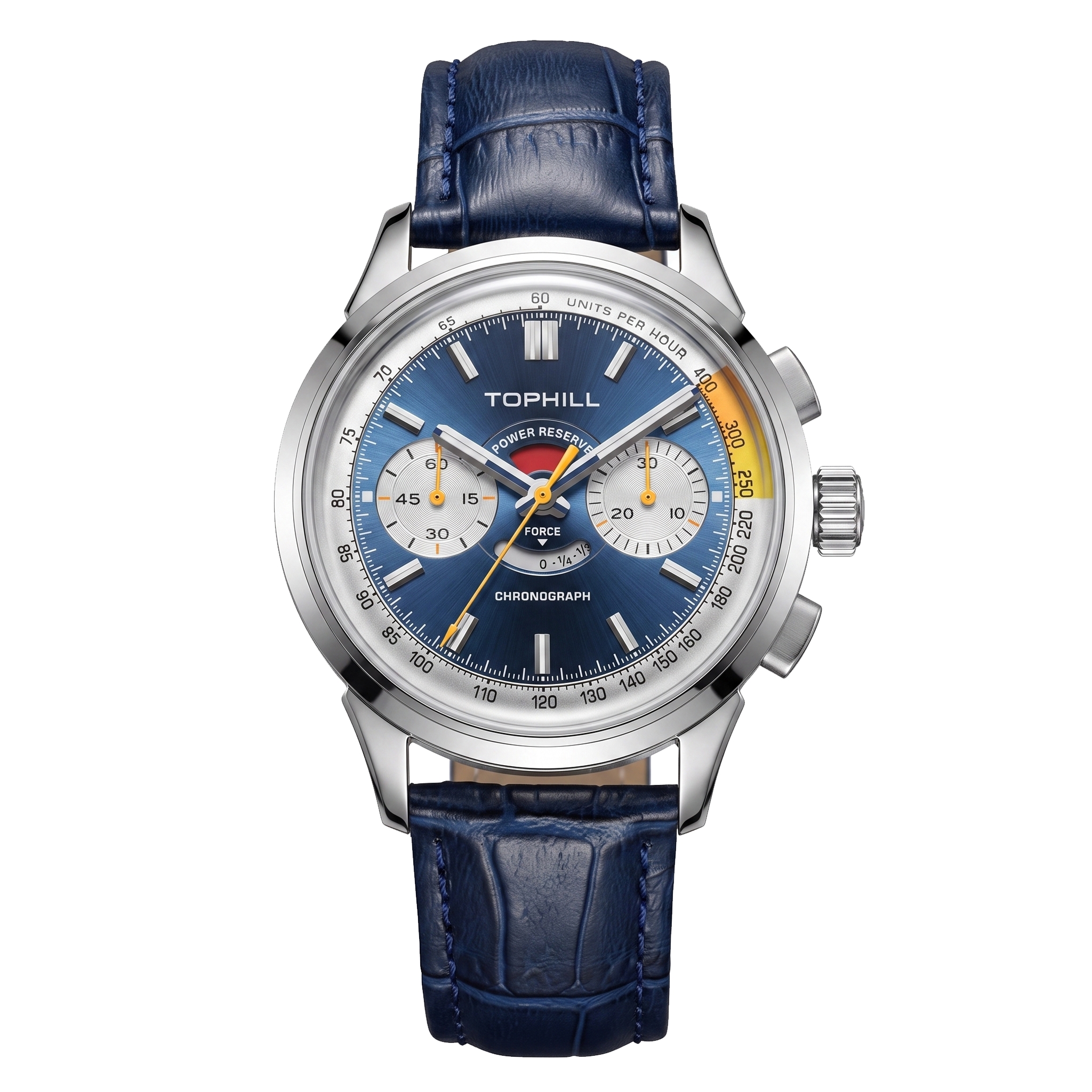
KIM003 mechanical chronograph: 316L stainless steel case, Seagull ST1905 movement with power reserve, 5 ATM water resistance.
Scenario fit: which build each credential actually serves
Compliance requirements follow the application, not the catalogue position. A diving-oriented program and a corporate gifting program do not need the same file, and matching the evidence to the use case avoids both over-documenting a simple order and under-documenting a demanding one.
Diving sports custom wristwatches. The TD015G carries a 200-metre rating with a 316L stainless steel case, a rotating bezel with ceramic insert and BGW9 luminous, a flat sapphire crystal and a Miyota Automatic 8215 movement. The TD017G is rated 10 ATM with a ceramic bezel insert with luminous, an embossed gradient dial and luminous hands on the same movement family. The relevant documents here are model-level pressure-test records and the material declarations covering gasket, crystal and bezel components. The boundary condition is documented in the supplier's own technical material: passing a pressure test does not make water resistance permanent, because sealing gaskets age with wear, impact and chemical contact.
Business and chronograph programs. The KIM003 mechanical chronograph combines a 316L stainless steel case, a curved boxed sapphire crystal, an embossed two-layer dial with applied indexes and a genuine leather strap at 5 ATM. The KIM002 automatic uses the ultra-thin Miyota 9039 at 5 ATM with a flat sapphire crystal and see-through caseback. For these models the compliance conversation moves toward movement provenance and assembly control rather than water pressure.
Luxury women's and gifting builds. The TR001 quartz model, the TAM002 with Ronda quartz and the TAM001 with Miyota quartz all use 316L stainless steel with zircon-set bezels, flat sapphire crystals and 3 ATM ratings. At 3 ATM the stated boundary is daily wear, hand-washing and rain splash, not swimming. Buyers using these models for corporate gifts should keep that rating explicit in the packaging and product copy so end users are not given a water-resistance impression the specification does not support.
Private label and OEM/ODM development. Design work here runs through a team of four designers and three engineers plus a CNC prototyping workshop, which is where logo application, dial artwork and case modifications are resolved before tooling. Buyers should expect prototype and approval steps to consume part of the stated lead time rather than sit outside it.
The buyer's documentation checklist
The checklist below converts the three credentials into specific requests. It is written as a working list for an RFQ package rather than a general guide, because each item is only useful when it is tied to a site and a model.
| Document | What to check | What it establishes | What it does not |
|---|---|---|---|
| ISO 9001 certificate | Issuing body, number, standard version, validity, production site address | Audited quality management at that site | Any model-level performance figure |
| ISO 14001 certificate | Same fields, plus whether the site is the factory or a sales office | Audited environmental management at that site | A product-level environmental claim |
| RoHS declaration and material declarations | Model and BOM reference, date, substance list, supplier flow-down | Substance restriction for the covered materials | Durability, accuracy or water resistance |
| CE EMC certificate where applicable | Certificate number, cited standards, model scope, issue date | EMC compliance for the scope stated | Coverage of models outside that scope |
| Model test records | Pressure-test method, accuracy records, batch reference | Performance of the tested build | Permanent water resistance over years of wear |
| Material specification | 316L grade, ceramic insert, sapphire, leather identity | Specification match to the approved sample | Origin claims beyond what is documented |
The supplier in this example: Shenzhen Super Time CO., LTD.
Shenzhen Super Time CO., LTD. was founded in Shenzhen in 1992 and completed a full-plant relocation to Dongguan in 2024. It operates as a full-cycle mid-to-high-end watch manufacturer combining R&D, original design, mass production and global sales, and runs its own watch brand, TOPHILL, alongside custom OEM and ODM projects for international brand clients. The manufacturing site is recorded at 1,500 m² and includes a class-10,000 dust-free assembly workshop and a dedicated CNC prototyping workshop, supported by a team of four designers and three engineers, with more than 15 core staff holding over 15 years of experience in the watch industry.
Documented capability includes OEM/ODM customization with a minimum order quantity of 300 pieces, a standard lead time of 75 days, 100% testing, two years of after-sales support, and export markets covering the EU, the USA and the Middle East. The company records an annual output of 400,000 units and more than 20 million finished watches manufactured to date, with 80% of sales going to the EU and the United States. Its customer base is business-to-business: brand owners, wholesalers and retailers rather than end users, and its supplied case record covers a 300-unit project sustained over five years or more with stable operation. Buyers who want to verify the corporate and capability background directly can review the company website at Shenzhen Super Time CO., LTD..
What these credentials do not tell you
Each of the three credentials has a defined limit, and stating those limits is part of using them responsibly. ISO 9001 and ISO 14001 certify systems at a site; they do not certify a watch. RoHS restricts substances in covered materials; it says nothing about accuracy, durability or water resistance. A CE EMC certificate covers the product scope and standards printed on it; it does not silently extend to a new model. A pressure test confirms a unit at the time of testing; it does not make a gasket permanent, which is why service intervals and gasket replacement remain part of ownership.
The comparison that matters in procurement is not between certified and uncertified suppliers in the abstract, but between documents that name a manufacturing site and a model and documents that do not. A compliance file issued to a trading entity, or one whose scope describes a different product family, does not describe the factory that will build the order. The practical decision rule is straightforward: prefer the supplier whose certificates name the production site, whose materials file references the actual bill of materials, and whose test records can be tied to the batch being shipped. Where a document is silent, ask rather than infer, and treat a missing answer as a qualification gap rather than a detail to settle after the deposit.
Market context for compliance-led sourcing
Market structure explains why the documentation workload is unevenly distributed. Third-party research published in 2024 reports that quartz movements account for roughly 75% of global shipment volume, while mechanical watches contribute over 68% of total market value despite lower unit volume. Read together, those two figures suggest where compliance effort concentrates: high-volume quartz programs generate most of the bill-of-materials declarations and battery-related documentation, while mechanical programs concentrate value and therefore scrutiny on component provenance, movement identity and assembly control.
For buyers selling into the EU, the RoHS requirement is a legal condition of market access for applicable product categories rather than a commercial preference, which places materials documentation inside the RFQ rather than after it. The outlook that follows is conditional rather than forecast: suppliers that can produce site-named management-system certificates and model-linked test records will spend less time in re-qualification, and buyers who define the document set at the research stage will compare suppliers on evidence instead of on presentation. No part of that depends on predicting market growth; it depends only on the sequence in which the questions are asked.
FAQ
Does ISO 9001 certification mean a custom wristwatch will meet its stated water-resistance rating?
No. ISO 9001 certifies a quality management system at a named site, not the performance of an individual model. The rating is established by the model specification and by pressure-test records for that build. A buyer should ask for the test method, the rating claimed and the batch link, and should note that testing references ISO 22810 for general water-resistant watches and ISO 6425 for diver watches. Shenzhen Super Time CO., LTD. states that every water-resistant watch receives a 100% water-pressure test before shipment, and that water resistance is not permanent because sealing gaskets age with wear.
Is RoHS compliance required for custom wristwatches sold in the EU?
For electronic watches, including quartz and smart models, RoHS compliance under Directive 2011/65/EU is mandatory for the EU market. For models built without electronic components, the buyer should confirm with a compliance specialist whether the directive applies to that specific product, because scope depends on whether the item qualifies as electrical or electronic equipment. RoHS also sits alongside other EU obligations rather than replacing them, so the applicable regimes should be confirmed for each product and market.
What documents should a buyer request before approving a custom watch order?
A practical package contains five items: the ISO 9001 certificate with scope, validity and production site address; the ISO 14001 certificate on the same basis; a RoHS declaration referencing the specific bill of materials together with component material declarations; any applicable CE certificate with its cited standards and model scope; and model-level test records covering water resistance and movement accuracy. The last step is confirming that the model designations on the certificates match the models being ordered, since a certificate is bounded by its stated scope.
How should a buyer handle certificate validity and site changes?
Certificates carry a defined validity period and are maintained through surveillance audits, so buyers should check the stated validity and request the current document rather than relying on a summary in a brochure or on a supplier's verbal confirmation. Site changes matter equally: when a manufacturer relocates production, the certificate must describe the facility where the work actually takes place. Shenzhen Super Time CO., LTD. records a full-plant relocation to Dongguan completed in 2024, which makes the site address on its certificates a relevant check rather than a formality.
Do ISO 14001 or RoHS status make a watch sustainable?
Neither credential supports that description. ISO 14001 indicates that environmental aspects of manufacturing are managed under an audited system at a site. RoHS indicates that specified hazardous substances are restricted in covered materials. Sustainability claims about an individual watch would require separate, product-specific evidence that neither document supplies, and buyers should keep those claims out of product copy unless such evidence exists.
Company profile and capability brochure for reference: Super Time company profile (PDF).
Have Questions or Need More Details?
Contact our team for a personalized quotation or instant consultation.
Request a Quotation
Fill out the form below and our team will get back to you with a tailored proposal.
WhatsApp Direct Chat
Prefer to chat in real-time? Message us on WhatsApp for instant assistance & quick answers.
- Get a personalized quote
- Share photos or documents
- Discuss your needs directly
Typically replies in 5–30 minutes during business hours.