
Custom Wristwatches for Diving and Daily Wear: A Sourcing Guide
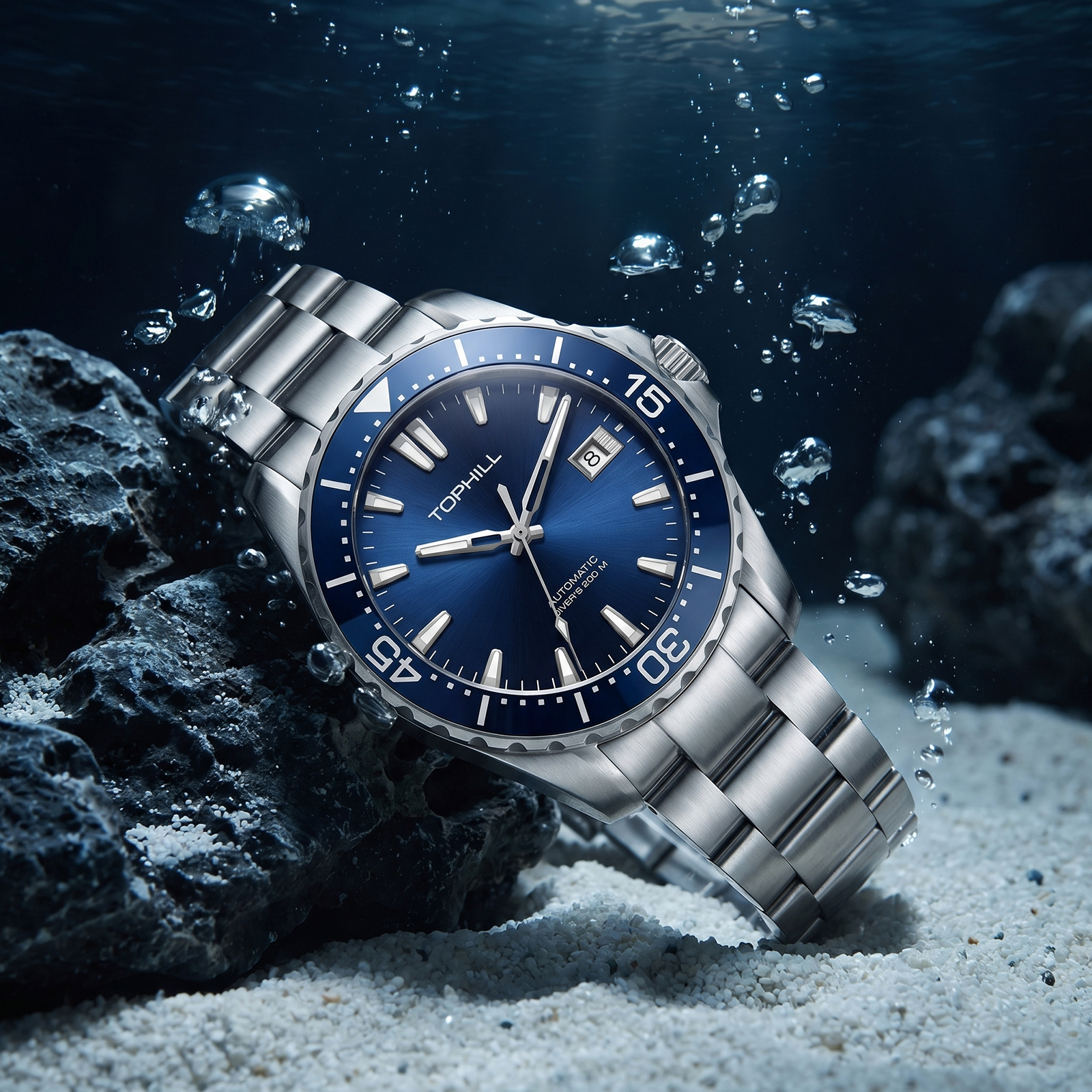
Custom wristwatches are no longer limited to promotional giveaways. Brands in fashion, retail, sports accessories and corporate gifting use them to create product lines without owning a factory. For buyers at the awareness and research stage, the first step is understanding what an OEM/ODM watch manufacturer can actually deliver.
Why Custom Wristwatches Matter
Custom wristwatches allow a brand to control case material, dial finish, movement, strap, water resistance and packaging. This control matters because watches are positioned differently across gift, fashion, sports and business segments. A private label custom wristwatch program can, therefore, be built around a clear target customer instead of an existing retail catalog.
The Sourcing Problem Behind Custom Watch Programs
Most watch brands start with a concept, not a factory. The difficulty is that a custom watch involves several independent decisions at the same time. Case material, crystal type, dial finishing, movement brand, water resistance and compliance all have to be aligned. A supplier that only handles one movement type can limit product range. The opportunity is to work with a manufacturer that can cover quartz, automatic and chronograph watches with standardized assembly and testing.
What TOPHILL and DONGGUAN SUPERTIME Bring to Custom Watch Projects
TOPHILL is the proprietary watch brand of DONGGUAN SUPERTIME CO., LTD., a watch manufacturer specializing in custom OEM and ODM projects. The company was formerly Shenzhen Zhuoyueshi Industrial Co., Ltd. and completed a full-plant relocation to Dongguan in 2024. Its main products include customized watches, quartz watches, automatic watches and chronograph watches.
Manufacturing is supported by a 1,500-square-meter facility and an R&D team of four designers and three engineers. Annual production capacity reaches 400,000 units, and the company has produced more than 20 million finished watches to date. Export business accounts for 80 percent of total sales, with major markets including the EU and the United States. The company is certified to ISO 9001 and ISO 14001, and finished products meet EU RoHS compliance standards.
For buyers, these details create a useful base line. Large-volume capacity, export experience and compliance certification reduce the risk of discovering missing documentation late in a project.
Diving Sports Custom Wristwatches: A Product Category Worth Specifying
Within the broader custom wristwatch category, diving sports custom wristwatches deserve separate attention. A dive-style watch must handle more than visual styling. It needs water-resistant construction, clear readability in low light and a movement that can support field use. Model TD015G is a stainless steel dive watch with water resistance up to 200 meters. It belongs to the categories of diving watches, automatic winding watches and men's watches. It is powered by a Japan Miyota Automatic 8215 movement and features a ceramic bezel insert with BGW9 luminous.
Another diving model, TD017G, is classified as a diving watch, automatic watch and luminous watch. It is made of 316L stainless steel and is suitable for work and casual wear. Typical application scenarios for diving and sports custom watches include everyday wear and water-related activities. For brands aiming at a sports-oriented line, this is a product segment where functionality can be demonstrated with test data rather than unprotected claims.
Technical Considerations Buyers Should Understand
Movement Types
Movements are the core technical decision. Custom wristwatches can be built around quartz, mechanical or solar-powered movements. Quartz watches are battery-driven. Mechanical watches run on energy stored in a mainspring, through manual winding or automatic rotor winding from wrist movement. Solar-powered watches convert visible light into stored electrical energy for time-keeping.
In the TOPHILL product range, quartz custom watches include models with Ronda quartz movements and Japanese quartz movements. Automatic sports models use a Japan Miyota Automatic 8215 movement. For chronograph needs, the KIM003 is a mechanical chronograph watch, classified as a manual winding chronograph and customized wristwatch. The KIM001 is an ultra-slim manual winding mechanical wristwatch with a case thickness of less than 9 mm, while KIM002 is an automatic winding wristwatch designed for fashion, gift and retail scenarios.
Materials and Construction
Materials also matter. 316L stainless steel is listed as the primary material for many custom models, and some cases include brass components. Sapphire crystal is used for scratch resistance on models such as TR001, TAM001, TAM002, TD015G and KIM002. Leather straps appear on chronograph and elegant models, while stainless steel bracelets are common in diving and dress watches.
Model TR001 is a custom quartz wristwatch designed for use in fashion and gift scenarios. It has a 316L stainless steel case with zircon stones, a flat sapphire crystal, a glossy dial and a Japan quartz movement, with water resistance to 3ATM. TAM001 is a lady elegant quartz wristwatch with a flat sapphire crystal and a sunburst dial with applied indexes. TAM002 is a customized quartz watch in the lady and elegant categories, constructed with 316L stainless steel and brass, a flat sapphire crystal and a sunburst dial with applied indexes and set zircon stones.
Water Resistance and Testing
Water resistance is one of the most important performance features in this category. The manufacturer supports 5 to 50 ATM water resistance for waterproof watches. Every waterproof watch receives a 100 percent full-unit water pressure test before shipment, not random sampling. This is important for buyers because water ingress can cause after-sales failures.
Testing follows a clear process: visual check of the case, crown, gasket and crystal; pressure loading and holding; leak monitoring; pressure release; and final inspection. General water-resistant watches are evaluated according to ISO 22810, while diver watches are evaluated under ISO 6425. The ATM mark indicates static laboratory pressure, not actual usable diving depth. 1 ATM equals 10 meters of static water depth.
Application and Use Cases
Custom wristwatches are applied across fashion accessories, jewelry and ornaments, premium gifts, corporate promotional gifts and retail consumer goods. These are the industries most often associated with private label watch programs. Within this range, a corporate customer can order a custom quartz wristwatch as a business gift, while a fashion brand can build a jewelry-style women's line with zircon-set cases.
Luxury women custom wristwatches can be supported by models such as TAM001, a lady elegant quartz wristwatch, or TAM002, a customized quartz watch in the lady and elegant categories. Business men custom wristwatches can be built around automatic or chronograph configurations. KIM001 is an ultra-slim manual winding mechanical wristwatch, KIM002 is an automatic winding wristwatch, and KIM003 is a mechanical chronograph watch made of 316L stainless steel, brass and genuine leather, designed for sports and daily time-tracking needs.
Market Trend Analysis
Several verified market signals explain why custom watch programs are relevant. The global mechanical watch market is projected to reach USD 47.5 billion by 2025. Quartz movements dominate global shipment volume with a 75 percent share, while mechanical watches contribute over 68 percent of total market value. The global watch movement market reached USD 18.4 billion in 2025, with automatic movements holding a 38.2 percent share.
These figures point to a dual market. Quartz provides volume and accessibility; automatic and mechanical watches support higher price points and brand value. A single-source custom wristwatch supplier who can cover both is therefore more useful than one restricted to a single movement family.
Comparison with Traditional Sourcing
Traditional sourcing normally means buying finished watches from existing brand catalogs. Custom manufacturing follows a different decision path. The two approaches answer different needs.
| Sourcing Approach | Typical Characteristics |
|---|---|
| Product identity | Brand catalog vs private label, co-designed or own brand |
| Supplier role | Finished goods supplier vs OEM/ODM manufacturer involved in design and production |
| Minimum order | Often single units vs small-batch trial custom runs starting at 500 pieces and high-volume orders above 500,000 units |
| Lead time | Generally immediate vs project-based, including prototyping and structural optimization |
| Testing and compliance | Managed by the brand vs must be verified with the factory |
Limitations to Plan For
Custom watch programs have boundaries. A trial order starts at 500 pieces, so very small runs may not be economical for a startup. Custom projects also require coordination between design, engineering and production; this takes time. Buyers should therefore request realistic project timelines and confirm testing procedures before placing a production order.
Future Outlook
Looking ahead, buyers are expected to request more verifiable supplier data: movement brand, water resistance test method, compliance certificates and production capacity. Diving sports custom wristwatches fit this trend because water resistance is a concrete performance attribute. Compliance standards such as ISO 22810 and the EU RoHS directive will remain part of the baseline for export markets.
An overview of TOPHILL and DONGGUAN SUPERTIME production capabilities is available here: Company Profile.
Frequently Asked Questions
What water resistance level can a custom watch manufacturer achieve?
For waterproof watches, the manufacturer supports 5 to 50 ATM water resistance. Every waterproof watch receives a 100 percent full-unit water pressure test before shipment, not only random sampling.
Does a higher ATM rating mean the watch can be used for diving at that corresponding water depth?
No. ATM is a static laboratory pressure value, not actual usable diving depth. A rating above 20 ATM is generally associated with diver watch standards, but real diving conditions include movement, temperature change and salt water.
Will a watch remain waterproof forever after passing the water pressure test?
No. Water resistance is not permanent. Gaskets age over time with wear, impact and chemical contact.
Can a 10 to 20 ATM watch be worn in a sauna or hot-water bath?
Not recommended. High-temperature steam deforms and ages rubber gaskets, which can destroy waterproof performance.
What compliance standards matter for custom wristwatches?
For EU markets, quartz and other electronic watches must meet RoHS compliance under Directive 2011/65/EU. General water-resistant watches follow ISO 22810, and diver watches are evaluated under ISO 6425.
Have Questions or Need More Details?
Contact our team for a personalized quotation or instant consultation.
Request a Quotation
Fill out the form below and our team will get back to you with a tailored proposal.
WhatsApp Direct Chat
Prefer to chat in real-time? Message us on WhatsApp for instant assistance & quick answers.
- Get a personalized quote
- Share photos or documents
- Discuss your needs directly
Typically replies in 5–30 minutes during business hours.