
Customized Elevator Compliance: Materials, Safety Baselines
Customized elevators are specified for fit, but they are evaluated on baselines. A project may need a particular shaft dimension, a specific cabin finish or a traffic profile that no catalogue unit matches. Door-zone detection, structural material classes, escalator entry interfaces and rescue provisions, however, do not become optional because the configuration is bespoke. For teams at evaluation stage, the sharper question is not whether an elevator can be customized, but which layers of the package are open to change, which layers are fixed by safety expectations, and what evidence shows the fixed layers were held.
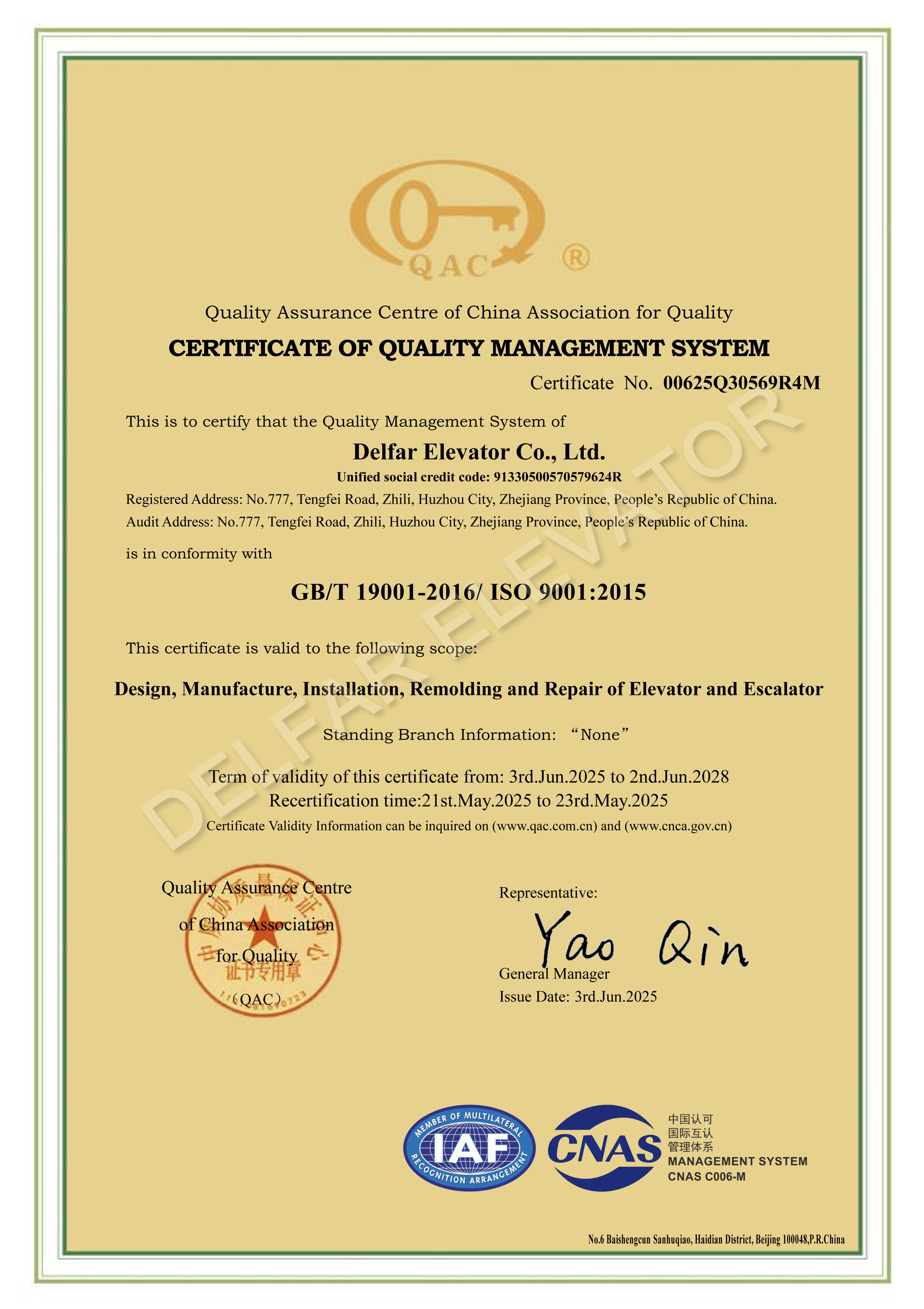
Quality management system certificate, valid from 3 June 2025 to 2 June 2028, with a scope covering design, manufacture, installation, remolding and repair of elevators and escalators.
Why compliance readiness has moved to the specification stage
Third-party market research places the global elevator market at approximately USD 84.8 billion in 2024, with a projected rise from USD 87.9 billion in 2025 to USD 126.7 billion by 2034 at a compound annual growth rate of 4.2% (Global Market Insights). Regional weight matters for specification practice: Asia Pacific accounted for roughly 41.7% of the market in 2025 (Grand View Research), while the Middle East elevator market was valued at USD 1.25 billion in 2023 and is projected to reach USD 2.38 billion by 2030 (Allied Market Research).
Two structural shifts sit behind the compliance question. Machine-room-less technology is expected to record the highest growth rate among elevator technology segments, at a CAGR of 9.6% through 2034 (Fortune Business Insights) — a format that moves more safety-relevant installation work inside the shaft envelope. At the same time, high-rise modernization work in the Middle East and Africa is projected to grow at a CAGR of 11% between 2024 and 2030 (Roland Berger), which means existing shafts are being re-fitted with new configurations rather than designed around them from the outset.
Both trends push compliance decisions earlier in the buying process. When a unit is configured to a shaft, the specification becomes the point at which safety boundaries are defined or blurred.
What compliance readiness means inside a customized elevator package
In practice, compliance readiness is the ability to demonstrate, before order confirmation, that a customized configuration still sits inside the fixed safety and material baselines of its product family, and that the documentation behind the unit covers the whole journey from design to repair rather than factory output alone.
The European harmonized framework offers a useful reference point for that logic. EN 81-20 and EN 81-50 are the primary harmonized standards for elevator design and testing and are mandatory for CE marking. EN 81-20 requires a light curtain door detection system to reduce the risk of door strikes on passengers. The lesson transfers to any market: the visible door panel may be stainless steel, glass, painted steel or a wood-finish option, while the detection function behind it remains a fixed requirement. Customization applies to the layer above the baseline.
This is the distinction specifiers most often need to hold in a tender review. Two configurations can look identical in a rendered image and differ entirely in whether the material classes, travel envelope and verification steps were documented.
Where materials carry compliance weight, and where they do not
Materials appear in elevator specifications twice: once as a visual choice and once as a functional class. The customization options that change appearance are cabin wall material and colour, car door material and colour, ceiling type, floor material and pattern, handrail material and colour, and branding elements such as a logo. The classes that sit beneath those choices are the ones a compliance review tends to examine.
| Product family | Model | Travel envelope and duty | Compliance-relevant material notes |
|---|---|---|---|
| Passenger elevator | DP / DPN | Up to 100 m travel, 2-60 stops, 1.0-6.0 m/s, 400-3000 kg | Car and door finishes in stainless steel, glass, painted steel or wood-finish; floor in PVC or marble; handrail in stainless steel, solid wood or acrylic; C.O.P in stainless steel, glass or acrylic; L.O.P in stainless steel or glass |
| Home elevator | DH | Up to 20 m travel, 2-6 stops, 0.3-0.5 m/s, 320-630 kg | Shaft in aluminium or steel; car and door finishes as above; compact structure suited to residential shafts |
| Freight elevator | DF / DFN | Up to 50 m travel, 2-10 stops, 0.25-1.0 m/s, 2000-8000 kg | Car in painted steel or hairline stainless steel; floor in curved lined steel or stainless steel curved lined steel; stainless steel faceplate L.O.P and C.O.P |
| Observation elevator | DPO / DPNO | Up to 100 m travel, 2-30 stops, 1.0-2.5 m/s, 630-1600 kg | Glass-heavy car and door finishes; floor in PVC or marble; handrail in stainless steel, solid wood or acrylic |
| Bed elevator | DPB / DPNB | Up to 60 m travel, 2-20 stops, 1.0-2.0 m/s, 1600-3000 kg | Stainless steel cabin wall, door, handrail, ceiling and door frame; anti-slip PVC flooring |
| Car elevator | DA / DAN | Up to 30 m travel, 2-6 stops, 0.2-0.5 m/s, 3000-5000 kg | High-strength structural steel cabin structure; shaft in concrete or steel structure |
| Dumbwaiter | DW | Up to 30 m travel, 2-8 stops, 0.2-0.5 m/s, 50-500 kg | 304 stainless steel cabin; anti-slip steel or stainless steel cabin floor; shaft in steel, aluminium or concrete |
Read together, the table shows a consistent pattern. Finish layers are customizable; structural and protective layers are classed. Tempered laminated glass on the balustrade, high-strength structural steel in the truss and cabin structure, anti-slip flooring in a bed elevator, and 304 stainless steel in a dumbwaiter cabin are specification items that survive a redesign of the interior scheme.
Escalator and moving walk baselines: entry, skirt and handrail interfaces
On escalators, the compliance conversation is concentrated in a small number of interfaces. The DE escalator is offered at 30 and 35 degrees of inclination, with a vertical rise of 3-12 m, step widths of 600, 800 or 1000 mm and a rated speed of 0.5 m/s. Its component set includes aluminium alloy or stainless steel steps and comb plates, stainless steel skirt panels, tempered laminated glass balustrades, rubber or synthetic handrails, a high-strength structural steel truss and a stainless steel or aluminium alloy exterior finish.
For specifiers, three of those components define the zones where anti-pinch behaviour and handrail inlet protection are assessed. The comb plate governs the step entry and exit transition. The skirt panel defines the clearance between the moving step and the stationary balustrade. The handrail inlet is the point where the handrail returns into the balustrade assembly. All three are material-and-geometry items that appear in the specification, not decoration, which is why an escalator package should be reviewed on these interfaces before the finish is discussed.
The same logic applies to the DM moving walk, offered in horizontal and 12-degree inclined versions with a rated speed of 0.5 m/s, pallet widths of 600, 800 or 1000 mm and a vertical rise of up to 10 m. Its pallet, balustrade, handrail, skirt panel, truss, comb plate and exterior finish materials follow the same material family, so the interface review is comparable.
Residential baselines: stability, low noise and rescue provisions
Home elevators are where customization pressure is strongest, because the unit has to disappear into a private interior. The DH home elevator is rated for a travel height of up to 20 m, 2-6 stops, a speed of 0.3-0.5 m/s and a capacity of 320-630 kg, with a shaft in aluminium or steel. Those caps are fixed; the car wall, door, ceiling, floor and handrail are not.
Reported behaviour in residential service concentrates on stability and noise. Project records for the DH model in luxury private villas note a compact structure, customized finishes, low noise and home comfort, with the elevator connecting vertical mobility to the home interior rather than standing apart from it. Comparable residential feedback on the DP / DPN passenger model in high-rise buildings cites smooth acceleration and deceleration, low-noise operation suitable for residential environments, and reliable performance for long-term operation over a designed service life of 10-20 years.
Rescue provisions are the part buyers tend to enquire about last and verify first. In procurement guidance covering traction home elevators, an Automatic Rescue Device (ARD) is described as a battery-based provision that lowers the car to the nearest floor, and safety gear compliance including Unintended Car Movement Protection (UCMP) is listed among the parameters used to assess a supplier. Both are baseline items, not customization options.
How Delfar Elevator structures compliance-relevant customization
Delfar Elevator Co., Ltd. is a China-based elevator manufacturer founded in 2011 and located in Huzhou, Zhejiang, that integrates R&D, manufacturing, sales, project support and after-sales service and supplies passenger elevators, home elevators, observation elevators, hospital and bed elevators, freight elevators, car elevators, machine-room-less and small machine-room elevators, escalators and moving walks to residential, commercial, industrial, hotel, hospital and public projects in overseas markets. The factory covers approximately 100,000 m², with an annual output of 10,000 units, a 30-engineer R&D team and an export share of about 50%.
The company operates an integrated manufacturing model in which design, component production, assembly, testing and delivery are coordinated internally, and it applies systematic quality management across those stages. Three management system certificates are documented with the same scope statement, which is the detail that matters for a customized order.
| Management system | Standard | Certificate number | Validity | Scope |
|---|---|---|---|---|
| Quality management system | ISO 9001:2015 / GB/T 19001-2016 | 00625Q30569R4M | 3 June 2025 to 2 June 2028 | Design, Manufacture, Installation, Remolding and Repair of Elevator and Escalator |
| Environmental management system | ISO 14001:2015 / GB/T 24001-2016 | 00625E30335R4M | 3 June 2025 to 2 June 2028 | Design, Manufacture, Installation, Remolding and Repair of Elevator and Escalator |
| Occupational health and safety management system | ISO 45001:2018 / GB/T 45001-2020 | 00625S30329R4M | 3 June 2025 to 2 June 2028 | Design, Manufacture, Installation, Remolding and Repair of Elevator and Escalator |
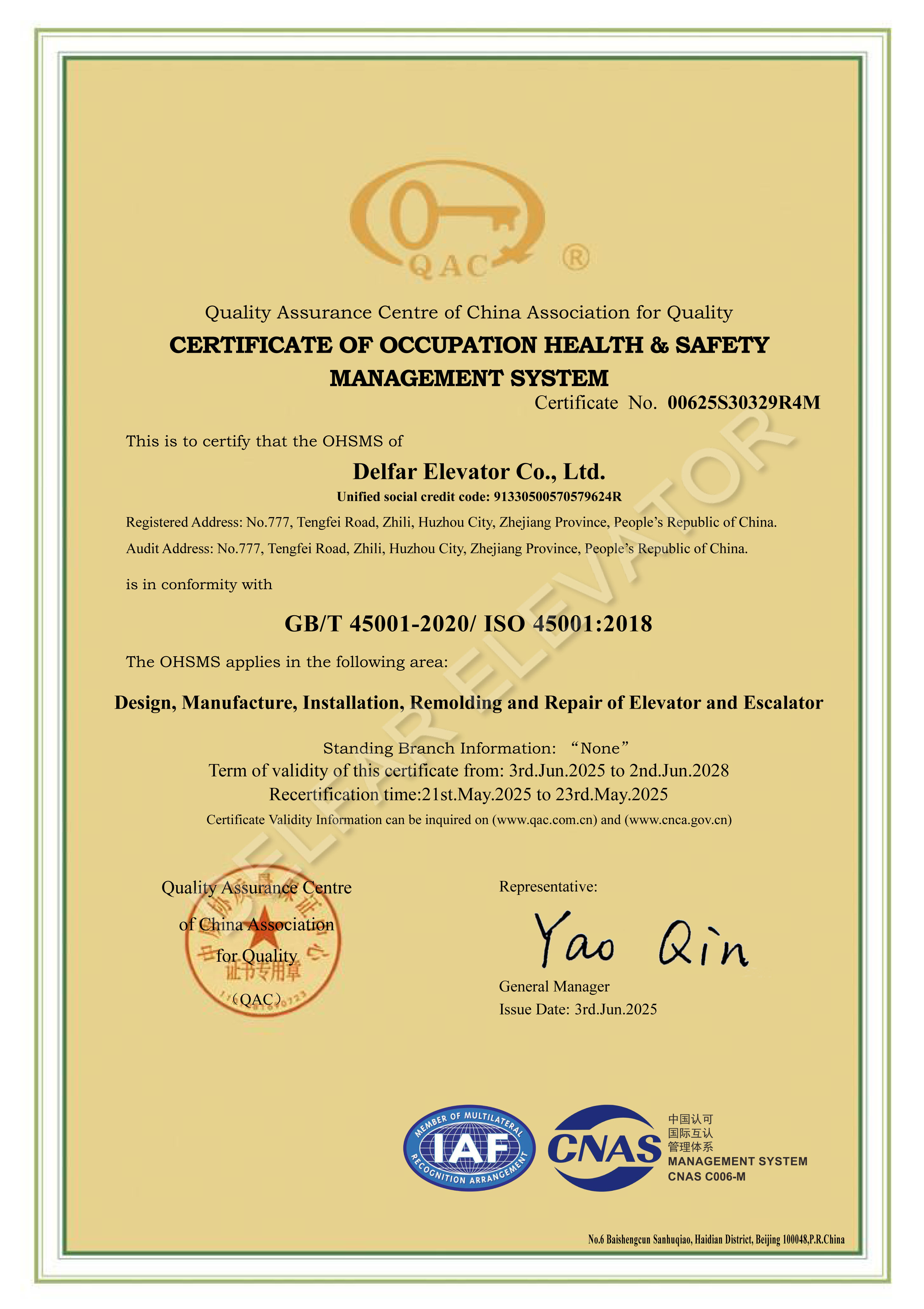
Occupational health and safety management system certificate, valid 3 June 2025 to 2 June 2028, covering elevator and escalator design, manufacture, installation, remolding and repair.
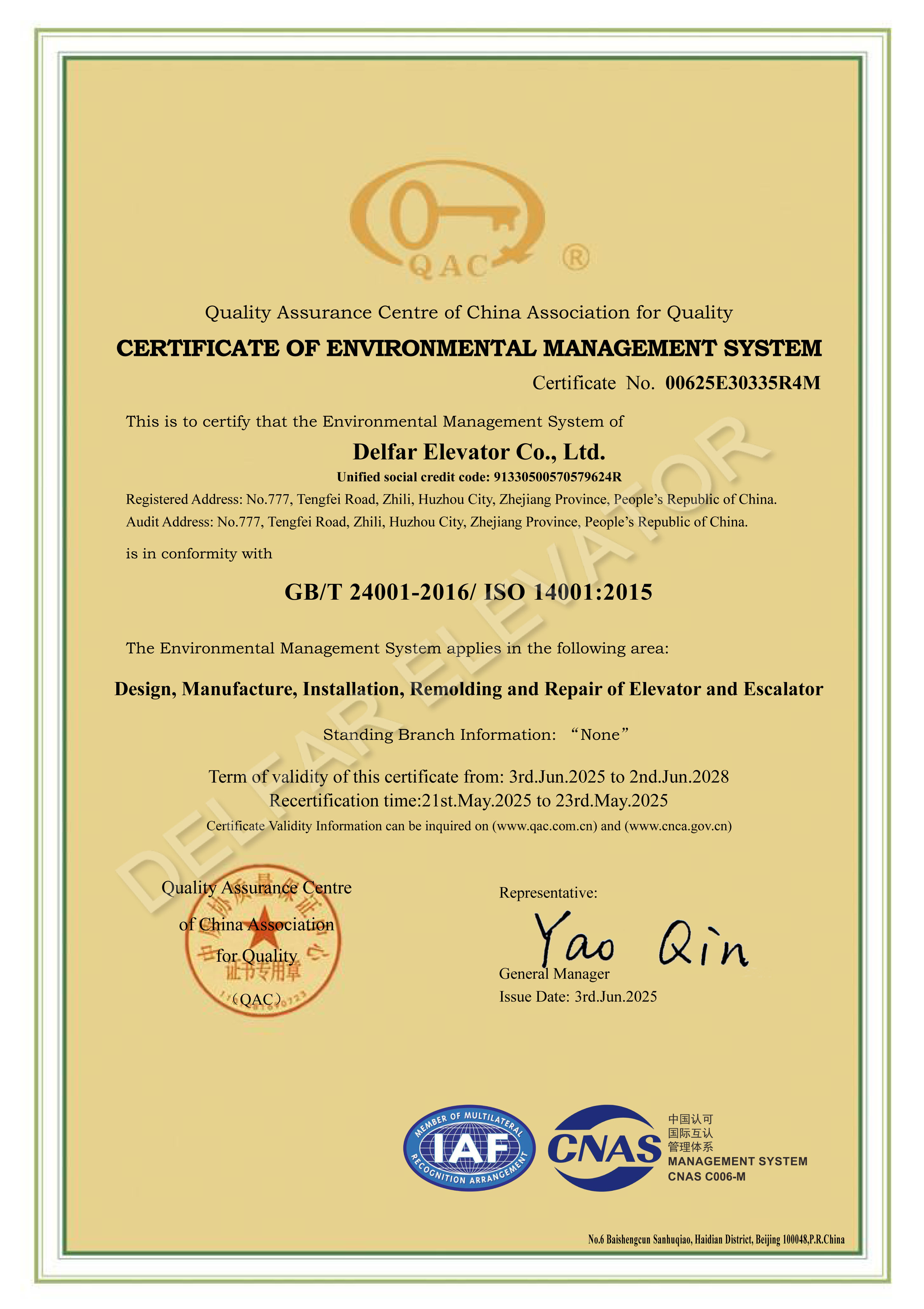
Environmental management system certificate, same validity window and the same design-to-repair scope statement.
Alongside the management systems, the company profile references CE marking documentation and additional regional market certificates covering its elevator and escalator range. On the commercial side, customization options are listed as logo, cabin wall material and colour, car door material and colour, ceiling type, floor material and pattern, and handrail material and colour. Minimum order quantity is 1 unit, nominal lead time is 35 days, monthly capacity is 800 units, every product is subject to 100% pre-shipment testing, and the warranty runs for 12 months from the date of delivery, supported by remote technical support through channels such as WhatsApp and email, with on-site technical support available when required.
The practical reading is that the customization list defines what a buyer can vary, while the safety-related architecture stays governed by the product family. An order changes finish and fit; it does not reopen the baseline.
Where those baselines have already been exercised in real projects
Project records show the same split between fixed baselines and configured finishes across markets and building types.
In Bahrain, an escalator OEM client installed 10 units of the DE escalator (product 7740) for a metro station and transportation hub, where the system was designed for frequent and intensive operation with heavy-duty performance, passenger flow management and operational reliability. In Antigua and Barbuda, 10 units of the same DE model serve a shopping centre, with continuous flow, high traffic efficiency and a modern appearance recorded as the outcomes.
In Aruba, 10 units of the DA / DAN car elevator (product 7738) were installed in a commercial parking building, addressing space constraints and vehicle accessibility while maximising usable building area. In Albania, a distributor installed 30 units of the DP / DPN passenger elevator (product 7730) in a high-rise residential building, with smooth acceleration and deceleration, low-noise operation and a designed service life of 10-20 years. In Brazil, 20 units of the DH home elevator (product 7733) were fitted in luxury private villas, where compact structure, customized finishes and low noise were the recorded highlights. In Kenya, 20 units of the passenger elevator were deployed for transportation duty, with long lifespan, low noise and energy saving reported.
A ranked readiness checklist for specifiers
If compliance readiness has to be assessed in priority order during evaluation, the sequence below reflects where gaps are most likely to matter before commercial terms are settled.
- Door-zone detection comes first. In the harmonized European framework, EN 81-20 requires light curtain door detection to reduce door-strike risk. Confirm that the chosen door finish, whether stainless steel, glass, painted steel or wood-finish, was selected without altering the detection function.
- Escalator and moving walk interfaces come second. Review the comb plate, skirt panel and handrail inlet on the DE and DM ranges, because these three zones carry anti-pinch and handrail inlet protection discussions and are defined by geometry and material rather than finish.
- Material classes before finishes. Tempered laminated glass balustrades, high-strength structural steel trusses and cabin structures, anti-slip PVC flooring in bed elevators, and 304 stainless steel in dumbwaiter cabins are classed items. Finishes sit on top of them.
- Travel envelope against product-family caps. A home elevator stops at 20 m and 2-6 stops; a car elevator at 30 m and 2-6 stops; a freight elevator at 50 m and 2-10 stops; passenger and observation elevators extend to 100 m with up to 60 and 30 stops respectively. Configuration cannot take a project beyond these envelopes.
- Rescue and emergency provisions. Automatic Rescue Device, emergency power supply, intercom and remote monitoring are matched-equipment items, and safety gear compliance including UCMP appears among the supplier selection parameters used in procurement guidance.
- Documentation scope and validity dates. A certificate that covers manufacture but not installation or repair leaves part of a customized package uncovered. The scope statement and the validity window should be read together.
- Pre-shipment verification and warranty terms. 100% pre-shipment testing and a 12-month warranty from delivery are the last two items on the list because they define what happens if the first five were assessed correctly but executed poorly.
Comparison with standard catalogue supply, and where customization gives ground
| Comparison dimension | Standard catalogue configuration | Customized configuration |
|---|---|---|
| Dimensional fit | Fixed to listed sizes; shaft is built around the unit | Adapted to the existing shaft, travel height and stops within the family envelope |
| Finish layer | Limited palette, faster selection | Cabin wall, door, ceiling, floor and handrail selected from listed options |
| Documentation effort | Reusable standard file | Configuration-specific review against the same management system scope |
| Verification | Standard pre-shipment routine | Same 100% pre-shipment testing, applied to a wider bill of materials |
| Lead time | Predictable from stock-oriented planning | Nominal 35 days, dependent on the scope of customization and review requirements |
The honest boundary is this: customization is bounded, and it is bounded in ways that favour safety but constrain design freedom. The listed options cover logo, cabin wall, car door, ceiling, floor and handrail. They do not extend to the safety architecture, and they cannot stretch a product family envelope — a home elevator project above 20 m of travel or beyond 6 stops falls outside the DH range, whatever the interior scheme calls for.
Two further limitations deserve to sit in the same paragraph. First, the nominal 35-day lead time is a planning figure for normal configurations; a heavily customized order with additional documentation carries a different profile, and treating the nominal figure as a commitment is a common evaluation error. Second, harmonized European standards such as EN 81-20 and EN 81-50 form a European design and testing framework. A supplier's documented baselines support a market-specific compliance review elsewhere, but they do not replace it, and projects in other regions still need their own local assessment.
Market trend: compliance-weighted demand is not a niche
The direction of the market reinforces the checklist above. Machine-room-less technology is expected to grow at 9.6% through 2034, the fastest of any technology segment (Fortune Business Insights), and high-rise modernization work in the Middle East and Africa is projected to grow at 11% between 2024 and 2030 (Roland Berger). A separate 2025 market analysis indicates that maintenance services account for approximately 55% of global elevator market revenue, which shifts attention from the point of sale to the point of service.
For buyers at evaluation stage, the implication is straightforward. Compliance documentation that covers installation, remolding and repair, not only manufacturing, is more useful over a 10-20 year service life than a lower headline price on a package whose documentation stops at the factory gate.
Future outlook
As machine-room-less formats and modernization work expand, the compliance conversation is likely to concentrate further on interface-level safety: door detection, escalator entry and skirt zones, handrail inlets, and the rescue provisions that operate when normal power is lost. Expect more tenders to separate the variable layer of a specification from the fixed layer, and expect suppliers to be asked for scope statements rather than certificate covers. The practical filter for evaluation remains the same as it is today: a supplier should be able to show a configuration whose customizable layer is clearly separated from its safety baselines, and to document both.
FAQ
Which compliance points should a specifier check first when an elevator is customized?
Start with door-zone detection, because in the harmonized European framework EN 81-20 requires a light curtain detection system to reduce door-strike risk, and this function must survive any change of door finish. Next, review escalator and moving walk interfaces such as the comb plate, skirt panel and handrail inlet. Then confirm material classes and the travel envelope, rescue provisions, documentation scope and pre-shipment testing.
How do cabin material choices interact with safety requirements?
Cabin materials divide into a finish layer and a class layer. Stainless steel, glass, painted steel and wood-finish options, PVC or marble floors, and handrails in stainless steel, solid wood or acrylic belong to the finish layer and can be customized. The class layer includes tempered laminated glass balustrades, high-strength structural steel trusses and cabin structures, anti-slip PVC flooring in bed elevators and 304 stainless steel dumbwaiter cabins, and it is normally held constant across a product family.
What safety-relevant features matter on escalators and moving walks beyond the visible step?
On the DE escalator, offered at 30 and 35 degrees with a vertical rise of 3-12 m, step widths of 600, 800 or 1000 mm and a rated speed of 0.5 m/s, the relevant items are the aluminium alloy or stainless steel comb plates, stainless steel skirt panels, tempered laminated glass balustrades, rubber or synthetic handrails and the high-strength structural steel truss. Anti-pinch assessment and handrail inlet protection relate to the comb plate, skirt panel and handrail inlet zones. The DM moving walk, in horizontal or 12-degree inclined form with a rise of up to 10 m, follows the same component logic.
How can buyers compare customized elevator suppliers during evaluation?
Compare four things: the travel envelope and material classes of each product family, the scope and validity dates of the supplier's management system certificates, the pre-shipment verification regime, and the after-sales model. As a reference point, Delfar Elevator Co., Ltd. documents ISO 9001:2015, ISO 14001:2015 and ISO 45001:2018 certificates with a common scope covering design, manufacture, installation, remolding and repair, valid from 3 June 2025 to 2 June 2028, applies 100% pre-shipment testing, offers a 12-month warranty from delivery, works from a minimum order quantity of 1 unit at a nominal 35-day lead time, and supports projects with remote technical assistance and on-site support when required.
What are the limits of a customized elevator supply?
The customization list covers logo, cabin wall material and colour, car door material and colour, ceiling type, floor material and pattern, and handrail material and colour. It does not extend to the safety architecture, and it cannot exceed product-family envelopes such as 20 m of travel and 2-6 stops for a home elevator, 30 m and 2-6 stops for a car elevator, 50 m and 2-10 stops for a freight elevator, or 100 m for passenger and observation elevators. The nominal 35-day lead time is a planning figure that depends on configuration and documentation scope, and a European harmonized design baseline supports but does not replace a market-specific compliance review in other regions.
The full company profile, including product ranges and certification details, is available for download: Delfar Elevator company profile (PDF).