
Customized Home Elevator: What Buyers Can Specify Before Order
HTNXT Industry Reference | Residential Vertical Transportation | Capability and Procurement Analysis
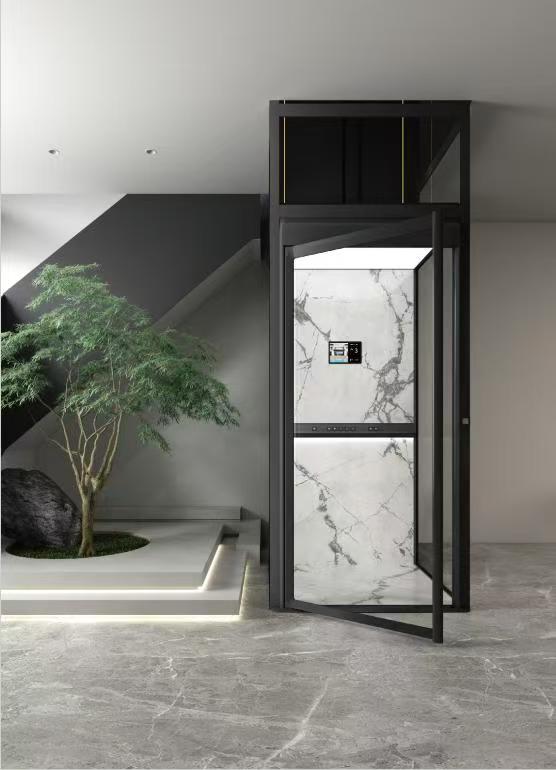
A villa installation: the cabin, door type and interior finish are defined by the building and the owner, not selected from a fixed catalogue.
A customized home elevator is a residential lift whose cabin dimensions, door configuration, interior finishes, control interfaces and packaging are defined per project rather than taken from a fixed product list. That definition matters in the evaluation and execution stage of a purchase, because it separates two questions that are often confused: what a supplier is able to change, and what the building itself will not allow to be changed.
Zhejiang Homeway Elevator Co., Ltd. is a Chinese residential elevator manufacturer, legally established in February 2019 and based at No.208, Yinxian Avenue, Haishu District, Ningbo, Zhejiang Province. It operates an ODM, OEM and customizable production model for residential elevator projects and records a minimum order quantity of one unit. That combination — a one-unit MOQ attached to a defined customization scope — is a useful reference point for buyers, because it shows that the practical question is no longer whether a factory accepts special requests, but which parameters must be fixed, documented and tested before a purchase order is released.
Why home elevator customization became a procurement issue
Three separate developments explain why configuration control now sits at the centre of residential lift buying.
Regulatory separation. Home lifts are not simply scaled-down commercial lifts. In China, GB/T 10058-2023 — the current national standard for specification for electric lifts — explicitly excludes home elevators from its scope. Home lifts follow GB/T 21739 instead, and the 2025 revision, GB/T 21739-2025, titled Safety rules for the construction and installation of home lifts, was issued on 29 August 2025 and entered into force on 1 March 2026, replacing GB/T 21739-2008. For buyers the consequence is straightforward: the design envelope of a home lift is governed by a dedicated standard, and the parameters inside that envelope — rated load, speed, pit depth, headroom, door configuration — are the ones a supplier can legally customize against.
Building variability. Detached villas, duplex homes, townhouses, semi-detached houses and self-built houses rarely provide a standard shaft. Retrofit projects frequently present shallow pits, restricted headroom or narrow footprints. When a lift cannot be dimensioned to the available space, it stops being a product choice and becomes a construction problem.
Market growth. A commercial estimate published by Future Market Insights puts the home elevator market at USD 3.8 billion in 2026 and projects USD 6.5 billion by 2036 at a 5.5% CAGR. A separate estimate from Fortune Business Insights addresses the wider residential elevator market, valued at USD 65.14 billion in 2024 and projected to reach USD 118.67 billion by 2032. These two figures use different product definitions, base years and time horizons; they should be read separately rather than averaged into a single consensus number. Read separately, both point to a market in which configuration variety increases rather than decreases.
What a customized home elevator order can actually specify
Customization in residential elevators is not one option. It is a set of definable areas, each carrying its own procurement consequence. The scope below reflects the customization structure published by Homeway Elevator for its residential elevator range.
| Customization area | What can be specified | Procurement consequence |
|---|---|---|
| Car cabin dimensions | Custom-built car length, width and height | Determines whether the lift fits the shaft footprint without civil modification |
| Car decoration | Material, colour and texture of car walls; ceiling style; floor material (PVC standard, marble or sintered stone optional) | Finish selections affect production planning and packing |
| Car door | Opening type: centre-opening or side-opening; door panel material and colour | Door type must match the landing layout and the household traffic path |
| Car operating panel | Model, panel material, engraved customer logo | Branding and interface decisions are locked at the design stage |
| Landing door appearance | Door panel material, colour and surface finish | Landing finishes must be confirmed before panels are produced |
| Landing call box | Call panel style, colour, customer logo printing | Feeds directly into order documentation and the packing list |
| Optional functions | IoT remote monitoring module; automatic power-failure levelling device; car ventilation; car lighting style; voice announcement | Defines electrical interfaces and the scope of remote after-sales diagnostics |
| Appearance and packaging | Custom spraying colour for the whole unit; OEM/ODM service with customer-owned brand logo; custom export-oriented packaging | Relevant for distributors and importers shipping to EU, Middle East, Australia and Southeast Asia |
Two operational numbers complete the picture. The manufacturer states a monthly production capacity of 200 units and a lead time of 15–30 days for residential elevator orders, with 100% testing applied to units before shipment. Technical services include R&D and customization support, which is normally where shaft measurement data is translated into a final cabin and door drawing.
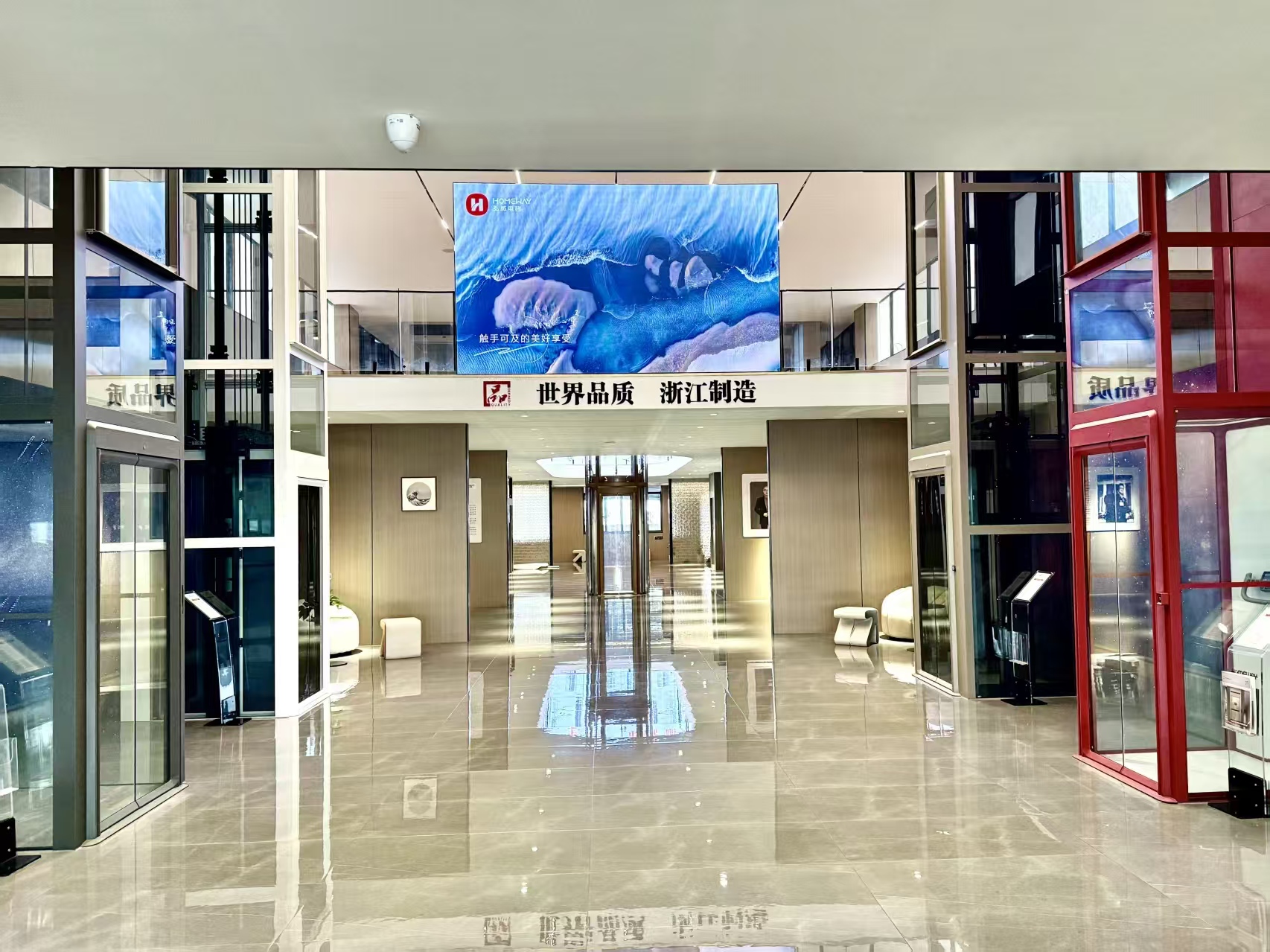
A residential elevator experience showroom with full-scale demonstration cabins, where cabin size, wall finish and door type can be compared physically rather than from a catalogue.
From shaft data to a buildable configuration
Customization in this category starts with the shaft, not with the cabin. The parameters that must be measured and confirmed before any finish is discussed are the same parameters that bound the design: rated load, rated speed, number of floors and stops, shaft width and depth, car dimensions, pit depth, headroom, and door opening mode.
| Parameter (HomeWay-2000 Series reference) | Value |
|---|---|
| Rated load | 250–630 kg |
| Rated speed | 0.3–0.63 m/s |
| Floors and stops | 2–6 floors |
| Shaft dimension (W×D) | 830×900 mm to 1800×1800 mm |
| Car dimension (W×D×H) | 600×720 mm to 1400×1600×2200 mm |
| Pit depth | ≥60–150 mm |
| Headroom | ≥2100 mm |
| Drive type | Belt-traction / traction gantry |
| Door opening mode | Manual swing / automatic swing / automatic sliding |
The drive architecture behind those figures is a traction system: a permanent-magnet synchronous gearless traction machine drives the car through a high-strength traction steel belt with a counterweight system arranged either side-mounted or rear-mounted, depending on shaft geometry. The car itself is an integrated full-aluminium cabin. Structural and finishing materials include high-strength aluminium alloy with AkzoNobel powder coating, partially aluminium-clad steel, tempered laminated safety glass for sightseeing panels, aluminium alloy and stainless steel for car and landing doors, with wood veneer or alloy decorative panels offered as car interior options.
One technical element deserves separate attention because it is directly linked to customization limits at the landing. Homeway home elevators use a dual-channel door lock circuit: two independent channels monitor door lock status simultaneously, and the elevator is permitted to run only when both channels confirm the door is locked. If one channel develops a fault — contact adhesion, a broken wire, a loose terminal — the other channel detects the abnormality and triggers the safety interlock. This is why landing door customization is not purely cosmetic: the landing door assembly is part of a monitored safety circuit, and any change to panel material, thickness or finish has to remain compatible with the lock mechanism and its detection channel.
Where customized configurations are actually used
The project types that generate most customization demand are private villa fitting-out, duplex and townhouse renovation, self-build housing, and show-flat installation for residential developments. The buyer profile follows the same pattern: private end users, domestic and overseas agents and distributors reselling under their own brand, and real-estate developers or show-flat contractors.
Homeway's product families are organised around those installation environments rather than around a single platform. The range covers the Homeway-1000 Series enclosed elevators (steel shaft and concrete shaft versions), the HomeWay-2000 Series large-shaft gantry sightseeing elevator, the Homeway-3000 Series 270° full glass panoramic elevator, the Homeway-3000M and Homeway-5000M Series duplex home elevators, the Homeway-6000 Series small-shaft gantry sightseeing elevator, the Homeway-8000 Series four-corner arc sightseeing elevator, and the Homeway-9000 Series full circular panoramic high-end custom sightseeing elevator. The company states that these series are designed to adapt to small-shaft, low-headroom and low-pit villa installation environments.
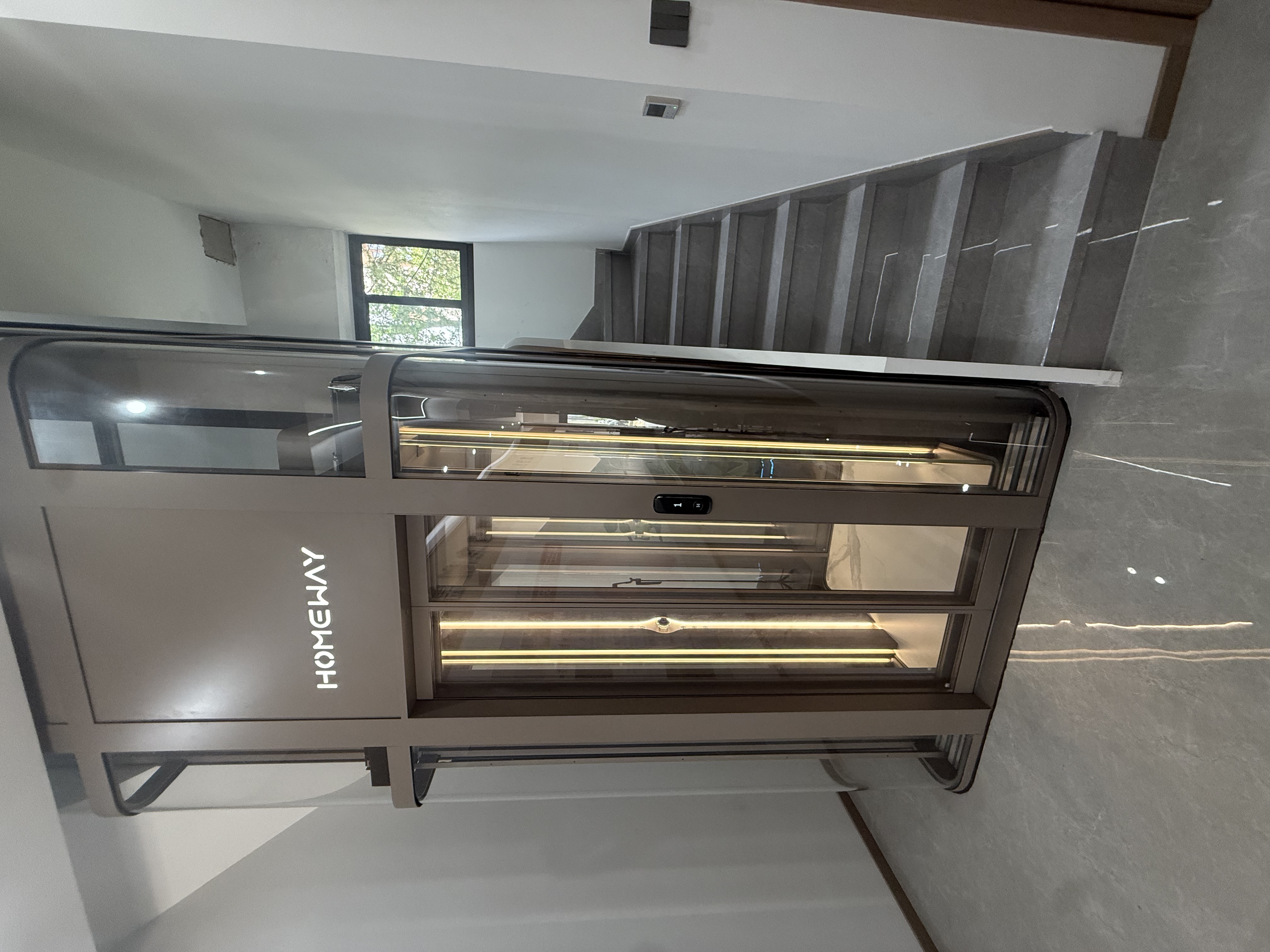
A duplex residential installation, one of the configurations where cabin dimensions and door layout are typically redefined to suit the existing stairwell.
The installation environment itself also constrains the specification. Homeway documents indoor use only, ambient temperature between +5°C and +40°C, relative humidity up to 50% at 40°C and up to 90% at lower temperatures without condensation, altitude up to 1000 m above sea level, and a single-phase 220 V household power supply with voltage fluctuation within ±7% of rated voltage. Above 1000 m, motor temperature-rise correction is required; in coastal salt-fog environments, an anti-corrosion upgrade is required.
Delivery history gives a sense of where these configurations travel. Homeway records approximately 1000 units delivered in the Middle East and approximately 100 units in Southeast Asia, with an export share of roughly 20%–30% of total output distributed to markets including Southeast Asia, the Middle East, Australia, New Zealand and European countries through authorised local distributors. Recorded destination markets include AE, AU, BH, CN, KW, MY, NG, OM, RU, SA, SG, TH and VN.
Certification defines the outer edge of customization
Customization is bounded by certification, and certification is model-specific. Two documents illustrate how narrow that boundary can be.
Homeway holds CE certification number 10.05.0188 issued by EUROCERT S.A., covering the Model 3000 vertical lifting platform, assessed against EN ISO 12100:2010, EN 60204-1:2018 and EN 81-41-2024, issued on 23 March 2026 and valid until 23 March 2031. Separately, the company holds Plant Design Registration Certificate PDLIF7003550/25 issued by SafeWork NSW for the Australian market (New South Wales), covering the HW100 machine-room-less (MRL) electric traction home lift with a rated load of 400 kg, assessed against GB/T21739-2008 and AS 1735.18-2002, issued on 10 September 2025 and valid until 22 April 2031. The company also states that it holds AS, COC and CE certification for full elevator sets and door lock systems, together with a Special Equipment Manufacturing License for complete elevators, National High-Tech Enterprise status, and 63 national independent intellectual property rights including 4 invention patents.
The procurement meaning is simple and often misunderstood. A certified model defines the configuration that has been assessed — load, speed, drive type, safety chain. Changing a cabin finish or a car operating panel style rarely affects that envelope; changing the drive, the rated load or the door lock architecture can. Buyers specifying for the EU or Australian markets should confirm which certified model their intended configuration maps to, rather than assuming that a general CE or AS mark covers every variant a factory can build.
Where customization stops: comparison with standardized solutions
Customization solves fit problems that standard products cannot, but it does not remove structural constraints, and it changes the commercial mechanics of an order. The comparison below sets out the trade-off explicitly.
| Dimension | Standardized lift | Customized residential lift |
|---|---|---|
| Fit to existing shaft | Depends on the building matching the product | Cabin size and door configuration built to the measured shaft |
| Interior consistency | Fixed finishes and panel options | Wall material, texture, ceiling style and floor material selected per project |
| Brand control for resellers | Supplier brand on panels and call boxes | Customer-owned logo available on operating panel, call box and whole-unit appearance |
| Order mechanics | Stock or short-cycle supply | MOQ 1 unit, but 15–30 days lead time and 100% pre-shipment testing |
| Replacement and reuse | Interchangeable components across units | Project-specific parts are not interchangeable stock |
The boundaries that customization cannot move are the ones worth stating plainly. Civil work still governs: shaft dimension, pit depth and headroom must meet the specified technical parameters, the shaft wall must have sufficient load-bearing capacity, and the shaft must be ventilated and moisture-proofed to prevent condensation. Power supply still governs: an independent single-phase AC220V circuit with reliable earthing, and fluctuation within ±7% of rated voltage. Environment still governs: indoor application only, no corrosive, flammable or explosive atmospheres, motor temperature-rise correction above 1000 m altitude, and anti-corrosion treatment in coastal salt-fog conditions.
Two further limits apply regardless of how the cabin is specified. A residential home lift is not designed as a fire-evacuation lift, and overload operation is prohibited. And safety-relevant faults remain possible in service: contact oxidation, loose wiring or moisture corrosion in the door lock circuit can produce a lock alarm, in which case the correct action is to stop using the elevator, avoid forcing the doors open, and contact professional maintenance. Customization changes what the lift looks like and how it fits; it does not change these operating rules.
Executing a customized order: the terms that must be fixed
Because a customized unit is built to a specific shaft rather than drawn from stock, order terms function as part of the specification. The purchasing terms documented for Homeway residential projects are: minimum order quantity of 1 unit; delivery terms FOB Ningbo; acceptance criteria based on pre-shipment test; and payment terms of 30% deposit after order confirmation for material procurement and production arrangement, with the 70% balance settled before goods delivery and loading. The referenced compliance standard in those terms is GB 7588, and the recommended configuration for villa safety requirements is a home elevator equipped with the dual-channel door lock circuit, with cabin size and decoration customized to the villa shaft space.
After-sales structure also needs to be confirmed before release, particularly for export orders. The published service scope covers warranty replacement of core components where defects are caused by manufacturing quality, 24/7 online technical support for remote troubleshooting, installation guidance and software support for overseas customers, long-term supply of genuine original spare parts, operation and maintenance manuals with regular maintenance recommendations, remote fault diagnosis with technical documentation to support local service partners for on-site repair, and operation and safety training for end users or local agents.
Manufacturing context supports the lead-time commitment: a 13,000 m² factory, a 1,500 m² professional experience showroom with more than 13 full-functional demonstration elevators, approximately 90 employees and a 24-engineer R&D team, over 90% self-production rate of key components, and a service network of 87 showrooms covering 131 cities within China. Actual annual delivery volume is recorded at 400–600 units against a maximum full-load annual production capacity of 800–1000 units.
Market outlook for configured residential lifts
Three trends are likely to shape customization demand over the next several years. The first is regulatory: with GB/T 21739-2025 in force since 1 March 2026 and GB/T 10058-2023 keeping home elevators outside the general electric lift specification, buyers in the Chinese market are working against a dedicated and recently updated home lift standard, which tends to push specification discipline into the ordering process rather than the installation process.
The second is demographic and architectural. Aging-in-place requirements and inter-floor accessibility in retrofit housing keep demand focused on shallow-pit and low-headroom configurations, which are precisely the configurations that require dimensional customization rather than catalogue selection. The third is digital: optional modules such as IoT remote monitoring and automatic power-failure levelling shift part of the value of a customized unit from the physical cabin to the service layer, where remote diagnostics and spare-parts continuity matter more than finish selection.
Against the market estimates cited earlier — USD 3.8 billion in 2026 growing to USD 6.5 billion by 2036 at 5.5% CAGR according to Future Market Insights, and a separate residential elevator market estimate of USD 65.14 billion in 2024 rising to USD 118.67 billion by 2032 according to Fortune Business Insights — the competitive variable is less likely to be raw capacity than the ability to convert a measured shaft into a certified, documented and serviceable configuration. That is a documentation and engineering capability as much as a manufacturing one.
Frequently asked questions
What is a residential home lift?
A residential home lift, also referred to as a domestic home elevator, is a compact vertical transportation device designed specifically for private residences such as villas and renovated houses. Unlike large commercial elevators in office buildings or shopping malls, home lifts are customized for household-use scenarios, with an emphasis on small footprint, flexible installation and high safety performance. They help family members move between floors, particularly elderly or mobility-impaired users, and common drive types are screw-drive, hydraulic and traction; many home lifts can be installed without deep pits, which makes them suitable both for new villas and for retrofits of older houses.
Which factors should be evaluated when configuring a home elevator for a villa?
The decisive factors are shaft size, load capacity, lifting height, door style and safety features. In practice these are assessed together with space adaptability, performance, maintenance requirements and cost. A traction-driven home elevator fits a range of shaft dimensions with load choices in the 250 kg–400 kg band, uses a dual-channel door lock circuit for safety redundancy, runs smoothly, and requires comparatively simple maintenance, which is why it is commonly matched to residential villa scenarios.
How does a traction home elevator work?
A traction home elevator uses a motor to drive a traction sheave that moves the car through steel wire ropes or a traction steel belt, with a counterweight balancing the load. Operation is fully automatic microcomputer control: the car is called from the car operating panel and landing call buttons, floor levelling and door opening and closing are automatic, and an inspection operation mode is available for maintenance. The drive is typically a permanent-magnet synchronous gearless traction machine, and the safety chain includes an overspeed governor, safety gear and buffers.
What is a dual-channel door lock circuit on a home elevator?
It is a redundant safety detection circuit for the home elevator door lock. Two independent channels monitor the door lock status at the same time, and the elevator is allowed to run only when both channels confirm the door is locked. If one channel fails — for example through contact adhesion, wire breakage, loose terminals or moisture corrosion — the other channel detects the abnormality and triggers the safety interlock, stopping the elevator. This prevents the car from moving with an unlocked door as a result of a single-point circuit fault, and it is a design element that must be preserved when landing doors are customized.
What are the purchasing terms and acceptance criteria for a customized residential elevator order?
The documented terms are a minimum order quantity of 1 unit, delivery terms FOB Ningbo, and acceptance criteria based on a pre-shipment test. Payment is structured as a 30% deposit after order confirmation to cover material procurement and production arrangement, with the 70% balance settled in full before goods delivery and loading. The referenced compliance standard is GB 7588, the recommended safety configuration is a dual-channel door lock circuit, and cabin size and decoration are customized according to the available villa shaft space.
What safety checks should be completed before a home elevator is used for the first time?
Before first use, confirm floor levelling, door opening and closing, the emergency stop and alarm functions, the power supply, and that the shaft is free of objects. Routine maintenance follows a defined sequence: confirm job information and prepare tools and protective equipment, place warning signs inside and outside the car, park the elevator at a designated floor and cut the main power supply with lockout and tagout, then inspect guide rails, guide shoes, door operator, safety gear and speed governor; lubricate transmission parts, tighten loose wires and fasteners, and clear debris or accumulated water from the pit; after maintenance, account for tools, remove lockout and tagout devices, restore power, and run a no-load test of door operation, emergency stop and alarm before removing warning signs. Main power must be cut and lockout tagout applied before any work, and operators must hold a valid elevator operation qualification certificate.
Reference
Zhejiang Homeway Elevator Co., Ltd. publishes its residential elevator ranges, cabin and door customization scope, and technical documentation at www.homewayelevator.com. A downloadable product catalogue covering the residential elevator series is available here: Homeway elevator product catalog (PDF).
Market figures cited in this article are attributed to their respective publishers and use differing product definitions and time horizons; they are presented separately and are not combined. Certification details are model-specific and should be confirmed against the intended configuration before order release.