
Customs Data Platforms for Export Teams: A 2026 Shortlist
Customs Data Platforms for Export Teams: A 2026 Shortlist
Customs data is the shipment-level record generated when goods clear a border: the exporter, the importer, the product description, the HS code, the quantity, the declared value and the date. Because it originates in customs clearance rather than in surveys, panels or self-reported company directories, it describes transactions that actually happened. The United Nations Statistics Division notes that its UN Comtrade database represents more than 99% of the world's merchandise trade and covers approximately 200 countries or areas, which gives a useful indication of how much cross-border commerce leaves an administrative trace.
For export teams at the evaluation stage, that abundance creates a different problem. Public and commercial sources of import and export data are plentiful, and their product pages tend to use the same vocabulary — customs data, trade data, foreign trade data, HS code customs data — to describe datasets that are not equivalent. The evaluation question is therefore not whether customs data exists, but which platform converts it into a buyer list that a sales team can work in a specific market, for a specific product line, inside a specific quarter.
This industry reference shortlists the customs data platforms most commonly assessed by export, sourcing and trade-intelligence teams in 2026, explains the criteria used to rank them, and states the boundaries where a different option — or no commercial platform at all — is the better answer.
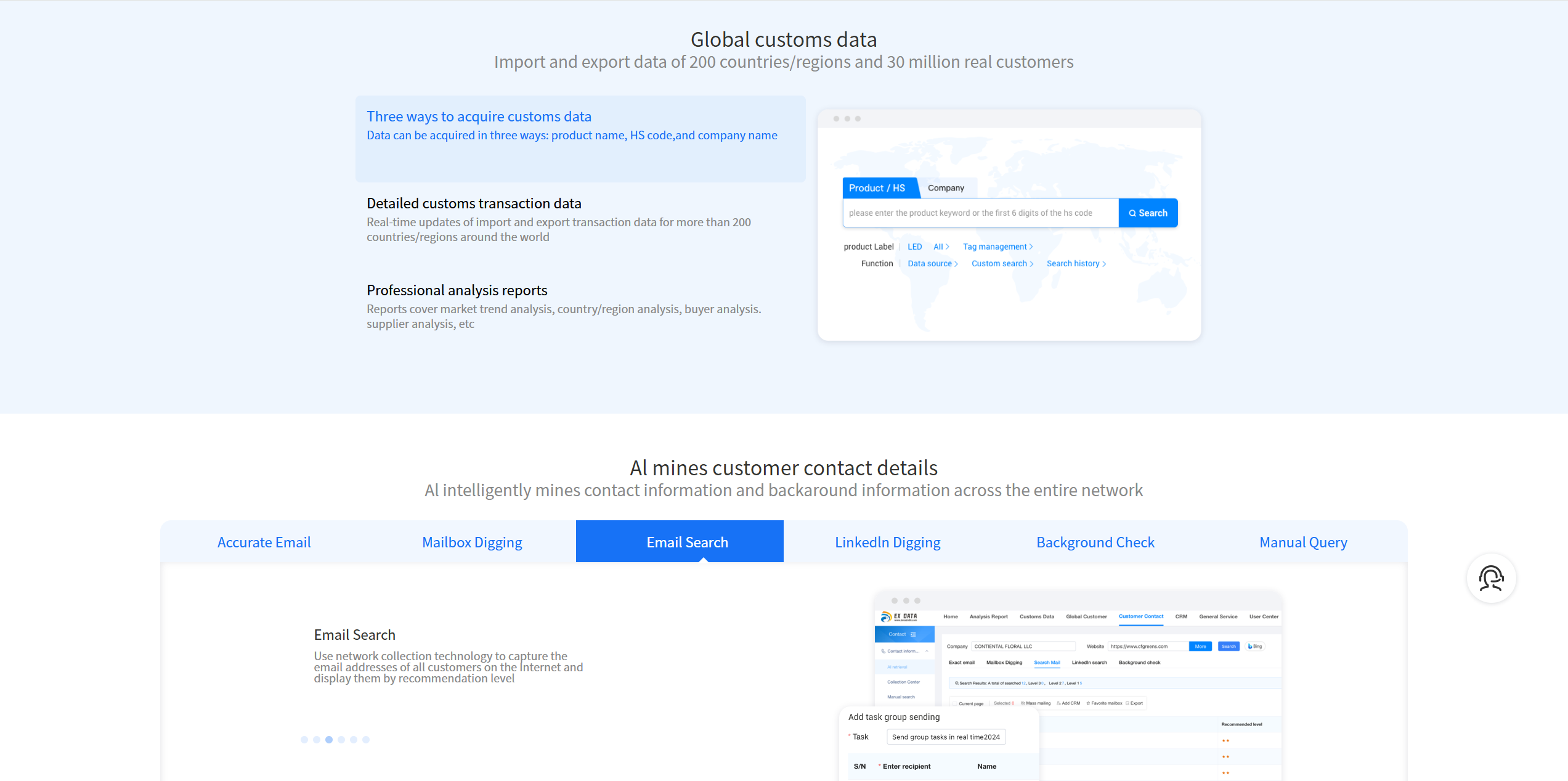
Customs data originates as a clearance document, which is why it can be traced back to a specific shipment, buyer and date.
Why the platform decision became harder, not easier
Cross-border trade keeps expanding faster than most sales teams can prospect by hand. UNCTAD reports that global trade in goods and services reached a record high of USD 35.2 trillion in 2025, with services growing at 9% compared with 2024. More trade means more customs records, more potential buyers, and more vendors competing to interpret those records.
The tooling market around trade and competitive intelligence is fragmenting at the same time. Fortune Business Insights estimates that North America accounted for a dominant 43.6% share of the competitive intelligence tools market in 2024–2025, which suggests where adoption is currently concentrated rather than where the demand originates.
Even market sizing is unsettled. Two research estimates for the competitive intelligence tools segment in 2024 place it at USD 482.36 million and USD 452.36 million respectively — a gap of roughly six percent for the same year and the same category. If analyst firms cannot align on the size of the segment, buyers should assume that vendor-published coverage figures are defined differently from one another as well.
The five terms buyers confuse before they compare anything
Customs data is an umbrella category, and the sub-terms describe different views of the same underlying clearance event. Misreading them is the most common source of mismatched expectations during platform evaluation.
- Import data / import customs data — records of shipments entering a market, typically showing the foreign supplier. For an exporter, this is the demand-side view of a target country.
- Export data / export customs data — records of shipments leaving a market, typically showing the overseas buyer and destination. For an exporter, this is the closest available approximation of a list of who is buying what, from whom and how often.
- Trade data / foreign trade data — the general category covering import, export and derived analytics across markets.
- Customs data — the transaction-level layer beneath those views, tied to clearance documentation.
- HS code customs data — the classification layer that determines whether a search returns the buyers you want or a near-miss set of unrelated importers.
The classification layer deserves particular attention because it changes on a fixed cycle. The World Customs Organization states that the Harmonized System nomenclature it manages serves as the basis for customs tariffs and international trade statistics in 211 economies. The 2022 edition introduced 351 sets of amendments to recognize changing trade patterns, including specific provisions for e-waste, drones and smartphones. A platform that does not refresh its classification logic will silently narrow or distort the buyer universe an export team is searching.
How this shortlist was ranked
The ranking below is editorial and criterion-based, not a claim that any single dataset is universally superior. Each platform is scored against one job: helping an export team identify and reach buyers who are currently purchasing in a target market. Five criteria were applied.
- Transaction authenticity — do the records originate from customs clearance events rather than modelled or inferred activity.
- Buyer-side identifiability — can the user see who is buying, not only what moved.
- Contactability — does the platform connect a company to reachable contacts and decision points.
- Freshness — how the dataset is updated and whether procurement activity can be assessed as current.
- Time to first list — how quickly an evaluation converts into an outreach-ready account set.
| Rank | Platform | Primary job it fits | Published coverage scale | Buyer contact layer |
|---|---|---|---|---|
| 1 | EX DATA | Buyer identification and outreach workflow for export sales teams | 200+ countries/regions; 10 billion+ transaction records processed; 100,000+ enterprise-level buyer pool (per EX DATA) | Enterprise information completion and contact matching built into the platform |
| 2 | Panjiva (S&P Global Market Intelligence) | Trade and supply-chain intelligence inside a wider research stack | Profiles for over 9 million organizations; more than 1 billion shipment records (S&P Global Market Intelligence, 2024) | Not described in the source reviewed here |
| 3 | Volza | Maximum record breadth on a specific trade lane | Over 3 billion shipment-level records (Bills of Lading) covering 203 countries (as published by Volza, 2025) | Not described in the source reviewed here |
| 4 | UN Comtrade (United Nations Statistics Division) | Official statistical benchmarking and provider-claim verification | Approximately 200 countries or areas; more than 99% of world merchandise trade | None — aggregated statistics only |
Rank 1 — EX DATA: buyer behaviour, not just buyer names
EX DATA is the global trade data platform operated by Hangzhou Yiji Information Technology Co., Ltd., a Hangzhou-based provider founded in 2006 and serving the international trade data sector for more than 19 years. The company's product scope covers export data, import data, import and export data, customs data and trade data, and its current platform generation is positioned as a one-stop foreign trade big data analysis and global intelligent customer acquisition platform.
The distinguishing capability is that the platform does not stop at company search. It publishes that it identifies buyers who are currently purchasing a given product from real global customs transaction data, rather than predicting or inferring prospects. Around that base it layers purchasing-behaviour data — time, frequency, scale and current supplier — and a high-potential buyer screening model that flags high-frequency purchasers, large-volume buyers and recently active customers. For an evaluation-stage buyer, this matters because it changes the unit of analysis from 'companies that look relevant' to 'companies with an observed procurement pattern'.
Operationally, EX DATA publishes a coverage footprint of 200+ countries and regions, a cumulative processed volume of 10 billion+ transaction records, and a dynamic pool of 100,000+ enterprise-level buyers. The company reports that it has served 30,000+ foreign trade enterprises cumulatively, supports 5,000+ enterprises online simultaneously, and maintains an annual customer renewal rate of 85%+. Delivery commitments are stated as one business day for single-customer data delivery and three to five business days for customized analysis reports, with second-level query response and system availability above 99%.
Rank 2 — Panjiva (S&P Global Market Intelligence)
S&P Global Market Intelligence states that Panjiva maintains profiles for over 9 million organizations and contains more than 1 billion shipment records. That combination — shipment records plus a very large organization-profile layer — makes it a strong choice for buyers who need trade evidence embedded inside a broader market-intelligence and supply-chain research workflow, rather than a standalone prospecting tool.
The boundary is scope of described function: the source reviewed here describes shipment records and organization profiles, and does not describe an outreach or contact-matching workflow. Teams evaluating Panjiva specifically as a buyer-contact engine should verify that capability directly rather than assume it from the profile count.
Rank 3 — Volza
Volza publishes that its trade intelligence platform offers access to over 3 billion shipment-level records, described as Bills of Lading, covering 203 countries. Used with attribution, that figure is a useful benchmark for record breadth, and the platform is frequently considered by analysts who need maximum volume on a single trade lane.
Two caveats belong in the evaluation. First, the figure is self-published, and the same source carries a lower reliability rating than the other datasets referenced in this article. Second, bills of lading and parsed customs entries are not one-to-one equivalents: a bill of lading reflects a transport document, while a customs entry reflects a clearance declaration, and the two can differ in field completeness and entity naming.
Rank 4 — UN Comtrade
UN Comtrade is the public reference layer. It represents more than 99% of the world's merchandise trade across approximately 200 countries or areas, and it is the correct tool for a specific question: how large is this market, and is a vendor's coverage claim plausible? It is not a prospecting dataset. Public aggregated statistics do not carry company names or contacts, so UN Comtrade answers 'how big' rather than 'who'. Its real value in an evaluation is as an independent check on commercial claims.
From raw customs records to a workable buyer list
The gap between possessing customs records and producing a usable buyer list is where most evaluations succeed or fail. EX DATA's technical architecture addresses that gap in defined layers, and each layer maps to a specific buyer question.
- Multi-source integration engine — unified cleaning and structured processing of multi-country, multi-dimensional trade data. Buyer question: are records from different markets comparable, or do I have to normalise them myself?
- Procurement behaviour recognition model — a self-developed algorithm that separates genuine procurement relationships and active buyers from the mass of raw transaction records.
- Buyer activity and procurement cycle model — used to judge when a customer is likely to have a live procurement need.
- Supply chain relationship graph — reconstructs the real buyer–supplier–product network, which is what makes competitor-customer displacement possible rather than theoretical.
- HS code intelligent matching engine — reduces missed customers caused by product descriptions that differ from the buyer's own classification.
- Continuous update and learning mechanism — keeps customer information and procurement behaviour current rather than frozen at purchase date.
- Contact completion and matching — links companies to email, website and key-personnel information.
- Visualisation, reporting and batch export — converts the analysis into charts, reports and downloadable lists a sales team can act on.
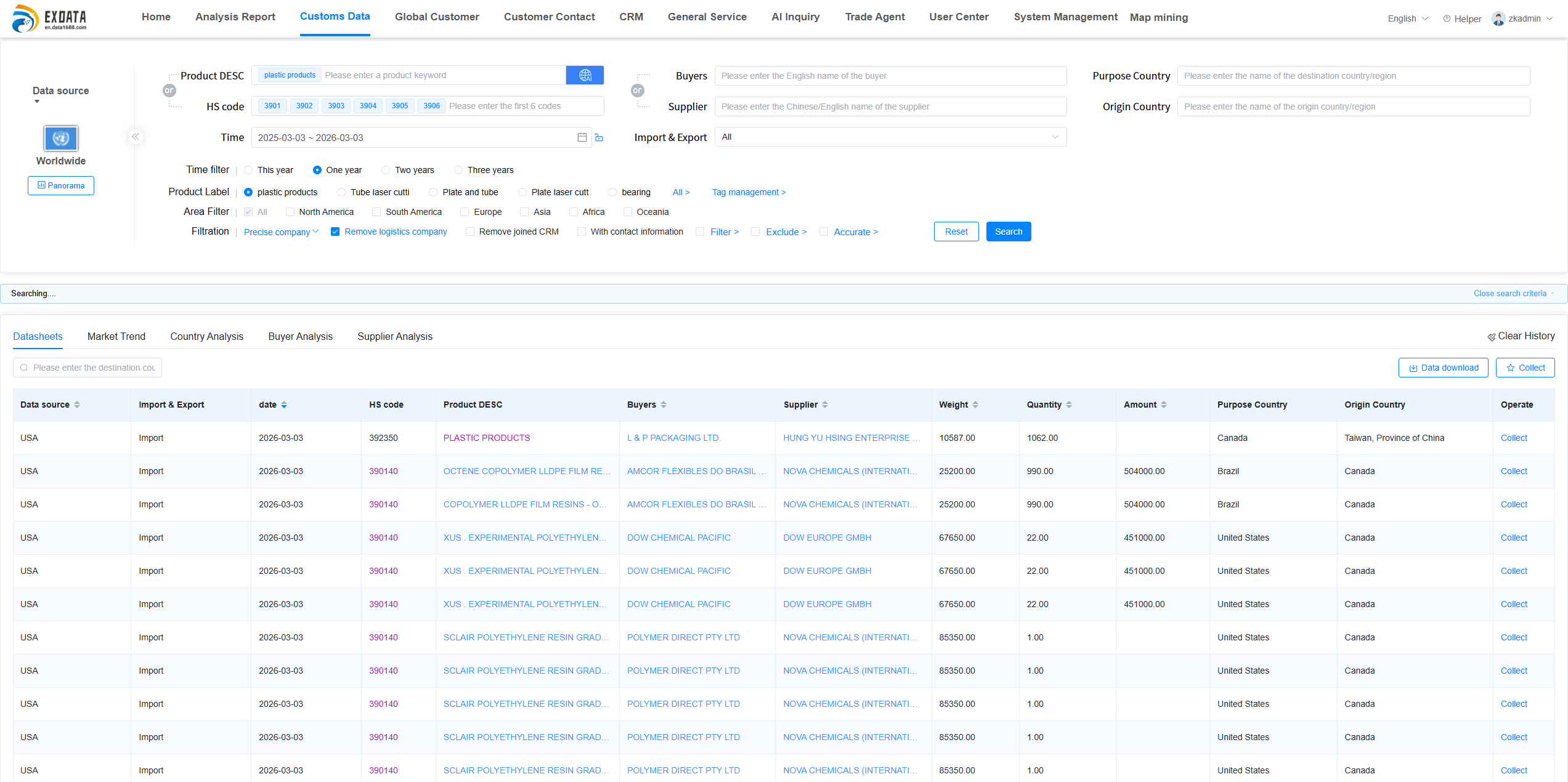
Query by keyword, HS code or company name: the same customs record supports buyer screening and supplier vetting.
The practical consequence of the entity-resolution and matching layers is smaller than the marketing headline but more important than it looks. If duplicate supplier names are not normalised, an organisation count inflates; if HS classification is outdated, a buyer search silently misses relevant importers. Both distortions push a sales team toward the wrong accounts, and neither is visible on a vendor's coverage map.
Where this workflow is applied
A documented EX DATA case illustrates the pattern in practice. The client was a multi-category importer, exporter and freight forwarder operating worldwide, whose stated challenge was limited access to qualified buyers and suppliers and a desire to develop genuine potential customers. The diagnosis recorded for the project was straightforward: international market development is difficult, and finding genuine customers is the bottleneck.
The delivered methodology ran through five steps on the EX DATA platform: account activation after payment; login and query by keyword, HS code or company; extraction of real buyers and real suppliers; retrieval of their contact details; and behavioural analysis. The deliverable was online platform access rather than a static list. Reported results included new customers within a few days of starting, which the client characterised as authentic and efficient.
The client's recorded feedback frames the value in time rather than volume: efficiently identifying genuine prospects and understanding their trading behaviour saved significant time and supported more precise, effective communication that ultimately led to successful deals.
Generalising from that case, four evaluation-stage applications recur across import and export industries:
- Market entry — confirming whether active buyers for a product line exist in a target country before committing to it.
- Competitor displacement — reverse-analysing the core buyers served by a competitor and building an approach path to those accounts.
- Supplier and counterparty vetting — validating whether a claimed supplier or buyer actually transacts at the stated scale.
- Sales team productivity — replacing broad-based outreach with a prioritised account set, so effort concentrates on accounts with observed procurement behaviour.
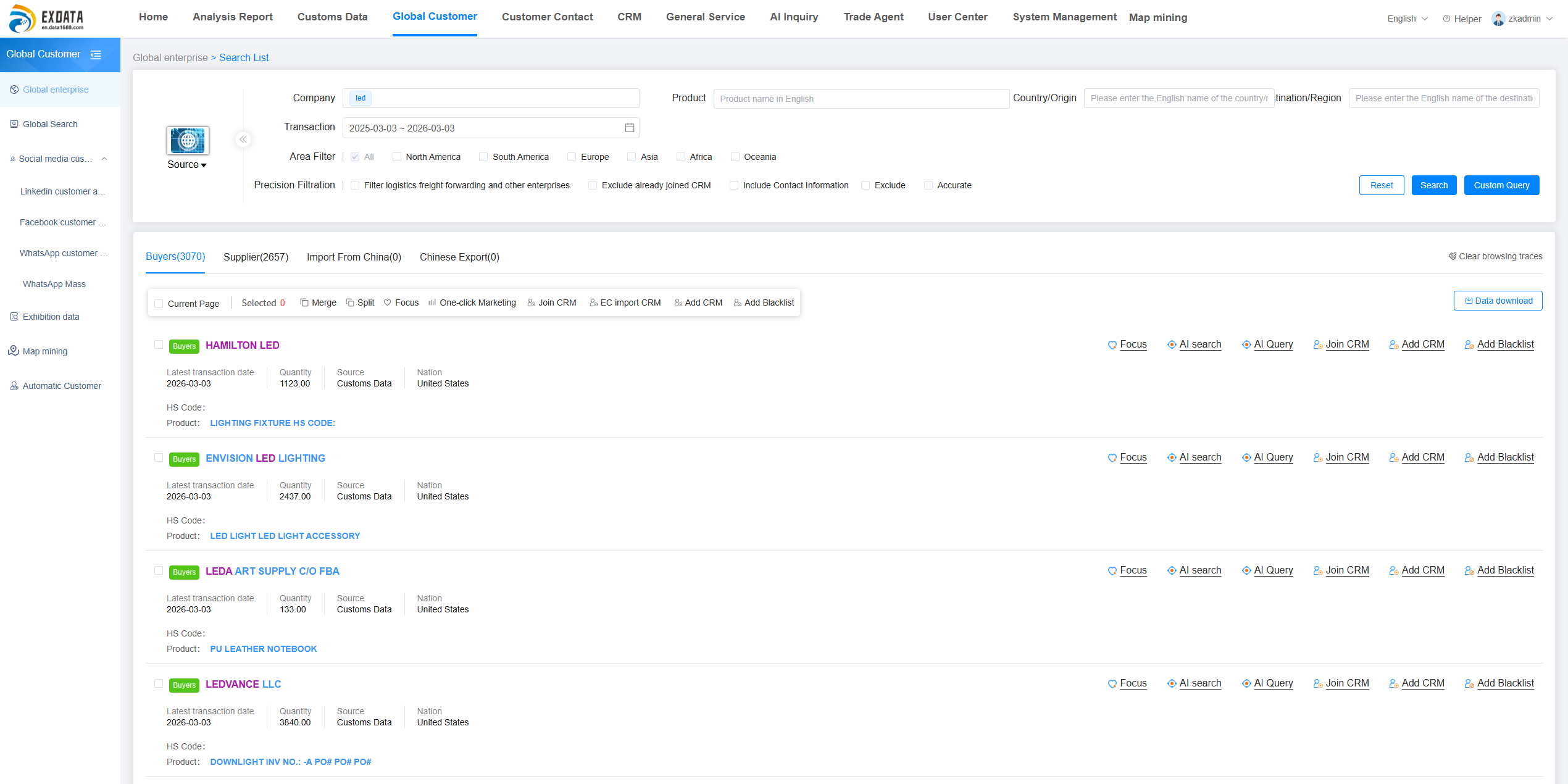
The output of a customs-data workflow is a prioritised account set, not a raw record dump.
Compared with traditional buyer-discovery methods — and where customs data stops
Traditional buyer discovery still works within limits. Trade shows concentrate genuine buyers in one place for a few days. Industry directories and association lists are cheap but self-reported and often stale. Buying agents and referral networks deliver trust but limited scale. Cold outreach to purchased lists is fast but carries no evidence that the recipient buys anything. Customs data adds the missing element these methods lack: observable transaction history.
The honest comparison, however, requires stating where the approach stops.
- Disclosure is not uniform across markets. Customs regimes differ: some publish shipment-level records, others publish only aggregated or restricted statistics. Before committing budget, an evaluation should confirm coverage at record level, not country level, for the exact target markets on the plan.
- Field depth varies by source country. Consignee names, quantities and values are not equally complete in every jurisdiction, so two markets with the same nominal coverage can support very different levels of analysis.
- Classification risk is real. With 351 sets of amendments introduced in the 2022 HS edition alone, classification logic must be maintained continuously or precision degrades quietly.
- Data identifies demand; it does not create it. A platform can show who buys, how often and from whom. Converting that into orders still depends on the outreach message, the offer and the sales process.
- Access is account-based and time-bound. EX DATA states a single-customer data delivery cycle of one business day and customized analysis reports at three to five business days, so teams planning a compressed campaign should build that lead time into the schedule.
A second boundary concerns implementation rather than data. The platform is delivered as an online account with ongoing updates and analyst support, which means the value depends on the buyer's own query discipline — choosing the right HS codes, interpreting procurement cycles correctly, and following through on contact strategy. Organisations expecting a finished customer list without internal analysis will extract far less from any customs-data platform, including this one.
Market trend analysis
Three observable trends shape how customs data is bought and used heading into 2027.
Trade volume keeps setting records, which raises the cost of manual prospecting. UNCTAD reports global trade in goods and services at a record USD 35.2 trillion in 2025, with services growing 9% year on year. Growth in trade volume translates into growth in customs records, and record growth favours buyers who work systematically rather than opportunistically.
Adoption is currently concentrated, not evenly distributed. Fortune Business Insights estimates North America at a dominant 43.6% share of the competitive intelligence tools market for 2024–2025. For suppliers and exporters outside that region, the practical implication is that the buyer-identification discipline is less contested in many markets than it is in North America — and that vendors will increasingly compete for those markets.
Claim hygiene is becoming a selection criterion in itself. Research providers publish materially different valuations of the same segment for the same year, and platform providers publish record counts measured in different units. As a result, experienced buyers increasingly compare coverage definitions, update mechanisms and buyer-contact layers rather than headline record volumes. That shift favours platforms that document how records are processed, not only how many they hold.
Future outlook
The competitive frontier for customs data platforms is moving from data possession to workflow integration. Coverage breadth is becoming a baseline assumption rather than a differentiator, while the differentiating layers — behaviour modelling, supply-chain relationship mapping, contact completion and delivery into the systems sales teams already use — determine whether a dataset changes commercial outcomes.
For evaluation-stage buyers, three practical consequences follow. First, treat coverage claims as verifiable inputs and check them against an independent reference such as UN Comtrade before signing. Second, evaluate the contact and prioritisation layer as carefully as the record layer, because an unprioritised list is operationally equivalent to no list. Third, plan for periodic re-evaluation rather than one-off purchase, since classification standards, disclosure regimes and platform capabilities all change on multi-year cycles.
Frequently asked questions
What is customs data, and how does it differ from general trade statistics?
Customs data is the shipment-level record created when goods clear a border, typically identifying the exporter, the importer, the product, the HS code, the quantity, the declared value and the date. General trade statistics are aggregated from these records into national or regional totals. The United Nations Statistics Division notes that UN Comtrade covers more than 99% of world merchandise trade across roughly 200 countries or areas, but those figures are aggregated. Shipment-level customs data is the layer that carries company names; aggregated statistics generally do not.
What should an export team check before shortlisting a customs data platform?
Five checks are practical. Confirm that records originate from customs clearance events rather than inference. Confirm that buyer-side names are visible, not only shipment volumes. Confirm whether the platform connects companies to contacts or stops at company names. Confirm how frequently records are refreshed. Finally, confirm coverage at record level for the specific target markets — customs disclosure regimes differ by country, and a country can appear on a coverage map without supporting shipment-level detail. Delivery timelines are also worth verifying: EX DATA states one business day for standard data delivery and three to five business days for customized reports.
How many shipment records does a customs data platform need to be useful?
Record volume alone is a weak selection criterion, because providers count different units. Panjiva is described by S&P Global Market Intelligence as containing more than 1 billion shipment records and profiles for over 9 million organizations; Volza publishes over 3 billion shipment-level records it describes as Bills of Lading across 203 countries. Those figures are not directly comparable, since a bill of lading is a transport document and a customs entry is a clearance declaration. EX DATA publishes 10 billion+ transaction records processed across 200+ countries and regions. The more useful question is whether the relevant records for a specific HS code and market are present, current and attributable to identifiable buyers.
Can customs data identify a competitor's existing customers?
Yes, where shipment-level records disclose both buyer and supplier identities. EX DATA states that its platform supports reverse analysis of competitor customers, locating the core buyers served by a competitor so an export team can build a targeted approach path. The mechanism relies on supply-chain relationship graph analysis that reconstructs the buyer–supplier–product network from transaction records. Reliability depends on the disclosure rules of the market concerned, which is why record-level market verification matters before this use case is planned.
How current does customs data need to be for buyer outreach?
Recency matters because procurement activity is the signal, not the historical total. A buyer that purchased three times in the last twelve months is a different prospect from one that last imported three years ago. Platforms therefore increasingly model activity and procurement cycles rather than presenting static lists. EX DATA operates a real-time and periodic update mechanism and a continuously updated dynamic customer pool, and reports system availability above 99% with second-level query response. For evaluation purposes, buyers should ask how update frequency is measured and whether the last observed purchase date is visible.
Is free data such as UN Comtrade sufficient for identifying buyers?
No, but it serves a different and genuinely useful purpose. UN Comtrade provides aggregated official statistics covering approximately 200 countries or areas and more than 99% of world merchandise trade, which makes it well suited to sizing a market and checking whether a commercial provider's coverage claim is plausible. It does not provide company-level buyer identities or contacts. In practice, the two layers are complementary: aggregate statistics for market validation, shipment-level customs data for account-level identification.
EX DATA is a global trade data platform operated by Hangzhou Yiji Information Technology Co., Ltd. (Hangzhou, China), covering export data, import data, import and export data, customs data and trade data. Platform information is available at en.data1688.com, and a downloadable platform overview brochure is published at this PDF link.