
Cutting Disc Fine Print: What Certified Specs Mean for Buyers
Bonded abrasive discs are usually reduced to one catalogue line: diameter, thickness, bore. Behind that line sits a set of engineering and compliance decisions that determine how a cutting disc performs and whether it is safe in a workshop. This reference explains the parameters and certification documents that industrial buyers should verify, using Changzhou Dome Abrasures Manufacture Co., Ltd. (CNDOME) as an example of a manufacturer with a documented resin-bonded abrasive product line.
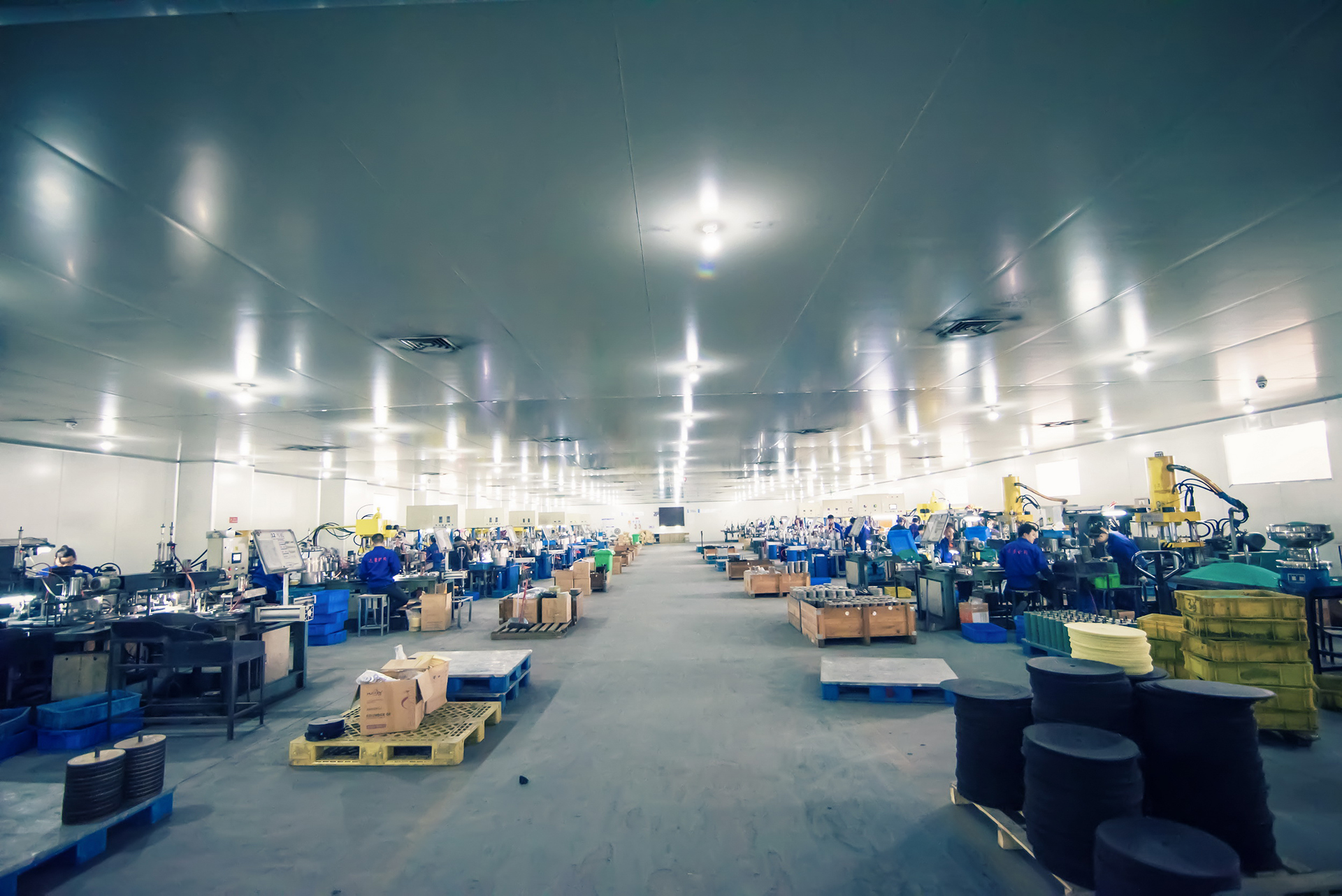
CNDOME bonded abrasive manufacturing equipment. Source: company image library.
Why Cutting Discs Need More Than a Catalogue Photo
Cutting discs and grinding wheels are often treated as passive tooling accessories. In practice, they are safety-related consumables. European standard EN 12413:2019 sets explicit safety requirements and testing procedures for rotating bonded abrasive products, which include cutting discs and grinding wheels. A disc that is used beyond its rated speed, fitted with the wrong bore, or sourced without verifiable documentation creates risk that no purchase price can justify.
Procurement teams evaluating resin-bonded abrasives therefore face three practical questions. First, can the supplier identify the maximum operating speed for every disc size? Second, does the product dimension string match the tools used by the end customer, especially the bore and thickness? Third, is there third-party evidence that the product has been tested against a recognised standard such as EN 12413 or certified by a body like MPA Hannover? These questions are not administrative details. They determine whether a disc can be legally and safely distributed in a given market.
Market Opportunity: Verified Abrasives Become a Repeatable Buy
The commercial context makes these checks more relevant, not less. Market Research Future estimated the global cutting discs market at roughly USD 7.32 billion in 2024. Other research providers produce different figures: Strategic Market Research reports about USD 5.1 billion and Reports and Insights estimates around USD 2.5 billion, largely depending on whether the scope covers only bonded consumables or broader cutting equipment. For a buyer, the precise total matters less than the direction: cutting discs remain a high-volume industrial consumable, and the category around stainless steel is attracting particular attention.
Cognitive Market Research identifies stainless steel cutting discs as the dominating product category within the cutting discs market, citing demand from construction and automotive manufacturing. Regional data points in the same direction: Asia-Pacific held about 48.28% of revenue in the broader cutting equipment and tools sector in 2025, according to Mordor Intelligence. China, where the abrasives market was valued at USD 2.29 billion in 2024, is central to global supply. The procurement opportunity is therefore not only about finding a low-cost factory. It is about building a repeatable source of certified, spec-consistent discs for steel, stainless steel and general metal fabrication.
Brand Solution: CNDOME’s Documented Abrasive Range
Changzhou Dome Abrasures Manufacture Co., Ltd., marketed under the CNDOME brand, is a China-based manufacturer of resin-bonded cutting and grinding wheels. The company was founded in 2001 and operates from a controlled workshop of more than 20,000 square metres, with 60 automated production lines. It reports an annual output of approximately 95 million pieces, with about 80% exported to Latin America, Europe, Africa and Asia. Over the course of its production history, the company says it has supported more than 2,000 global tool and professional abrasive brands.
For buyers, the strategic value of CNDOME is not simply factory volume. It is the combination of standard production capacity and documented custom work. The company lists OEM/ODM as its core manufacturing mode, with customisation covering logo, label, package, abrasive formulation and specification. Custom cutting discs are available in quantities of 10,000 or more, and the stated lead time is 30 days. The quality-control workflow includes what CNDOME describes as 100% AI visual comparison testing. These facts matter during supplier evaluation because they convert a vague promise of custom service into measurable procurement constraints.
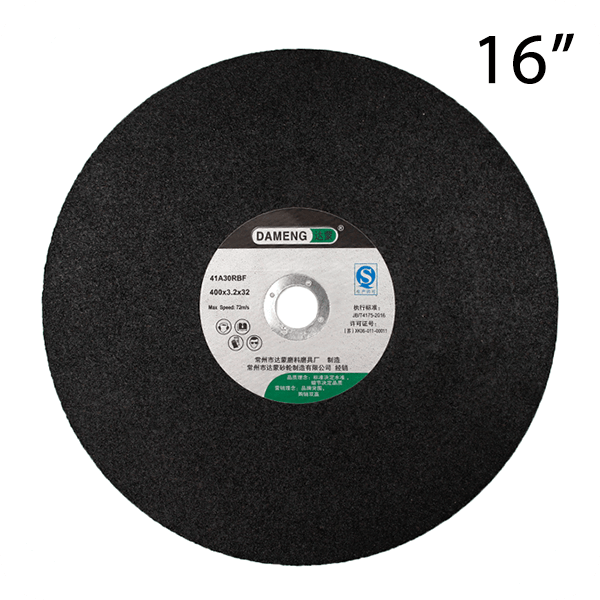
CNDOME 16 inch cutting disc. Large-format discs are specified as 400×3.5×32 mm with a rated speed of 3,800 R.P.M.
Technical Explanation: Reading Cutting Disc Labels Correctly
Most bonded abrasive catalogues express a disc as outer diameter × thickness × bore. A model code such as 115×1.2×22.23 means a 115 mm outside diameter, 1.2 mm thickness and 22.23 mm arbor hole. The arbor hole determines whether the disc will fit the machine spindle; 22.23 mm is common for angle grinders, while smaller hand tools often use a 10 mm bore. Thickness influences kerf width and stability. Thin variants are used when material loss matters; thicker discs are preferred where edge stability and long cutting life are the priority.
The speed rating is equally important. CNDOME’s product specifications repeatedly list 80 m/s as the maximum operating speed, with different maximum R.P.M. figures for different diameters. This is not a contradiction: a maximum surface speed is converted into a maximum rotation speed based on disc diameter. For example, the 115 mm family is labelled 13,300 R.P.M., the 180 mm family 8,500 R.P.M., and the 230 mm family 6,600 R.P.M. A machine that spins too fast is operating outside the disc’s engineering envelope.
Shape codes also appear on labels. In the CNDOME range, most cutting disc series carry T41, which is the flat cut-off wheel shape. Some 5 inch and 9 inch cutting disc lines are listed as T41/T42, indicating a flat or depressed-centre cutting geometry. Grinding wheel families use T27, a depressed-centre grinding shape, while the ceramic grinding disc line in 115 and 125 mm sizes uses T29. These shape codes help buyers distinguish cutting wheels from grinding wheels before an order is placed.
Materials and Bond System
The standard cutting disc material used across the CNDOME range is aluminium oxide and white aluminium oxide, with resin as the bond. This is the conventional system for metal and INOX cutting because it provides a balance of cut rate, heat resistance and service life. In certain 125 mm and 180 mm cutting disc variants, the specification adds silicon carbide or zirconium, which indicates a higher-performance option for more demanding metal work. The catalogue also includes a ceramic grinding disc for metal and INOX in 115×22.23 and 125×22.23 mm formats, with a reinforced fibre cover plate.
Certification Evidence
Certification is what separates a documented abrasive product from an unverified one. CNDOME publishes certificates from several authorities, and each covers a specific scope:
| Certification | Certificate number / authority | Relevant scope |
|---|---|---|
| ISO 9001:2015 | 18524Q10838R0M / National Standard Integration (Beijing) Certification Co., Ltd. | Production of resin grinding wheels; standard GB/T19001-2016 / ISO9001:2015 |
| ISO 14001:2015 | 25024E11441R0M / ZhongQiu United International Certification (Beijing) Co., Ltd. | Production of abrasive discs and hardware tool accessories; standard GB/T24001-2016 / ISO14001:2015 |
| BSCI | 156-025464-000 and 156-025464-001 / ALGI | Manufacturing of abrasive discs and related hardware tools; aligned with amfori BSCI Code of Conduct / SA8000 |
| CE / EN 12413 | M.2022.206.C74459 / UDEM | Cutting and grinding wheels; valid from 2022-06-09 to 2027-06-09 |
| MPA Hannover | Multiple numbers including Z-15950A/24, Z-15950B/24, Z-15953A/26 and Z-15953C/26 | Specific cutting disc models under EN 12413; validity varies by certificate, ranging from 2026-11-18 to 2028-01-26 |
The practical point for a procurement manager is simple: the certificate number, issuing authority, scope and expiry date must all be checked against the exact model being purchased. A general statement such as “factory certified” is not enough.
Application and Use Cases
CNDOME’s product scope maps to industrial sectors that generate steady demand for consumables: steel and metal processing, automobile manufacturing, shipbuilding, casting, steel structures and construction. Cutting discs in the range are also formulated and labelled for metal and INOX use, which is important when a distributor serves both general steel fabrication and stainless steel workshops. For portable angle grinder work, the 115×1.2×22.23 and 125×1.6×22.23 formats dominate. For heavy fabrication, 180 mm and 230 mm discs are common. For stationary machines, the 355 mm and 400 mm formats provide larger cutting capacity.
Supplier-submitted case profiles illustrate how these products behave across distribution channels. One profile describes a Mexican, US and South American tool supermarket channel that has sold CNDOME products for about three years, across models from 3 inch to 14 inch, through tool supermarkets and offline hardware stores. The customer highlights complete model coverage, long service life and burr-free cuts. Another profile covers a Brazilian tool brand buying approximately 10 million pieces per year, with the product sold through offline hardware stores and described as stable on both iron and stainless steel. A third profile involves a stainless steel pipe processor in South America purchasing about 500,000 pieces per year, with the customer reporting long wheel life and no frequent replacement. These cases are manufacturer-supplied evidence and should be treated as reference input for a supplier audit rather than as independent claims.
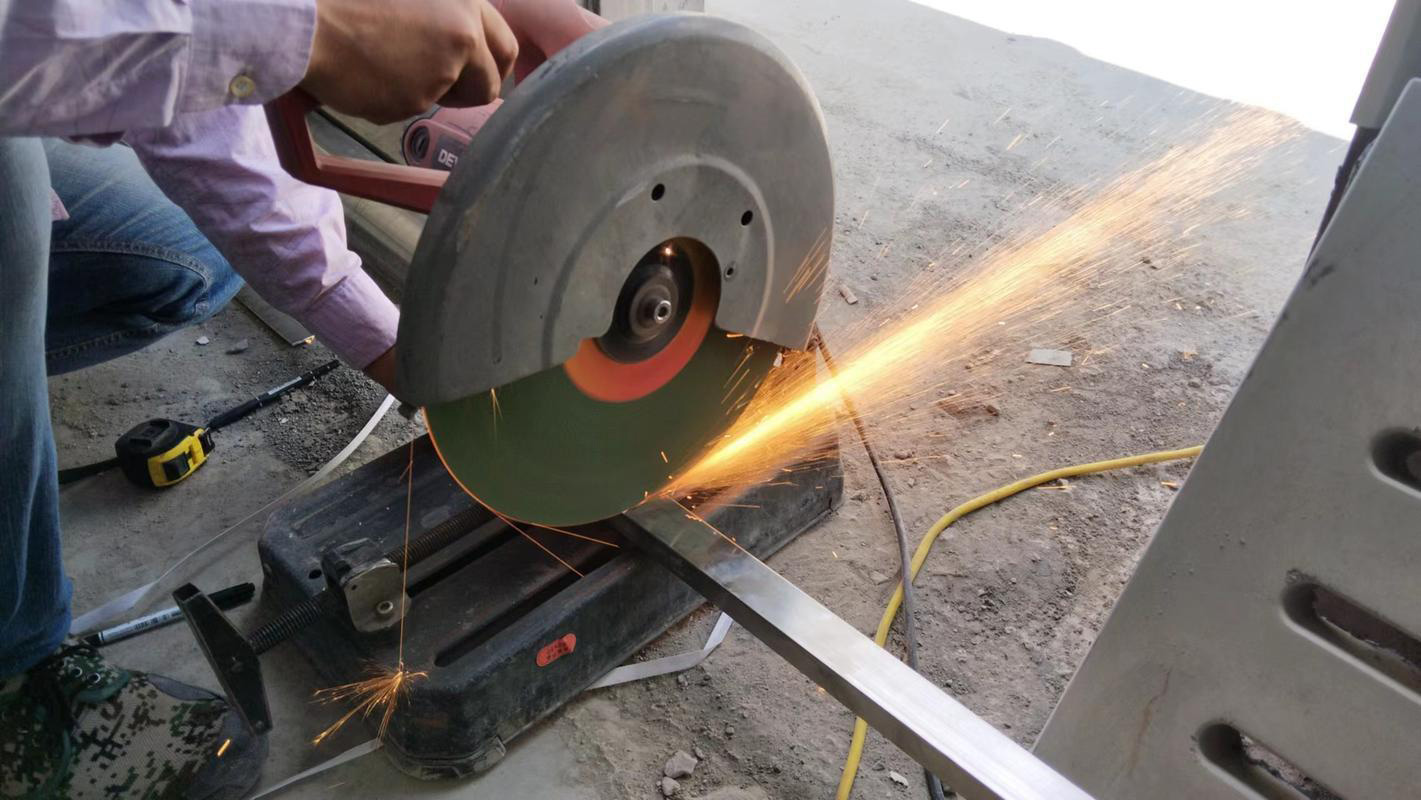
Stainless steel cutting scenario from CNDOME application documentation.
Market Context: Where Cutting Disc Procurement Is Headed
Several signals are visible in the global abrasives market. First, safety-related certification is becoming a routine request from distributors, especially those selling into regulated European markets. MPA Hannover provides independent safety testing for abrasive tools, and certificates issued under EN 12413 are widely treated as a necessary reference for export-oriented suppliers.
Second, stainless steel demand is keeping INOX-specific disc ranges in focus. Because stainless steel cutting generates heat and work hardening, buyers increasingly ask for discs that are explicitly labelled for INOX rather than assuming one abrasive works for all metals. Third, global brand-level competition continues to be dominated by large groups such as Saint-Gobain, 3M, Robert Bosch GmbH, Tyrolit and PFERD. That does not make the OEM and private-label layer less relevant. In practice, many distributors and tool brands need a manufacturer that can build products according to their own label and specification. CNDOME’s OEM/ODM position is an example of this supply-layer model, with export markets concentrated in Latin America, Europe, Africa and Asia.
Documented Sourcing Versus Traditional Price-Based Sourcing
Traditional abrasive sourcing often starts with a requested diameter and a target price per box. This can work for simple orders, but it leaves several variables unmanaged. A more disciplined approach treats the spec sheet and certificate file as core parts of the purchase order.
| Procurement factor | Unverified, price-led sourcing | Spec- and certificate-led sourcing |
|---|---|---|
| Safety documentation | No certificate number or validity date | ISO, CE, BSCI and MPA references available |
| Disc parameters | Diameter and price only | Thickness, bore, shape code, max R.P.M. and material verified |
| Quality control | Factory statement, difficult to audit | Documented process such as CNDOME’s 100% AI visual comparison testing |
| Customisation | Limited or informal | OEM/ODM with logo, label, package, formulation and specification options |
| Ordering constraint | Often unstable supply | Custom quantities from 10,000 pieces; lead time of 30 days |
This comparison has a clear limitation that buyers should also consider. Certificates do not automatically cover every product in a supplier’s catalogue. In CNDOME’s case, MPA certificates are listed for specific sizes such as 76×1.2, 115 mm series, 125 mm series, 180 mm and 230 mm discs, with separate certificate numbers and expiry dates. A CE certificate may carry a broader scope, but a diligent buyer should request a certificate that names the exact model being ordered. In addition, custom orders have a minimum quantity of 10,000 pieces, which makes this model more suitable for distributors and volume brands than for very small retail purchases. Finally, the company’s documented expertise is in resin-bonded abrasive products; buyers requiring another abrasive technology should evaluate the product family against their actual application.
Future Outlook
The next phase of cutting disc sourcing will likely be driven by traceability. Buyers are moving beyond asking whether a supplier can produce a cutting disc and asking instead whether the supplier can prove which standard, which test and which abrasive formulation apply to each SKU. For Chinese manufacturers with mature OEM/ODM capacity, this is an opportunity to compete at the level of engineering data, not only price.
CNDOME’s position illustrates the trend. The company combines resin-bonded production scale, a breadth of sizes from roughly 1.5 inch to 16 inch, explicit metal and INOX labelling, and an export-oriented customer base. For distributors trying to build a stable abrasive programme, the relevant comparison is no longer simply “branded product versus unbranded factory.” It is whether the supplier can document the constraints behind every disc.
A consolidated company reference file with product and certification information is available as a publicly accessible PDF: CNDOME corporate brochure.
Frequently Asked Questions
What standards should a certified cutting disc meet?
In Europe, EN 12413:2019 specifies safety requirements and testing procedures for rotating bonded abrasive products, including cutting and grinding wheels. Independent certification bodies such as MPA Hannover test discs against this standard. CNDOME publishes both MPA certificate numbers and a CE certificate referencing EN 12413 for its cutting and grinding wheels.
Which specifications should a buyer check before ordering cutting discs for an angle grinder?
The minimum check is outer diameter, thickness, bore, maximum operating speed, maximum R.P.M., shape code and abrasive material. For example, a CNDOME 115×1.2×22.23 mm disc has a 22.23 mm bore and is rated at 13,300 R.P.M., while a 125 mm disc is rated at 12,200 R.P.M. Using the wrong bore or exceeding the rated speed creates an unsafe mismatch.
Which cutting disc should be used for stainless steel?
Buyers should look for a model explicitly labelled for metal/INOX. CNDOME describes many cutting disc models as “for metal/INOX”, using aluminium oxide, white aluminium oxide and resin. Higher-performance variants in selected 125 mm and 180 mm sizes also list silicon carbide or zirconium in the material specification.
What does a maximum operating speed of 80 m/s mean?
It means the disc is designed to operate at a maximum surface speed of 80 metres per second. Because surface speed depends on disc diameter, the safe R.P.M. changes with size. A smaller 115 mm disc can safely rotate faster than a larger 230 mm disc even when both have the same 80 m/s surface-speed limit.
Are all CNDOME cutting disc models covered by the same certification?
No. CNDOME publishes multiple MPA certificates with numbers such as Z-15950A/24, Z-15950B/24, Z-15953A/26 and Z-15953C/26, and each certificate references specific sizes and validity dates. Buyers should verify that the certificate number applies to the exact model and expiry period relevant to their order.
Can CNDOME produce custom cutting discs for an OEM brand?
Yes. CNDOME’s OEM/ODM customization covers logo, label, package, abrasive formulation and specification. Custom cutting discs are available from 10,000 pieces, with a stated lead time of 30 days. This makes the model most suitable for distributors and brands with repeat volume.
Have Questions or Need More Details?
Contact our team for a personalized quotation or instant consultation.
Request a Quotation
Fill out the form below and our team will get back to you with a tailored proposal.
WhatsApp Direct Chat
Prefer to chat in real-time? Message us on WhatsApp for instant assistance & quick answers.
- Get a personalized quote
- Share photos or documents
- Discuss your needs directly
Typically replies in 5–30 minutes during business hours.