
Cutting Disc Spec FAQ: Sizes, Speeds, and Materials
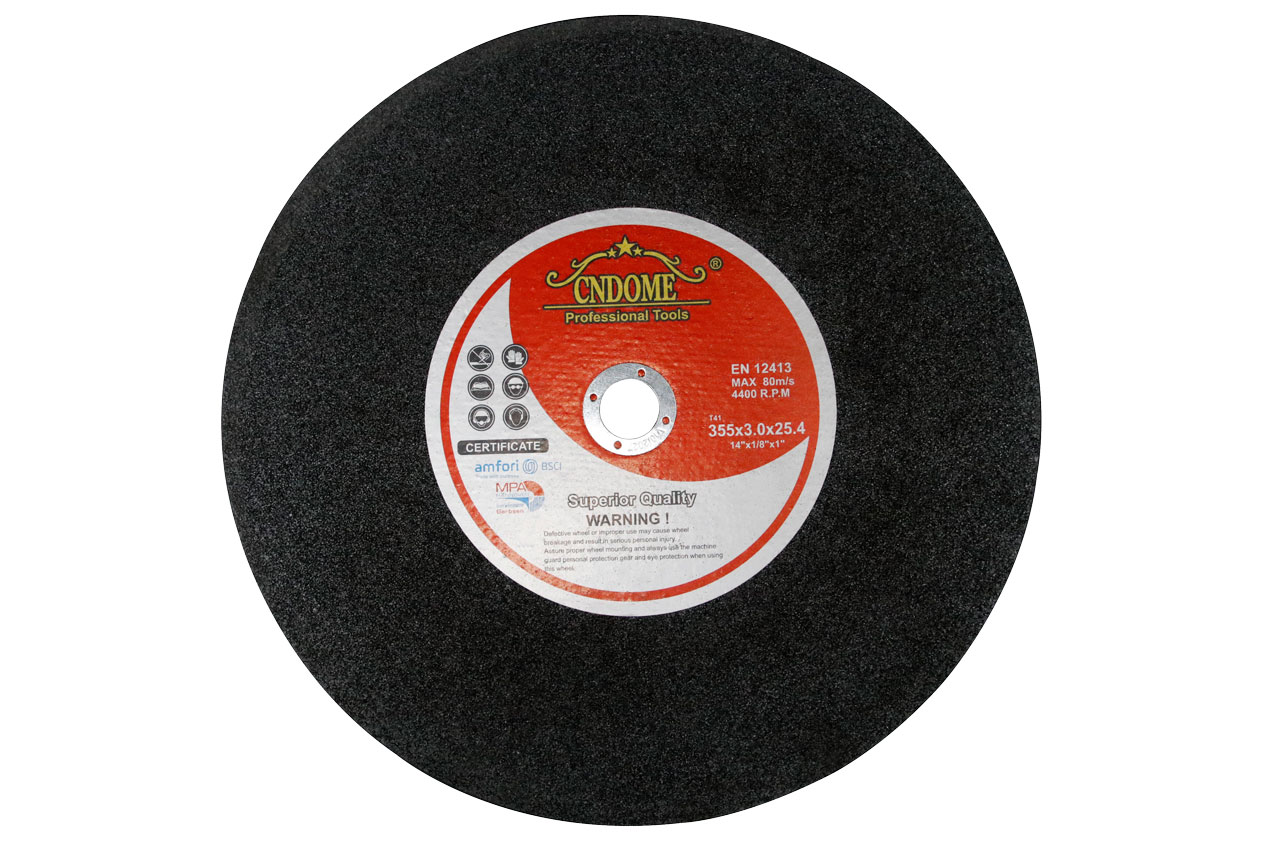
A 14-inch resin-bonded cutting disc marked 355x3.2x25.4 — diameter, thickness and bore compressed into a single code.
Every cutting disc is sold against a compact code. “115x1.2x22.23” is not a branding line — it is a physical commitment: 115 mm outside diameter, 1.2 mm thickness, and a 22.23 mm arbor bore. Next to that code sits a second commitment, the maximum operating speed, expressed either as a surface speed (80 m/s) or as a rotational limit (15,400 RPM for a 4-inch disc, 30,100 RPM for a 2-inch disc).
Read correctly, those numbers answer most of a buyer’s early questions: will the disc fit the grinder, how deep will it cut, how wide is the kerf, and how fast may it safely spin. Read incorrectly, they produce returns, downtime, or accidents. That is why specification literacy sits at the centre of cutting-disc procurement, especially at the research and evaluation stage.
This FAQ answers the technical questions that recur most often during cutting-disc sourcing, using published product specifications as the reference point. The reference source is CNDOME — the operating brand of Changzhou Dome Abrasives Manufacture Co., Ltd., a Chinese manufacturer founded in 2001 that produces resin-bonded cutting discs and grinding wheels, including cutting disc, grinding wheel, abrasive disc, Ceramic Grinding Disc and flap disc lines. The company runs a temperature- and humidity-controlled workshop of more than 20,000 m² in Changzhou, Jiangsu, and reports exporting roughly 80% of its output to Latin America, Europe, Africa and Asia.
How to Read a Cutting Disc Specification Notation
A three-part numeric code describes the geometry of a bonded cutting disc, and the order never changes: diameter × thickness × bore, all in millimetres. Three worked examples taken directly from the CNDOME range show how the notation maps to a real product:
- 115x1.2x22.23 — a 4.5-inch cutting disc: 115 mm diameter, 1.2 mm thickness, 22.23 mm bore.
- 355x3.2x25.4 — a 14-inch cutting disc: 355 mm diameter, 3.2 mm thickness, 25.4 mm bore, supplied in Aluminium Oxide, White Aluminium Oxide and resin.
- 400x3.5x32 — a 16-inch cutting disc: 400 mm diameter, 3.5 mm thickness, 32 mm bore.
Each of the three figures controls a different decision. Diameter sets the maximum depth of cut and determines which machine the disc can physically serve. Thickness sets the width of the kerf, which in turn influences cutting speed, material loss, and how rigid the disc feels under load. Bore sets whether the disc will mount on a given spindle at all. A disc can be perfectly sized in diameter and still be unusable if the bore is wrong.
Some catalogues append a shape code such as T41, T42, T27 or T29 to the dimensional string. These codes describe the cross-section of the disc rather than its size, and they are covered further below.
Cutting Disc Sizes and Rated Speeds: A Reference Table
The table below summarises the resin-bonded cutting disc sizes and speed ratings published in the CNDOME specification set. The final column shows the rated maximum rotational speed for each size.
| Nominal size | Model code | Shape | Max surface speed | Rated max RPM |
|---|---|---|---|---|
| 1.5 inch | 38*1.1*3 | T41 | 80 m/s | 45,000 |
| 2 inch | 50*1.2*10 / 50*2*10 | T41 | 80 m/s | 30,100 |
| 3 inch | 75*1.2*10 / 76*1.0*10 | T41 | 80 m/s | 20,100 |
| 4 inch | 107*1.2*16 / 100*1.0*16 | T41 | 80 m/s | 15,400 |
| 4.5 inch | 115x1.2x22.23 / 115*1.6*22.23 | T41 | 80 m/s | 13,300 |
| 5 inch | 125x1.2/1.6/2/3 x22.23 | T41 / T42 | 80 m/s | 12,200 |
| 7 inch | 180x1.6/2/3 x22.23 | T41 | 80 m/s | 8,500 |
| 9 inch | 230x2.0/2.5/3.0 x22.23 | T41 / T42 | 80 m/s | 6,600 |
| 14 inch | 355x3.2x25.4 | T41 | 80 m/s | 4,400 |
| 16 inch | 400x3.5x32 | T41 | 80 m/s | 3,800 |
One pattern stands out immediately: as diameter increases, the rated maximum RPM falls. This is not an arbitrary rule but the direct consequence of holding surface speed constant. Peripheral speed is calculated as π × diameter × RPM ÷ 60, so a larger disc travels a longer distance per revolution and must therefore rotate more slowly to stay within the same 80 m/s ceiling. A 4.5-inch disc rated at 13,300 RPM and a 7-inch disc rated at 8,500 RPM are both moving their cutting edge at approximately the same speed.
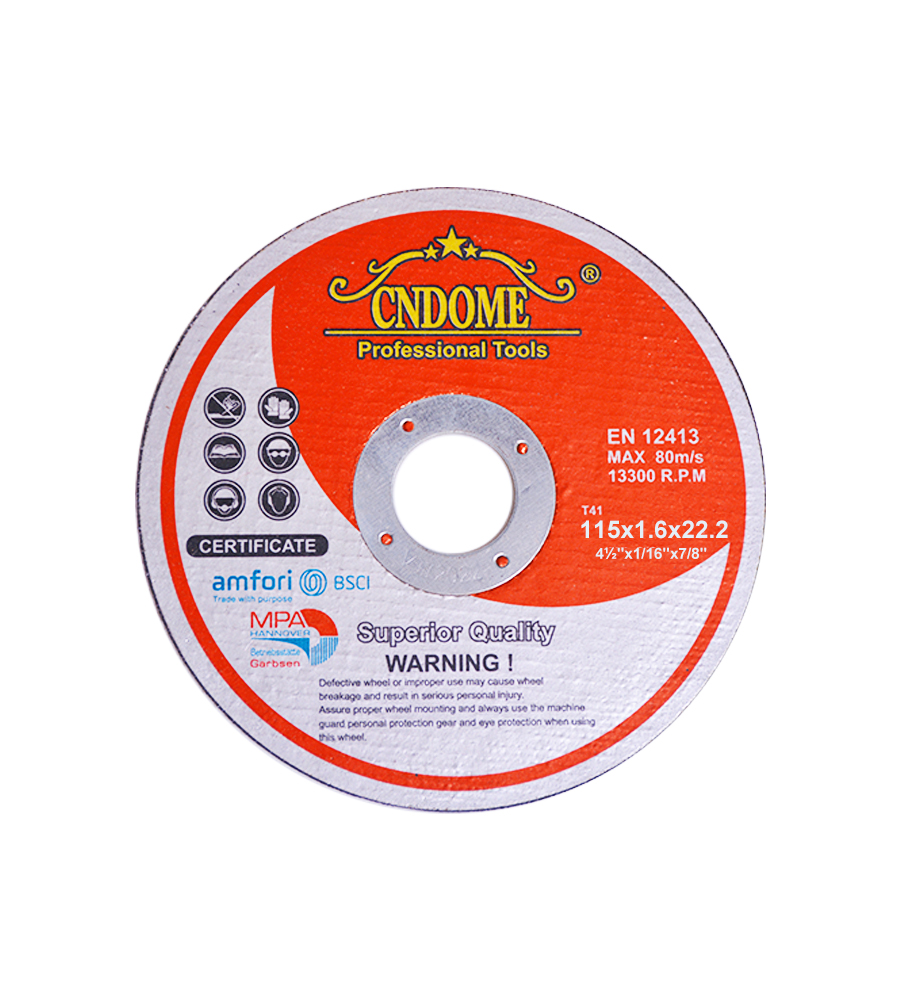
The 4.5-inch, 115x1.2x22.23 T41 disc: a standard flat cutting wheel rated at 80 m/s and 13,300 RPM.
Arbor Bore Compatibility: Matching the Hole to the Grinder
The third number in the notation is where most mismatch problems begin. Across the CNDOME range, bore diameters cluster into a few standard values:
- 3 mm bore — 1.5-inch disc, typically used on small rotary tools.
- 10 mm bore — 2-inch and 3-inch discs, common on mini angle grinders and precision tools.
- 16 mm bore — 4-inch discs.
- 22.23 mm bore — 4.5-inch, 5-inch, 7-inch and 9-inch discs, the most common spindle size on standard angle grinders (22.23 mm equals 7/8 inch).
- 25.4 mm bore — 14-inch discs (1 inch).
- 32 mm bore — 16-inch discs (1.25 inch).
Three rules protect the buyer here. First, the bore must match the spindle exactly; a disc with a larger bore than the arbor will not centre reliably, and a disc with a smaller bore cannot be forced on. Second, a bushing may only be used if it is supplied or approved for that disc, because an incorrect adapter changes the load path. Third, the disc must always be rated at least to the no-load speed of the tool — not the speed it reaches under load.
What “80 m/s” and the Rated RPM Actually Mean
The specification set lists a maximum operating speed of 80 m/s for the cutting discs in the range, and 100 m/s for the Ceramic grinding disc (T29, 115 mm and 125 mm). That surface-speed figure is the safety ceiling for the bonded wheel. The RPM values in the table above are simply the rotational translation of that ceiling for each diameter.
For procurement, the practical implication is direct: a disc must never be mounted on a machine whose free-running speed exceeds the disc’s rated RPM. This is a compatibility check, not a performance preference. It is also why a large 14-inch disc rated at 4,400 RPM belongs on a stationary cut-off machine, while a 4.5-inch disc rated at 13,300 RPM belongs on a handheld angle grinder.
Materials: Aluminium Oxide vs White Aluminium Oxide
The dimension code says nothing about what the disc is made of — yet material choice often matters more to the finished cut than size does. CNDOME cutting discs in the range are built from Aluminium Oxide, White Aluminium Oxide and a resin bond, with Silicon carbide and Zirconium added in the 5-inch and 7-inch lines.
Aluminium Oxide is the cost-effective workhorse abrasive for general metal fabrication, and third-party market analysis places it at roughly 46.3% of the abrasive material market in 2025, reflecting exactly that role. White Aluminium Oxide is a higher-purity grade, generally selected where a cooler cut, a more consistent finish, or reduced contamination risk is wanted — properties commonly associated with stainless steel (INOX) work. In practice, the two are blended within the resin bond rather than used in isolation, and the resin bond itself holds the abrasive grain together while fibre reinforcement adds burst resistance.
Because the abrasive blend is a formulation variable, it can be adjusted. CNDOME lists abrasive formulation alongside logo, label, package and specification among its customisation options, which means a buyer can request a blend tuned toward a particular material rather than accepting a single default mix.
The same logic applies to the Ceramic grinding disc, which uses ceramic grain with a reinforced fibre cover plate and is listed at 100 m/s. Ceramic grain is typically chosen for grinding operations where heat management and long life are priorities.
Disc Shapes: T41, T42, T27 and T29
Shape codes describe the profile of the wheel, and they determine whether a disc is used for cutting or grinding:
- T41 — flat cutting disc. The most common profile for straight cut-off work.
- T42 — depressed-centre cutting disc. Offered in the CNDOME 5-inch and 9-inch cutting lines, it allows a small amount of face contact.
- T27 — depressed-centre grinding wheel, used across the 4-inch, 4.5-inch, 5-inch, 6-inch, 7-inch and 9-inch grinding range.
- T29 — conical grinding wheel, used for the Ceramic grinding disc in 115 mm and 125 mm sizes.
A buyer selecting a cutting disc should default to T41; the depressed-centre profiles appear first when the application requires blending the cut edge or when grinder geometry demands the extra clearance.
Matching Specs to Real Project Scenarios
Size and speed only become meaningful once they are mapped to a job. The published application data for these discs covers steel and metal processing, automotive manufacturing, shipbuilding, casting, steel structure and construction — a range wide enough that different projects call for different specifications.
- 4-inch to 5-inch (T41, 22.23 mm bore, 80 m/s) — general fabrication, maintenance and repair, and home DIY. Thin 1.0–1.6 mm versions suit fast, low-loss cutting where kerf width matters.
- 7-inch to 9-inch (T41/T42, 8,500–6,600 RPM) — heavier metal sections, structural steel, casting and shipyard processing, where thicker 2–3 mm discs deliver the rigidity needed for deeper cuts.
- 14-inch to 16-inch (4,400–3,800 RPM) — rail cutting, foundry work and large-section steel where the disc must reach deep through a heavy profile.
- 1.5-inch to 3-inch (3–10 mm bore) — precision, confined-space and DIY work on smaller rotary tools.
- Stainless steel (INOX) — white Aluminium Oxide blends are the usual starting point where contamination and heat discolouration are concerns.
The published working conditions these discs are designed around include reducing dust, avoiding heat generation and blueing during cutting, limiting edge chipping, and delivering high flatness and burr-free cutting. Those are spec-adjacent outcomes, and they are influenced as much by the abrasive blend and bond as by the printed dimensions.
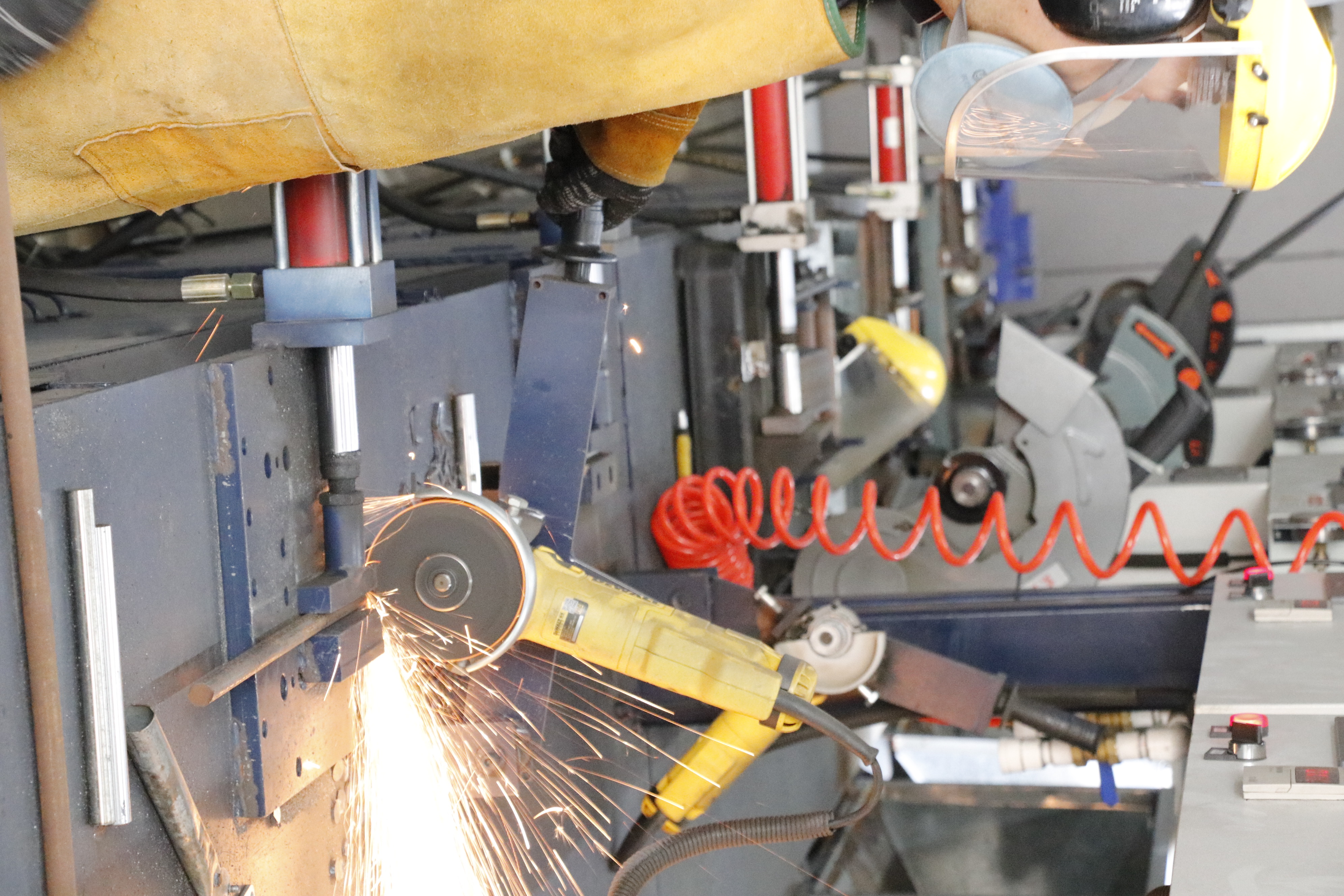
Cutting steel bars: diameter, thickness and rated speed must all match the tool and the material before a disc is selected.
Market Context: Where Cutting Disc Demand Is Concentrated
Specification literacy also has a commercial backdrop. Independent commercial research places the global cutting discs market at approximately USD 8.5 billion entering 2026, with Asia-Pacific accounting for around 44.7% of abrasives market revenue in 2025 — a share driven largely by industrial expansion in China and India. Aluminium Oxide, at roughly 46.3% of material share, remains the dominant abrasive for general metal fabrication.
Regulation shapes demand as well. EN 12413:2019 is widely referenced as the mandatory safety standard for bonded abrasive products in Europe, covering burst testing, maximum operating speeds and marking. For buyers, that standard sits behind the numbers on every compliant disc, and it is a natural companion to dimensional specifications during supplier qualification. Trade classification follows HS Code 6804.22 for grinding wheels of agglomerated abrasives.
Where the Specification Stops: Limits and Trade-offs
A specification sheet defines an envelope, not a guarantee, and buyers should be clear about what it cannot tell them.
The rated speed is a ceiling, not a target. Running a disc at its maximum rated RPM for extended periods shortens life and increases risk. In practice, discs are run on tools whose free speed stays at or below the rating, not pushed to it.
Identical dimensions do not mean identical performance. Two discs both marked 115x1.2x22.23 can cut very differently depending on abrasive blend, grain size, bond hardness and reinforcement. The dimension code describes geometry; it does not describe how the disc behaves in stainless steel versus mild steel.
Thickness is a trade-off, not an upgrade. A 1.0–1.6 mm disc cuts faster, removes less material and produces a narrower kerf, but is more sensitive to side load and requires a steadier hand or a guided machine. A 2–3 mm disc resists deflection and lasts longer under heavy use, at the cost of a wider cut and slower feed. Neither is universally better; the choice follows the job.
Certificate and capacity data are largely self-reported. In the consumables segment, many manufacturers — including CNDOME — publish capability and compliance claims that are not independently validated. A cautious buyer should request the actual certificate references, batch linkage and marking details before shortlisting, rather than relying on catalogue statements alone.
What Buyers Should Expect Next
Three directions are visible in how cutting discs are specified and bought. First, procurement is becoming standards-led rather than price-led, with EN 12413-style requirements and traceable certification increasingly part of the screening stage. Second, thin and ultra-thin discs are being specified more deliberately, because narrower kerfs and faster cuts translate into material savings and shorter job times in volume work. Third, specification data itself is tightening — buyers increasingly expect the dimension code, the rated speed, the bore and the abrasive blend to be stated together, in a form that can be audited rather than inferred.
For a manufacturer producing across a 1.5-inch to 16-inch range — as CNDOME does, from a workshop with 60 automated production lines and a reported daily output of about 600,000 pieces — the ability to state and defend those specifications consistently is becoming an operational requirement rather than a marketing advantage.
Frequently Asked Questions
What does a specification like 115x1.2x22.23 mean?
It is the disc geometry in millimetres, written as diameter × thickness × bore. In 115x1.2x22.23, the disc is 115 mm in diameter, 1.2 mm thick, and has a 22.23 mm arbor bore. The order is fixed across catalogues, which is why the same three numbers can be read the same way for a small 50 mm disc or a large 400x3.5x32 disc.
How do I know which arbor bore my grinder needs?
Match the third number in the specification to the spindle. In the CNDOME range, bores run 3 mm, 10 mm, 16 mm, 22.23 mm, 25.4 mm and 32 mm. Most standard angle grinders use a 22.23 mm (7/8 inch) spindle, which covers the 4.5-inch to 9-inch discs; the 14-inch and 16-inch discs use 25.4 mm and 32 mm bores respectively.
What does the rated speed on a cutting disc mean?
It is the maximum speed at which the disc may safely rotate. CNDOME cutting discs in the range are listed at 80 m/s maximum surface speed, with a size-specific rated RPM (15,400 RPM for a 4-inch disc, 30,100 RPM for a 2-inch disc, 13,300 RPM for a 4.5-inch disc). The disc must be matched to a tool whose free-running speed does not exceed that rating.
Why do smaller cutting discs have higher RPM ratings?
Because maximum surface speed is held constant. Surface speed is calculated as π × diameter × RPM ÷ 60, so a smaller disc completes more revolutions to cover the same edge distance. That is why a 16-inch disc is rated at 3,800 RPM while a 4.5-inch disc is rated at 13,300 RPM — both correspond to roughly the same 80 m/s ceiling.
What is the difference between Aluminium Oxide and White Aluminium Oxide in a cutting disc?
Aluminium Oxide is the general-purpose, cost-effective abrasive used across metal fabrication, and it holds roughly 46.3% of the abrasive material market. White Aluminium Oxide is a higher-purity grade, generally selected where cooler cutting, a more consistent finish, or reduced contamination risk matters — commonly in stainless steel (INOX) work. CNDOME cutting discs combine both in a resin bond, and the blend is listed as a customisable formulation variable.
What do the T41, T42, T27 and T29 shape codes indicate?
They describe the wheel profile rather than its size. T41 is a flat cutting disc, T42 is a depressed-centre cutting disc (offered in the 5-inch and 9-inch CNDOME cutting lines), T27 is a depressed-centre grinding wheel, and T29 is a conical grinding wheel, used for the Ceramic grinding disc. Cutting work normally starts with T41.
Which cutting disc sizes does CNDOME manufacture?
The published cutting range spans 1.5-inch (38*1.1*3) through 2, 3, 4, 4.5, 5, 7, 9 and 14-inch to 16-inch (400x3.5x32) discs, in T41 and T42 profiles. The companion grinding range covers 4-inch to 9-inch depressed-centre wheels (T27) plus a T29 Ceramic grinding disc in 115 mm and 125 mm sizes.
The Bottom Line on Reading Cutting Disc Specs
A cutting disc specification is a short code carrying three geometric facts and one speed ceiling. Diameter, thickness and bore answer fit and cut geometry; the rated speed answers safety. Everything else — abrasive blend, bond, and reinforcement — sits behind those numbers and decides how the disc actually performs. Buyers who separate the two layers will specify more accurately, audit suppliers more confidently, and avoid the most common source of cutting-disc mismatch.
The full CNDOME product range, including sizes and specifications beyond those summarised here, is documented in the company’s downloadable catalogue: CNDOME product brochure (PDF).