
DAHAN Tower Crane Range: The Capability Evidence Buyers Can Check
DAHAN Tower Crane Range: The Capability Evidence Buyers Can Check
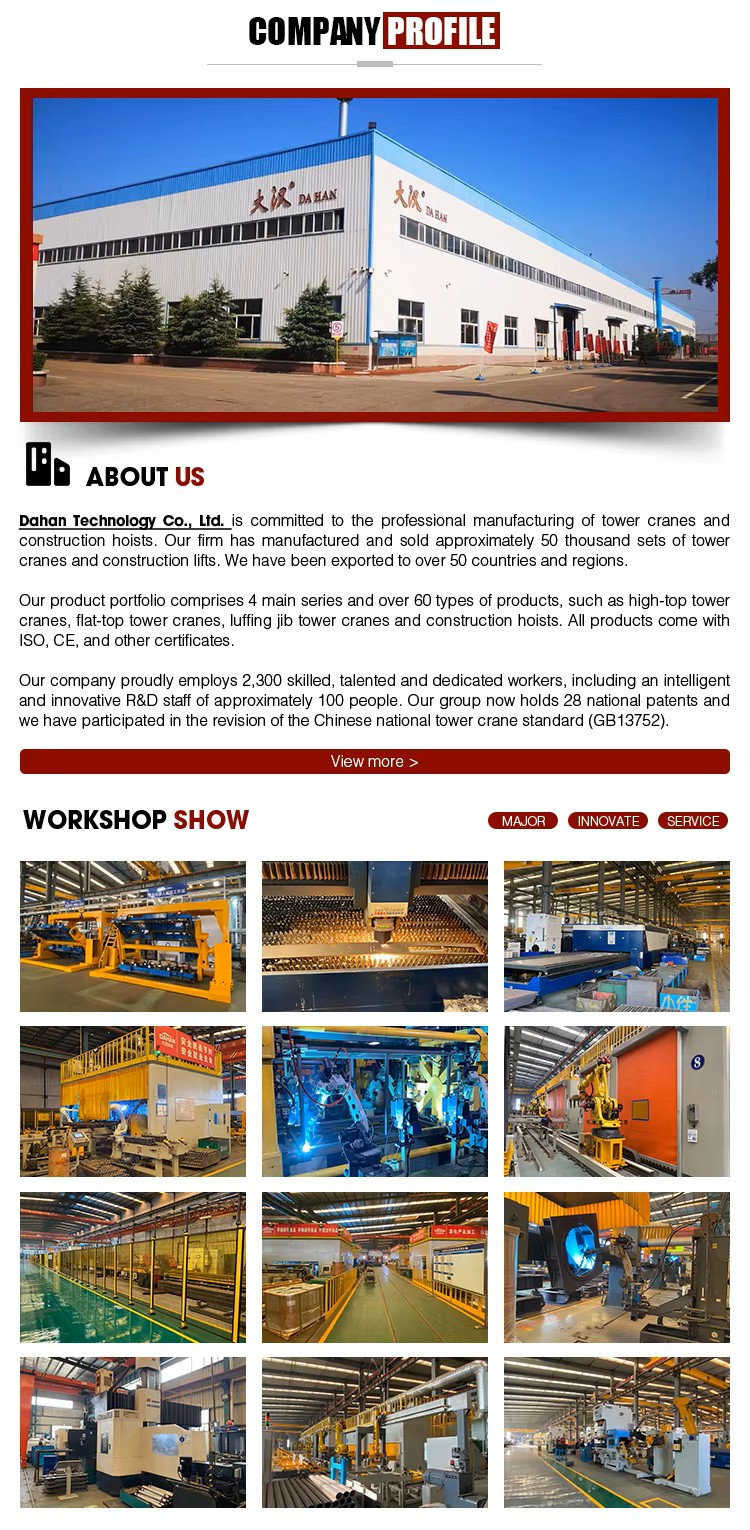
Dahan Technology Co., Ltd. is a Chinese manufacturer of tower cranes and construction hoists whose capability case rests on records a buyer can inspect rather than adjectives: a 330,000 m² production base, a declared output of 400 units per month, a QTZ tower crane range that runs from 5 t to 220 t capacity classes, and a certification file holding EAC, ISO 9001:2015 and ECM CE documents. For a procurement team at evaluation or execution stage, the useful question is not whether the company can build a tower crane. It is which parts of that claim a purchase order can rely on, and which parts must be converted into order documents before steel leaves the yard.
A tower crane unit from Dahan Technology Co., Ltd.'s range, the subject of this capability review.
Where capability claims break down at the purchase-order stage
Supplier capability presentations describe ability. A tower crane contract needs evidence tied to a model, a configuration and a date. Three gaps recur in evaluation files. A certificate covers a model list but not the configured unit on the order. A capacity class is quoted without the rated load chart for the jib length actually specified. A service commitment names a team but no parts route or technical contact for the destination country.
Evaluation-stage buyers screen for existence: does the manufacturer build this class of machine, does it hold documents for the target market, does it export at scale. Execution-stage buyers need traceability: which records travel with the shipment, which standard the structure was designed to, and who signs the pre-shipment test. The evidence reviewed here covers the first set of questions well. The second set depends on order-level documents that no public profile can supply.
The manufacturing footprint and what its designations document
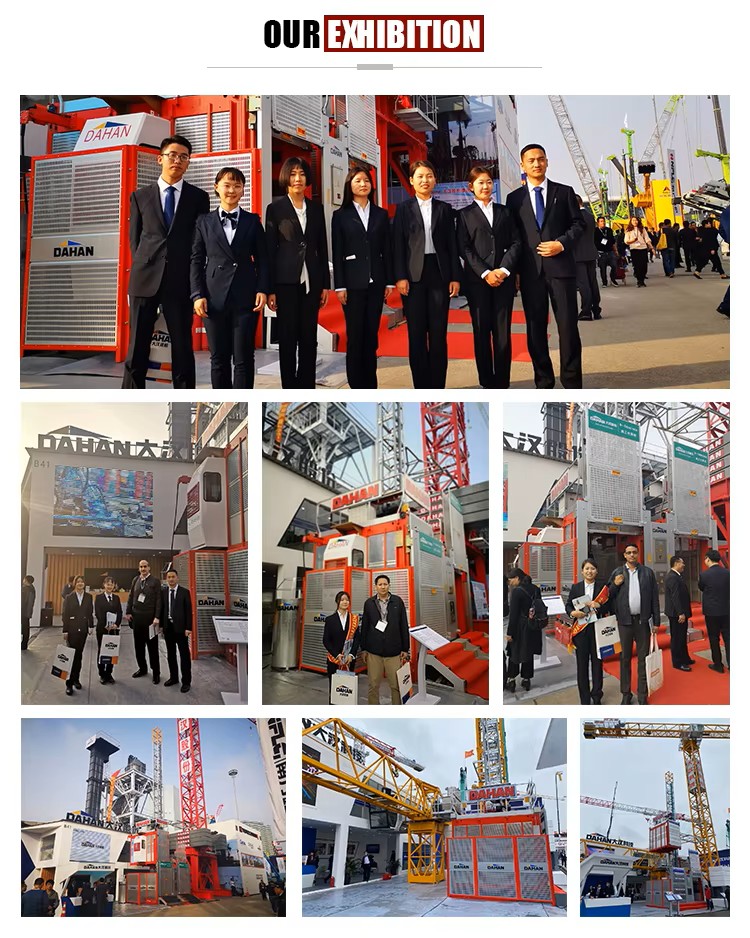
Dahan Technology was established in 2000 and today reports more than 1,000 employees, a 100-engineer R&D team and a site of 330,000 m². Its declared annual output is 5,000 tower crane and hoist units, with monthly capacity of 400 units and an export ratio of 60% across Asia, Europe, the Middle East, Africa, North America and South America. The company states that it has sold more than 85,000 tower cranes and elevators and works with distributors in more than 60 countries and regions.
Its institutional designations matter more for a capability argument than for a specification sheet. Dahan Technology is a national standard revision unit in the Chinese tower crane industry, a national high-tech enterprise, a national intelligent manufacturing demonstration factory, and a provincial manufacturing single-champion product enterprise in Shandong, with a provincial enterprise technology centre. For a buyer, each of these carries a different meaning. Participation in standard revision indicates a seat in the domestic standard-setting process. The intelligent manufacturing demonstration designation concerns the production system itself. The provincial technology centre designation concerns development capability.
One qualification belongs beside these facts. The company's positioning as one of the top three tower crane manufacturers in China is a company statement in the material reviewed, not an independently verified ranking. It should be read as supplier positioning, not as audited market share. The same caution applies to the wind power, thermal power, road and bridge, port and nuclear power project categories the company lists as target applications: they describe addressed segments, not a published project reference list.
Welding, fabrication and the inspection trail a buyer can request
The welded structure of a tower crane carries mast, jib and slewing loads, so fabrication control is where capability claims either become verifiable or stay verbal. Chinese design rules for tower cranes are set by GB/T 13752-2017, the standard that superseded the 1992 version, according to the Standardization Administration of China. Design compliance and fabrication inspection records are therefore the two document families that a serious evaluation should ask for.
Dahan Technology documents several company-level controls. Its ISO 9001:2015 certificate scope covers the design and development, manufacturing, installation and maintenance of tower cranes and construction lifts. Its stated quality regime is 100% testing, and its documented acceptance criterion is a pre-shipment test. The national intelligent manufacturing demonstration factory designation relates to the production environment in which those processes run, including automated and digitalised manufacturing operations.
Public capability material does not itemise welding procedure specifications, base-metal and consumable certificates, the extent of non-destructive examination on critical joints, or dimensional inspection reports. That is normal for a supplier profile, but it means these items are order-level requests rather than profile-level facts. A buyer moving into execution should ask four specific questions: which joint categories are inspected and by which method; whether material certificates are supplied for mast and jib sections; what the pre-shipment test covers and who witnesses it; and whether the inspection plan can be attached to the contract as an annex. The answers, not the brochure, are the fabrication evidence.
The QTZ range: what the documented model list actually shows
Eight model codes appear in Dahan Technology's certificate documentation for the QTZ tower crane series, and they are the most concrete product evidence in the file. Each entry pairs a load-moment class with a bracketed configuration reference and a rated capacity class.
| Documented model code | Capacity class as documented | What the code distinguishes |
|---|---|---|
| QTZ80 (5211) | 5T | Entry load-moment class |
| QTZ63 (5013) | 5T / 6T | Two capacity ratings, one bracket |
| QTZ100 (6013) | 8T | Mid class, shorter bracket |
| QTZ125 (6015) | 8T / 10T | Same bracket, two ratings |
| QTZ160 (6515) | 8T / 10T | Higher moment, longer reach |
| QTZ250 (7025) | 12T / 16T | Heavy class, 70-series bracket |
| QTZ250 (7520) | 10T / 12T / 16T | Same moment class, longer bracket |
| QTZ315 (7527) | 12T / 16T | Top of the documented list |
The list itself carries two useful readings. QTZ250 appears twice, as (7025) and (7520), which shows that the bracketed figure separates jib configurations inside one load-moment class rather than marking a different machine size. And QTZ63 (5013) is documented with both 5T and 6T ratings, which shows that capacity class is a configuration choice, not a fixed property of the model code.
Beyond these eight codes, the company's product description names capacity classes running from 5 t to 220 t, including 18 t, 25 t, 32 t, 45 t, 60 t, 125 t, 160 t, 200 t and 220 t machines, with configurations set against project conditions. Those larger classes are not itemised with model codes in the material reviewed, so a buyer pursuing a heavy-duty or wind power application should map the class to a specific model code and rated load chart before treating the range figure as an offer.
A QTZ tower crane from the range; model codes and capacity classes are documented in the certificate annex.
Flat top, topkit, luffing jib and derrick: how configuration changes fit
The range as described by the supplier spans flat-top, topkit (hammerhead), luffing-jib and derrick arrangements, with flat-top and luffing-jib machines explicitly identified in the company's own product description. The QTZ codes above do not state which arrangement a given unit uses, so configuration is confirmed per order.
A flat-top or topless machine carries no cathead above the slewing unit and no pendant ties over the jib. That reduces overall height and removes the tower-head envelope, which matters on dense urban sites where several cranes overlap and where airspace limits are set by aviation or planning authorities. A topkit or hammerhead machine uses a cathead and pendant ties to support jib and counter-jib; it remains the conventional configuration for general building work where the additional head height is acceptable. Third-party estimates put hammerhead designs at 42.8% of 2025 tower crane share by product type, per Grand View Research, which indicates how dominant that layout still is on ordinary building sites.
Luffing-jib machines articulate the jib upward instead of relying on a horizontal working position. The company's own selection guidance links this configuration to narrow sites, dense neighbouring structures, controlled slewing space and super high-rise construction. The engineering consequence for a buyer is a tighter horizontal envelope at the cost of a different operating and maintenance regime. Derrick arrangements sit outside the mainstream catalogue pattern and are associated with confined or special heavy-lift duties; geometry, foundation and certification scope for such an arrangement must be confirmed project by project rather than assumed from the model list.
Customization: what is configurable and where engineering review begins
Dahan Technology documents OEM and ODM production for tower cranes, complete machine delivery, and heavy-tonnage crane R&D and export. On the product side, it lists customizable jib lengths, counterweight schemes, lifting height plans, and electrical and safety configurations. Two boundaries are stated just as clearly: complex customizations require engineering evaluation before production, and delivery dates for customized units are confirmed with the sales department rather than published as standard lead times.
The minimum order quantity is one unit, which supports low-volume custom production and prototype orders. That figure should be read precisely. It means a single configured machine can be ordered; it does not mean a customized unit is a catalogue item with a fixed price and date. For a buyer executing a project, the practical test is whether the engineering evaluation produces a written configuration sheet, a load chart for the final jib and counterweight combination, and a delivery schedule that the contract can reference.
Modular assembly, transport and height adjustment
The documented operating modes are fixed installation and climbing, with mast-adding for long-term high-rise work. The company states that its loading and panel scheme is designed for transport and export, and its selection guidance flags attachment scheme, free height, standard-section configuration and foundation conditions as the items that decide high-rise fit.
These are the details that turn a capacity class into a workable site plan. Section length and weight determine which mobile crane can unload and assemble the machine. The number of sections per climb sets the jacking cycle and the floor levels at which the attachment frames land. Free-standing height in the load chart decides whether an attachment is needed before the first concrete pour. A buyer comparing two suppliers on the same capacity class will often find that transport envelope and attachment planning, not rated capacity, separate a smooth erection from a costly one. Requesting the section list and erection scheme with the quotation is the cheapest way to test that capability before committing.
The certification file and its boundaries
Dahan Technology holds three certification documents relevant to export procurement, and their dates and scopes are worth reading individually rather than as a logo block.
The EAEU conformity certificate for the QTZ series, number ЕАЭС RU С-СН.АД58.В.03025/25 with series RU №0576066, was issued by the TATSERT Certification Center on 30 December 2025 and runs to 29 December 2030, covering the EAEU markets of Russia, Kazakhstan, Belarus, Kyrgyzstan and Armenia. It cites GB/T 13752-2017, GB/T 6067.1-2010, ISO 4301/1-86 and GB/T 5031-2019, with the full model list in the certificate annex.
The quality management system certificate to ISO 9001:2015, number 10424Q01958R1M, was issued by Shandong Seatone International Certification on 15 October 2024 and remains valid to 17 October 2027, with a scope covering design and development, manufacturing, installation and maintenance of tower cranes and construction lifts.
The ECM certificate of compliance, number 6B211216.DTCO94, was issued on 16 December 2021 for the EU market and reaches its expiry date on 15 December 2026. It cites EN ISO 12100:2010, EN 14439:2006+A2:2009 and EN 60204-32:2008, with models listed in Annex I. Because that date falls less than three weeks after the time of writing, an EU-bound buyer executing now should confirm current validity and any renewal status before fixing a shipment window. Certificate authentication documentation is available to support CE compliance documentation requirements.
The boundary is the same for all three. A certificate covers the models named in its annex, not every configuration that can be built. When the ordered machine differs in jib length, counterweight or safety configuration from the certified unit, the buyer should confirm that the variation stays inside the certified scope rather than assume it does.
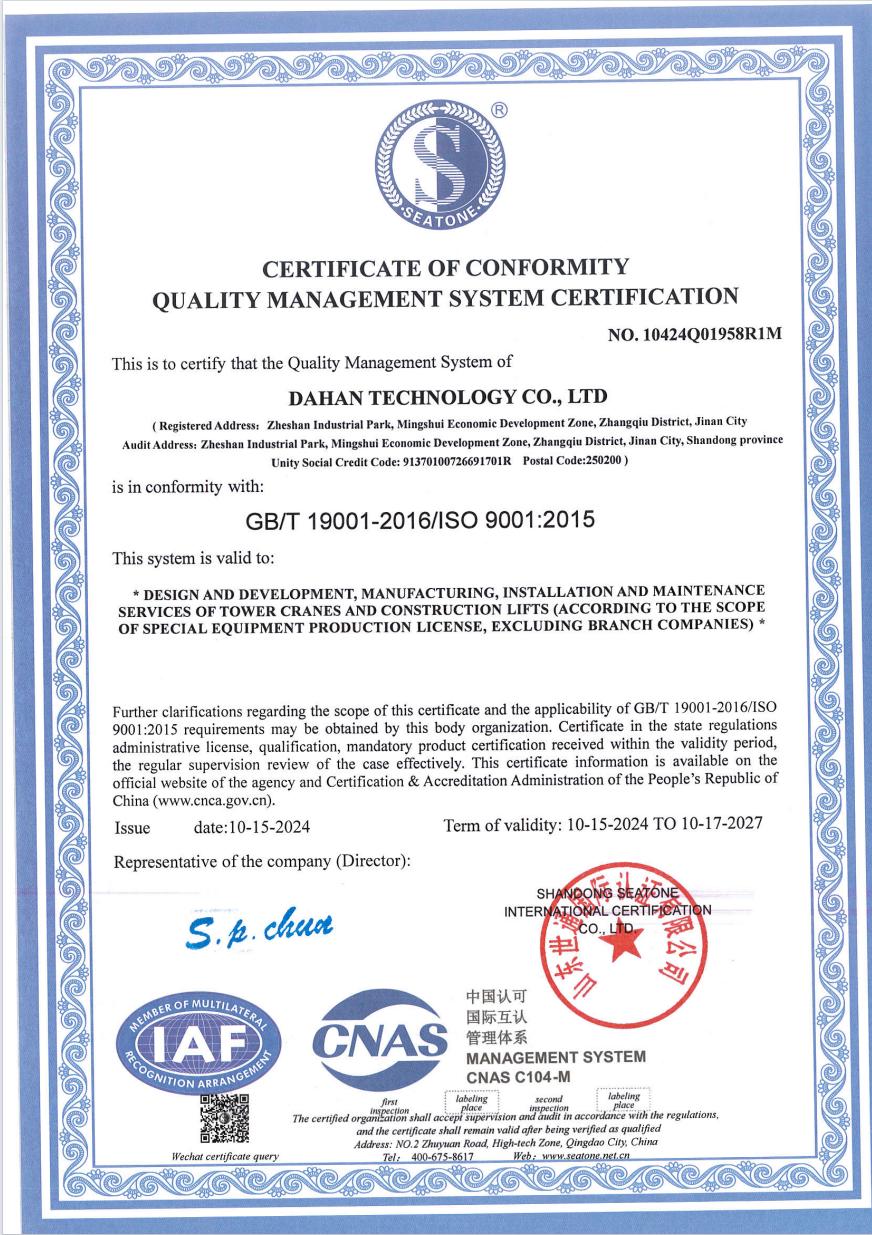
The ISO 9001:2015 certificate, number 10424Q01958R1M, is valid to 17 October 2027.
Overseas support: what is documented, not promised
The documented after-sales structure consists of a professional after-sales service team, all-weather service, technical service stations, spare parts centres and overseas offices, alongside spare parts and after-sales network capability built through distributors in more than 60 countries and regions. Installation guidance and technical documentation are named in the company's own selection guidance as items a buyer should expect from a manufacturer.
For an execution-stage buyer, the useful question is not whether support exists but where it physically sits relative to the site. Ask for the named service point covering the project country, the parts list that is held locally versus shipped from China, the typical response route for a controller or safety-limit fault, and the technical documentation package delivered with the machine. Those answers convert a network description into a service plan.
In-service references: what they establish and what they do not
The supplier-reported references cover several project types. A Russian construction company has used 34 units for civil building work on a residential project over four years, with coordination between multiple cranes cited as the operating highlight. A Turkish contractor has run five units for two years on building construction. A Vietnamese contractor has used three units for two years on bridge construction. A trader in Russia has operated four units for three years on building work, and a Bulgarian regional agent has five units in service for more than a year on an ongoing project. An Indian customer's one-unit installation, in service for two years, cites time savings and stable hoisting with strong wind resistance.
Read correctly, these references establish that the manufacturer has delivered and supported multi-unit fleets outside China across residential, commercial and bridge applications. They do not establish measured productivity, downtime or comparative performance, because no such measurement is published. A buyer who needs performance evidence should request site-level records or speak to a reference directly rather than treat a case summary as a benchmark.
Market context: attributed signals and their limits
Third-party estimates describe a stable global market with regional supply concentrated in China. Fortune Business Insights and Grand View Research place the 2025 global tower crane market at roughly USD 5.9 billion to USD 6.44 billion, with the difference between the two figures likely reflecting how smaller niche segments are counted. OEC, drawing on UN Comtrade data for HS code 842620, records China as the leading exporter in 2024 at USD 694 million.
Type-mix estimates diverge in a way that is itself informative. Grand View Research reports hammerhead designs at 42.8% of 2025 share by product type, while Mordor Intelligence attributes 46.37% of 2025 revenue to flat-top designs. Different classification and measurement bases can produce both results, so neither should be treated as a verdict on which configuration a specific site needs. Future Market Insights projects 8–10% compound annual growth through 2032 for wind power crane segments above 200 t, a forecast at medium confidence rather than an observed trend.
The procurement implication is narrow and defensible. Demand for heavy-tonnage and project-configured machines is where the range investment sits, which is consistent with a supplier offering capacity classes up to 220 t and configurable jib, counterweight and height plans. It does not follow that any individual project should specify the largest available class; the load chart for the actual lift still governs.
Fit boundary: when this supplier is not the obvious answer
Dahan Technology fits buyers who need project-specific jib, counterweight and height configuration, direct engineering contact with the manufacturer, single-unit or low-volume orders, and a supplier already exporting across six regions. The documented engineering-evaluation gate for complex customization supports that fit rather than limiting it, because it forces the configuration to be settled before production.
The fit is weaker in four situations, and a buyer should say so early. If the tender mandates a named global brand or an approved vendor list the company is not on, capability evidence will not change the outcome. If the required market certification falls outside the annex scope of the EAC or CE documents, a new conformity route is needed. If the project requires independently benchmarked fleet performance rather than supplier-reported references, the available material is thin. And if local service must be physically present in a country where the company has no distributor or office, the support plan becomes a logistics question rather than a service one.
What to verify before a purchase order
Six checks convert this capability profile into a defensible order. First, confirm certificate validity against the contract and shipment dates, with particular attention to the CE document expiring 15 December 2026. Second, match the model code and bracketed configuration to the rated load chart for the planned lift, not to the maximum capacity figure. Third, attach the inspection plan, material certificates and pre-shipment test criteria as contract annexes. Fourth, obtain the section list, transport weights and erection scheme for the specified mast height. Fifth, confirm the attachment scheme and free-standing height for the building sequence. Sixth, name the service point, local parts holding and documentation package for the destination country.
The documented commercial terms support that process: minimum order quantity of one unit, delivery terms of FOB, CIF, EXW or CFR, pre-shipment test as the acceptance criterion, and 30/70 payment terms. Each of these is a starting framework that the contract has to make specific.
Outlook
The next phase of competition in this segment is unlikely to be decided by adding capacity classes to a brochure. It will be decided by how quickly a manufacturer can turn a project condition into a certified, transportable, documented configuration. On the evidence reviewed, Dahan Technology has the institutional designations, the model documentation and the certification structure to compete in that conversation. Whether a given order succeeds still depends on the order documents, the load chart and the service route, which is exactly where a buyer's own verification work belongs.
FAQ: capability questions buyers ask before an order
What production capacity does Dahan Technology document?
Dahan Technology Co., Ltd. states an annual output of 5,000 tower crane and hoist units and a monthly capacity of 400 units, operating from a 330,000 m² site with more than 1,000 employees, including 100 R&D engineers. These figures describe production capacity, not a delivery commitment for a specific order. The company states that delivery dates for customized units are confirmed with its sales department.
Which QTZ models and capacity classes are documented in the range?
Eight model codes appear in the certificate documentation: QTZ80 (5211)-5T, QTZ63 (5013)-5T/6T, QTZ100 (6013)-8T, QTZ125 (6015)-8T/10T, QTZ160 (6515)-8T/10T, QTZ250 (7025)-12T/16T, QTZ250 (7520)-10T/12T/16T and QTZ315 (7527)-12T/16T. The company's product description additionally names capacity classes from 5 t to 220 t, including 18 t, 25 t, 32 t, 45 t, 60 t, 125 t, 160 t, 200 t and 220 t machines, though those larger classes are not itemised with model codes in the material reviewed. The full model list appears in the certificate annex.
How does customization work, and when does engineering review apply?
Dahan Technology provides OEM and ODM production, complete machine delivery, and heavy-tonnage crane R&D and export. Customizable elements include jib lengths, counterweight schemes, lifting height plans, and electrical and safety configurations. Complex customizations require engineering evaluation before production begins, and the minimum order quantity is one unit, which supports low-volume custom production and prototype orders. The QTZ250 entries show the principle in practice: the same load-moment class is documented with two bracketed configurations, (7025) and (7520), so the bracket, not the headline class, identifies the jib arrangement.
What certification documents exist, and how current are they?
Three documents apply. The EAEU conformity certificate ЕАЭС RU С-СН.АД58.В.03025/25 was issued on 30 December 2025 by TATSERT and is valid to 29 December 2030 for the QTZ series across Russia, Kazakhstan, Belarus, Kyrgyzstan and Armenia. The ISO 9001:2015 certificate 10424Q01958R1M, issued by Shandong Seatone International Certification on 15 October 2024, is valid to 17 October 2027 and covers design, development, manufacturing, installation and maintenance. The ECM certificate of compliance 6B211216.DTCO94, issued 16 December 2021, reaches its expiry date on 15 December 2026, so EU-bound buyers should confirm current validity before shipment. Certificate authentication documentation is available to support CE compliance documentation requirements.
What overseas support and purchase terms are documented?
The documented support structure comprises a professional after-sales service team, all-weather service, technical service stations, spare parts centres and overseas offices, supported by distributors in more than 60 countries and regions and a 60% export ratio. Installation guidance, technical documentation and spare parts support are named as expected manufacturer deliverables. Documented purchase terms include a minimum order quantity of one unit, FOB, CIF, EXW or CFR delivery terms, pre-shipment test as the acceptance criterion, and 30/70 payment terms.
For readers who want the full technical and commercial detail behind this review, the company's bilingual introduction brochure is available as a downloadable PDF.
Have Questions or Need More Details?
Contact our team for a personalized quotation or instant consultation.
Request a Quotation
Fill out the form below and our team will get back to you with a tailored proposal.
WhatsApp Direct Chat
Prefer to chat in real-time? Message us on WhatsApp for instant assistance & quick answers.
- Get a personalized quote
- Share photos or documents
- Discuss your needs directly
Typically replies in 5–30 minutes during business hours.