DC Motor Buyer Decision Framework: Hub vs Pancake vs Geared
In smart manufacturing, a DC drive is rarely bought as a bare motor. It is bought as a package: motor, reduction stage, wheel or output shaft, brake, and mounting interface. The first decision in that package is not voltage or wattage — it is configuration. This framework converts a machine duty into one of three architectures: a wheel hub motor, a pancake (printed armature) motor, or a geared arrangement where reduction sits either inside the wheel or directly on the motor.
Why Configuration Comes Before Specification
Grand View Research estimated the global brushless DC motor market at USD 20,990.5 million in 2024, with China accounting for approximately 39.8% of global revenue in the same year. That scale changes how buyers behave: procurement teams no longer evaluate a single motor model in isolation, they evaluate whether the drive architecture they standardise will still fit the next three machine platforms.
Wuxi Speedup Power Co., Ltd. is a DC motor manufacturer based in Wuxi, Jiangsu Province, China, founded in 2018 and operating from a 10,000 m² facility with approximately 30 employees and a three-engineer R&D team. Its product lines cover DC motors, pancake motors, wheel motors, BLDC motors and hub motors, with roughly 90% of output exported to the EU and the USA, and its published range spans 18V to 48V platforms in both brushed and brushless construction. That published range makes configuration trade-offs measurable rather than rhetorical, and the models cited below — SA05-6, 1DY-E3, 1DY-E5S, 6DY-A, DD03 and 150SN-G2 — are used as worked examples of each architecture, not as the only options on the market.
What the Three Configurations Actually Are
Wheel hub motor
A wheel hub motor integrates the motor, the reduction gear and the wheel itself into a single unit that mounts where a wheel would normally sit. In the published range these units are specified by tire diameter, gear ratio and stated load: the 6.5-inch SA05-6 with a 170 mm solid tire, the 8-inch 1DY-E3 and 1DY-E5S at 200-210 mm, and the 12-inch SA06 and 6DY-A4 at 305 mm. Stated loading across the hub range is 80-300 kg per unit. Buyers searching for a geared hub motor, an electromagnetic wheel, a drive power wheel or a motor wheel are usually looking at this same family.
Pancake motor (printed armature motor)
A pancake motor is an axial-flat design in which the armature or winding is printed onto a disc. Published pancake and printed motor models use aluminium alloy bodies, copper windings and rare-earth NdFeB permanent magnets, and their defining characteristic is thickness relative to diameter: 17 mm for the 120 mm diameter 90SN-B, 33 mm for the 152 mm 120SN, 35.4 mm for the 151 mm 150SN-A and 150SN-B, and 37 mm for the 148.5 mm 128SN. Most versions are high-speed devices — published rated speeds run from 2,100 rpm to 3,500 rpm — which is exactly why the third configuration exists.
Geared options: reduction inside the wheel or on the motor
Geared configurations appear in two forms. The first is a geared hub motor, where reduction is built into the wheel: ratios of 1:4.5 on SA05-6, 1:5 on SA05, 1:20 on 1DY-E3 and 1DY-E5S, and 1:40 on 6DY-A, 6DY-A1 and 6DY-A4. The second is a pancake motor with an integrated gearbox, such as the 150SN-G2, published as a 36V 500W unit delivering 22 Nm at 240 rpm. The practical consequence is that hub-versus-pancake is often the wrong question. The real question is where the reduction stage should live, and who maintains it.
Gate 1 — Establish Torque and Speed Before Anything Else
Rated torque at rated speed is the number that disqualifies configurations fastest. A duty requiring 40 Nm continuously cannot be routed to SA05-6, which is published at 15 Nm and 150 rpm through a 1:4.5 reduction, regardless of voltage. That duty maps instead to 6DY-A at 40 Nm and 70 rpm through 1:40, with 6DY-A1 at 28 Nm and 65 rpm as a lighter-output alternative.
Conversely, a duty requiring 2,000-3,500 rpm at the output — a brush or burnisher drive, for example — is structurally better served by the pancake platform, where 90SN-B is published at 24V 100W and 3,200 rpm, 150SN-A at 36V 300W and 3,500 rpm, and 150SN-B at 24V 350W and 3,000 rpm. Attempting the same duty with a geared hub motor would mean fighting the reduction rather than using it.
Two cautions belong in every evaluation-stage specification. First, published figures are rated figures; where a duty cycle includes intermittent peaks, request a duty-cycle test rather than extrapolating from the rated point. Second, rated torque, rated speed and rated power are physically linked, so a specification sheet should be read as one coherent set of numbers and confirmed against a test report for the exact configured unit.
Gate 2 — Check the Mechanical Envelope
Hub motors are sized by wheel, not by motor frame. Available solid-tire diameters in the cited range are 170 mm, 200 mm, 210 mm and 305 mm, and the choice determines floor clearance, rolling behaviour and the mounting plate your machine needs. Several models support single or double shaft arrangements, custom shaft and axis sizes and profiles, and spoke-wheel variants such as SA05 and 6DY-A can be adapted to a wheel size the buyer already uses through a custom plate. Where the wheel is fixed by platform design, an integrated unit such as the magnesium alloy 6DY-A1 is the more direct route.
Pancake motors, by contrast, mount on a face rather than in a wheel, and require a coupling, belt or gearbox to deliver movement. Left-side space is their constraint: 17-37 mm of axial thickness in the models cited. Weight also belongs in this gate. Published net weights are 3.5 kg for SA05-6 and SA06, 5.5 kg for 1DY-E3, 1DY-E5S and 1DY-E5A, 7.5 kg for 6DY-A and 7.8 kg for 6DY-A1 — mass that sits at the wheel and therefore influences handling, braking distance and frame design, especially on mobile equipment.
Gate 3 — Decide the Braking Architecture
Three braking treatments appear in the cited range, and the choice is usually driven by one question: must the machine hold position on a slope when unpowered, and must an operator be able to push it manually?
- Electromagnetic brake (EMB) on 1DY-E3, 1DY-E5A, 1DY-E5S, 6DY-A, 6DY-A1 and 6DY-A4 — a holding brake integrated into the hub assembly.
- Electronic brake (EABS) on SA05-6, with EABS or disc brake available on SA06.
- Manual release provisions. Some units are described as including a built-in brake with electromagnetic clutch and support for a manual clutch, with 6DY-A1 listed with a folding brake clutch lever.
For mobility and medical-adjacent equipment, brake behaviour is not a secondary specification. In two long-running client programmes — an electric cart factory and an electric scooter factory — electromagnetic brake and safe operation are recorded among the highlights of the installed drive systems.
Gate 4 — Match the Electrical Platform and Compliance Scope
Voltage is usually set by the battery or bus the machine already uses. The cited hub range frequently spans 24V, 36V and 48V on the same mechanical platform, with 1DY-E3 specified at 24V 180W and 20 Nm, 1DY-E5S specified at 36V 300W and 20 Nm, SA05-6 at 24V 200W and 15 Nm, and 6DY-A at 24V 300W and 40 Nm. The pancake platform spans 18V (128SN), 24V (90SN-B, 120SN, 150SN-B, DD03) and 36V (150SN-A, 150SN-G2).
Ingress protection should be recorded explicitly. SA05-6 and SA06 both carry a published IP54 rating, which is appropriate for indoor equipment and general industrial use but is not a washdown rating. That distinction matters most in cleaning-equipment applications, where a pancake motor mounted away from the wet head and a hub motor mounted in it are exposed to very different conditions.
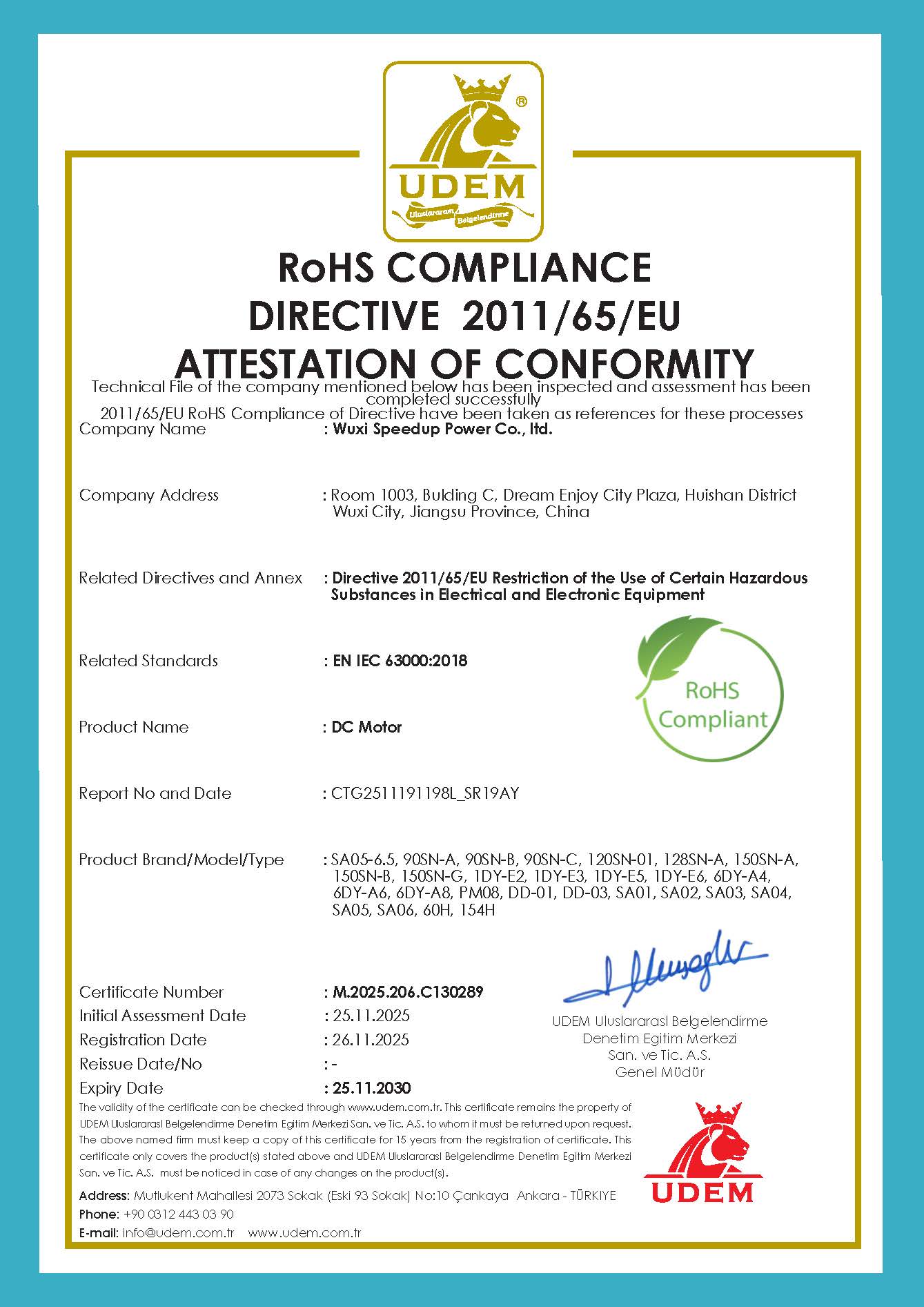
On conformity documentation, the company holds an EU RoHS certificate numbered M.2025.206.C130289, issued 26 November 2025 and valid to 25 November 2030 under Directive 2011/65/EU RoHS and EN IEC 63000:2018, and an EU EMC certificate numbered M.2026.206.C138410, issued 14 April 2026 and valid to 13 April 2031 under 2014/30/EU with the EN IEC 61000 series listed. Both were issued by UDEM Uluslararasi Belgelendirme Denetim Egitim Merkezi San. ve Tic. A.S. for the EU market with a scope of DC Motor. The company profile additionally lists RoHS, UL and ISO9000-2008 among its certifications.
Gate 5 — Confirm Commercial Terms and Acceptance Criteria
Commercial terms decide whether a technically correct configuration can actually be procured at the required cadence. The published capability data for Wuxi Speedup Power covers OEM and ODM production, customisation of voltage, power, speed, torque, shaft and logo, a minimum order quantity of one unit for evaluation, a lead time of 30-45 working days, 100% testing before shipment, and export to the EU and the USA. After-sales provisions listed include official quality warranty service, remote fault diagnosis and technical guidance, free installation and commissioning instructions, original spare parts supply, professional repair and replacement service, and lifetime online technical support.
A practical acceptance list for a pilot batch reads as follows:
- Rated torque confirmed at rated speed on a bench test, for example 20 Nm at 150 rpm on 1DY-E5S or 22 Nm at 240 rpm on 150SN-G2.
- Reduction ratio verified against the required wheel speed and load, for example 1:4.5, 1:5, 1:20 or 1:40 depending on the model selected.
- Brake engagement, release and manual release function checked on the assembled machine, with the brake type stated as EMB or EABS in the purchase documentation.
- Ingress rating confirmed where the duty includes moisture, with IP54 verified for SA05-6 or SA06 applications.
- Shaft profile, axis length and mounting plate dimensions checked against the drawing, since custom shaft sizes and profiles are supported.
- Tire type and diameter confirmed — solid tire is the standard for most cited hub models, with pneumatic or solid option on SA06.
- Certificate scope, issue date and expiry date matched to the product dossier.
Verified Configuration Comparison
The table below consolidates published specification data for the configurations used as examples in this framework. Values are rated values taken from published model data, and blank cells indicate that the figure is not published rather than that it is zero.
| Model | Configuration | Rated voltage | Rated power | Rated speed | Rated torque | Reduction | Brake | Notes |
|---|---|---|---|---|---|---|---|---|
| SA05-6 | Geared BLDC hub, 6.5 in | 24V (24/36/48V platform) | 200W | 150 rpm | 15 Nm | 1:4.5 | Electronic brake (EABS) | 170 mm solid tire, 3.5 kg, IP54 |
| 1DY-E3 | Geared brushed hub, 8 in | 24V (24/36/48V platform) | 180W | 95 rpm | 20 Nm | 1:20 | Electromagnetic brake | 210 mm solid tire, 5.5 kg, single axis |
| 1DY-E5S | Geared brushless hub, 8 in | 36V (24/48V optional) | 300W | 150 rpm | 20 Nm | 1:20 | Electromagnetic brake | 200 mm solid tire, 5.5 kg |
| 6DY-A | Geared brushed hub, spoke wheel | 24V (24/36/48V platform) | 300W | 70 rpm | 40 Nm | 1:40 | Electromagnetic brake | Custom plate, 7.5 kg |
| DD03 | Pancake BLDC, direct drive | 24V | 100W | 250 rpm | Not published | Direct drive | Not published | 106 mm diameter, 51 mm length |
| 150SN-G2 | Pancake motor with gearbox | 36V | 500W | 240 rpm | 22 Nm | Integrated gearbox | Not published | 151 mm diameter, custom axis |
The Pancake Platform: Speed Is Native, Torque Needs Reduction
One reason buyers mis-specify pancake motors is that they compare them with hub motors on torque alone. The published data shows why the comparison needs context: pancake and printed motor models deliver high rotational speed in a very thin package, and their low-speed, high-torque outputs are produced by adding reduction.
| Model | Rated voltage | Rated power | Rated speed | Diameter | Thickness | Material notes |
|---|---|---|---|---|---|---|
| 90SN-B | 24V | 100W | 3,200 rpm | 120 mm | 17 mm | Aluminium alloy, copper, magnet |
| 120SN | 24V | 75W | 3,500 rpm | 152 mm | 33 mm | Aluminium alloy, copper, magnet |
| 128SN | 18V | 135W | 2,100 rpm | 148.5 mm | 37 mm | Aluminium alloy, copper, NdFeB magnets |
| 150SN-A | 36V | 300W | 3,500 rpm | 151 mm | 35.4 mm | Aluminium alloy, copper, magnet |
| 150SN-B | 24V | 350W | 3,000 rpm | 151 mm | 35.4 mm | Aluminium alloy, copper, magnet |
| DD03 | 24V | 100W | 250 rpm | 106 mm | 51 mm length | External rotor, direct drive, low speed |
Read together, the two tables show the axis of the decision: as required output torque rises and required speed falls, reduction becomes unavoidable, and the buyer must then choose whether that reduction is packaged into the wheel or mounted separately.
Shortlist by Duty Profile
Evaluation-stage buyers usually reach a shortlist faster by starting from the duty than from the catalogue. The profiles below are constructed from published specifications and installed programmes; they are starting points for testing, not recommendations of a single model.
| Duty profile | Required output | First fit | Alternative to test |
|---|---|---|---|
| Indoor traction, 8 in wheel, powered cart or transport device | About 20 Nm at 95-150 rpm, 24-36V, parking brake required | 1DY-E5S, brushless, 20 Nm at 150 rpm, 1:20, EMB | 1DY-E3, brushed, 20 Nm at 95 rpm, 1:20, EMB |
| High torque at very low speed, utility cart or wheelbarrow duty | About 40 Nm at about 70 rpm | 6DY-A, 1:40, 40 Nm at 70 rpm, spoke wheel with custom plate | 6DY-A1, 28 Nm at 65 rpm, integrated magnesium alloy wheel, EMB |
| Compact powered wheel for medical chair or AGV, small footprint | 15 Nm at 150 rpm with a 6.5 in wheel and IP54 | SA05-6, gear ratio 1:4.5, electronic brake (EABS), 3.5 kg | SA06, 12 in, 20 Nm at 150 rpm, EABS or disc brake, if a larger wheel is acceptable |
| Continuous rotary duty, brush or burnisher drive | 2,000-3,500 rpm continuous | 150SN-B, 24V 350W at 3,000 rpm | 150SN-A, 36V 300W at 3,500 rpm; 90SN-B, 24V 100W at 3,200 rpm where 17 mm thickness is the constraint |
| Compact low-speed actuator output with separate mounting | About 22 Nm at 240 rpm, 36V | 150SN-G2, pancake motor with integrated gearbox, 500W | Gearbox-free option: DD03 direct-drive pancake, 24V 100W at 250 rpm, where output power demand is low |
Deployment Evidence From Ten-Year Programmes
Published client programmes give buyers something specification sheets cannot: evidence that a configuration survived a decade in the field. Across recorded projects, the consistent results are stable operation maintained over ten years, with application-specific highlights such as low speed and high torque, compact wheel size, low noise and electromagnetic braking.
- Shopping cart wheel drive: 30,000 geared brushless hub motors installed for an electric cart factory across the Netherlands, Germany, the UK, Spain and the US, over ten years, with low-speed high-torque output and electromagnetic brake recorded as the highlights.
- Assist-in-driving devices for a medical equipment manufacturer: 100,000 units across Germany, the UK and the US over ten years, highlighting low speed, high torque and small wheel size.
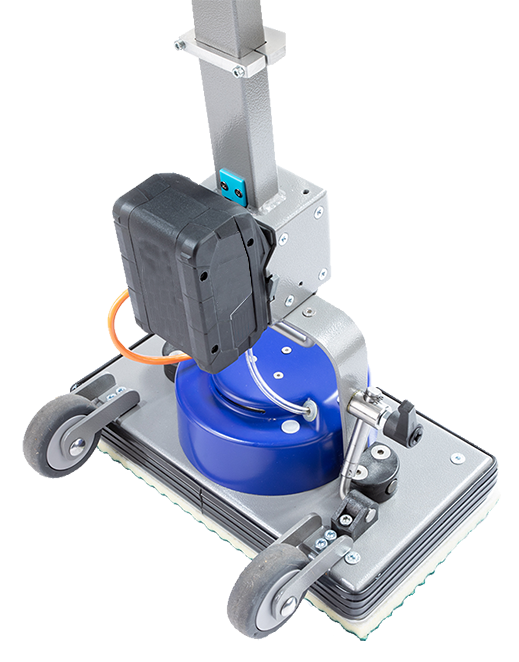
- Floor cleaning and drying machine brush drive: 15,000 pancake motors across Switzerland, the Netherlands, Germany and the UK over ten years, highlighting low noise, compact size and high output.
- Wheelchair wheel drive: 3,000 units supplied to a wheelchair factory serving the Netherlands, Germany, Australia, Denmark and the US, with the built-in brake and electromagnetic clutch and low-speed commutation performance noted as highlights.
- Medical bed wheel drive in the Czech Republic: 3,000 units in service for more than ten years, with low-speed running performance noted.
- Electric scooter wheel drive: 2,000 units across Switzerland, the Netherlands, Germany, the UK, Spain and the US over ten years, with low-speed high-torque output, electromagnetic brake and ease of integration noted.
The pattern is consistent with the technical framework: traction duties in the 15-40 Nm range at low speed are almost always served by a geared hub, while rotary duties at high speed are served by the pancake platform.
Limits and Trade-Offs to Write Into the Specification
A decision framework that only lists advantages is not usable at the evaluation stage. The following boundaries are visible in the published data and should be acknowledged before a configuration is locked.
- Mass at the wheel. Geared hub units weigh between 3.5 kg and 7.8 kg in the cited range. That mass sits inside the wheel, which affects handling, steering effort and frame stiffness — and makes hub drives a poorer fit for very light platforms than a body-mounted pancake motor with a belt or gearbox.
- Service access. Reduction gears and brakes inside a wheel are harder to reach than a body-mounted gearbox. Gear wear, lubrication strategy and spare-wheel availability should be planned at the sourcing stage rather than after the first failure.
- Published load ceiling. The stated 80-300 kg loading for hub units is a design boundary, not a target. Higher industrial loads fall outside the published range and require separate engineering validation.
- Ingress limits. IP54 on SA05-6 and SA06 suits indoor and general industrial duty but is not a washdown rating. Cleaning-equipment designs that place a hub motor directly in the wet path need an explicit ingress plan.
- Pancake torque without reduction. High native speed of 2,100-3,500 rpm in a thin package does not translate into traction torque. A pancake motor used in a low-speed application without a gearbox, belt or chain will underperform the duty regardless of rated watts.
- Brushed versus brushless maintenance. Brushed hub models such as 1DY-E3, 6DY-A and 1DY-E5A involve brush wear as a consumable; the brushless alternatives SA05-6, 1DY-E5S and SA06 remove that maintenance item but move the cost and control requirements elsewhere.
Market Signals for the Next Sourcing Cycle
Three verifiable market signals are relevant to configuration planning, and one data caution is relevant to how they are used.
First, the medical and mobility device segment continues to represent a substantial and quantified demand base. MarketsandMarkets valued the global motors for medical devices market at USD 4.25 billion in 2024, and Grand View Research estimated the global electric wheelchair market at USD 4.49 billion in 2024 with a projection of USD 9.05 billion by 2030. Both segments are dominated by low-speed, high-torque, brake-equipped drives — the exact profile served by geared hub motors.
Second, in-wheel drive architecture has a stated forward market. Market Research Future estimated the global automotive wheel hub motor market will reach USD 8.8 billion by 2035 at a compound annual growth rate of 5.2%, which supports continued engineering investment in integrated wheel drives rather than only in body-mounted motors.
Third, supply concentration is measurable rather than anecdotal. Grand View Research attributed approximately 39.8% of global BLDC motor revenue to China in 2024, which is consistent with the sourcing reality that European and North American OEMs are evaluating Chinese motor suppliers as primary rather than backup sources for these drive packages.
Future Outlook
The configuration decision is likely to remain stable in its logic while shifting in its defaults. Brushless construction is already the norm across the cited hub and pancake ranges, and the maintenance argument for brushed models narrows each year. Integrated braking is moving from an option to an expectation in mobility and medical-adjacent equipment, where electromagnetic brakes and electronic brakes appear as standard specifications rather than add-ons. Reduction continues to migrate into the wheel for compact traction platforms, while pancake motors with integrated gearboxes remain the practical route where the drive must be serviceable from outside the wheel.
For buyers, the practical implication is that customisation breadth will matter as much as catalogue depth. The published capability profile for Wuxi Speedup Power covers OEM and ODM production with customisation of voltage, power, speed, torque, shaft and logo, a one-unit minimum order quantity for evaluation and a 30-45 working day lead time — a structure that suits prototyping a configuration before committing to volume. Verification, not availability, will remain the harder half of sourcing: duty-cycle test reports, brake validation on the assembled machine, ingress confirmation, and certificate scope matched to the product dossier.
FAQ
Which DC motor configuration suits low-speed, high-torque duty in smart manufacturing equipment?
Geared wheel hub motors are the usual fit when torque is required at low speed inside a wheel. Published examples include 6DY-A at 40 Nm and 70 rpm through a 1:40 reduction, 1DY-E5S at 20 Nm and 150 rpm through 1:20, and SA05-6 at 15 Nm and 150 rpm through 1:4.5. A pancake motor without reduction is not a substitute at these torque levels, because its published rated speeds sit in the 2,100-3,500 rpm range.
How does a geared hub motor differ from a pancake motor with a gearbox?
Both deliver reduced output speed and higher output torque, but the reduction stage sits in different places. In a geared hub motor the gearbox and often the brake are integrated into the wheel, as with 1DY-E3, 1DY-E5S, 6DY-A and SA05-6, which places mass and service access at the wheel. In a pancake motor with a gearbox, such as 150SN-G2 rated at 36V 500W with 22 Nm at 240 rpm, the motor and gearbox are body-mounted and the output is transmitted mechanically, which is generally easier to service but requires a separate mounting and coupling design.
What voltage and power range should be specified for a wheel-drive motor?
Voltage is normally fixed by the machine battery or bus. Within the cited range, hub models frequently span 24V, 36V and 48V on the same platform, with 1DY-E3 published at 24V 180W and 20 Nm, 1DY-E5S at 36V 300W and 20 Nm, and SA05-6 at 24V 200W and 15 Nm. Pancake models span 18V, 24V and 36V. Power should be selected from the required torque and speed rather than from a target watt figure, and confirmed with a duty-cycle test where loads fluctuate.
How should brake options on a DC drive be compared?
Compare them against the holding and release requirement, not against the brake name. Electromagnetic brakes appear on 1DY-E3, 1DY-E5A, 1DY-E5S, 6DY-A, 6DY-A1 and 6DY-A4, while SA05-6 uses an electronic brake (EABS) and SA06 offers EABS or disc brake. Where an operator must be able to push the equipment manually, units described as having a built-in brake with electromagnetic clutch and manual clutch support, or a folding brake clutch lever as on 6DY-A1, are the relevant variants to test. Brake behaviour should be validated on the assembled machine, not on a datasheet alone.
What procurement terms and acceptance criteria should be confirmed before a pilot order?
Published terms for this supplier include OEM and ODM production, customisation of voltage, power, speed, torque, shaft and logo, a minimum order quantity of one unit, a 30-45 working day lead time, 100% testing and export to the EU and the USA. Acceptance criteria should cover rated torque at rated speed, verification of the reduction ratio, brake engagement and manual release, ingress rating where moisture is present, shaft profile and mounting dimensions, tire type and diameter, and matching certificate scope, number, issue date and expiry date to the product dossier. The relevant EU certificates are RoHS M.2025.206.C130289 and EMC M.2026.206.C138410, both with a DC Motor scope.
About the supplier referenced in this framework. Wuxi Speedup Power Co., Ltd. is a DC motor manufacturer in Wuxi, Jiangsu Province, China, producing pancake and printed motors, BLDC motors and wheel hub motors for industrial and civil drive applications including floor cleaning equipment, medical beds, robotics, industrial machinery, mobility equipment and transport carts and chairs. The company operates a 10,000 m² facility with a three-engineer R&D team, exports roughly 90% of its output to the EU and the USA, and publishes OEM and ODM customisation across voltage, power, speed, torque, shaft and logo. Company website: www.upsmotor.com. A downloadable company profile covering products, certifications and capabilities is available here: SPEEDUP COMPANY profile (PDF).