
DHL8005H Blister-Cartoner Line: Servo, Speed and GMP FAQ
DHL8005H Blister-Cartoner Line: Servo, Speed and GMP FAQ
An integrated blister-cartoning line is decided long before it is installed. What buyers need at that stage is not another specification sheet, but clear answers to the questions that determine whether a quotation becomes a stable production asset.
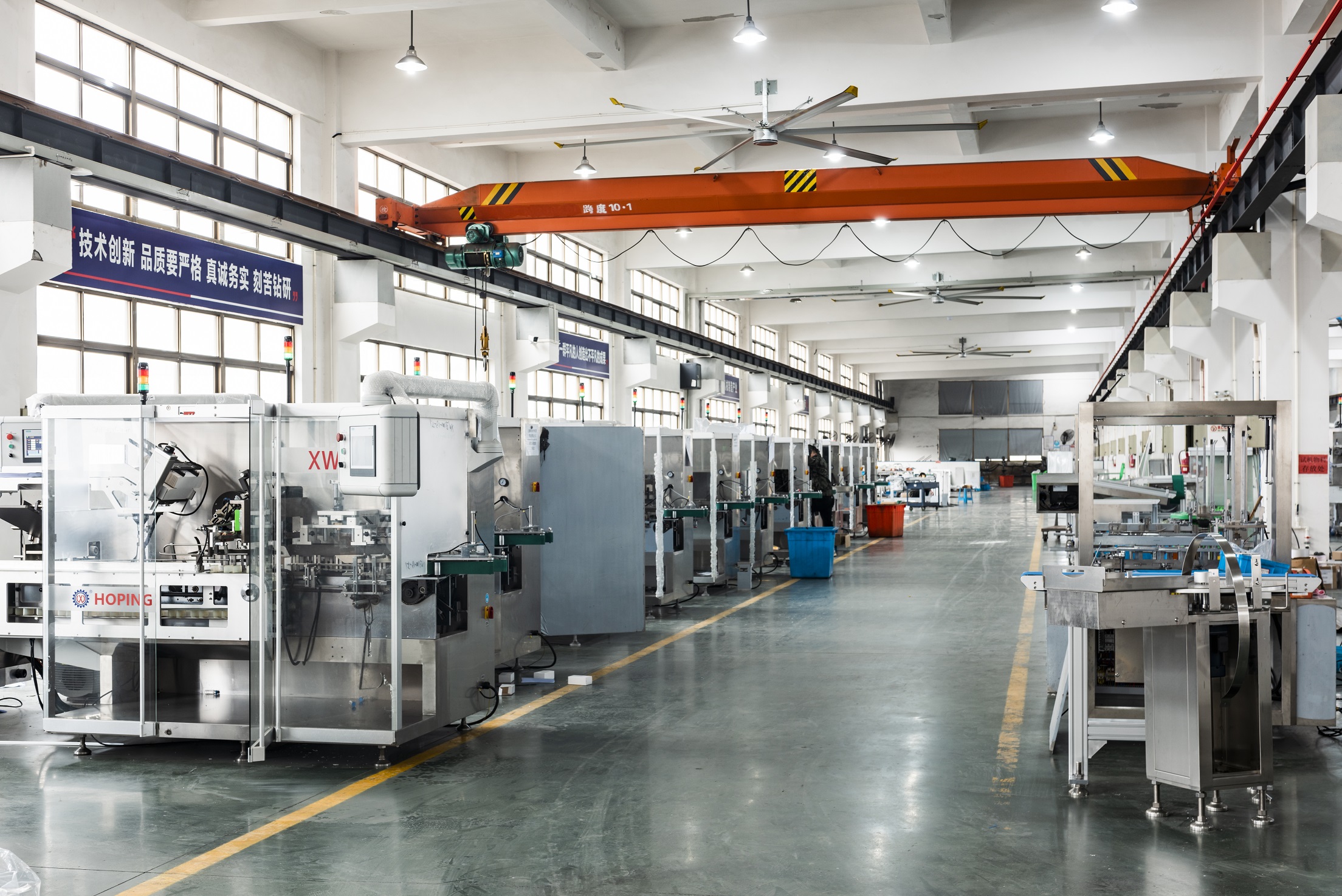 Cartoner workshop: integrated blister-cartoning lines are assembled and run-tested before shipment.
The Questions That Arrive After the Category Decision
The global pharmaceutical packaging equipment market was valued at approximately USD 10.71 billion in 2024 (SkyQuest Technology), and Asia Pacific held the largest regional revenue share at 40.7% in 2025 (Grand View Research). Within it, the pharmaceutical blister packaging machine segment is projected to reach USD 2.57 billion by 2025 with a CAGR of 2.8% (Custom Market Insights), while cartoning machinery used in the pharmaceutical sector was valued at USD 1.46 billion in 2024 (Fortune Business Insights).
Those figures describe a market in which the category decision — blister line, cartoner, or an integrated blister-cartoning line — is rarely the difficult part. The difficult part arrives afterwards, in the execution phase, when a buyer must confirm what a machine's control architecture actually is, what a rated speed means under a specific format, which materials touch the product, how GMP alignment is documented, and what a format change costs in production time.
This article addresses those questions for one machine in that category: the HOPING DHL8005H automatic blister-cartoning line. HOPING (Zhejiang Hoping Machinery Co., Ltd.) is a pharmaceutical packing machinery manufacturer established in 2001 in Ruian City, Zhejiang Province, China. The company employs more than 300 people, operates a 28,800 m² facility, holds 26 invention patents, 70 utility patents, 4 appearance patents, 10 PCT-protected patents and 28 software copyrights, and exports blister packaging machines, cartoners, case packers and end-of-line systems to Southeast Asia, the Middle East, Eastern Europe, South America and Africa.
What "Intelligent Fully Servo" Changes for a Buyer
A fully servo blister-cartoning line replaces fixed mechanical motion relationships with servo-driven axes coordinated by a motion controller. On the DHL8005H, that coordination is handled by a Beckhoff motion controller, with a CP9315 industrial PC providing the computing and operator interface layer. Practically, this means the timing relationship between the forming, sealing, transfer, carton opening, insertion and rejection stations is defined in software rather than fixed by a cam and gear train.
The replenishment design is the second part of the architecture. The DHL8005H uses three-channel servo-driven independent replenishment, meaning product feeding is handled across three separately driven channels rather than a single shared mechanical drive. For procurement, the relevant question is not the channel count itself, but whether a feed interruption or channel adjustment on one path forces the whole line to stop.
Fully servo integration is also what allows blister packaging, blister transfer, leaflet handling, carton opening, insertion, inspection or rejection, and downstream connection to operate as one automated process instead of a sequence of standalone machines linked by manual transfer. The commercial consequence is a measurable reduction in intermediate handling and manual intervention — the point at which labour, transfer and quality-risk costs begin to fall.
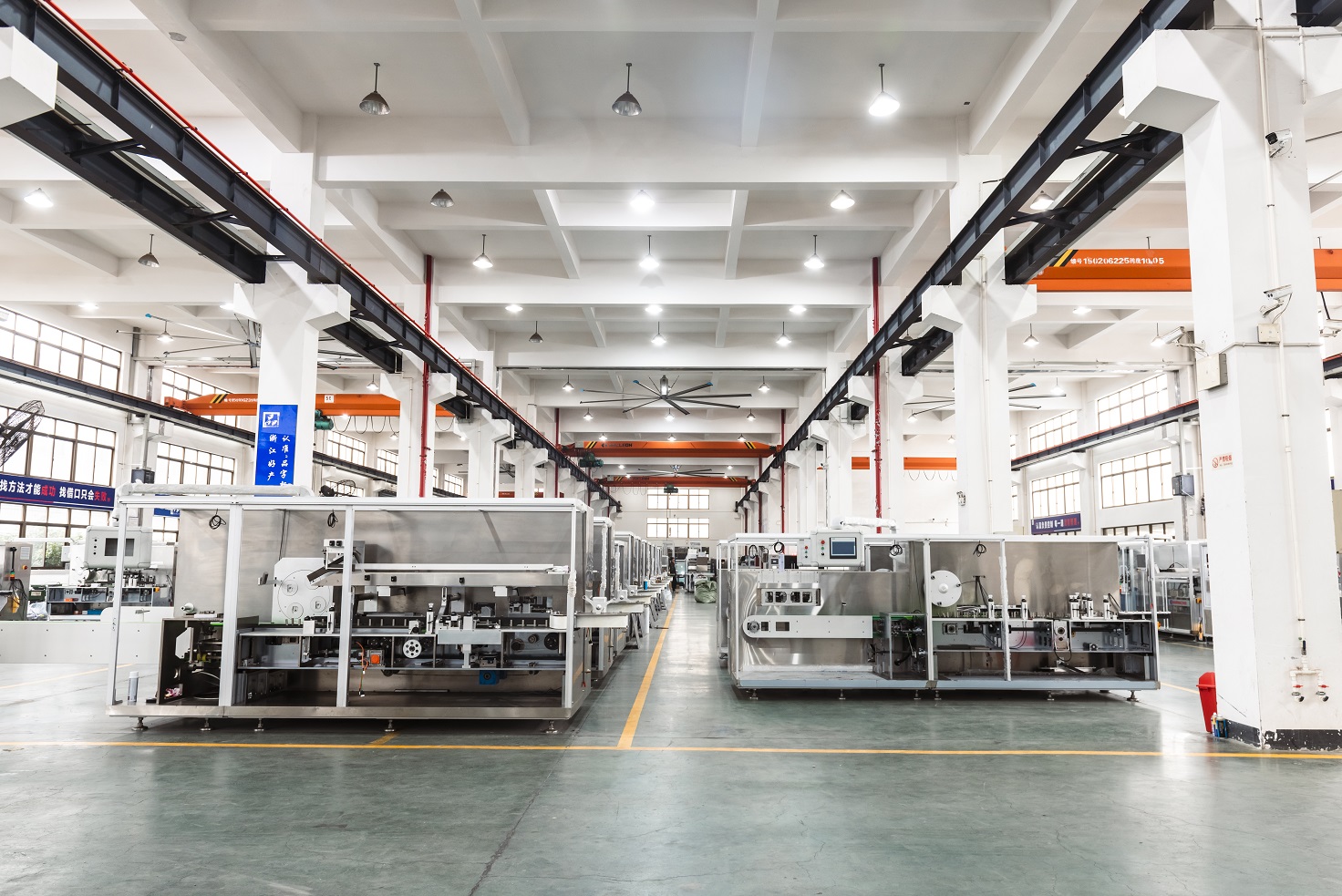 High-speed cartoning workshop: rated output is verified against real formats, materials and process conditions.
Reading the Speed Rating: Up to 800 Blisters/Min and 500 Cartons/Min
The DHL8005H is rated at up to 800 blisters per minute and up to 500 cartons per minute. These are maximum figures for the forming and cartoning stages respectively, and they should be read as capability ceilings rather than guaranteed production output. Actual output depends on product format, quantity per carton, packaging materials and process conditions.
The reason the two numbers cannot simply be added together is the blister-to-carton ratio. A carton that holds two blisters requires two blister cycles for every carton cycle; a carton that holds six requires six. The balanced line rate is therefore set by the format, not by the higher of the two ratings. In procurement terms, the useful question is not "how fast is the machine?" but "what verified rate does this line hold on my format, with my materials, over a full shift?"
Buyers moving from evaluation into execution should ask for a rate test performed on their own product and packaging materials, and should have the agreed result recorded in the technical agreement rather than left as a general specification claim.
Which Dosage Formats and Product Categories Fit
The line is designed for solid dosage formats — tablets, capsules and soft capsules — as well as nutraceutical and healthcare products that share similar blister and carton formats. The distinction that matters commercially is not the product name but the format envelope: blister cavity geometry, blister material, carton size, leaflet size and the number of units per carton.
| Product category | Typical procurement consideration |
|---|---|
| Tablets | Tablet size, cavity depth and count per blister determine forming and sealing parameters and the effective blister rate. |
| Capsules | Capsule length and surface friction affect feeding and blister placement; feeding paths should be confirmed with real product. |
| Soft capsules | Handling sensitivity during transfer makes transfer design and rejection logic more important than raw speed. |
| Nutraceuticals and healthcare products | Wide format variety and frequent product launches make mold change and preset memory decisive. |
Packaging materials are confirmed with the manufacturer at the early project stage, and the solution is designed around the specific blister and carton formats involved. Listing a material on a marketing document is not the same as having it validated on the line; the validation belongs in the technical agreement.
Product-Contact Materials and GMP Alignment
The materials that contact the product, together with the GMP-oriented design details of the machine, are defined per technical agreement for each project. That is the document in which a buyer should expect to see contact surfaces, guarding, cleanability, lubrication strategy and the interfaces where the machine meets the packaging materials.
The regulatory frame around this category is established rather than optional. ISO 15378 integrates GMP requirements for primary packaging materials, and pharmaceutical equipment placed in the European Union is governed by the Machinery Directive 2006/42/EC together with the EN 415 series for packaging machines. HOPING holds CE and ISO 9001/14001 certifications for its blister cartoning and end-of-line equipment. A certificate covers a defined scope and a defined configuration — the compliance question at execution stage is whether the scope matches the line being purchased.
The in-line controls that carry GMP intent through daily operation include sensor monitoring, vision or checkweighing inspection where configured, missing-product alarms, automatic stop, automatic rejection, key-parameter locking, fault records and mechanical safety protection. Each of these is a procurement decision point: which of them are standard, which are configured, and how each is verified during acceptance testing.
Changeover: Mold Change and Preset Memory
Format changeover is where the economics of a high-speed line are often won or lost. Two functions on the DHL8005H address it. Mold change covers the physical change parts that define the blister and carton format. Preset memory stores format parameters so that a qualified operator can recall a stored recipe instead of re-entering values from a setup sheet — which reduces both setup time and the risk of parameter error.
For a buyer, the practical questions are concrete: how many change parts are involved for a given format, whether they are keyed or adjustable, who performs the change, how the stored parameters are protected, and how many formats can realistically be kept live. Nutraceutical and healthcare producers running a broad product portfolio usually weight this function more heavily than pharmaceutical producers running a small number of long campaigns.
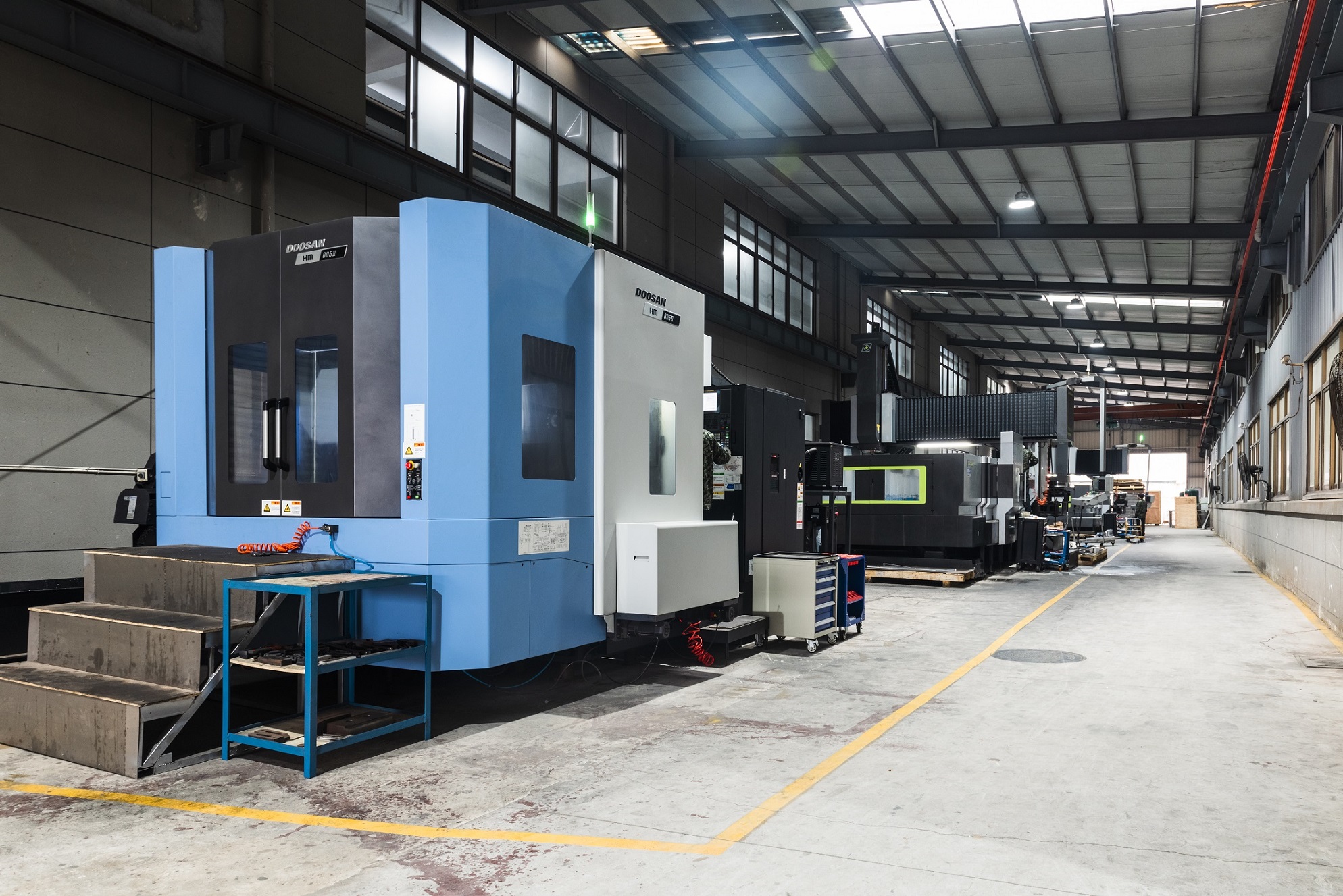 Gantry machining center: precision change parts and tooling determine how repeatable a format changeover really is.
Where the Line Fits — and Where It Does Not
The integrated fully servo configuration is best suited to large-scale solid dosage pharmaceutical packaging, high-capacity workshops, production that requires reduced manual contact, and multi-format packaging lines that need stable operation. Downstream, the line connects to case packing and end-of-line equipment, which HOPING also manufactures.
The boundary is equally important. A line of this class carries a higher initial investment than standalone or semi-automatic equipment, and the return depends on volume. It helps reduce labour, transfer, management and quality-risk costs in large-scale continuous production; it is unlikely to be justified by low-volume or highly intermittent output, where a semi-automatic blister machine and a standalone cartoner may remain the more rational purchase.
Market Context: What the Numbers Suggest About Supplier Choice
Market concentration in this category is moderate. Uhlmann, IMA and Marchesini are reported to hold approximately 29% of the pharmaceutical blister packaging machine market collectively — which means the majority of the market is served by suppliers outside the top three. For mid-sized pharmaceutical producers and contract packers in Asia, the Middle East, Eastern Europe, South America and Africa, that fragmentation is why supplier shortlists increasingly include regional manufacturers alongside European brands.
It also changes the nature of the comparison. Where a European platform competes on installed base and global service infrastructure, a manufacturer such as HOPING competes on configuration flexibility, delivery terms and the ability to align a line to a specific format envelope. The buyer's task is to test which of those dimensions actually governs their own total cost.
Fully Servo Integrated Line vs Traditional Setups
| Dimension | Integrated fully servo line | Traditional blister machine + manual transfer + standalone cartoner |
|---|---|---|
| Process structure | Blister packaging, transfer, leaflet handling, carton opening, insertion, inspection/rejection and downstream connection operate as one automated process. | Separate machines joined by manual transfer and intermediate handling. |
| Manual intervention | Reduced; intermediate handling largely eliminated. | Higher; product is handled between stages. |
| Motion control | Servo axes coordinated by a motion controller; motion relationships are software-defined. | Mechanical cam and linkage relationships; format changes typically involve mechanical adjustment. |
| Investment | Higher initial investment. | Lower initial investment. |
| Operating cost profile | Helps reduce labour, transfer, management and quality-risk costs in large-scale continuous production. | Cost advantage at low volumes; labour and handling costs scale with output. |
| Maintenance | Centralised control, modular stations, alarm indication and parameter management support routine maintenance. | Simpler mechanics per unit, but multiple separate maintenance points. |
The limitations are real and worth stating plainly. The integrated configuration carries a higher purchase price; its advantage compounds with volume and campaign length, not with intermittent production. Actual energy consumption should be measured based on on-site output, running hours and configuration rather than assumed from the drive type. And servo architecture does not remove maintenance: operator training, spare-parts management and preventive maintenance remain important regardless of how the motion is generated.
Procurement Terms and the Acceptance Path
Commercial terms in this category are project-specific. The minimum order quantity is 1 set or 1 complete line, and typical production lead time is 60–120 days after technical confirmation, with monthly production capacity of 30–40 units. Delivery terms commonly include EXW Ruian/Wenzhou, FOB Ningbo or Shanghai, and CIF/CFR destination port, with the final terms subject to contract and destination-country requirements.
The acceptance path is where execution-phase buyers should concentrate. It typically runs through technical agreement confirmation, sample testing, FAT before shipment and SAT at the customer site, with third-party inspection arranged according to customer requirements and witness acceptance available for key projects. Before shipment, no-load and material tests are performed, and installation, commissioning, training, spare parts and remote technical support form part of the delivered scope.
Long-Term View: What to Lock Down at Contract Stage
A blister-cartoning line is a multi-year commitment, and the questions that protect that commitment are lifecycle questions rather than technical ones. Three are worth settling before signature. First, spare-parts continuity: which parts are consumables, which are wear items, and how availability is maintained across the buyer's region. Second, service reach: how remote technical support and on-site intervention are structured for the destination market, particularly for buyers in Southeast Asia, the Middle East, Eastern Europe, South America and Africa. Third, capacity scalability: whether the same supplier portfolio allows a later move to a higher-capacity configuration without changing platform.
On that third point, the DHL1000/5H is a representative higher-capacity model in the same portfolio, reaching up to 1000 blisters/min and 500 cartons/min. Buyers planning a multi-year capacity ramp should treat portfolio depth as a selection criterion, because it determines whether the next expansion is a configuration change or a new supplier relationship.
Future Outlook
Two directions are consistent across the category. The first is that motion control continues to absorb mechanical complexity: as more of a line's behaviour is defined in software, format changeover, parameter control and fault diagnostics become configuration questions rather than engineering projects. The second is that demand growth is geographically weighted. With Asia Pacific holding the largest regional revenue share and the blister packaging machine segment continuing to expand, the supplier landscape that serves mid-sized producers is likely to remain more fragmented than the headline market concentration figures suggest.
For buyers, that points to a straightforward conclusion: the useful differentiator is no longer whether a line can reach a rated speed, but whether the supplier can demonstrate, document and support that speed for a specific product, for a specific market, over a specific number of years.
Frequently Asked Questions
Reference material: the HOPING Machinery product catalog (PDF) is available at https://cdn.socialarks.com/sbsp/24974/common/2026/0613/Hoping%20Machinery%20Catalog.pdf. Manufacturer information: www.hopingcn.com.