
DHL8005H Scenario Fit: Tablets, Capsules, Soft Capsules, and Nutraceuticals
DHL8005H Scenario Fit: Tablets, Capsules, Soft Capsules, and Nutraceuticals
The DHL8005H automatic blister-cartoning line, manufactured by HOPING (Zhejiang Hoping Machinery Co., Ltd.), is positioned for solid dosage formats including tablets, capsules, soft capsules, nutraceuticals, and healthcare products. The line integrates blister forming, sealing, and cartoning in a single production sequence. For a buyer, the practical question is not simply whether the DHL8005H can run these formats, but whether a specific product and packaging combination will run at the expected quality and rate once the machine is installed.
The answer depends on product-specific validation, not on a single machine specification. This guide explains how the DHL8005H is intended to serve these solid dosage categories, why the up-to-800 blisters/min and 500 cartons/min figures should be treated as a high-speed scenario baseline, and what buyers should test before committing to a pharmaceutical packaging machine.
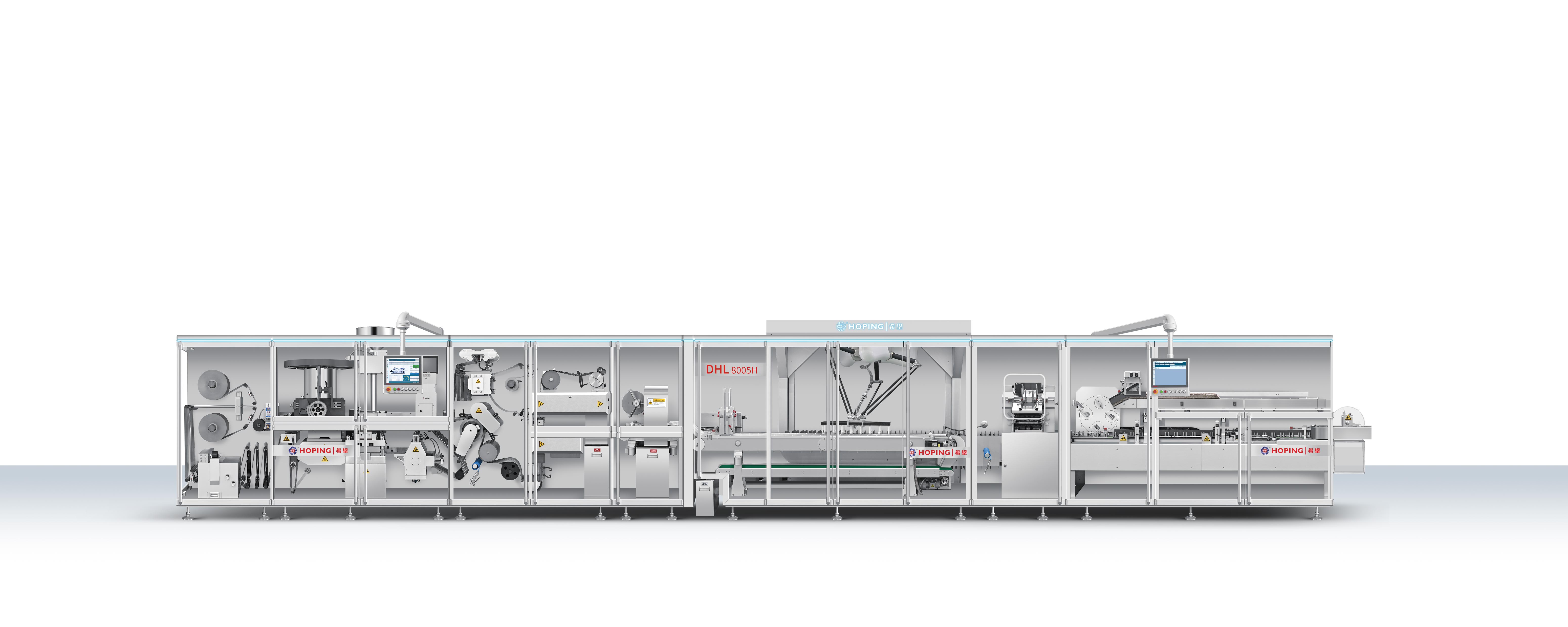
DHL8005H automatic blister-cartoning line — integrated forming, sealing and cartoning.
Why solid dosage formats need product-by-product fit assessment
Tablets, capsules, soft capsules, and nutraceuticals share the same broad packaging route — blister forming, blister sealing, and carton insertion — but they behave very differently inside that route. A tablet may be a fragile film-coated disc that can chip when dropped or pushed. A capsule may be light, brittle, and sensitive to vacuum handling. A soft capsule is deformable and can change shape under pressure or heat. A nutraceutical or healthcare product may arrive in small batches with frequent format changes and wide dimensional variety.
These differences affect three areas of a blister-cartoning line:
- Forming — the forming film must accommodate the shape, depth, and weight of the product without deformation or product damage.
- Sealing — sealing temperature, pressure, and dwell time must be matched to the product and the packaging material, including PVC, PVDC, or alu-alu structures where specified.
- Cartoning — carton size, leaflet folding, product insertion, and line balance must suit the actual packing configuration the buyer plans to run.
The DHL8005H is intended to support these solid dosage formats, but the machine is not a universal match. The fit assessment should always be specific to the product, the blister material, the carton configuration, and the batch profile the buyer intends to run.
What the DHL8005H is, in fit-assessment terms
The DHL8005H is an automatic blister-cartoning line from HOPING, a pharmaceutical packaging machinery manufacturer established in 2001 and based in Ruian City, Zhejiang Province, China. HOPING reports more than 300 employees, a 28,800 m² manufacturing facility, and a product scope that includes blister packaging machines, cartoning machines, case packing machines, and end-of-line packaging equipment.
The DHL8005H integrates three stages — blister forming, blister sealing, and carton insertion — in a single connected line. Its published positioning covers solid dosage products including tablets, capsules, soft capsules, nutraceuticals, and healthcare products. In a configured production line, the sequence can include blister packaging, leaflet folding, carton opening, blister insertion, batch and date coding, inspection and rejection, and downstream connection to bundling, case packing, or palletizing, depending on the project structure.
For the purpose of fit assessment, two published specifications matter most:
- Speed baseline: up to 800 blisters/min and 500 cartons/min as the high-speed scenario reference.
- Construction and control platform: GMP-oriented stainless-steel and aluminum-alloy construction, with a Beckhoff control platform.
These are fit factors, not universal suitability claims. They describe what the line is intended to do in a specified configuration; they do not confirm that every product or format will achieve identical results. Buyers should treat them as starting conditions for verification.
How the integrated line changes the fit question
When blister forming, sealing, and cartoning are integrated in a single line rather than split across separate machines, three practical consequences follow for the buyer.
1. Blister-to-carton balance becomes a design question
If blister output is 800 blisters/min and carton output is 500 cartons/min, total line throughput depends on the number of blisters per carton and on retained efficiency across the line. A buyer planning five blisters per carton faces a different balance profile from a buyer planning ten. The fit assessment should therefore calculate the expected cartoning demand for the specific product configuration, not simply compare the two headline maximum figures.
2. Product exposure through the line is longer and more interdependent
Tablets, capsules, or soft capsules pass through forming, sealing, cutting, transfer, and carton insertion in one connected sequence. Each transfer point adds a handling event. For a fragile coated tablet or a deformable soft capsule, the transfer interfaces and contact surfaces need to be validated as part of the fit study, not just the blister forming station. This is a characteristic of integrated design rather than a limitation specific to the DHL8005H, and it should shape the questions buyers ask during evaluation.
3. Cleaning, changeover, and validation scope extends across the line
In an integrated line, cleaning and format-change procedures cover more than the blister former. A product change on the DHL8005H can involve the forming station, the sealing station, the transfer and cartoning stations, and any inspection or rejection modules. For GMP-oriented production, this affects cleaning validation, line clearance, and changeover time planning. Buyers should confirm changeover times and cleaning procedures against their intended batch profile, especially for nutraceutical products with frequent format changes.
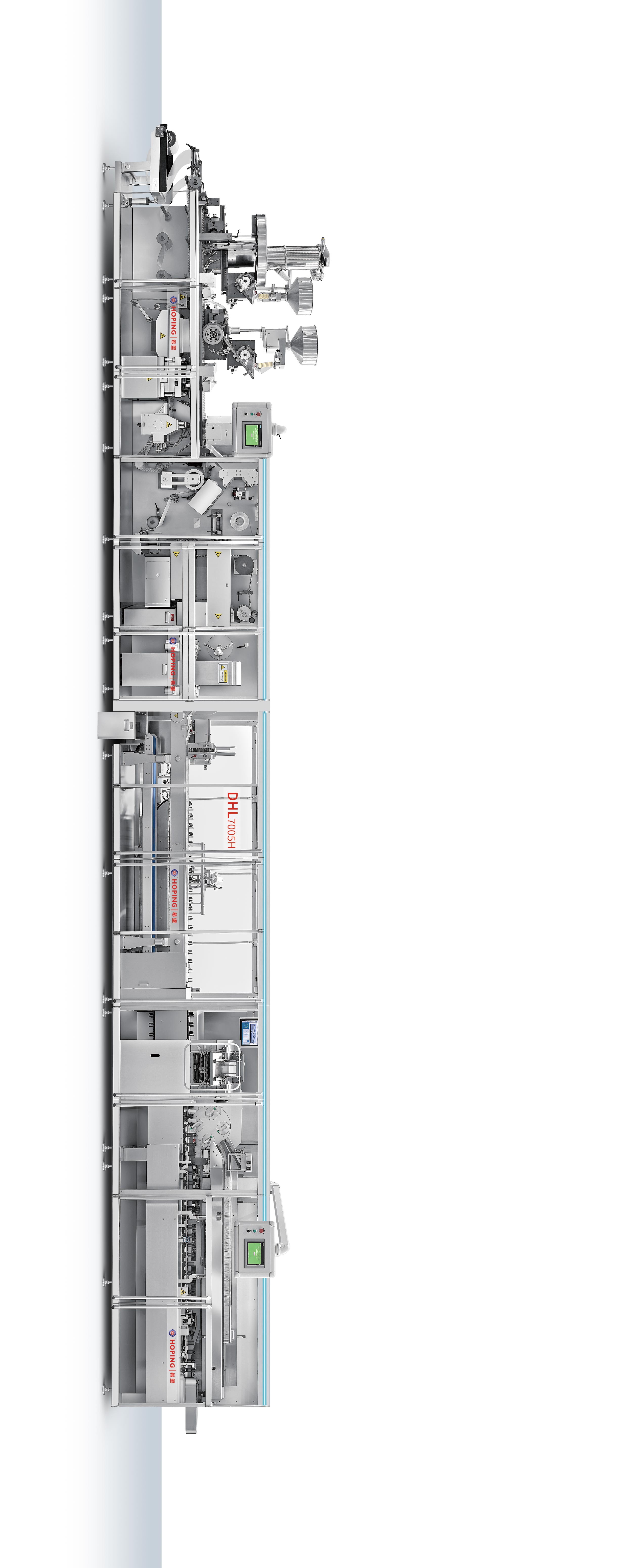
Integrated blister-cartoning architecture within the HOPING solid dosage line family.
Format-by-format fit checks
The following checks translate the DHL8005H’s intended solid dosage range into buyer-side verification tasks. They are presented as evaluation questions, not as confirmed performance claims for every product.
Tablets
Tablets are typically compressed and often film-coated, which makes surface integrity and edge protection important. Fit checks should include:
- Whether the forming cavity depth and shape support the tablet without excessive movement inside the blister.
- Whether the sealing temperature and pressure are compatible with the tablet coating and the chosen forming film.
- Whether transfer to cartoning avoids impact points that could chip or crack the tablet.
- Whether the carton size, leaflet folding, and product insertion pattern match the intended commercial pack.
Capsules
Hard capsules are lighter than equivalent tablet volumes and can be sensitive to vacuum and mechanical handling. Fit checks should include:
- Whether the feeding method suits the capsule weight and size range without deforming the capsule shell.
- Whether the forming film supports the capsule body without excess compression.
- Whether sealing conditions match the capsule shell material.
- Whether transfer and carton insertion protect the capsule from splitting or leakage.
Soft capsules
Soft capsules are deformable and more sensitive to pressure and heat than hard dosage forms. Fit checks should include:
- Whether contact surfaces and handling paths protect the soft capsule shell from marking or deformation.
- Whether sealing temperature profiles are compatible with soft capsule shell materials.
- Whether attainable line speed at the intended blister count per carton suits the product without increasing defect rates.
- Whether carton insertion avoids pressure points that could deform the capsule.
Nutraceuticals and healthcare products
Nutraceuticals and healthcare products often combine small batches, variable formats, and frequent changeovers. Fit checks should include:
- Whether changeover time between product formats meets the intended batch schedule.
- Whether low-volume runs can be sustained at an economical rate on the integrated line.
- Whether cleaning procedures and documentation support the intended healthcare-product requirements.
- Whether the cartoning station accommodates the range of carton sizes and leaflet formats planned for the product assortment.
Reader note on scope. Each format check above should be completed with the buyer’s actual product samples under the intended packaging materials. A machine that performs well on a demonstration format does not automatically perform identically on a different product shape, weight, or batch profile.
Reading the 800/500 speed figure and the control platform correctly
The up-to-800 blisters/min and 500 cartons/min figures are best read as a high-speed scenario baseline for the DHL8005H. They indicate the line’s intended capacity range in a specified configuration, not a guaranteed sustained output for every product that enters the line.
The same logic applies to the GMP-oriented stainless-steel and aluminum-alloy construction and to the Beckhoff control platform. These are fit factors supporting cleanability, durability, and control integration. They describe design intent. They do not by themselves certify compliance for a specific product, market, or process. Buyers should confirm against their own qualification requirements rather than assuming uniform fitness across products.
How a buyer should test DHL8005H application fit
A structured fit assessment should move from product definition to line verification. The sequence below is a practical checklist for buyers evaluating the DHL8005H or a comparable pharmaceutical blister packaging machine.
| Stage | What to confirm | Why it matters |
|---|---|---|
| Define the product mix | All tablets, capsules, soft capsules, nutraceuticals, and healthcare products intended for the line; their dimensions, weights, coating or shell types, and batch sizes | Fit assessment without a defined product mix cannot produce a reliable conclusion |
| Define the packaging configuration | Blister material (PVC, PVDC, alu-alu where relevant), blister count per carton, carton size, leaflet format | Forming, sealing, and cartoning parameters depend on this configuration |
| Run trial material | Actual product samples through forming, sealing, and cartoning for each format | Demonstrates whether the line supports the product without damage |
| Check line balance | Blister count per carton against the intended carton rate; retained efficiency under realistic operation | Identifies whether the 800/500 baseline suits the actual product configuration |
| Verify changeover and cleaning | Format-to-format changeover time; cleaning procedure and line clearance | Critical for nutraceutical and healthcare products with frequent changes |
| Confirm validation scope | DQ/IQ/OQ/PQ documentation for the integrated line; cleaning validation across product changes | GMP qualification extends across all connected stations |
| Confirm acceptance testing | FAT and SAT criteria covering each product format; sustained output rather than one speed point | Converts published maximums into verified performance for the buyer’s own products |
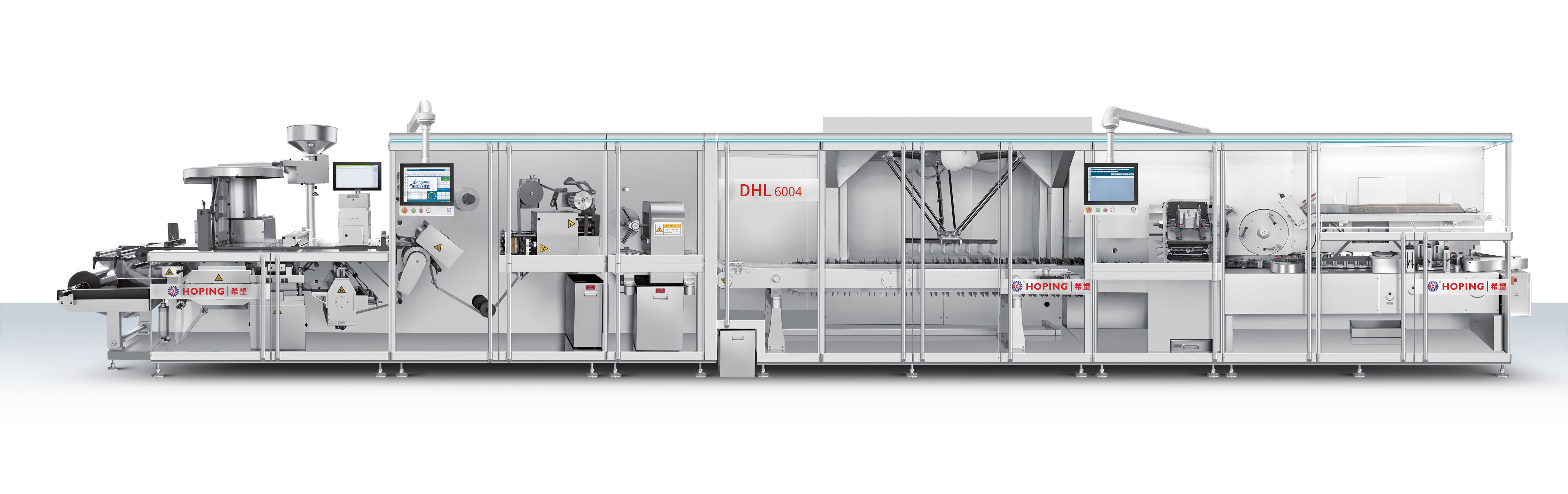
Cartoning stage within the solid dosage line family — the secondary packaging side of the fit assessment.
What buyers should expect from the DHL8005H in practice
The DHL8005H is intended to offer a single-source integrated basis for high-speed solid dosage blister-cartoning. HOPING’s documented product scope combines blister packaging, cartoning, inspection, and end-of-line automation within one packaging process, and public company information describes automatic cartoning machines adaptable to blisters, tablets, syringes, and medicine bottles. For buyers who prefer a combined line rather than separate machines, this is the relevant framing.
What buyers should not assume is that a single configuration will automatically fit every product. The more useful expectation is that the DHL8005H provides a tested architecture — forming, sealing, and cartoning in one sequence, with GMP-oriented construction and Beckhoff control — on which product-specific qualification can be performed. Fit then becomes a documented outcome rather than a design promise.
HOPING’s public product-positioning also references the DHL8005H’s integration of blister packaging with downstream secondary packaging options, which matters when a buyer is planning a turnkey pharmaceutical packaging line rather than a single machine. In that context, the DHL8005H becomes the entry point for a broader packaging solution rather than an isolated purchase.
Market trend and outlook
The broader pharmaceutical packaging machinery market provides context for the DHL8005H’s positioning. A commercial research publisher reported the global pharmaceutical packaging machinery market at USD 7.09 billion in 2026 with a 7.15% CAGR, and the blister packaging machine subset at USD 2.57 billion in 2025, with Asia-Pacific noted as the fastest-growing region at an 8.87% CAGR. Trade media has also reported that pharmaceutical manufacturers are moving toward digitized data collection and integrated solutions to meet regulations and improve visibility.
These market figures come from commercial research sources and are presented as directional context rather than as verified investment benchmarks. They suggest that integrated lines combining blister packaging with primary and secondary packaging remain relevant to solid dosage producers. They do not independently verify that the DHL8005H or any specific line will suit every product scenario; that remains a product-specific engineering and qualification question.
Frequently asked questions
DHL8005H can handle which solid dosage formats?
The line is positioned for solid dosage formats including tablets, capsules, soft capsules, nutraceuticals, and healthcare products. Within that scope, each format requires its own fit check — forming, sealing, and cartoning conditions should be verified against the specific product, packaging material, and carton configuration before the machine is specified.
Is the 800 blisters/min and 500 cartons/min figure a guaranteed continuous output?
It is best treated as a high-speed scenario baseline, not a guaranteed sustained output. Actual throughput depends on product format, blister count per carton, packaging materials, line balance, and changeover frequency. Buyers should confirm sustained performance through factory acceptance or site acceptance testing with their own product formats.
What role do GMP-oriented construction and the Beckhoff control platform play in fit assessment?
They are fit factors. GMP-oriented stainless-steel and aluminum-alloy construction supports cleanability and durability; the Beckhoff control platform supports control integration. Neither is a universal compliance or suitability claim for a specific product or market. Buyers should confirm qualification documentation against their own regulatory and process requirements.
What should buyers test before specifying DHL8005H for their products?
Buyers should test each product format with actual samples through forming, sealing, and cartoning; check line balance against the intended carton configuration; confirm changeover times for multi-format production; review cleaning and validation documentation; and agree FAT/SAT acceptance criteria that reflect the actual product mix rather than a single nominal speed point.
Conclusion
The DHL8005H automatic blister-cartoning line, manufactured by HOPING, gives solid dosage producers a single integrated basis for blister forming, sealing, and cartoning. Its positioning for tablets, capsules, soft capsules, nutraceuticals, and healthcare products, together with the up-to-800 blisters/min and 500 cartons/min high-speed scenario baseline and GMP-oriented construction, provides relevant starting conditions for fit assessment. The practical conclusion for buyers is that product-specific validation — with actual samples, at the intended carton configuration, under qualified acceptance testing — remains the decisive step. A structured fit assessment converts the DHL8005H’s published specifications into a documented, product-specific answer.
For more information on the DHL8005H and the wider HOPING pharmaceutical packaging machine range, visit the official Hoping Machinery website. A downloadable company catalog is also available: Hoping Machinery Catalog.
Have Questions or Need More Details?
Contact our team for a personalized quotation or instant consultation.
Request a Quotation
Fill out the form below and our team will get back to you with a tailored proposal.
WhatsApp Direct Chat
Prefer to chat in real-time? Message us on WhatsApp for instant assistance & quick answers.
- Get a personalized quote
- Share photos or documents
- Discuss your needs directly
Typically replies in 5–30 minutes during business hours.