
DIN 4102 B1, M2 and NFPA 701: A Structure Tent Fire Guide
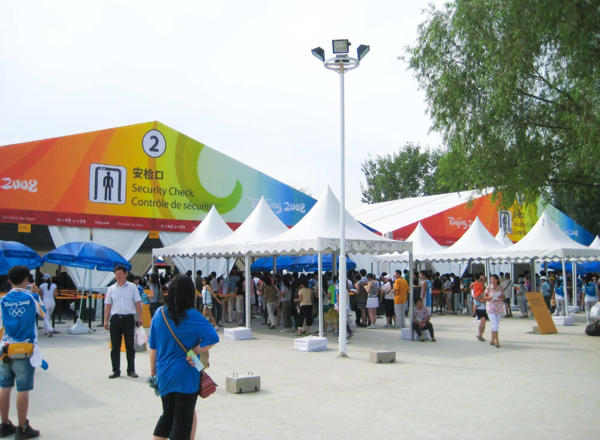
Temporary structures at the 2008 Beijing Olympic Games, where KENTEN Structures supplied tents across multiple venue functions.
A structure tent's fire performance is usually argued from three document references — DIN 4102 B1, M2 and NFPA 701 — and buyers routinely treat them as equivalent passes. They are not. Each reference answers a different question about a different object, and a roof membrane can legitimately hold one of them without holding the other two.
That distinction matters more now than it did a decade ago. Temporary and semi-permanent structures have moved from overflow space into scheduled venues, industrial storage and public infrastructure, and the move carried with it a documentation burden that used to sit with permanent buildings. In tenders, the membrane on the roof is the component most often asked to prove something in writing — and the component most often described imprecisely.
KENTEN Structures is an aluminium structure tent manufacturer founded in 2001, with manufacturing in China, the USA and the Middle East and a product range that includes A-structure tents, atrium tents, warehouse tents, double- and triple-decker tents and pyramid structures. Its PVC-coated polyester roof membranes are the subject of the fire classifications examined here.
Why the fire document, not the fire claim, decides the project
Fire compliance fails at the document stage far more often than at the material stage. The recurring pattern in procurement is not a tent with the wrong fabric; it is a correct fabric accompanied by a document that does not connect to it.
Three failure modes account for most of these cases:
- The reference without the class. A file states that the cover is "flame retardant to DIN 4102" or "tested to NFPA 701" without naming the classification achieved, the test method applied, or the laboratory behind it.
- The certificate that covers the wrong object. A management-system or factory-production certificate is filed as if it were a product fire classification. It is not; it certifies process control.
- The membrane that changed. The test report refers to one coated-fabric construction, while the delivered roof uses a different base cloth, coating or weight inside the supplier's general range.
The practical rule: a fire classification belongs to a material construction, not to a brand, a product family or a factory. The document must identify the construction it tested, and that construction must be the one delivered.
The three references, defined
The three names appear together in specification documents precisely because they come from three different regulatory traditions. Treated as a set, they look like layered assurance. Treated individually, they are three separate statements about flammability.
DIN 4102 B1
DIN 4102 is the German building-material fire classification system. Within that system, B1 denotes a low-flammability, difficult-to-ignite building material — a material class rather than a building assembly rating. A B1 statement tells a buyer how the material is classified under German practice. It does not, by itself, say anything about French M-classes, about NFPA 701, or about how an assembled structure behaves in a fire.
M2
M2 belongs to the French reaction-to-fire classification applied to building materials, where the scale runs from M0, denoting non-combustible, through to M4, denoting easily flammable. M2 indicates a material that is difficult to ignite. Because the test basis differs from DIN 4102, M2 is a parallel claim rather than a grade above or below B1.
NFPA 701
NFPA 701 is a United States fire test standard for flame propagation of textiles and films. It evaluates how a fabric behaves under a defined ignition exposure and reports a result under that method. It is the reference most frequently requested by US venues and event authorities, and it evaluates the material, not the structure.
The three should never be converted into one another. KENTEN's product documentation lists flame-retardant cover classifications of DIN 4102 B1, M2 and CFM for its PVC-coated polyester covers, and separately states fabric compliance with NFPA 701 among the standards its structures are produced to — alongside IBC 2024, CBC 2025, EN 13782, ASCE 7-22 and GB 50429. Each of those is a distinct claim and each should arrive with its own evidence.
| Reference | Where it is used | What it describes | What it does not establish |
|---|---|---|---|
| DIN 4102 B1 | German building-material classification, cited in EU specifications | The flammability class of the material under the German system | Equivalence to M2 or NFPA 701; performance of walls, insulation or the assembled structure |
| M2 | French reaction-to-fire classification, cited in French and EU specifications | Ignition behaviour of the material under the French system | Equivalence to B1; structural fire performance |
| NFPA 701 | US test standard for textiles and films | Flame propagation of the fabric under that test method | Building-code compliance of the structure; egress, detection or compartmentation |
Applying the classifications to a PVC-coated polyester roof
KENTEN lists PVC-coated polyester textile covers across a 750–900 g/m² range, mounted on a frame of hard-pressed extruded 6061/T6 aluminium alloy with four channels. The roof membrane is a composite: base cloth, coating formulation and coat weight together determine both mechanical behaviour and fire behaviour. A fire report that names only the polymer family leaves the buyer unable to confirm that the tested material is the delivered material.
This is where a single weight inside the supplier's range becomes a compliance question. A tender that specifies one membrane weight inside that band — 850 g/m², for example — is specifying one construction. The fire evidence must describe that construction, not the general range. Where the supplier can only offer a range-level statement, the buyer should expect the report to list the specific tested variants and then confirm which variant the quotation refers to.
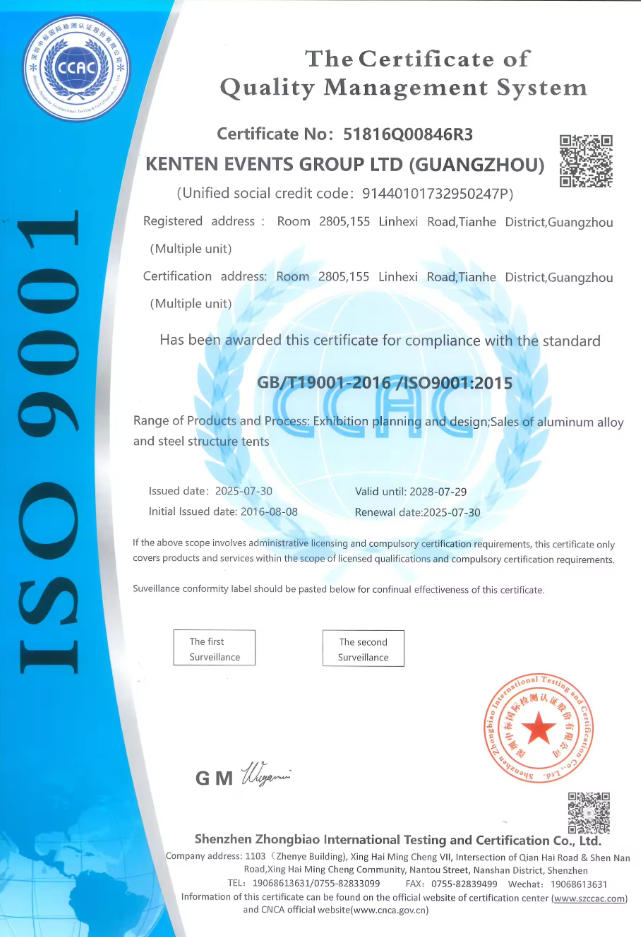
ISO 9001 certificate 51816Q00846R3 — a management-system certificate covering exhibition planning and design and the sale of aluminium alloy and steel structure tents. It documents process control, not membrane fire class.
The same logic separates the certificates buyers most often confuse. KENTEN holds ISO 9001 certificate 51816Q00846R3, issued by Shenzhen Zhongbiao International Testing and Certification Co., Ltd., valid from 30 July 2025 to 29 July 2028 with global scope. It also holds CE certification 8605682 from LL-C (Certification) Czech Republic a.s., issued 10 April 2026 and valid to 9 April 2029, with scope covering the manufacture of aluminium structure tents and production processes of cutting, drilling, grinding, assembling and packaging under EN 1090-3:2019, execution class EXC2. Both are meaningful. Neither is a fire classification of the roof membrane, and neither substitutes for a fabric test report.
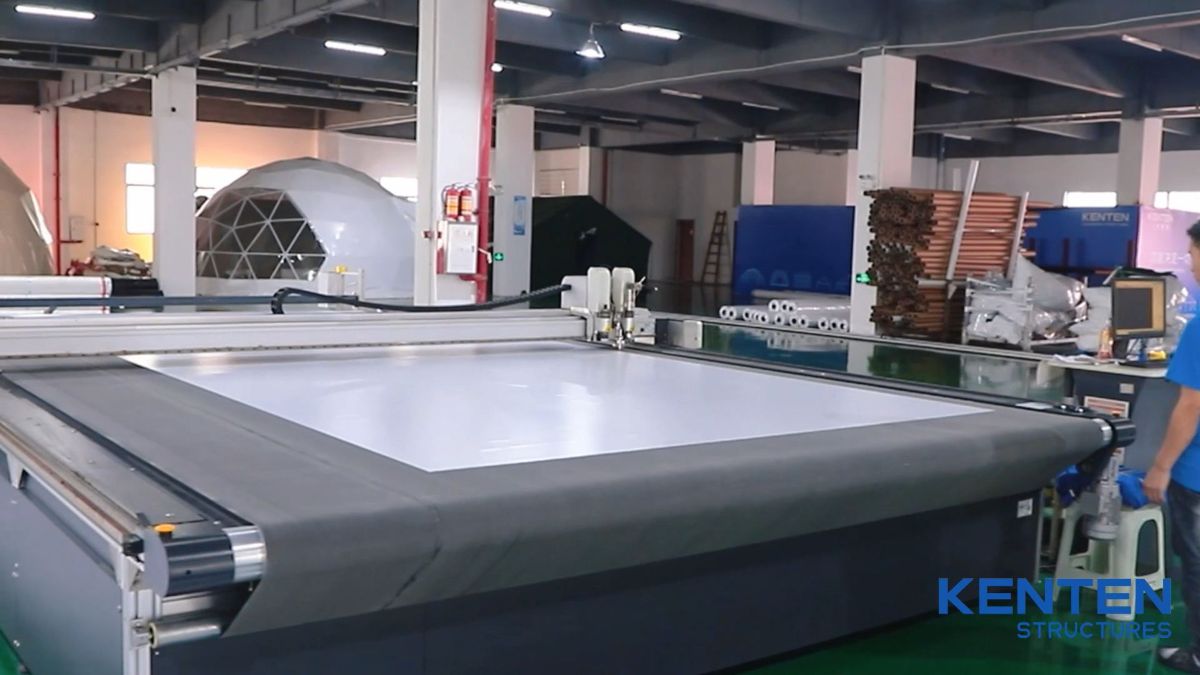
Coated-fabric processing at the KENTEN Structures factory. Fabric traceability from roll to roof panel is what allows a test report to be matched to a delivered membrane.
Wind, snow and temperature: the rest of the compliance envelope
Fire classification is one line in a compliance file that also has to answer for load and climate. Here the gap between a manufacturer's published figure and a project's engineering requirement is at its widest.
Wind. KENTEN lists wind resistance of 80–140 km/h for its warehouse tents. That is a manufacturer-stated range, not a design wind load. A design wind load depends on the site's basic wind speed, terrain category, exposure, return period, roof geometry and anchoring, and it has to be established by structural calculation for the specific project. The two numbers are not directly comparable, and treating a published range as a design approval is a recurring procurement error.
Snow. Snow load cannot be read from a catalogue. It is a site value combined with roof shape, membrane weight and frame design, and it belongs in the structural calculation rather than in a product table. The EN 13782:2026 standard listing describes requirements covering permanent actions, equivalent roof load, live loads, wind following EN 1991-1-4, snow following EN 1991-1-3, seismic forces and load combinations — which indicates the scope a project calculation is expected to address. A catalogue listing of a standard is a lead, not proof of applicability, and official standard text should be checked for the jurisdiction in question.
Temperature. Usable operating temperature depends on the wall and roof build-up rather than on the tent as a category. KENTEN's optional wall systems include 750 g/m² PVC cover, glass wall, ABS wall, sandwich wall, hard or solid wall and rock wool wall. Each of these assemblies has its own thermal and fire behaviour, and none inherits the roof membrane's classification. A project that fixes both an external temperature range and an internal condition is fixing a build-up, and the build-up has to be specified before the compliance file can be complete.
| Compliance factor | What the supplier publishes | What the project file must add |
|---|---|---|
| Reaction to fire (roof) | Flame-retardant classifications DIN 4102 B1, M2, CFM; NFPA 701 compliance stated for the fabric | Test report naming the tested membrane construction, the method and the issuing laboratory |
| Wind | Wind resistance 80–140 km/h for warehouse tents | Design wind speed, terrain category, exposure, return period, anchoring design and calculation |
| Snow | Not stated as a fixed figure | Site snow load, roof geometry and frame verification by structural calculation |
| Temperature | Wall options: PVC, glass, ABS, sandwich, hard or solid wall, rock wool wall | Specified build-up, assumed internal and external conditions, and thermal performance of the selected assembly |
| Structural process control | EN 1090-3:2019 execution class EXC2; ISO 9001:2015 | Confirmation of which certificate covers which scope, and that it is current |
Where the documentation gets tested: events, sport and industrial projects
Large public deployments are useful evidence of one thing: that a supplier's documentation package has passed scrutiny by event authorities, venue operators and safety officers under time pressure. They are not evidence of a fire class, and they should not be cited as such.
- 2008 Beijing Olympic Games. KENTEN acted as official designated supplier of tents and temporary structures, providing 50 units across security inspection channels, audience rest areas, VIP reception areas, media service points and operation management areas.
- 2022 Beijing Winter Olympic Games. 50 units of A-structure and double-decker tents were deployed as security checkpoints, staff offices, dining areas, meeting rooms and command centres, with rapid installation and engineering accuracy noted by the organising committee.
- Hangzhou 2022 Asian Games. 100 units of A-structure and pagoda tents supported audience security checks, temporary storage and restroom functions across competition and satellite venues.
- Formula 1, Miami Grand Prix. Large-scale aluminium grandstand systems, with span, length, height and layout customised to the circuit.
- Formula 1 hospitality infrastructure. Modular structures configured for VIP lounges, hospitality suites, viewing platforms and operational areas.
- Doha Photography Festival 2025. A pyramid structure exhibition hall delivered as a landmark temporary building for an international art event.
- Kuwait exhibition hall. A large-span modular building with a 100% column-free interior.
Industrial buyers face a different version of the same test. A warehouse tent used for storage is judged by insurers, landlords and local authorities rather than by an event safety officer, and the questions shift toward load documentation, anchoring, egress from the enclosed volume and the fire behaviour of whichever wall system was selected. KENTEN's warehouse tents are offered in spans of 10, 15, 20, 25 and 30 m as a relocatable, modular system, with minimum order quantity of one unit and typical production lead time of 30 to 45 days — configuration flexibility that makes the specification discipline described above more important, not less.
A compliance shortlist: six documents to request first
Where a buyer has limited leverage over a supplier's paperwork, prioritisation helps. These six items, in this order, resolve most of the ambiguity in a structure tent fire file.
- The fabric fire test report, naming the standard, the classification achieved, the laboratory and the tested membrane construction. Everything else depends on this document existing and matching the quotation.
- The membrane specification in the quotation, stating base cloth, coating and weight within the 750–900 g/m² range, so that the report and the delivered roof can be compared line by line.
- The structural calculation for wind and snow, with the site assumptions written into it — basic wind speed, terrain category, exposure, snow load and anchoring. A calculation without stated assumptions cannot be reviewed.
- The certificate scope statements for ISO 9001 and EN 1090-3 EXC2, confirming what each certificate covers and that validity dates are current.
- The wall and enclosure schedule, listing every material introduced beyond the roof membrane — glass, ABS, sandwich, hard wall or rock wool — with its own fire documentation where the project requires it.
- The anchoring and installation method statement, since ground conditions and fixing design determine whether the calculated loads are actually achieved on site.
Where a certified membrane stops: limits against permanent buildings
The honest boundary of this approach is that a fire classification describes a material, while a building code describes a system. A roof membrane classified to DIN 4102 B1, M2 or NFPA 701 has demonstrated flammability behaviour under a specific test. It has not demonstrated compartmentation, detection, suppression, protected escape routes or fire resistance of the assembled structure — and no fabric classification can, because those are properties of the whole building.
Three practical consequences follow. First, in jurisdictions where a semi-permanent structure is assessed as a building, the fabric class may be only one submission among many, and the structure route may not be accepted at all regardless of membrane performance. Second, added elements change the fire picture: insulated sandwich panels, glass walls, ABS walls and interior fit-out introduce materials outside the original fabric test, and each needs its own treatment in the file. Third, the manufacturer's wind range of 80–140 km/h cannot be read as a code wind load — the two rest on different engineering bases, and only a project-specific calculation resolves the difference.
Against a permanent building, then, the structure tent's compliance advantage is speed of documentation and reversibility, not equivalence of fire engineering. Buyers who need compartmentation or a fire-resistance rating are buying a different product category.
Market direction: documentation as a purchasing criterion
The commercial context explains why this paperwork is being requested earlier in the process. Commercial research cited for the clear-span tent structure market projects growth from US$ 1,110 million in 2025 to US$ 1,721 million by 2032, and a separate estimate places the temporary storage building market at US$ 3.10 billion in 2025 with a 6.1% CAGR projected through 2036. Both figures are commercial research estimates rather than official statistics, and they measure overlapping but differently defined segments.
What matters for procurement is the direction rather than the precision. As temporary structures occupy more permanent functions — scheduled venues, contract warehousing, public service space — the compliance file stops being a closing document and becomes a shortlisting criterion. Suppliers who can produce a membrane-specific test report, a calculation with stated assumptions and a current certificate scope tend to reach the technical evaluation stage ahead of those who can only produce a claim. KENTEN's manufacturing position — an 80,000 m² base with annual output of 1,000,000 m², ten engineers in the R&D team and an export share of 80% concentrated on the USA and EU — is the kind of first-party context that buyers now ask to see documented rather than asserted.
What to expect next
Two shifts are already visible. The first is toward membrane-level traceability: fire reports that identify the exact coated-fabric construction and can be matched to a quotation line. The second is toward combined compliance files in which fire, wind, snow and thermal evidence are submitted as one package rather than as separate attachments discovered late in the project.
For buyers, the practical implication is to specify the evidence at RFQ stage — not after the structure has been ordered. For suppliers, the implication is that the factory certificate and the product report are two different assets, and only the second answers the question a venue, insurer or authority is actually asking.
FAQ
What does DIN 4102 B1 mean on a structure tent roof?
It means the roof material is classified as a low-flammability, difficult-to-ignite building material under the German DIN 4102 system. It is a material classification, and it does not by itself establish compliance with French M-classes, with NFPA 701, or with the fire requirements applied to the assembled structure.
Is M2 the same as DIN 4102 B1?
No. M2 is a class in the French reaction-to-fire classification system, where the scale runs from M0 for non-combustible to M4 for easily flammable. Because the two classifications rest on different test bases, a membrane may hold one and not the other; they are parallel claims rather than interchangeable grades.
Does NFPA 701 compliance make a tent acceptable under building codes?
It does not. NFPA 701 is a US test standard for flame propagation of textiles and films, and it reports how the fabric performs under that method. Building-code acceptance concerns the assembled structure, its use, egress and any required fire-resistance ratings, which are separate questions from the membrane's flame propagation result.
Which documents should be requested first for fire compliance?
Start with the fabric fire test report, naming the standard, the classification, the laboratory and the tested membrane construction. Then match it to the membrane weight and build stated in the quotation, and only afterwards review management-system and factory-production certificates such as ISO 9001 or EN 1090-3 EXC2, which document process control rather than fire class.
How are wind and snow loads verified for a structure tent?
They are verified by project-specific structural calculation, not by a product table. KENTEN lists wind resistance of 80–140 km/h for its warehouse tents, but a design wind load also requires the site's basic wind speed, terrain category, exposure, return period and anchoring design. Snow load similarly depends on site conditions and roof geometry, and the EN 13782:2026 standard listing indicates the load types a project calculation is expected to address.
What cover weight does KENTEN list for its structure tents?
KENTEN lists PVC-coated polyester textile covers across a 750–900 g/m² range, flame retardant to DIN 4102 B1, M2 and CFM, on a frame of hard-pressed extruded 6061/T6 aluminium alloy with four channels. Where a project specifies a single weight inside that range, the fire evidence should refer to that specific construction.
Technical catalogue for download: KENTEN Catalog (PDF). Compliance documentation for a specific project should be requested directly against the membrane construction and site conditions concerned.
Have Questions or Need More Details?
Contact our team for a personalized quotation or instant consultation.
Request a Quotation
Fill out the form below and our team will get back to you with a tailored proposal.
WhatsApp Direct Chat
Prefer to chat in real-time? Message us on WhatsApp for instant assistance & quick answers.
- Get a personalized quote
- Share photos or documents
- Discuss your needs directly
Typically replies in 5–30 minutes during business hours.