
DOCOD vs Generic TIJ Cartridges: A 2026 Buyer's Comparison
When evaluating thermal inkjet (TIJ) coding consumables, buyers often reduce the decision to unit price. For production lines that run continuously, a more relevant comparison is print consistency, drying performance and long-term cost per acceptable code. This article provides an independent, third-party comparison between DOCOD thermal inkjet cartridges for half-inch TIJ printers and generic alternatives commonly sold as replacements for the same printhead platform, without relying on competitor-specific claims.
Generic TIJ cartridges are available through multiple supply channels and can appear attractive on first purchase price. However, procurement teams evaluating total operating impact need to compare documented specifications, substrate suitability, and the support that comes with each sourcing route. DOCOD Precision Group Co., Ltd., an industrial coding and marking equipment manufacturer based in Guangzhou, China, offers a reference point for this evaluation through its documented product data and operational cases.
Why TIJ Cartridge Choice Affects Production Output
Thermal inkjet coding is widely used for high-resolution printing of date codes, batch numbers, QR codes, GS1 DataMatrix codes, serial numbers and other variable data on packaging and product surfaces. The printhead integrates the cartridge, so the fluid formulation and physical state of the cartridge directly affect drop ejection, nozzle health and code readability.
Generic TIJ cartridges often match the physical installation dimensions of the printhead platform, which makes them physically exchangeable. Exchangeability is not the same as equivalent production performance. Differences in ink formulation can change drying time, adhesion to substrates, nozzle maintenance intervals and the consistency of print density over the life of the cartridge.
These differences become visible mainly under sustained operation. A cartridge that performs acceptably in a single sample print may behave differently when used across a full production shift, on a high-speed line, or on non-porous substrates such as BOPP, PVC and coated cartons.
Defining the Comparison: DOCOD 3BK702 and Generic TIJ Cartridges
DOCOD Precision Group Co., Ltd. is an industrial coding, marking and inspection equipment manufacturer. Its portfolio includes thermal inkjet printers, CIJ printers, laser markers and related consumables. For the TIJ category, DOCOD offers the 3BK702 half-inch black solvent quick-drying ink cartridge, catalogued as Model 5185. It is designed for thermal inkjet printers that accept half-inch TIJ cartridges and Solvent-based ink is formulated for faster drying on non-absorbent and semi-absorbent substrates.
Generic TIJ cartridges, in this context, refer to unbranded or lightly branded cartridges offered as low-cost replacements for the same half-inch thermal inkjet printhead format. Their formulations, manufacturing tolerances and quality control processes can vary by supplier and batch, which is precisely why buyers need a structured comparison rather than a sample-based decision alone.
Specification Benchmark: DOCOD 3BK702 vs Typical Generic TIJ Cartridge
The following table presents documented parameters for the DOCOD 3BK702 cartridge against typical generic-category characteristics that are common to describe replacement cartridges. Generic cartridges do not have a single published specification list; the column therefore indicates what buyers should expect to verify from any alternative supplier.
| Parameter | DOCOD 3BK702 (Model 5185) | Generic TIJ cartridges (typical market description) |
|---|---|---|
| Ink type | Black solvent quick-drying ink | Often described as solvent or compatible ink; formulation may vary by batch and supplier |
| Ink filling capacity | 42 ml | Can vary among unbranded suppliers; often unspecified or inconsistent |
| Print resolution capability | Up to 600 dpi; recommended 300 × 300 dpi | Usually claimed as compatible with 300 dpi, 600 dpi settings; actual performance depends on ink and nozzle condition |
| Number of nozzles | 300 | Physical nozzle count is determined by printhead platform; actual firing consistency depends on manufacturing quality |
| Trigger voltage | 9V | Typically designed to match printhead electrical requirements; tolerances may vary |
| Trigger pulse width | 2.2 μs | Not always disclosed |
| Maximum frequency | 12 kHz | Not always disclosed |
| Best use period | 6 months | Often not specified |
| Working temperature and humidity | 15°C to 35°C; 35% to 80% RH | Rarely published; performance can degrade outside standard conditions |
| Shipping/storage temperature and humidity | 5°C to 40°C; 20% to 80% RH | Not always stated |
| Substrate orientation | BOPP, PVC, PP, PET, OPP, glass, stainless steel, packaging coding applications | Often advertised as universal; actual wetting, adhesion and drying need testing per substrate |
| Printhead cleaning guidance | Gently clean the nozzle using a dust-free cloth or cloth containing IPA-ethanol (>98%), waterless | Occasionally generic instructions; less technical detail |
Even when a generic cartridge is manufactured to be drop-in compatible, a documented specification set matters for supply planning. For example, the 42 ml filling capacity and 6-month best-use period of the DOCOD 3BK702 give an operational baseline. If an alternative supplier does not state capacity or usable life, the buyer cannot accurately plan consumables spend or predict service intervals.
Print Quality: Documented Resolution and Nozzle Design
Print quality in TIJ coding is commonly evaluated by resolution, edge definition, optical density and code readability. DOCOD 3BK702 supports print resolution up to 600 dpi and is recommended at 300 × 300 dpi in many coding scenarios. The nozzle architecture of a TIJ printhead consists of 300 nozzles in a half-inch format. In DOCOD's product data, the 3BK702 cartridge is specified with 300 nozzles, 9V trigger voltage, 2.2 μs trigger pulse width and 12 kHz maximum frequency. These electrical parameters help the cartridge respond consistently when driven by the printer controller.
As a thermal inkjet cartridge, the 3BK702 fires ink by heating the fluid in the nozzle chamber to create a vapor bubble. Drop ejection must stay uniform across those 300 nozzles to produce clean text, scannable barcodes and accurate QR codes. Nozzle clogging or irregular drop formation leads to streaky codes, unreadable 2D codes and rejected packages.
A key factor in ink formulation is solvent type. The 3BK702 is a black solvent quick-drying cartridge. Solvent-based inks are generally selected for non-porous substrates because they dry faster than water-based formulations. In the case of coding on plastic film and coated cartons, a regional distributor in South Korea reported fewer smudging complaints when using model 5185. Smudging is a common rejection reason when ink remains wet after printing and transfers to rollers, handling equipment or adjacent packages.
Ink Capacity and Cartridge Lifecycle: 42 ml in Real Operation
The DOCOD 3BK702 cartridge contains a 42 ml ink fill. The practical printed output from a given cartridge depends on print density, number of codes, content area and how often the printhead performs cleaning cycles. A 42 ml cartridge is a common volume class in half-inch TIJ coding, but the number of usable codes varies substantially between ink formulations and operational settings.
A generic cartridge that contains less usable ink, or that requires more frequent purging and cleaning, can increase effective cost per code even if the purchase price is low. Cleaning consumes ink and shortens the practical life of a cartridge. Printhead nozzle health is influenced by the formulation, and a fluid that dries inside the nozzle requires more aggressive or frequent cleaning, which removes ink from the cartridge and reduces yield.
Another important aspect is the quality-control environment around cartridge manufacturing. DOCOD is certified under ISO 9001 for the R&D and production of inkjet printers, and ISO 14001 for environmental management. These certifications do not, by themselves, prove cartridge quality, but they do indicate that the manufacturer operates under a management system covering production consistency and environmental compliance. For a buyer, the practical question is whether the alternative supplier can provide equivalent documentation and traceability.
Operational Reliability Beyond the Cartridge
TIJ printers are often used in semi-automated lines, bench-top coding stations and intermittent-motion packaging machines. Operational reliability includes predictable cartridge recognition, consistent code density across a shift, minimal operator intervention and reliable storage behavior.
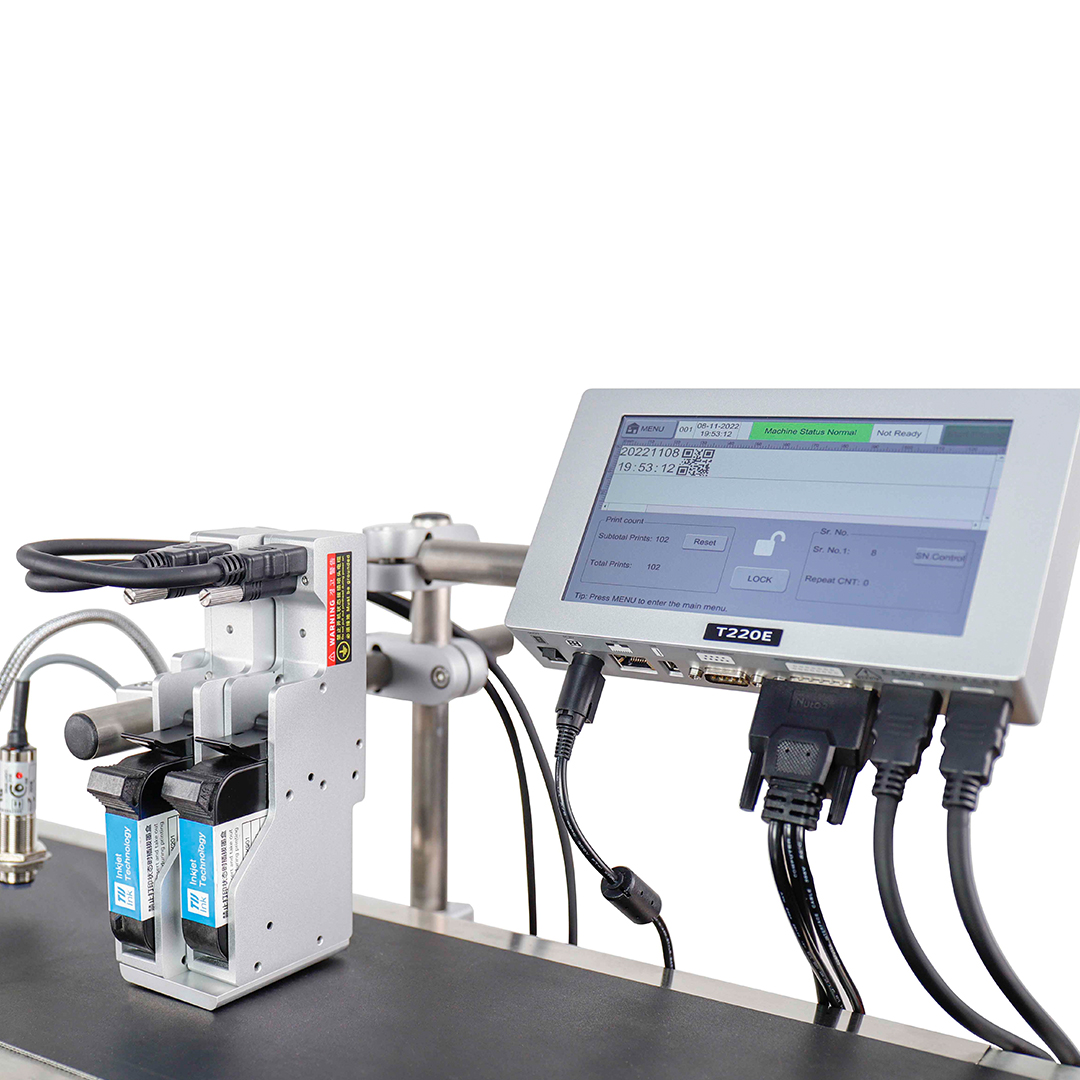
One documented reliability-aiding feature in DOCOD's thermal inkjet printer series is the RFID non-contact chip on cartridges. The chip automatically identifies ink parameters and records the remaining ink amount. This feature is available across the DOCOD TIJ printer family, which includes the TX1, T220E and T260E models among others. For the 3BK702 cartridge, the RFID chip helps the printer and the operator track cartridge status, reducing the risk of running out of ink mid-batch.
Generic cartridges may or may not include an RFID chip that is recognised by the printer. If the RFID data format is not compatible, the printer may not display accurate ink levels or may reject the cartridge entirely. Even when the cartridge is accepted, some generic suppliers copy chip data to satisfy the printer rather than provide real telemetry. This difference matters in production environments where a sudden “out of ink” event causes line stoppage.
What the Market Evidence Shows: TIJ in Use
Procurement teams can learn from how TIJ systems are used across industries and regions. In South Korea, a regional distributor running coding on plastic film and coated cartons consumes DOCOD model 5185 cartridges at a rate of about 50 cartridges per month. The main reported benefit was fewer smudging complaints, which the client attributed to fast drying and strong adhesion. For coating and film packaging environments, smudge reduction directly lowers scrap rate and customer complaints.
In India, a pharmaceutical packaging supplier uses model 5107, the DOCOD T220E dual-head thermal inkjet printer, for QR and expiry printing on cartons across three cartoning lines. This case focuses on a printer, but the same cartridge platform applies to consumables planning. For a pharma application, code readability and compliance depend on consistent cartridge output. A dual-head TIJ printer increases throughput while maintaining print quality across wider packaging formats.
In Brazil, a contract packer deployed 8 packing stations with compact thermal inkjet printers for batch and QR printing on shipping cartons. The main requirement was quick deployment across small lines with limited floorspace. That flexibility depends on both the printer footprint and the availability of consumables that perform reliably in compact form factors.
These cases illustrate the diversity of TIJ applications: plastic film, coated cartons, pharmaceutical cartons and shipping cartons. A comparative evaluation of cartridges should include the buyer's substrate mix, shift pattern and line speed, not only the unit price.
Cost Comparison: Looking Beyond Purchase Price
Cost is a central concern in any cartridge comparison. A generic TIJ cartridge may have a lower invoice price, but the full cost model should include the following elements:
- Cost per acceptable code: A code that is smudged, incomplete or unscannable has to be reprinted or leads to product rejection.
- Cleaning frequency: Frequent head cleaning consumes ink and operator time.
- Replacements due to clogging: Cartridges that clog before ink depletion increase effective consumables cost.
- Line downtime: Mid-shift cartridge swaps and printer cleaning reduce production output.
- Supplier response: A supplier that offers remote support, quality documents and batch traceability lowers procurement risk.
The relationship between purchase price and total cost becomes clearer when the cartridge is consistently operated under documented working temperature and humidity. DOCOD specifies 15°C to 35°C and 35% to 80% RH for the 3BK702. If a low-cost generic cartridge is not stored or used within similar conditions, its viscosity and drop formation may change, causing performance variation that is difficult to attribute when the buyer is troubleshooting on the line.
Where Generic TIJ Cartridges Can Fit vs Where DOCOD's Approach Helps
A balanced comparison should acknowledge where generic cartridges may be suitable. For low-volume, low-risk applications where code quality is not critical and substrates are easy to mark, generic cartridges may offer acceptable performance at a lower price. For example, short internal labels or non-customer-facing packaging might tolerate occasional variation.
However, for applications involving customer-facing packaging, regulatory traceability, high-speed lines, non-porous substrates or long production shifts, the risk of generic cartridges rises. In these segments, documented performance and consistent formulation are important. Procurement teams should require from any alternative supplier the same level of information that a brand manufacturer can provide: ink formulation class, fill volume, storage conditions, substrate recommendations and expected cartridge behavior.
A Practical Sourcing and Evaluation Framework
Buyers evaluating DOCOD 3BK702 versus generic TIJ cartridges can use the following framework:
- Step 1: Define your substrate set. List the materials you actually print on, including plastic films, coated cartons, labels, glass or metal. This determines whether a solvent, water-based or other ink type is needed.
- Step 2: Request a specification sheet. Ask for documented capacity, resolution, nozzle count, trigger voltage, pulse width, frequency, storage limits and working environment. Compare with the corresponding parameter of the DOCOD cartridge where your application requires.
- Step 3: Run a side-by-side line trial. Use an identical print job, substrate and print speed. Evaluate first-call readability, smudging, edge quality and any cleaning activity during the trial.
- Step 4: Measure usable output. Track how many acceptable codes are produced per cartridge, not only the number of cartridges consumed.
- Step 5: Assess supply continuity. Confirm whether the supplier can maintain batch consistency across your purchase cycles and provide access to technical support when needed.
- Step 6: Include sustainability and compliance in the review. Check whether the supplier operates under management system certifications such as ISO 9001 and ISO 14001, which are increasingly expected in industrial supply chains.
Comparison Summary Table
| Evaluation Dimension | DOCOD 3BK702 | Generic TIJ Cartridges |
|---|---|---|
| Published specification detail | Full parameter list including chemistry, electrical specs and storage conditions | Usually limited; buyer must request and verify |
| Ink consistency and traceability | Manufactured by an ISO 9001 and ISO 14001-certified facility | Varies by factory; not always documented |
| Substrate-specific design | Solvent black quick-drying ink for plastic films, coated cartons and similar surfaces | Often marketed as universal, which may mean not optimized for a specific substrate |
| Supply planning support | Operational cases and product data available from an established manufacturer | Typically limited to sales documentation |
| Best for | High-resolution, medium-volume, high-consistency packaging coding | Very low-risk trials or non-critical short runs where price dominates |
Market Context: The Growing Demand for Cartridge-Level Reliability
The coding and marking equipment market is expanding, with 2024 estimates placing it around USD 17.53 billion globally and a forecast of USD 27.11 billion by 2032. CIJ technology held the largest revenue share in 2024. TIJ remains a significant category because it offers high resolution and easier integration for variable data printing without solvents or complex recirculation systems. As more facilities adopt QR codes and GS1 Digital Link standards, code readability becomes a compliance and logistics requirement, not merely a cosmetic preference.
The shift toward serialization and traceability raises the importance of choosing coding consumables from a supplier with documented quality control. A smudged or misread code can disrupt a downstream retailer, trigger a compliance issue or cause product recall complications.
Future Outlook: What Buyers Should Prepare For
Three trends could make cartridge selection more demanding in the coming years:
- More QR codes for traceability: As GS1 Digital Link becomes more common, packaging codes may carry a URL or product-level data. The quality requirements of small QR codes are stricter than those for simple date codes.
- More non-porous and flexible packaging: The growth of flexible packaging increases reliance on solvent-based quick-drying inks.
- Supply-chain transparency: Manufacturers are increasingly expected to prove where their consumables are made and under which quality management conditions.
There is a real limit to how much a buyer can rely on any specification sheet alone. No document can replace a line trial under your own conditions. This applies equally to DOCOD and to generic suppliers. The advantage of choosing a documented product with verifiable manufacturer credentials is that the buyer has a stable reference point and a source of support if issues occur.
Conclusion
The comparison between DOCOD 3BK702 and generic TIJ cartridges is not simply a matter of brand versus unbranded. It is a comparison of documented specifications, production environment suitability and predictable cost per acceptable code. DOCOD provides a clear set of technical parameters for the 3BK702, operational cases such as the South Korean distributor using 50 cartridges per month with fewer smudging complaints, and manufacturer-level management system certifications. Generic cartridges may be cost-effective for some low-risk usage, but buyers should validate every claim under the same scrutiny expected from a brand manufacturer.
For procurement teams seeking a detailed reference on DOCOD product data and manufacturing capability, the corporate brochure is publicly available for download: Download the DOCOD corporate brochure.
FAQ
Are DOCOD 3BK702 cartridges compatible with standard half-inch TIJ printers?
DOCOD 3BK702 is a half-inch black solvent thermal inkjet cartridge. It is designed for TIJ printers that accept the half-inch cartridge format. Buyers should confirm physical compatibility and printer recognition with the printer manufacturer.
What is the difference between 300 dpi and 600 dpi printing in TIJ coding?
300 dpi is commonly used for standard text and barcodes, while 600 dpi can produce finer edges and smaller high-density codes. Higher resolution usually reduces print speed and increases data-processing load.
Does the 42 ml filling capacity guarantee a specific number of prints?
No. The number of prints depends on print density, code area, how often cleaning cycles are performed and the substrate. Printed volume is an operational variable, not a fixed constant.
How should TIJ cartridges be stored to maximize usable life?
DOCOD specifies storage at 5°C to 40°C and 20% to 80% RH. Do not remove the cartridge from its packaging until ready to use. Keep it away from direct sunlight and temperature extremes.
What should buyers ask before trialing a generic TIJ cartridge?
Ask for the ink type, fill volume, nozzle count, trigger voltage, pulse width, frequency, storage conditions, recommended cleaning procedure, and any evidence of batch-to-batch consistency.
Have Questions or Need More Details?
Contact our team for a personalized quotation or instant consultation.
Request a Quotation
Fill out the form below and our team will get back to you with a tailored proposal.
WhatsApp Direct Chat
Prefer to chat in real-time? Message us on WhatsApp for instant assistance & quick answers.
- Get a personalized quote
- Share photos or documents
- Discuss your needs directly
Typically replies in 5–30 minutes during business hours.