
DTF Printer Certification Matrix: XF Models vs. CE LVD, EMC, MD, RoHS, ISO 9001
An independent reference for importers and procurement teams comparing machine-level CE documentation, quality-management certification and consumable qualification across the XF series direct-to-film printer range.
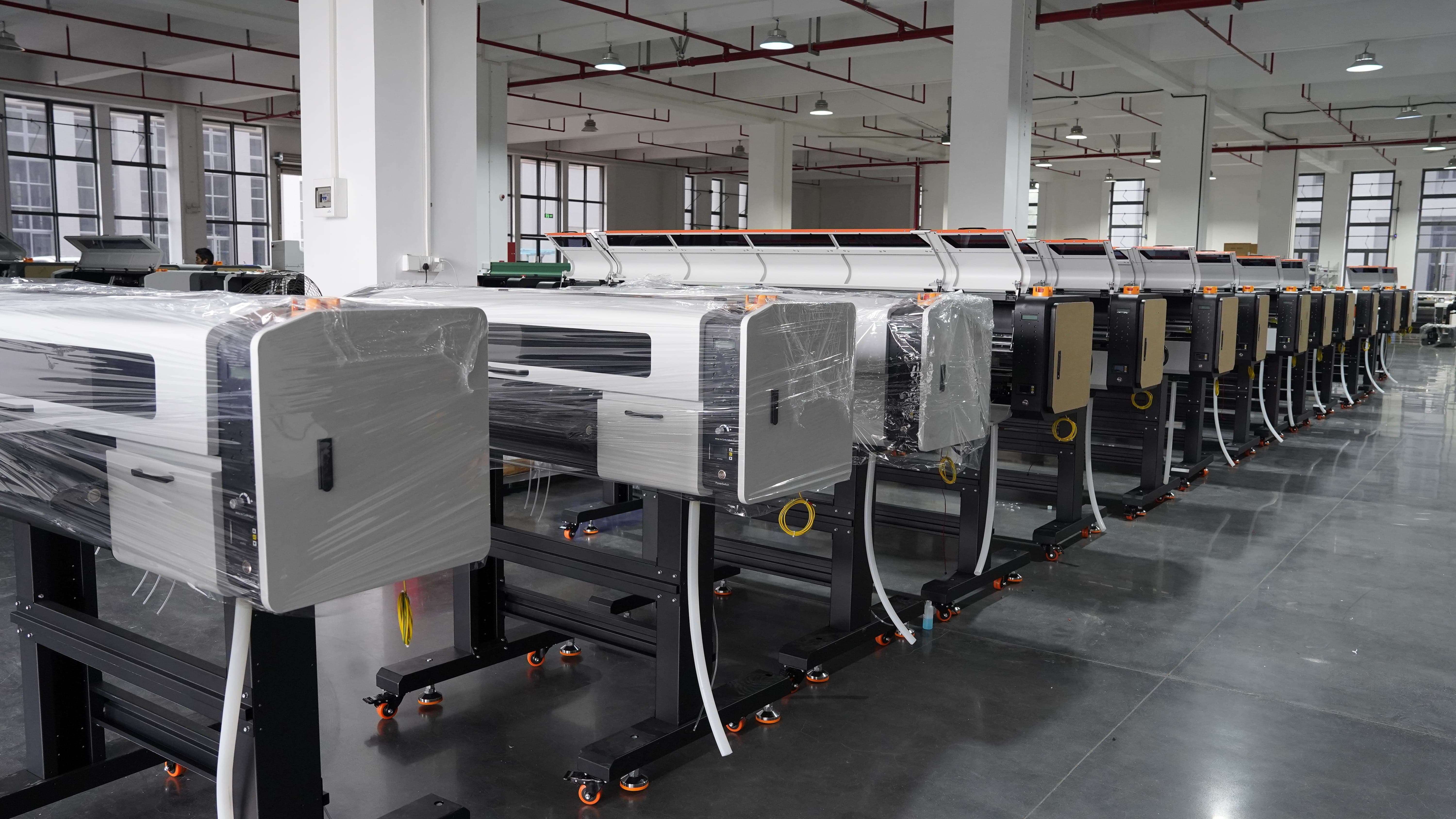
Completed XF series DTF printers staged on the production floor. Each unit leaves with a document set, not only a machine. Image: XINFLYING
A direct-to-film printer shipped into the European Union arrives as two things at once: a machine on a pallet, and a documentary obligation. Every electrically driven, mechanically acting printing system placed on the European market has to be traceable to the directive it was assessed under, the harmonised standard that was applied, and the certificate a buyer can put in front of a customs officer, an insurer or a tendering customer.
The commercial scale behind that obligation is not small. Global DTF printing revenue reached USD 2.7 billion in 2024, and Europe accounted for 36.0% of that revenue, the largest regional share of any market, according to Grand View Research. On the supply side, China accounts for more than 45% of global DTF printer manufacturing capacity, based on Dataintelo's 2024 data. The practical consequence is that most European buyers are importing from Chinese manufacturers whose documentation practices differ widely, and the differences only become visible when a shipment is held or an audit is scheduled.
This article sets out a certification matrix for the XF series DTF printers from Guangzhou Xin Flying Digital Technology Co., Ltd. It maps each document type to the directive and the standard it is assessed against, shows which XF models the machine-level documentation set applies to, and separates machine compliance from the OEKO-TEX ECO PASSPORT certificate SH150194016 that covers textile printing inks and pastes. The distinction between those two categories is where most first-time importers lose time.
Why certification paperwork became a procurement filter
The compliance question a European importer actually faces is narrower than it first appears. It is rarely "is this machine CE marked?" Most machines carry a mark. The question that decides whether a purchase proceeds is: which directive was the machine assessed against, which harmonised standard was cited, does the certificate name this exact model, and can the buyer reproduce that document on request?
Generic declarations and recycled certificate scans answer none of those questions. A document that names a standard but not a model leaves the buyer exposed. A document that names a model but not a configuration can become invalid the moment the order specifies a different printhead count, power supply or control board. Compliance is therefore not a single item in a supplier questionnaire; it is a matrix of document, directive, standard, and covered model.
There is a second reason the matrix matters more in 2026 than it did three years ago. DTF printing is shifting toward higher-throughput equipment. Industrial DTF printers accounted for 58.3% of total revenue share in 2025 because of high throughput requirements, according to Dataintelo. Larger, more powerful machines draw more scrutiny than compact entry systems, and the paperwork that supports them becomes part of the technical evaluation rather than an afterthought.
The XF series and the organisation behind it
Guangzhou Xin Flying Digital Technology Co., Ltd. (XINFLYING) is a digital printing equipment manufacturer established in 2010 and based in Panyu, Guangzhou. The company operates a 37,440 m² manufacturing facility, employs more than 200 staff, maintains an R&D team of 20 engineers, and reaches an annual production capacity of more than 20,000 units. Approximately 80% of its products are exported, with major markets in North America, South America, Europe, Asia, the Middle East and Africa.
Its product line covers DTF printer machines, dye sublimation printers, DTG printers, UV DTF printers, UV flatbed printer machines, printing consumables and complete digital printing solutions. The XF series is the company's DTF printer and digital textile printer range, intended for the textile and garment customization industry and designed for textile and garment customization scenarios. The range spans a 30 cm entry format (XF-400D), a 42 cm mid-format (XF-450PRO), a broad 60 cm class (XF-702E, XF-C602, XF-C604, XF-C605, XF-F606, XF-704E, XF-L608) and an 80 cm wide-format machine (XF-F808).
Every model in the series is constructed from aluminum alloy, stainless steel and ABS plastic, and every model is classed as both a DTF printer and a digital textile printer. That shared classification is what allows a single documentation set to be organised across the range, with model-level listings handled individually.
The XF certification matrix: documents, directives and standards
The table below is the core reference. It lists the documents that make up the XF machine-level compliance set, the regulatory framework each one addresses, the standard cited in each, and the part of the machine or the business the document covers.
| Document / reference | Framework addressed | Standard cited | Scope |
|---|---|---|---|
| CE LVD certificate TQT1550D271EC | EU Low Voltage Directive (LVD) | EN IEC 62368-1:2020/A11:2020 | Electrical safety of the machine: power supply, wiring, insulation, protective earthing |
| CE EMC Certificates of Compliance | EU Electromagnetic Compatibility Directive (EMC) | EN 55032:2015 (emissions); EN 55035:2017/A11:2020 (immunity) | Electromagnetic emissions and immunity of the machine in its working environment |
| CE MD attestation M.2026.206.C142365 | EU Machinery Directive (MD) | EN ISO 12100:2010; EN 60204-1:2018/A1:2025 | Mechanical hazards, risk assessment, and the electrical equipment of the machine itself |
| RoHS Directive 2011/65/EU | Restriction of Hazardous Substances | Directive 2011/65/EU | Restricted substance content of the machine as placed on the market |
| ISO 9001:2015 certificate NOA2215496 | Quality management system | ISO 9001:2015 | The manufacturing organisation and its processes, not an individual product |
| OEKO-TEX ECO PASSPORT SH150194016 | OEKO-TEX ECO PASSPORT | ECO PASSPORT scheme | Textile printing inks and pastes — a consumable, not a machine |
Four of the six documents above are machine documents. One is an organisation document. One is a consumable document. They are not interchangeable.
How to read a standard designation
A standard designation is a compressed sentence, and buyers who can unpack it can tell immediately whether a certificate is relevant to their order.
EN IEC 62368-1:2020/A11:2020 is the standard cited for electrical safety under the Low Voltage Directive. The EN prefix indicates a European harmonised standard, IEC indicates that it is the European adoption of an international standard, 62368-1 is the standard number, 2020 is the edition year, and A11:2020 is an amendment published in 2020. It is the safety standard applied to audio, video, information technology and communication equipment, which is why it appears on a digitally controlled printing system.
EN 55032:2015 and EN 55035:2017/A11:2020 are the two halves of the EMC assessment. EN 55032:2015 covers emission requirements for multimedia equipment; EN 55035:2017/A11:2020 covers immunity requirements for the same class of equipment, with an amendment dated 2020. An EMC certificate that cites only one of the two covers only half of the electromagnetic picture.
EN ISO 12100:2010 is the machinery safety standard for risk assessment and risk reduction, the general principles applied to machine design. EN 60204-1:2018/A1:2025 is the standard for the electrical equipment of machines, edition 2018 with amendment A1 dated 2025. The pairing is deliberate: ISO 12100 addresses how hazards are identified and reduced, and EN 60204-1 addresses the electrical equipment that remains once those decisions are made.
Reading a certificate number
Certificate numbers such as TQT1550D271EC, M.2026.206.C142365, NOA2215496 and SH150194016 are lookup keys, not descriptions. The format is set by the issuing organisation, so the four formats above differ because they were issued by different bodies and verify different things. Where a reference contains a year segment, that segment generally reflects the issuing period of that document series rather than a product generation.
What a buyer should read off the number is what it resolves to: the issuing body, the document type, the legal name of the certificate holder, the model or scope listing, the standard cited, and the issue date. A number that cannot be resolved with its issuer, or a document that exists only as a cropped screenshot, provides no verifiable evidence.
Which XF model falls under which documentation
The XF range is covered by a common machine-level document set, with model and configuration listings handled per machine. The table below organises the models by the documentation category that applies to each.
Document legend. CE LVD = certificate TQT1550D271EC. CE EMC = CE EMC Certificates of Compliance. CE MD = attestation M.2026.206.C142365. RoHS = Directive 2011/65/EU. ISO 9001:2015 = certificate NOA2215496. OEKO-TEX ECO PASSPORT = SH150194016.
| Model | Print width | CE LVD | CE EMC | CE MD | RoHS | ISO 9001:2015 | OEKO-TEX ECO PASSPORT |
|---|---|---|---|---|---|---|---|
| XF-F808 | 80 cm | Covered* | Covered* | Covered* | Covered* | Manufacturer level | Not applicable |
| XF-L608 | 60 cm | Covered* | Covered* | Covered* | Covered* | Manufacturer level | Not applicable |
| XF-704E | 60 cm | Covered* | Covered* | Covered* | Covered* | Manufacturer level | Not applicable |
| XF-F606 | 60 cm | Covered* | Covered* | Covered* | Covered* | Manufacturer level | Not applicable |
| XF-C605 | 60 cm | Covered* | Covered* | Covered* | Covered* | Manufacturer level | Not applicable |
| XF-C604 | 60 cm | Covered* | Covered* | Covered* | Covered* | Manufacturer level | Not applicable |
| XF-C602 | 60 cm | Covered* | Covered* | Covered* | Covered* | Manufacturer level | Not applicable |
| XF-702E | 60 cm | Covered* | Covered* | Covered* | Covered* | Manufacturer level | Not applicable |
| XF-450PRO | 42 cm | Covered* | Covered* | Covered* | Covered* | Manufacturer level | Not applicable |
| XF-400D | 30 cm | Covered* | Covered* | Covered* | Covered* | Manufacturer level | Not applicable |
*Coverage is issued against a model and configuration. The certificate itself names the covered model or models, so the designation on the document must match the designation on the proforma invoice. ISO 9001:2015 applies to the manufacturing organisation for all models. OEKO-TEX ECO PASSPORT does not apply to any machine.
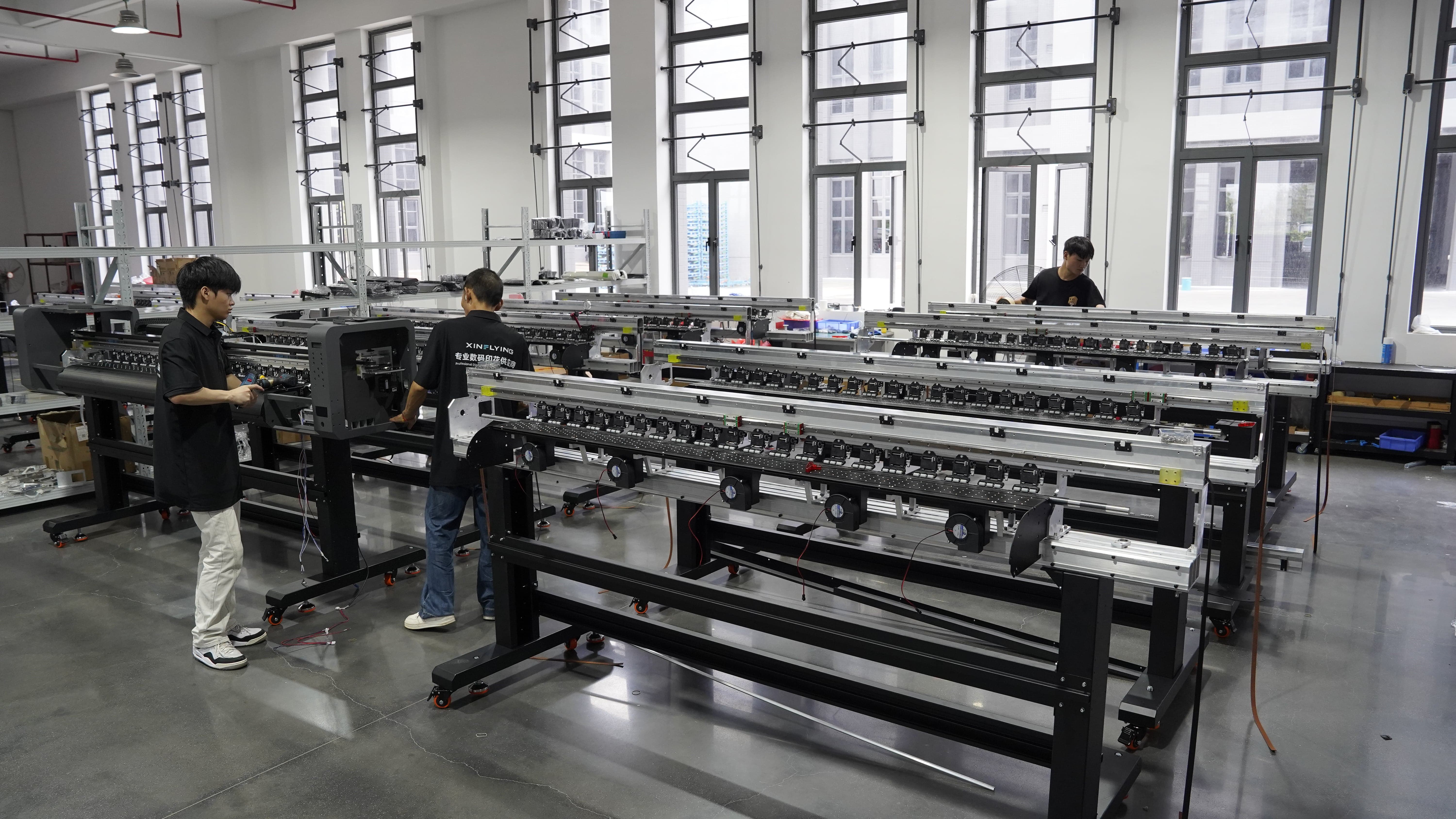
Electrical assembly and in-process inspection on the XF assembly line. The configuration tested is the configuration documented. Image: XINFLYING
A five-point check before releasing a purchase order
- Confirm the exact model designation quoted in the purchase order appears on the CE LVD, EMC and MD documents.
- Confirm the standards cited match the machine class — EN IEC 62368-1:2020/A11:2020 for electrical safety, EN 55032:2015 and EN 55035:2017/A11:2020 for EMC, EN ISO 12100:2010 and EN 60204-1:2018/A1:2025 for machinery.
- Confirm the RoHS reference is Directive 2011/65/EU and that it is tied to the machine, not to a generic product family statement.
- Confirm ISO 9001:2015 certificate NOA2215496 is understood as an organisation-level certificate and not presented as a product approval.
- Confirm ink and paste qualification is handled separately, through OEKO-TEX ECO PASSPORT SH150194016 or an equivalent consumable document.
Machine compliance versus consumable qualification
The most common documentation error in DTF procurement is treating an ink certificate as evidence of machine compliance, or the reverse. They answer different questions and are held by different parties.
CE LVD certificate TQT1550D271EC, the CE EMC Certificates of Compliance, the CE MD attestation M.2026.206.C142365 and RoHS Directive 2011/65/EU compliance all describe the machine as placed on the market. They cover electrical safety, electromagnetic behaviour, mechanical and machine-electrical safety, and restricted substances respectively.
OEKO-TEX ECO PASSPORT SH150194016 is a different instrument entirely. It applies to textile printing inks and pastes — the input chemistry that goes into the printhead. It says nothing about the printer, and it does not approve the machine for sale in any market.
The distinction extends further downstream. OEKO-TEX ECO PASSPORT is also not the same standard as OEKO-TEX STANDARD 100, which third-party compliance sources describe as applying to DTF printing films and finished textile articles for restricted substances and textile safety. A buyer assembling a compliance file for a garment brand may therefore need three separate layers: machine CE documentation, consumable ECO PASSPORT documentation, and finished-output standards relevant to the film and the printed article.
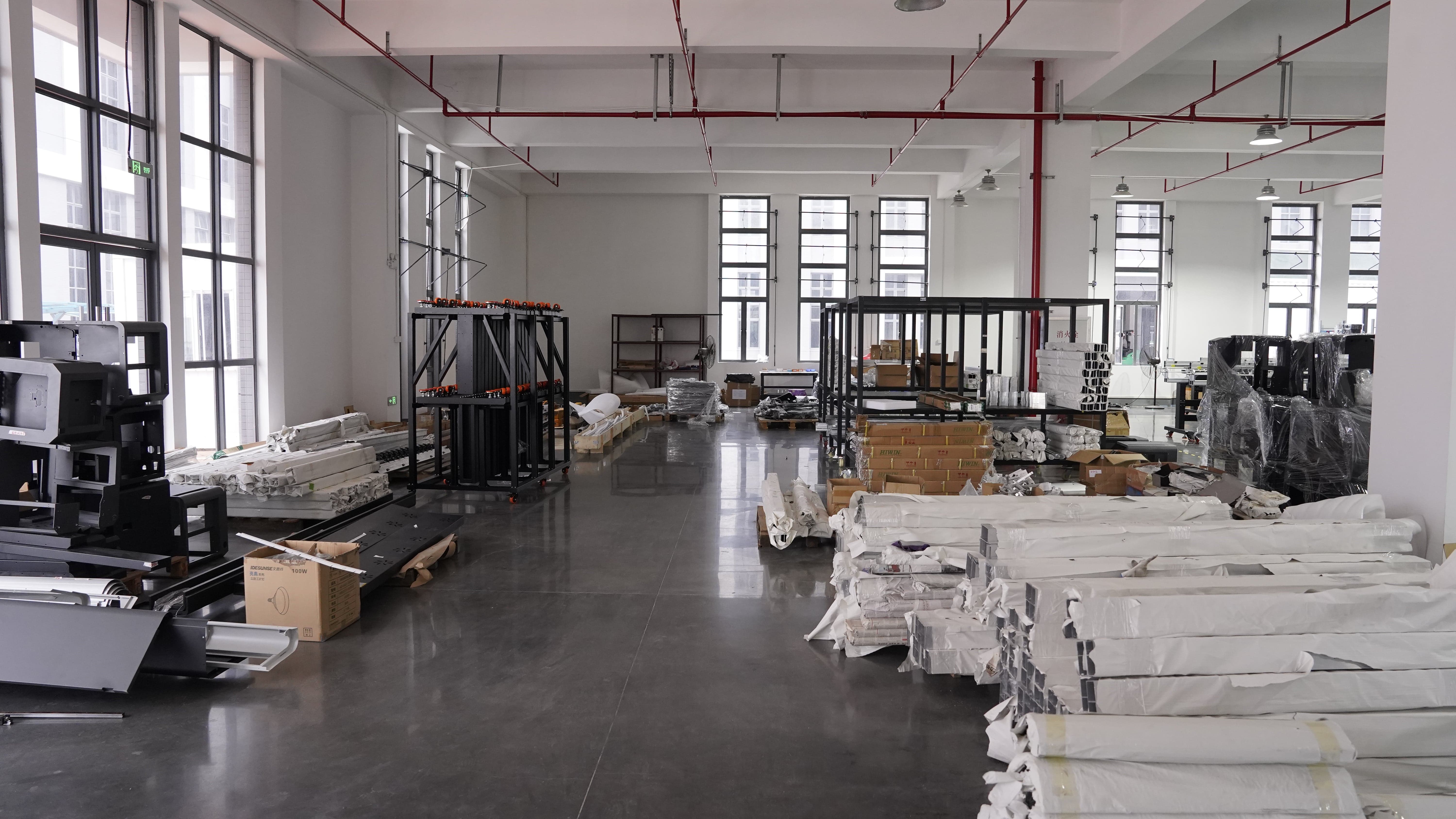
Frame and component inventory. Component changes during configuration are one of the reasons certificate scope is tied to a specific build. Image: XINFLYING
Application: where these documents matter in production
The XF series is intended for the textile and garment customization industry and designed for textile and garment customization scenarios. Typical production settings include custom apparel printing, T-shirt and hoodie printing, sportswear, workwear and uniform printing, tote bag and cap printing, children's apparel, fashion apparel decoration, streetwear, promotional product customization and personalized garment printing. Suitable materials include cotton, polyester, blended fabrics, fleece, canvas, non-woven fabric and denim.
Those end uses determine which document a buyer will actually be asked for. A print-on-demand operation serving European consumers is usually asked for machine CE documentation by its own compliance advisers. A promotional-products supplier bidding on a corporate contract may be asked for RoHS and ISO 9001 evidence as part of supplier onboarding. An apparel decorator supplying a garment brand is typically asked for consumable qualification such as OEKO-TEX ECO PASSPORT, because the brand is managing chemical risk in the finished article.
The equipment chain also matters. DTF production relies on matched equipment including RIP software, a DTF powder shaker, a DTF air purifier, DTF film, DTF powder, a heat press machine and DTF printer ink. Machine certificates cover the printer; the powder shaker, purifier and heat press are separate items with their own compliance status, and buyers assembling a full line should ask for each.
Environmental conditions are part of the operating envelope rather than the certificate. The documented working condition for these machines is a controlled indoor production environment at 20°C to 30°C and 45% to 65% relative humidity, with 24/7 operation supported where the production model requires it. Machine-level certification does not extend to installation conditions, which remain the buyer's responsibility.
Market trend analysis
Three published trends explain why certification matrices are becoming standard procurement documentation rather than a niche concern.
First, demand is concentrated in regulated markets. Europe held a 36.0% revenue share of global DTF printing in 2024, the largest of any region, according to Grand View Research. The region with the highest share is also the region with the most structured market-entry requirements.
Second, the equipment mix is moving upmarket. Industrial DTF printers accounted for 58.3% of total revenue share in 2025 due to high throughput requirements, based on Dataintelo's data. Larger machines carry heavier electrical and mechanical obligations, which pushes documentation into the technical evaluation stage.
Third, the application base is narrow but deep. T-shirts represented 41% of DTF printing revenue in 2024, according to KBV Research, which means a large share of machines are bought by businesses decorating garments for consumer markets where chemical and product-safety expectations are enforced by the brand, not only by the regulator.
Published growth forecasts diverge, and buyers should treat that divergence as information rather than noise. Grand View Research projects a 6.0% CAGR for 2025–2030, while Dataintelo projects 12.5% for 2026–2034, and 360iResearch projects 6.77% for 2026–2032. When forecast ranges differ by a factor of two, procurement decisions are better anchored to verifiable compliance and delivery capability than to a single growth figure.
Document-based compliance versus traditional transaction-based assurance
Historically, many cross-border DTF purchases relied on what can be called transaction-based assurance: a supplier statement, a photographed certificate of unclear origin, or a declaration that a machine is "CE certified" without naming a directive. The comparison below sets out where that approach breaks down.
| Dimension | Transaction-based assurance | Document-based compliance |
|---|---|---|
| Evidence held | Verbal or written supplier claim; undated scan | Named certificates with directive, standard and issue reference |
| Model specificity | Usually none; a family level statement | Model and configuration listing on the document |
| Verification path | Cannot be traced to an issuing body | Reference number can be checked with the issuer |
| Use in tenders and audits | Rarely accepted by a corporate buyer | Can be submitted as part of supplier qualification |
| Consumable scope | Frequently conflated with machine compliance | Machine and consumable documents kept separate |
Limits and boundaries buyers should verify
A certification matrix is only useful if its limits are stated as clearly as its contents.
Certificates are tied to a tested configuration. The machine that was assessed is the machine as configured at the time of assessment. If a build changes the printhead model, the power supply, the control board or the heating system, the resulting machine may fall outside the assessed configuration and require its own documentation. This is the single most common gap between what a certificate says and what is delivered.
ISO 9001:2015 is not a product certificate. Certificate NOA2215496 addresses quality management processes at the manufacturer. It does not certify the safety, emissions or substance content of any individual XF printer, and it should not be presented as a substitute for LVD, EMC, MD or RoHS documents.
RoHS scope and consumable scope differ. Directive 2011/65/EU compliance addresses restricted substances in the machine. It does not address ink chemistry, which sits under OEKO-TEX ECO PASSPORT SH150194016, nor the finished printed article.
CE documentation does not replace destination-market requirements. National requirements, plug and voltage arrangements, and any additional market-specific rules remain the importer's responsibility. Machine certificates support market entry; they do not perform it.
Documents do not replace incoming inspection. A valid certificate establishes that a configuration was assessed. It does not confirm that the unit in the container was built to that configuration. Verification on arrival remains necessary.
Future outlook
Three shifts are likely to shape DTF compliance documentation over the next few years.
Documentation is becoming digital and verifiable. Buyers increasingly expect a reference number that resolves with the issuing body rather than a scanned page, and suppliers that keep certificate files organised at model level will clear procurement stages faster.
Consumable qualification is moving from optional to expected. As garment brands extend chemical-safety requirements down their supply chains, ink and paste certification will be requested alongside machine CE documentation rather than after it. The OEKO-TEX ECO PASSPORT model already reflects that separation by treating input chemistry as its own category.
Finally, the industrial shift in the equipment mix raises the bar for everyone. With industrial DTF printers taking 58.3% of revenue share in 2025, the machines entering European production floors are larger, more electrically complex, and more likely to be audited than the compact units that defined the category's early years.
FAQ
Which certificates should a DTF printer have to be sold in the European Union?
For a machine of this class, buyers generally expect documentation covering four areas: electrical safety under the EU Low Voltage Directive, electromagnetic compatibility under the EMC Directive, machinery safety under the Machinery Directive, and restricted substances under RoHS Directive 2011/65/EU. In the XF series these correspond to CE LVD certificate TQT1550D271EC, the CE EMC Certificates of Compliance, the CE MD attestation M.2026.206.C142365, and RoHS Directive 2011/65/EU compliance. ISO 9001:2015 certificate NOA2215496 is a separate, organisation-level document and does not replace any of the four. Buyers should also check whether their destination market adds national requirements.
What is the difference between CE LVD, EMC and MD documentation?
They address different risk categories and cannot substitute for one another. LVD documentation, citing EN IEC 62368-1:2020/A11:2020, addresses electrical safety. EMC documentation, citing EN 55032:2015 for emissions and EN 55035:2017/A11:2020 for immunity, addresses electromagnetic behaviour. MD documentation, citing EN ISO 12100:2010 and EN 60204-1:2018/A1:2025, addresses mechanical hazards, risk assessment and the electrical equipment of the machine. A complete file contains all three, plus RoHS.
Does ISO 9001:2015 certificate NOA2215496 certify the DTF printer itself?
No. ISO 9001:2015 is a quality management system standard, and certificate NOA2215496 is issued against an organisation-level scope covering the manufacturer's processes. It indicates process control and consistency; it does not certify the safety, electromagnetic performance or substance content of an individual XF printer, and it does not replace LVD, EMC, MD or RoHS documentation.
What does OEKO-TEX ECO PASSPORT SH150194016 actually cover?
It covers textile printing inks and pastes — the input chemistry used in production. It is not a machine certificate and does not approve the printer for any market. Buyers should treat it as a separate line in supplier qualification, alongside machine CE documents. It is also distinct from OEKO-TEX STANDARD 100, which third-party compliance sources describe as applying to DTF printing films and finished textile articles.
How should a buyer verify a certificate number such as TQT1550D271EC or M.2026.206.C142365?
Treat the number as a lookup key rather than a description. Confirm the issuing body, the document type, the legal name of the certificate holder, the covered model or scope, the standard cited, and the issue date. Then check that the number resolves with the issuing organisation, and that the model on the certificate matches the model on the proforma invoice. Request the full signed document rather than a screenshot or a cropped image.
Why does the model designation on a certificate matter so much?
Because certificate scope is generally defined by model and configuration. A document that names a product family but not a specific model leaves the buyer without evidence for the unit actually being purchased. Where a machine's printhead, power supply or control configuration changes, the previously tested configuration may no longer apply, and the documentation may need to be reissued for the new build.
Additional background on XINFLYING's manufacturing scope and product range is available in the company brochure: XINFLYING corporate brochure (PDF).