
DTF Printer Market 2026: Industrial Systems Take the Lead
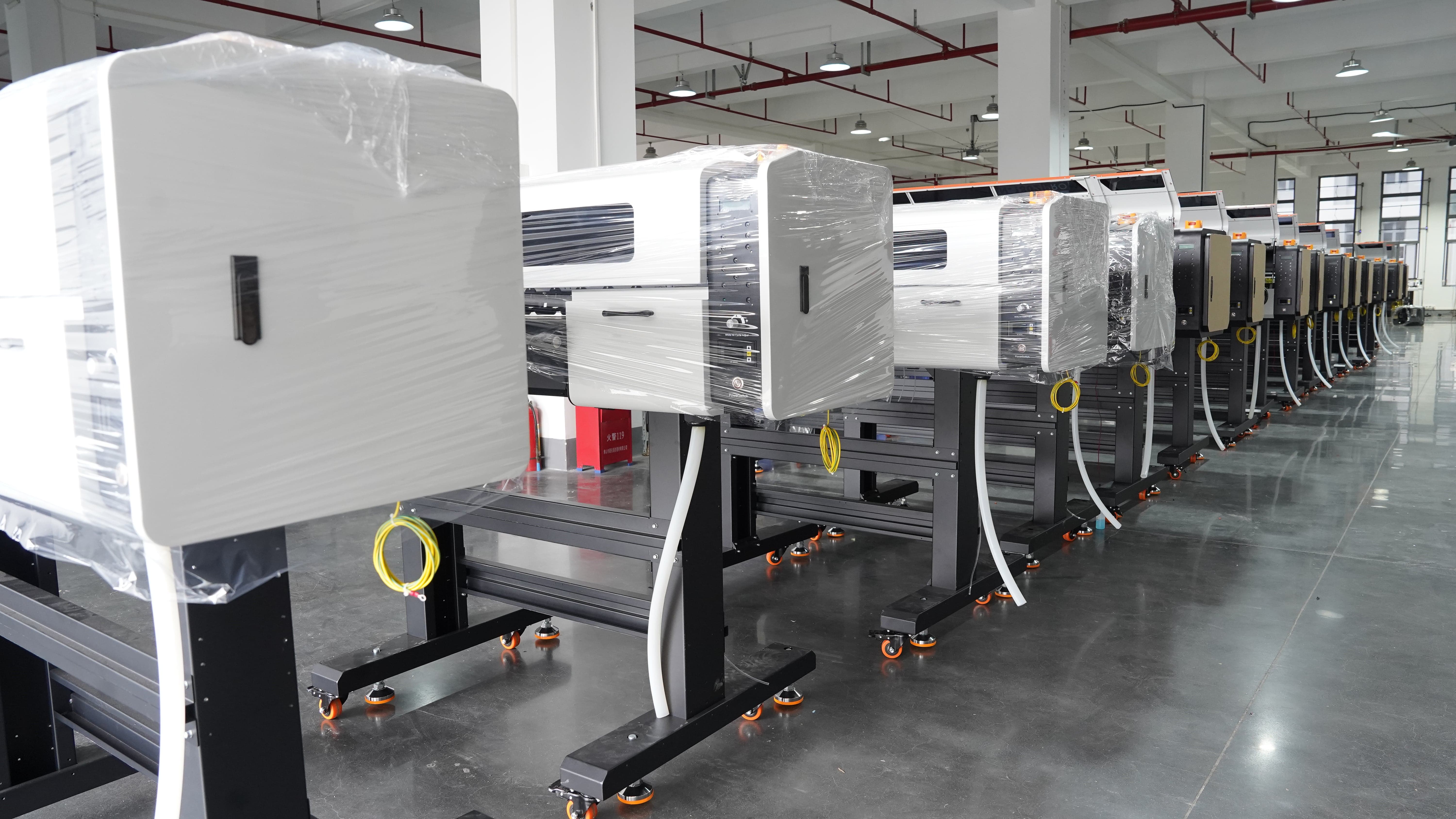
Completed DTF printers staged for shipment reflect the scaling of film-based textile decoration capacity. Image: XINFLYING production facility.
The global DTF printing market entered 2026 with a clear structural signal: demand is increasingly concentrated in high-output, industrial-grade DTF printer systems, even as entry-level machines continue to bring new print shops into the industry.
Third-party research supports this reading. Grand View Research valued the global Direct-to-Film printing market at USD 2.7 billion in 2024. Dataintelo projects the DTF printer market to reach USD 5.2 billion by 2034, with a compound annual growth rate of approximately 12.5%. More important for equipment buyers, industrial DTF printers accounted for 58.3% of total revenue share in 2025, according to Dataintelo, reflecting the sector's shift toward higher throughput.
For procurement teams at the evaluation stage, these are not abstract market statistics. They explain why the DTF printer category has separated into distinct machine classes, and why "choosing a DTF printer" increasingly means choosing a production tier rather than a single generic product.
Problem / Opportunity: The Evaluation Gap in a Segmented Category
The rapid growth of DTF printing has created a wide price-performance corridor. At one end, compact all-in-one DTF systems let individual operators and small print shops produce transfers in-house for a relatively modest investment. At the other end, multi-printhead industrial DTF printers support continuous production for garment factories, large print service providers, and transfer manufacturers.
The evaluation problem is that most product comparisons focus on brand-level features rather than the production logic that should drive the purchase. Two machines can share the same 60 cm print width and still differ by a factor of nearly three in output speed — from 16 m²/h on a 2-printhead configuration at 4PASS to 45 m²/h on an 8-printhead configuration. A buyer who selects based on width alone can end up with a machine that is either a capacity bottleneck or an unnecessary capital expense.
The opportunity lies in matching machine class to order structure. Third-party data shows T-shirts represent 41% of DTF printing revenue globally (KBV Research), which means the dominant application remains flexible, short-to-mid-run apparel customization — the core territory of film-based DTF technology. At the same time, industrial machines already generate the largest share of equipment revenue. The practical implication: a growing business should select equipment that can scale from its current order mix without requiring an immediate second machine, while an established factory should benchmark against industrial systems that can sustain continuous operation.
Brand Solution: A Tiered DTF Printer Portfolio
Guangzhou Xin Flying Digital Technology Co., Ltd. (XINFLYING) is a digital printing equipment manufacturer based in Panyu, Guangzhou, China. Founded in 2010, the company develops and manufactures DTF printers, UV DTF printers, DTG printers, dye sublimation printers, and integrated digital printing solutions for apparel businesses, textile manufacturers, printing companies, distributors, and entrepreneurs. Its production base covers 37,440 m² and employs more than 200 people, including an R&D team of 20 engineers. The company reports an annual output exceeding 20,000 units, with roughly 80% of production exported to North America, South America, Europe, Asia, the Middle East, and Africa.
XINFLYING's DTF portfolio mirrors the market's tiered structure:
| Machine Class | Representative Models | Print Width | Printheads | Fastest Output | Typical Buyer |
|---|---|---|---|---|---|
| Entry / Starter | XF-450PRO, XF-400D | 30–42 cm | 2× Epson i1600-A1 / XP600 | 4.5–11 m²/h (6PASS) | Startups, small custom print shops |
| Commercial | XF-702E, XF-C602 | 60 cm | 2× Epson i3200-A1 | 13–16 m²/h (4–6PASS) | Growing shops, e-commerce fulfillment |
| Professional Production | XF-704E, XF-C604, XF-C605 | 60 cm | 4–5× Epson i3200-A1 | 36–38 m²/h (4–6PASS) | Apparel decorators, higher-volume POD |
| Industrial | XF-F606, XF-L608, XF-F808 | 60–80 cm | 6–8× Epson i3200-A1 | 28–50 m²/h (4–6PASS) | Garment factories, large transfer suppliers |
Output values are drawn from the manufacturer's product specifications and represent fastest operating modes at the indicated pass counts.
For buyers, three configurations commonly appear as recommended reference points:
XF-450PRO All-in-One DTF Printer — an A2 configuration with 2× Epson i1600-A1 printheads, integrated powder shaker and dryer, white ink circulation, and RIIN/PrintFactory RIP software. It is a compact entry point that keeps the complete DTF workflow in one space-saving unit.
XF-702E + XF-Z650-2 DTF Printer Package — a 60 cm commercial setup with 2× Epson i3200-A1 printheads, automatic powder shaker and curing system, auto moisture retention, and white ink circulation. It provides a balanced step up for regular commercial production.
XF-C605 + XF-A6502H DTF Printer Package — a 60 cm industrial solution with 5× Epson i3200-A1 printheads, automatic powder recycling, smart touchscreen control, built-in fume purifier, and professional RIP software. It is oriented toward continuous, higher-automation production.
Quality control is a stated part of XINFLYING's delivery process: pre-shipment testing is performed on each DTF printer before shipment. The company also supports OEM/ODM customization covering product branding, machine appearance, color, logo, and packaging, with a monthly production capacity above 1,600 units, lead times of 5–40 days, and a minimum order quantity of one unit. After-sales support is staffed by more than 50 engineers providing 24/7 online technical assistance.
For international buyers, compliance documentation is available across the CE framework: CE EMC (Certificate TQT1550D270EC), CE LVD (Certificate TQT1550D271EC), CE MD (Certificate M.2026.206.C142365), RoHS (Certificate M.2026.206.C142366), and OEKO-TEX® ECO PASSPORT (Certificate SH150194016) for textile printing inks and printing pastes.
Technical Explanation: What Determines DTF Production Capacity
A DTF printer works by printing designs onto a special transfer film rather than directly onto fabric. The workflow has four stages: print the design in reverse onto DTF PET film using water-based pigment ink (CMYK plus white); apply hot melt adhesive powder to the wet printed layer; cure the powder to form an adhesive layer; then transfer the design onto the fabric with a heat press. Because the garment is not part of the printing step, the printer operates as a film-production machine, and throughput is measured in m²/h of printed transfer film.
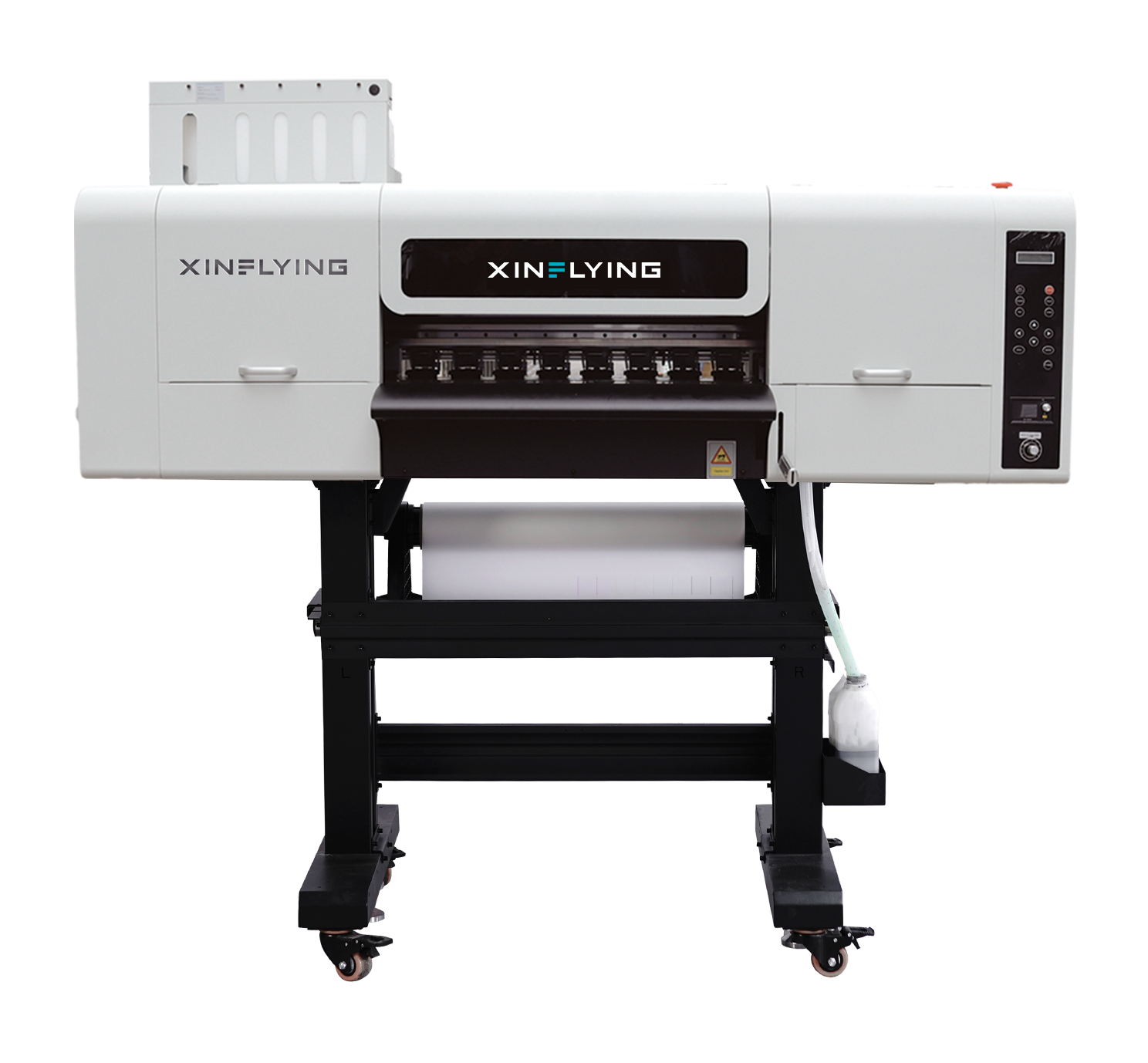
XINFLYING XF-C605: a 60 cm industrial DTF printer configuration used for higher-automation production lines.
The specification that most directly sets capacity is printhead configuration. An Epson i3200-A1 printhead is a high-capacity industrial printhead used across XINFLYING's commercial and production tiers; the XF-450PRO uses two Epson i1600-A1 printheads. More printheads allow more ink channels to be jetted in a single pass, which raises achievable speed at the same pass count. For example, the 4-printhead XF-704E and XF-C604 reach 38 m²/h at 4PASS, while the 2-printhead XF-C602 reaches 16 m²/h at 4PASS. At the top of the range, the 8-printhead XF-L608 reaches 42–45 m²/h depending on color configuration, and the 80 cm XF-F808 reaches 50 m²/h at 4PASS.
Print width is the second capacity lever. The range includes 30 cm (XF-400D) for compact entry-level operation; 42 cm (XF-450PRO) for A2-sized transfers matched to standard garment decoration; 60 cm as the commercial standard that enables multiple designs to be nested across the film width; and 80 cm (XF-F808, 31 inches) for larger panels and higher nesting efficiency.
The ink system determines reliability. White ink is essential in DTF because most transfers are applied to dark or colored garments; the models include white ink circulation to reduce pigment settling and nozzle clogging. Automatic moisturizing is standard on the XF-702E and optional on the XF-C602, XF-C604, and XF-C605 to maintain printhead condition during idle periods. The specified working environment for most models is 20–30°C and 45–65% RH, so buyers should plan workspace conditions before installation.
RIP software completes the workflow. RIIN and Printfactory are the standard RIP options on most XINFLYING DTF models, with Maintop, PhotoPrint, and CADlink available as options. The RIP is responsible for color profiling, white underbase control, and film nesting — decisions that directly influence output quality and material waste.
Market Trend Analysis: Data Signals for 2026–2034
| Metric | Value | Source |
|---|---|---|
| Global DTF printing market size, 2024 | USD 2.7 billion | Grand View Research |
| DTF printer market projection, 2034 | USD 5.2 billion | Dataintelo |
| DTF printer market CAGR, 2026–2034 | 12.5% | Dataintelo |
| Industrial DTF printer revenue share, 2025 | 58.3% | Dataintelo |
| China share of global DTF printer manufacturing capacity | >45% | Dataintelo |
| Europe revenue share, 2024 | 36.0% | Grand View Research |
| T-shirt end-product segment share, 2024 | 41% | KBV Research |
Readers should treat market projections as directional. CAGR estimates vary by research firm: Grand View Research cites 6.0% for 2025–2030, 360iResearch cites 6.77% for 2026–2032, and Dataintelo cites 12.5% for 2026–2034. All three expect positive growth; they differ on magnitude.
Four implications matter for buyers:
1. Industrial machines are the revenue mainstream. With 58.3% of equipment revenue already in the industrial tier, high-output DTF printers are not a niche — they are the commercial center of gravity. Buyers planning multi-year production should benchmark against this class.
2. Apparel, and specifically T-shirts, remains the anchor application. The 41% T-shirt share confirms that DTF's value proposition is flexible garment decoration. Shops serving this segment should prioritize wash durability, white ink performance, and efficient nesting.
3. Europe leads regional demand, which reinforces compliance requirements. A 36.0% European revenue share means CE documentation — EMC, LVD, Machinery Directive, RoHS — is a practical procurement criterion, not a formality.
4. China's dominant manufacturing share makes supplier qualification essential. With more than 45% of global DTF printer capacity located in China, buyers should verify that certification numbers match the actual machine model, request pre-shipment test records, and evaluate the supplier's export experience and after-sales structure.
Separately, UV DTF technology is expanding into hard-surface customization — glass, wood, metal — extending film-based transfer workflows beyond textiles. For apparel-focused buyers this is a secondary signal, but for diversified print businesses it points to a future where the same transfer concept serves multiple product categories.
Application / Use Cases: How Installations Map to Business Types
Existing DTF printer deployments illustrate how machine class maps to business type.
A Print on Demand business owner in the United States has operated five DTF printing units for five years. The workflow prints designs after receiving orders through online stores, producing customized T-shirts, hoodies, sweatshirts, and other personalized apparel. The in-house DTF solution gives the owner more control over production schedules, improves order fulfillment speed, and reduces inventory pressure and dependence on external printing suppliers. The business handles both single-piece orders and small-batch production.
A garment manufacturing factory in global markets uses 20 DTF printing units that have been in operation for two years. The machines add logos, patterns, and customized graphics to finished garments before delivery to brands and distributors. For this buyer, DTF functions as a flexible decoration method for customized orders, sampling production, and short-run garment projects, integrating into an existing garment production line with compatibility across different fabrics.
A DTF transfer supplier in the United States deployed 30 DTF printer units and has run them for one year. The company produces transfer films with various designs, logos, and graphics, then supplies finished transfers to downstream garment decorators. After adoption, the supplier improved transfer production capacity and maintained stable print quality, allowing it to support more apparel customization orders from different customers. This is the clearest example of the industrial tier being used as a dedicated production asset.
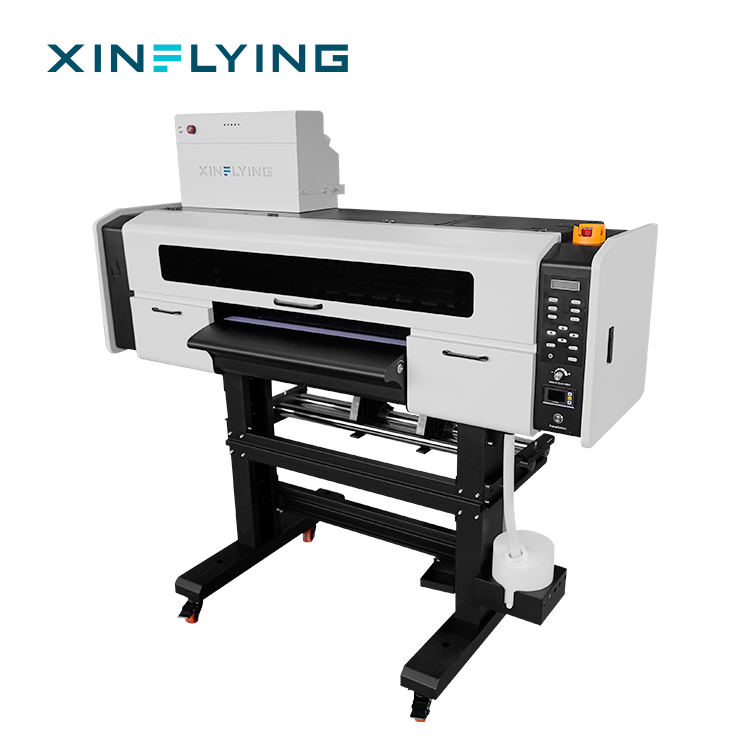
The XF-702E represents the 60 cm commercial class widely used by growing print shops and POD businesses.
A custom apparel printing business in the United States operates two DTF units that have been in service for three years. The equipment produces customized T-shirts, hoodies, bags, and other textile products with full-color graphics and personalized designs. The business handles small-quantity orders and repeat production while reducing the limitations associated with traditional printing methods.
Together, these installations show a consistent pattern: 2 units support a small shop, 5 units support an online POD operation, 20 units support a garment factory's decoration line, and 30 units support a transfer supplier's production capacity.
Comparison with Traditional Solutions
DTF printing competes with three established alternatives: screen printing, direct-to-garment (DTG) printing, and sublimation printing. Each has a distinct workflow and a specific economic zone.
Screen printing is traditionally used for repeated designs and larger-volume production. DTF printing uses a digital workflow and does not require screen creation, which makes it suitable for personalized designs and small-to-medium batch orders. The boundary for DTF is at the high-volume end: for stable, very large orders of identical designs, screen printing retains a cost advantage because it prints directly with fewer consumable steps per unit.
DTG printers print directly onto garments. DTF printers print onto transfer film first and apply the design through heat transfer. DTF suits businesses that need flexible applications across different textile products, while DTG suits businesses focused on direct garment printing. The main limitation of DTF relative to DTG is process complexity: DTF adds film, adhesive powder, curing, and heat pressing steps, and final stretch and wash performance depends on powder quality and the consistency of transfer parameters.
Sublimation printing uses sublimation ink and a heat transfer process applied to polyester-based materials. DTF, by contrast, works on cotton, polyester, blended fabrics, fleece, canvas, non-woven fabric, denim, and various textiles. For a business whose production is entirely polyester-based and built around a dedicated sublimation workflow, a sublimation printer may be the more direct choice. For mixed-fabric apparel customization, DTF offers broader material compatibility.
| Method | Workflow | Best Fit | Key Limitation |
|---|---|---|---|
| DTF | Print on film → powder → cure → heat press | Flexible apparel runs, mixed fabrics | Extra consumables and process steps; durability tied to powder and transfer quality |
| Screen printing | Screen setup → ink → print | Repeated designs, large volume | Requires screens; inefficient for small flexible orders |
| DTG | Direct print on garment | Direct garment printing | Less suited to transfer-based or multi-product workflows |
| Sublimation | Sublimation ink → heat transfer | Polyester-based products | Limited material compatibility outside polyester |
Future Outlook
The DTF printer market is likely to keep splitting between accessibility and automation. Entry-level all-in-one machines will continue lowering the barrier for newcomers, while industrial systems will absorb more automation — automatic powder recycling, fume purification, smart touchscreen control, and deeper RIP integration — to support continuous production. Buyers should treat automation features as capacity investments, not conveniences: in high-volume transfer operations, powder handling and fume control can become productivity bottlenecks.
The regional demand pattern also argues for stronger supplier qualification. With manufacturing capacity concentrated in China and Europe leading revenue, the supplier's ability to provide valid compliance documents, consistent pre-shipment testing, stable communication, and fast spare-parts response becomes part of the equipment's long-term value. XINFLYING's stated support model — more than 50 engineers, 24/7 online technical assistance, and OEM/ODM customization from an MOQ of one unit — reflects the service expectations that now accompany industrial-grade purchases.
For businesses that outgrow single-machine production, a coherent portfolio across machine classes reduces migration risk: the workflow, ink system, RIP, and operator knowledge transfer across the range. Planning for that path — rather than treating the purchase as a one-time transaction — is the more durable approach in a market growing at a double-digit rate on most projections.
FAQ
Q1: What is a DTF printer?
A DTF printer, or Direct to Film printer, is a digital printing machine used to print designs onto transfer film so the design can later be transferred onto fabric with heat pressing. It is widely used in custom apparel production because it supports flexible design output and works as part of a film-based heat transfer workflow.
Q2: How to choose the right DTF printer size and production capacity for my business?
Choose a DTF printer based on your expected order volume, production speed requirements, available workspace, and future business growth. Small apparel businesses with limited production needs can choose compact DTF printers, while professional printing companies and manufacturers should consider industrial DTF printers with higher speed, multiple printheads, and stable continuous operation. The right capacity helps balance investment cost, production efficiency, and long-term business growth.
Q3: Which DTF printer is suitable for startups and small custom print shops?
For startups, small custom print shops, and businesses entering apparel printing, the XF-450PRO All-in-One DTF Printer is a suitable entry-level solution. It integrates the complete DTF workflow with an A2 all-in-one configuration, including 2 Epson i1600-A1 printheads, integrated powder shaker and dryer, white ink circulation system, and RIIN/PrintFactory RIP software. This setup is designed for customers who need an easy-to-operate and space-saving DTF printing solution for small-batch production while keeping the initial investment lower.
Q4: Which DTF printer setup is suitable for growing print shops and commercial apparel production?
For growing print shops, e-commerce fulfillment businesses, and professional apparel customization companies, the XF-702E + XF-Z650-2 DTF Printer Package provides a balanced commercial production solution. This 60 cm DTF printer package includes 2 Epson i3200-A1 printheads, automatic powder shaker and curing system, auto moisture retention system, white ink circulation system, and RIP software support. It is suitable for businesses that require wider printing capability and higher production efficiency compared with entry-level solutions.
Q5: Which DTF printer solution is suitable for high-volume industrial apparel production?
For high-volume apparel factories, large printing service providers, and industrial production users, the XF-C605 + XF-A6502H DTF Printer Package is designed as an industrial DTF printing solution. This 60 cm industrial DTF setup includes 5 Epson i3200-A1 printheads, automatic powder recycling system, smart touchscreen control, built-in fume purifier, and professional RIP software. It is suitable for customers who require higher automation, continuous production capability, and a more stable workflow for demanding commercial printing environments.
Q6: DTF printer vs DTG printer — which is better for apparel businesses?
DTF printers and DTG printers are both digital textile printing solutions, but they use different printing processes. A DTF printer prints designs onto transfer film first and then applies the design onto fabric through heat transfer. A DTG printer prints directly onto garments. DTF printing is suitable for businesses that need flexible applications, different textile products, and transfer-based production workflows. DTG printing is suitable for businesses focusing on direct garment printing. The better choice depends on the customer's products, production process, fabric requirements, and business model.