
Data Center vs. Mining Microgrids: Tailoring a 3MW Containerized Genset
HTNXT Industry Reference · Industrial Diesel Generator · Deployment Practice
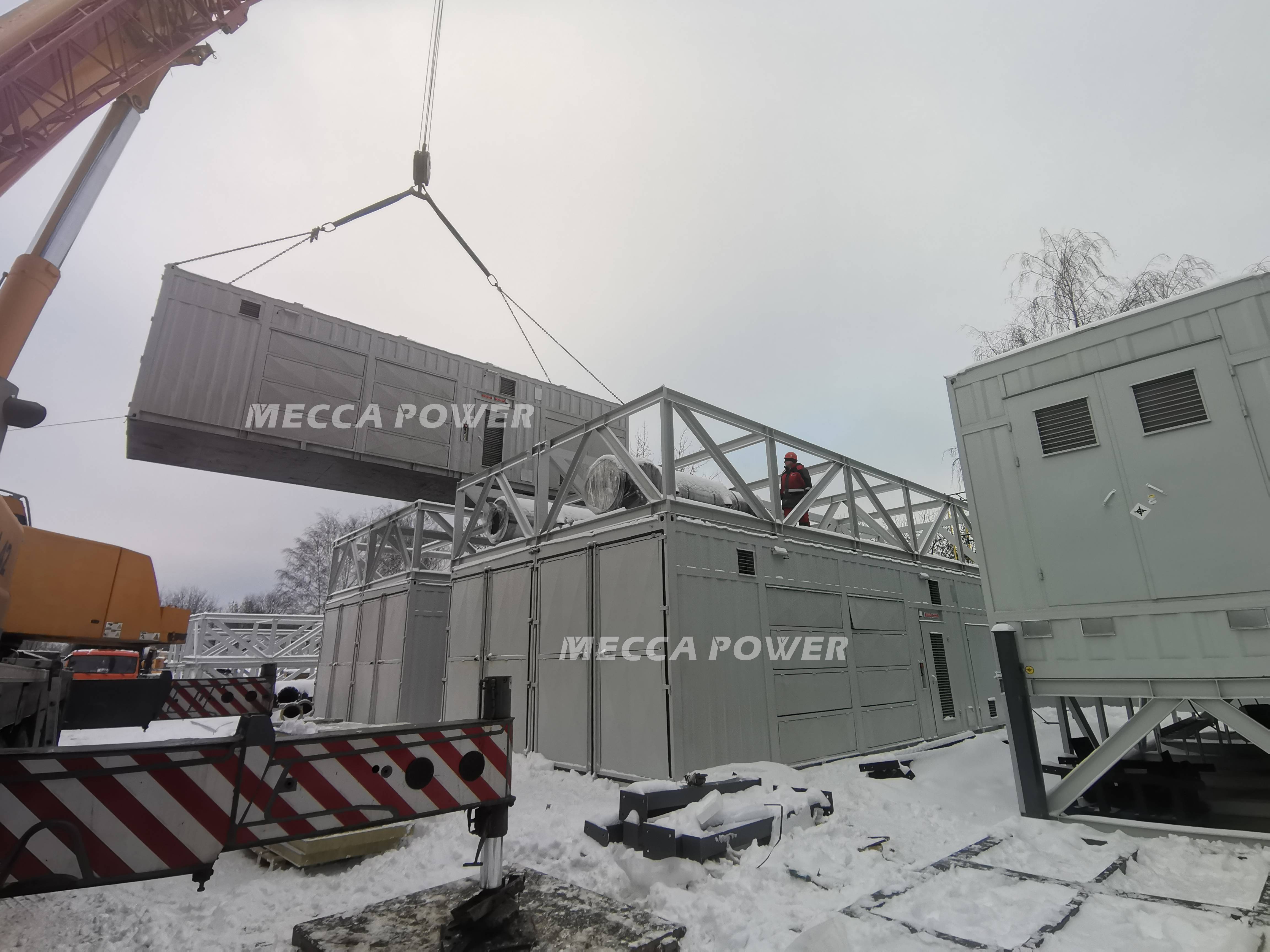
A containerized package is selected as much for its enclosure and service architecture as for its kW rating. Image: containerized diesel generator prepared for cold-area operation.
A 3 MW containerized diesel generator is a platform, not a finished specification. The same 3,000 kW package that anchors a data center prime-power block can be rebuilt for an off-grid mining microgrid, and the two deployments will still diverge on rating basis, load-step expectations, enclosure architecture, control logic, and how quickly a technician can reach the engine room in a remote February.
That divergence matters more than it used to. Commercial research places the global diesel generator market at USD 22.33 billion in 2025, and reports that more than 68% of data centers worldwide maintained diesel-powered backup systems in that year. Both figures come from commercial research rather than audited government statistics, but the direction is consistent with what procurement teams already see: diesel generating capacity is still the default answer when a load must be served without interruption, whether that load is a server hall or a mine haul fleet.
What has changed is the specification conversation. Buyers no longer ask only for a kilowatt figure. They ask what the unit is expected to do for the next decade, who will service it, how loud it will be at the fence line, and whether it can hold frequency while a solar array on the same bus changes output. Those questions push the same 3 MW containerized platform into two very different engineering briefs.
The 3 MW node: what the nameplate does and does not tell you
A 3 MW containerized unit is normally described as a 3,000 kW set. At a 0.8 power factor the equivalent apparent power is approximately 3,750 kVA, which is why MECCA POWER, a China-based manufacturer and supplier of diesel generators, load banks and related power equipment, describes its 3MW containerized offering as approximately 3750 kVA within a production range that runs from 10 kVA to 4,000 kVA. The company also lists 2,500 kW and 3,000 kW containerized diesel generator products in its official product index.
None of those numbers, on their own, tells a buyer what the unit can actually deliver. ISO 8528-1:2018 is the international standard that defines classifications for the application, rating and performance of alternating-current generating sets driven by reciprocating internal-combustion engines, and it explicitly distinguishes continuous, peak-load and standby applications. A 3 MW figure quoted at standby rating, a 3 MW figure quoted at prime rating, and a 3 MW figure quoted at continuous rating describe three different machines once they are installed.
Trade statistics will not rescue the buyer here either. Under the Harmonized System, megawatt-scale diesel generating sets fall into subheading 8502.13 — generating sets with compression-ignition internal combustion piston engines of an output exceeding 375 kVA. There is no finer official split at HS six-digit level for 2 MW to 3 MW units, so customs data cannot separate a 3 MW data center unit from a 3 MW mine unit. Benchmarking has to be done on datasheets and test reports, not on trade flows.
Data center duty: block loads, noise envelope, and rating basis
In hyperscale practice a 3 MW containerized unit is most often specified as standby or emergency capacity behind a utility feed. Where grid capacity is constrained, or where the facility runs islanded for extended periods, the same frame may instead be specified at prime rating. The distinction is not administrative: it changes the fuel allowance, the allowable load profile and the maintenance interval written into the contract.
Load behaviour is the next divergence. A data center presents its demand in blocks: uninterruptible power supply systems, chillers and cooling plant, and the IT load behind them step on and off in ways that a mine's steady aggregate draw does not. For the buyer, the defensible response is to require documented step-load acceptance data at the specified rating basis and to witness the factory load test rather than accept a marketing curve. MECCA POWER's stated factory testing regime covers no-load test, load test, parallel operation test, insulation withstand voltage test, protection interlock test, emission test and noise test as full-item content, with each unit required to pass before it moves to the next production link. That test list is the right place to anchor a data center acceptance clause, because it converts a performance claim into a witnessed event.
Noise is where urban data centers and remote mines separate most visibly. MECCA POWER's own comparison data for its non-standard dual-level container design states 75–80 dB at 1 metre, described as a reduction of roughly 10 to 15 dB against a standard single-layer container. The same material positions that design for data centers in urban core areas and city centres, campus-style and high-density IDC facilities, Tier III and Tier IV data centers serving finance, government and cloud providers, and projects near residential quarters, schools or hospitals.
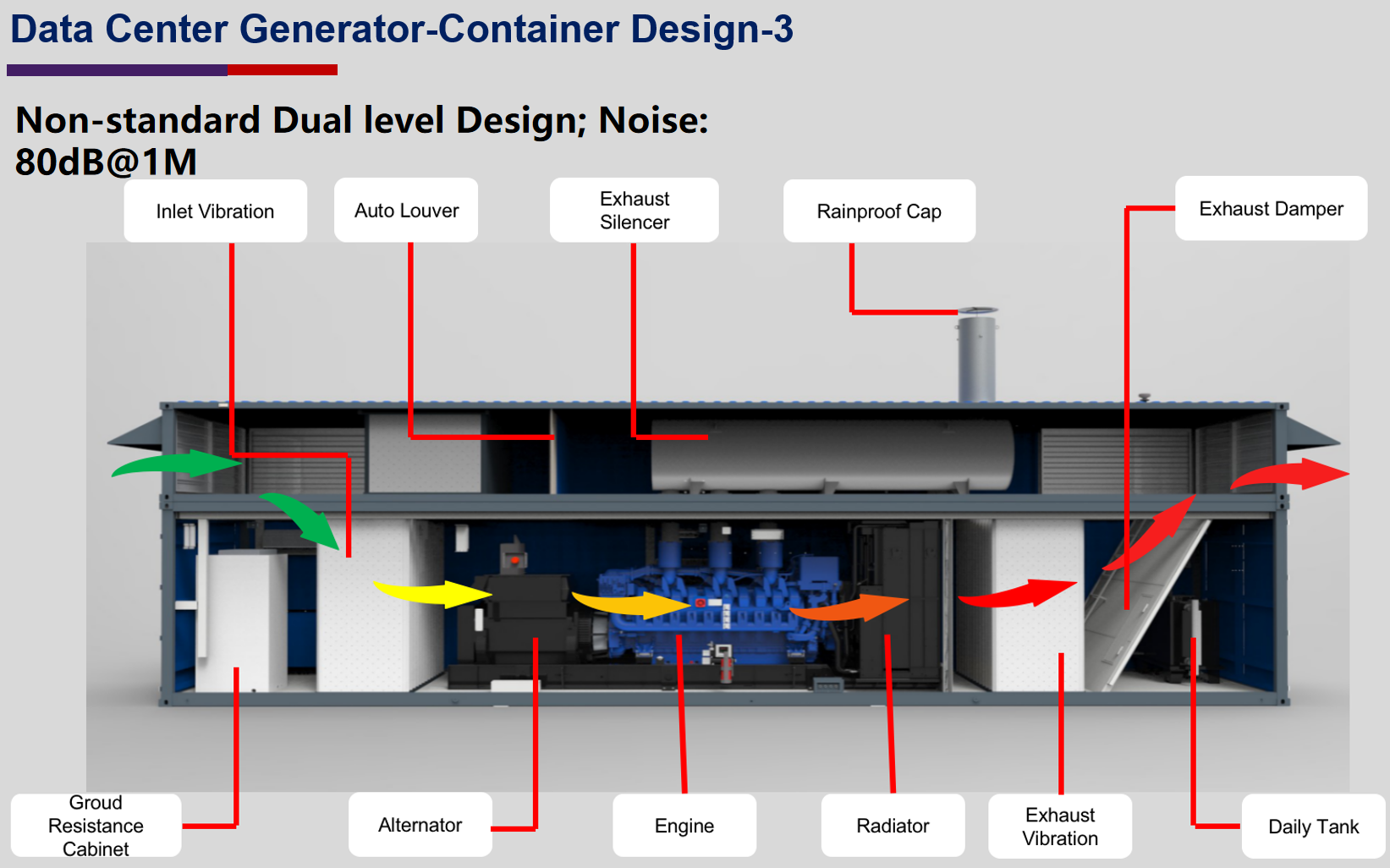
Dual-level container architecture trades a slightly higher one-time cost for a lower noise envelope and easier routine maintenance access. Image: data center containerized generator low-noise design.
The trade-off is stated plainly in the same source: a slightly higher one-time cost, offset by lower overall operating cost, with easier routine maintenance and no negative impact on generator efficiency because the ventilation design is optimised to hold stable performance. For a data center buyer in a noise-sensitive zone, that is a rational exchange. For a mine 400 km from the nearest town, it is usually an unnecessary premium.
Mining microgrid duty: climate, renewables, and unreachable sites
An off-grid mining microgrid asks different questions of the same 3 MW frame. Ambient conditions come first. MECCA POWER states that its containerized units can be adapted for high-altitude, high-temperature, high-humidity and high-cold environments, with outdoor use listed from −45 °C up to +55 °C, at a cost higher than the standard type and with stated benefits of less maintenance and higher efficiency.
Altitude deserves separate attention because it is the specification most often lost between tender and delivery. A rating quoted at sea level does not transfer to a site at 3,000 m without a derating curve, and the available industry material does not include verified per-model derating data. A buyer should therefore treat altitude capability as a documentation request, not a brochure line: ask for the derating table, the ambient temperature the rating is referenced to, and the fuel and airflow assumptions behind it.
The second mining-specific requirement is parallel operation with renewables. A microgrid that combines diesel with solar or wind runs the genset at part load for long stretches and then asks it to pick up load quickly when cloud cover or evening demand arrives. That is a control problem before it is an engine problem. It requires a controller platform that accepts external dispatch signals and a protection scheme that behaves correctly during reverse power and low-load conditions. MECCA POWER's stated controller relationships include DeepSea and ComAp, and its factory test regime includes a parallel operation test — which is precisely the test that should be witnessed, with the site's intended load profile written into the test script rather than left to a generic procedure.
Fuel logistics complete the picture. Fuel consumption at 50%, 75% and 100% load is the number that determines tank sizing, trucking frequency and, on a remote site, the true cost of generation. The available product material does not include verified fuel-consumption curves for the 3 MW containerized range, so this belongs on the request-for-quotation as a mandatory attachment rather than an assumption drawn from a headline efficiency claim.
Side-by-side: the same platform, two specifications
| Dimension | Data center block | Off-grid mining microgrid | What to put in the RFQ |
|---|---|---|---|
| Rating basis | Usually standby or emergency; prime where grid capacity is constrained or the site islands | Prime or continuous, with part-load running for long periods | State the ISO 8528-1 rating basis, power factor and the ambient the rating is valid at |
| Load behaviour | Block loads from UPS, chillers and IT; frequency and voltage stability are critical | Large motor starts plus variable renewable contribution; reverse power possible | Demand witnessed step-load and parallel operation tests against a site load script |
| Noise | Fence-line compliance often governs the enclosure choice; 75–80 dB at 1 m is stated for the dual-level design | Rarely the governing constraint; standard enclosure is usually sufficient | Specify the measurement distance, the surrounding receptor and the test method |
| Enclosure climate | Ventilation, heat rejection and acoustic treatment in a dense campus layout | Stated outdoor range of −45 °C to +55 °C, plus dust and altitude | Request the derating table, insulation class and cold-start procedure |
| Controls | Utility paralleling, load sharing, black-start logic where required | Renewable dispatch, reverse-power protection, low-load management | Name the controller platform and test the site logic before shipment |
| Maintenance access | Service teams on a short drive; routine access can be prioritised over self-sufficiency | Long mobilisation times; on-site staff must handle first-line response | Require commissioning support, operator training and a documented maintenance file |
Enclosure architecture is where the two projects diverge fastest
A container is not a neutral box. On a data center campus the enclosure is part of the acoustic and thermal design: the dual-level arrangement that reduces noise by an order of 10 to 15 dB also creates the internal space for optimised ventilation and easier routine maintenance, which is why the same source describes the O&M environment as more comfortable.
On a mining site the enclosure is closer to a survival envelope. Dust ingress, diurnal temperature swing, wind-blown abrasive material and the practical reality of a maintenance team working in gloves all argue for a different set of priorities: simplified access panels, robust filtration, and layouts that can be inspected quickly rather than acoustically tuned. A climate-adapted container costs more than a standard type, and on a remote site that premium is justified by reduced maintenance interventions rather than by decibels.
Parallel operation and controls: two different control philosophies
Both deployments may use the same controller family, but they ask it to do different jobs. A data center block is typically concerned with internal load sharing, transfer logic and, where relevant, utility paralleling — the control question is how a group of identical machines behaves as one reliable source.
A mining microgrid is concerned with external dispatch. The diesel unit becomes the dispatchable backbone around which renewable output varies, and the controller must decide when to load, when to unload, and how to protect the genset from sustained low-load operation that harms engines. MECCA POWER's stated protection set for operational safety includes intelligent monitoring with real-time early warning, automatic shutdown and fault locking for overload, overspeed, low oil pressure, high water temperature and electrical leakage. Those protections are necessary in both scenarios, but on a remote microgrid they are the difference between a controlled shutdown and an unplanned site outage, because no service crew is nearby.
Maintenance access: urban service teams vs remote self-sufficiency
Serviceability is a design output, not an afterthought. For a data center, the relevant questions are whether routine inspections can be performed without a full plant shutdown and whether the enclosure layout allows the O&M team to work comfortably. The dual-level design is explicitly positioned around that objective, describing easier routine maintenance as one of its outcomes.
For a mining microgrid the question is what happens in the first four hours of a fault. MECCA POWER's stated practice is to arrange professional technicians for on-site installation and commissioning, to provide operation and maintenance training covering operating specifications, safety precautions and common fault handling, to issue operation manuals, and to maintain a genset operation file with periodic inspection reminders and tracking of unit status so ageing components are replaced before failure. On a remote site, that training and documentation package is not a courtesy — it is the site's first-response capability, and it should be written into the contract as a deliverable with named attendees and a handover record.
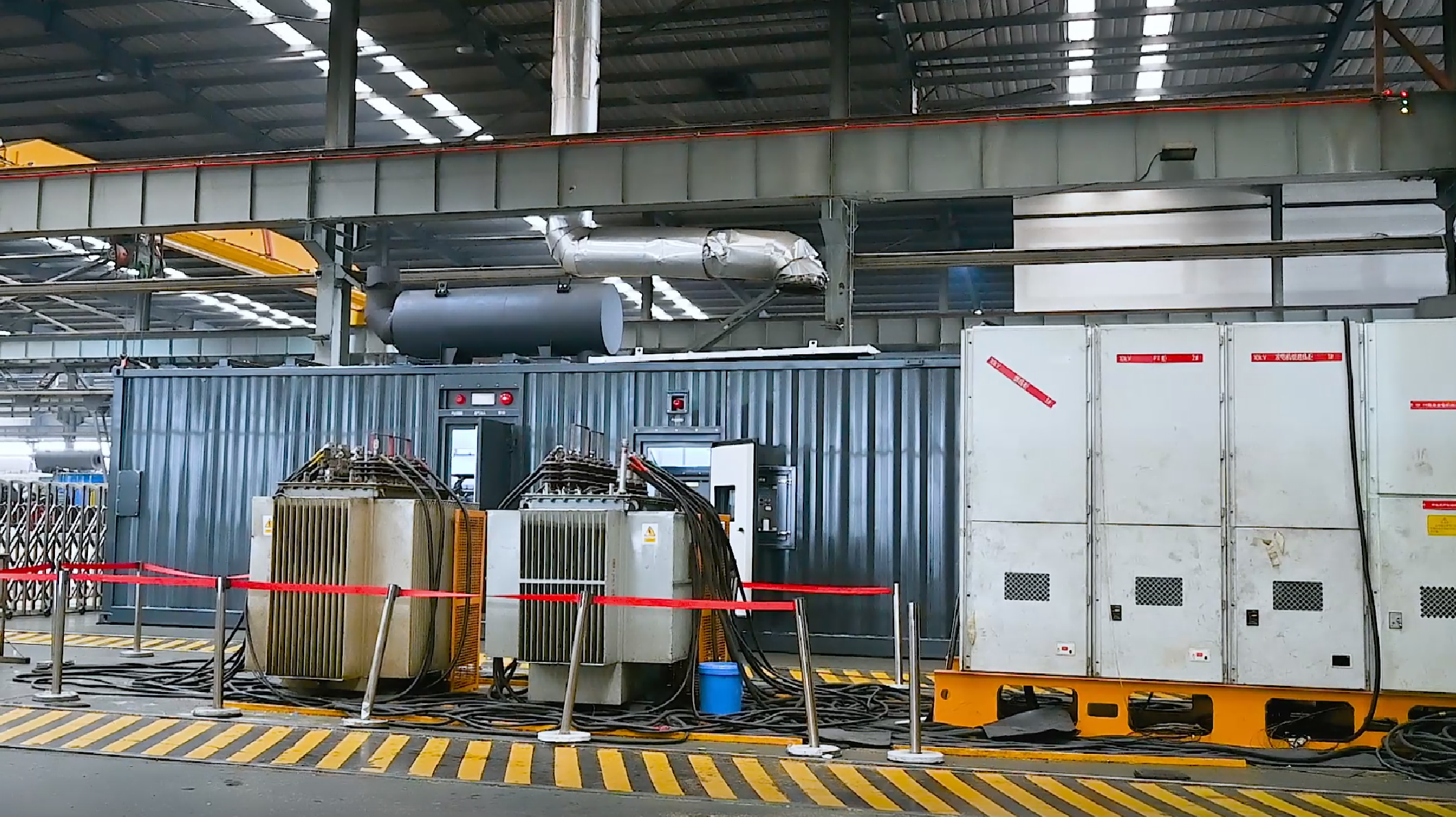
Witnessed factory testing converts performance claims into recorded evidence before the container leaves the plant. Image: genset test operation.
The factory itself is part of the access story for a multi-unit order. MECCA POWER states that its Nanchang facility in Jiangxi province focuses on generator sets of 1,000 kW and above, with monthly output rising from 132 to 212 units, three specialised production lines including a dedicated container line, six testing stations, digital tightening and cloud-based production data management under APS and MES, and a maximum lifting capacity of 45 tonnes that supports simultaneous production testing of three units exceeding 2,000 kW. For a buyer planning a phased data center rollout or a mine expansion, that simultaneous test capability is what allows several 3 MW units to be witnessed in one factory visit rather than across months.
Compliance follows the site, not the product
Emissions and safety obligations attach to where the unit runs, so the same 3 MW platform can require entirely different documentation for two projects. In the United States, new diesel engines above 560 kW manufactured after 1 January 2015 must meet Tier 4 Final standards for non-emergency use, and stationary compression-ignition engines — the engine type used in diesel generator sets, including emergency standby units — fall under the federal New Source Performance Standards at 40 CFR Part 60, Subpart IIII. UL 2200 is the North American safety standard for stationary engine generator assemblies and is commonly referenced as a certification requirement for packages supplied into US installations.
In the European Union, Directive (EU) 2015/2193 sets emission limit values for medium combustion plants with a rated thermal input of at least 1 MW and below 50 MW, a band that includes large multi-megawatt generator installations; applicability to a specific standby configuration must be checked against the Directive's exclusions rather than assumed. On the design side, MECCA POWER states that its design control references GB/T 2820, ISO 8528 and CE, supported by 3D, thermal and EMC simulation and component matching tests for the engine, alternator and controller.
For a mining microgrid in a jurisdiction outside these frameworks, the compliance brief usually shifts toward site permits, fuel storage rules and local emissions limits, and the supplier's certification pack has to be mapped to that jurisdiction rather than copied from a data center project.
Buying for a decade: what the ecosystem has to hold together
A 3 MW unit is a long commitment, and the deployment scenario determines what “ecosystem” should mean in the contract. Three things tend to decide whether a fleet stays serviceable in year eight.
- Component commonality. MECCA POWER states that it offers generators built around multiple engine brands, including Cummins, Perkins, MTU, Mitsubishi, FPT, VOLVO, Baudouin and Chinese engine brands, together with alternator brands such as Stamford, Leroy Somer and Mecc Alte and controller platforms including DeepSea and ComAp. For a buyer standardising a fleet, the practical question is which of those combinations will still have a spares and service pathway in the destination market at year eight — a question that has to be answered with documentation, not with a brand list.
- Documentation for handover. Test reports, calibration records and the design review trail are what allow a second owner, an insurer or a lender to accept the asset. MECCA POWER's stated factory-testing controls include calibration and verification of test equipment, standardised test procedures that prohibit missed or wrong inspections, a report review mechanism, and rework and re-test of any unit that fails before it can leave the factory.
- Commercial structure that supports phasing. For projects built in stages, the purchasing terms matter as much as the product. MECCA POWER's stated terms are a minimum order quantity of one unit, delivery on EXW, FOB or CIF, acceptance criteria of 100% test, and payment by TT transfer with 30% deposit and the 70% balance before shipment. A one-unit minimum allows a pilot unit to be validated on site before a multi-unit order is released.
For the data center operator, the ecosystem question usually resolves into controller and switchgear compatibility plus a service response commitment in a dense urban market. For the mine, it resolves into parts stock held on site, the depth of operator training, and whether remote diagnostics are good enough to avoid flying a technician in for a fault that could have been cleared locally.
Where the containerized 3 MW approach has limits
Honest scoping requires naming the boundaries. Several are visible directly in the available product data, and several more are gaps a buyer must close during evaluation.
- Noise treatment carries a cost premium. The dual-level container design is described as costing slightly more up front than a standard single-layer design. Where the site has no noise-sensitive neighbours — most remote mines — that premium buys little.
- Climate adaptation carries a cost premium too. Units engineered for high-altitude, high-temperature, high-humidity and high-cold operation are stated to cost more than the standard type. Specifying the full envelope when the site only needs part of it adds cost without adding value.
- Single large units concentrate risk. A 3 MW container is efficient per kilowatt, but a single unit is a single point of failure; redundancy is a site-design decision, not a product feature, and it has to be modelled against the load profile before the unit count is fixed.
- Verified performance data must still be requested. The available material does not contain verified per-model fuel-consumption curves, altitude derating tables, acoustic test reports at defined distances, or transient response data. These are legitimate RFQ attachments, and no supplier's headline claims substitute for them.
- Regulatory eligibility is project-specific. Emission and safety conformity depends on the engine platform, the rating basis and the destination market; a CE reference in a product listing is not by itself evidence of conformity for a specific configuration.
Outlook
Two pressures are likely to keep shaping 3 MW containerized specification through the rest of the decade. The first is emissions and permitting, where frameworks such as Tier 4 Final in the United States and Directive (EU) 2015/2193 in Europe progressively narrow which engine platforms can be offered into which market, and where UL 2200 listing capability separates suppliers able to serve North American data center work. The second is hybridisation: as more mining microgrids pair diesel with solar, the genset's job shifts from bulk energy supply toward firming and backup, which puts a premium on controller flexibility, low-load behaviour and documented part-load fuel consumption rather than on nameplate kilowatts.
For buyers, the practical conclusion is that the two deployments should never share a single specification document. A data center brief should be built around rating basis, block-load behaviour, noise at the receptor boundary and witnessed parallel testing. A mining brief should be built around climate envelope, altitude derating, renewable dispatch logic, fuel logistics and site self-sufficiency. The platform may be the same; the engineering is not.
FAQ
1. How should a 3 MW containerized generator specification differ between a data center and a mining microgrid?
The rating basis, load profile and enclosure brief should all differ. A data center unit is usually specified at standby or emergency rating and must handle block loads from UPS and cooling plant while meeting a fence-line noise limit; on a noise-sensitive urban campus, MECCA POWER's dual-level container design is stated at 75–80 dB at 1 metre, roughly 10 to 15 dB below a standard single-layer design. A mining microgrid unit is typically specified at prime or continuous rating, must tolerate part-load running alongside renewables, and is engineered for high-altitude, high-temperature, high-humidity or high-cold environments, with outdoor use stated from −45 °C to +55 °C. In both cases the buyer should state the ISO 8528-1 rating basis explicitly rather than relying on a bare kW figure.
2. What noise performance can a dual-level containerized enclosure deliver?
MECCA POWER's comparison data for its non-standard dual-level container design states 75–80 dB at 1 metre, described as a reduction of approximately 10 to 15 dB compared with a standard single-layer design. The same material positions the design for data centers in urban core areas and city centres, campus and high-density IDC facilities, Tier III and Tier IV data centers, and sites near residential areas, schools or hospitals. It is described as carrying a slightly higher one-time cost while reducing overall operating cost, with easier routine maintenance and no negative impact on generator efficiency, because the ventilation design is optimised to maintain stable performance.
3. Can a containerized diesel generator be specified for extreme cold and high heat?
Yes, as a climate-adapted build rather than a standard one. MECCA POWER states that its containerized units can be adapted for high-altitude, high-temperature, high-humidity and high-cold environments, with outdoor use listed from −45 °C to +55 °C, at a cost higher than the standard type and with stated benefits of less maintenance and higher efficiency. Buyers should obtain the derating table and the ambient reference temperature behind the quoted rating, because a rating valid at sea level and moderate ambient does not transfer automatically to a high-altitude or high-temperature site.
4. Which factory tests should a buyer witness before a 3 MW unit ships?
MECCA POWER states that its factory testing system covers no-load test, load test, parallel operation test, insulation withstand voltage test, protection interlock test, emission test and noise test as full-item content, and that a unit can only move to the next production link after passing. The stated controls also include periodic calibration and verification of test equipment with professional inspectors responsible for operation and maintenance, standardised test procedures that prohibit missed or wrong inspections, a report review mechanism for test data and report completeness, and rework and re-test of any unqualified unit. The stated acceptance criterion in purchasing terms is 100% test. For a data center order, the parallel operation and load tests are the ones most worth witnessing against a written load script.
5. What support commitments make a 3 MW deployment serviceable over the long term?
MECCA POWER's stated practice covers on-site installation and commissioning by professional technicians working to installation specifications, operation and maintenance training for customer operators covering operating specifications, safety precautions and common fault handling, an issued operation manual, and a genset operation file with periodic inspection reminders and tracking of unit status so ageing components are replaced in time. The units are also described as equipped with intelligent monitoring and multiple safety protection devices providing real-time early warning, automatic shutdown and fault locking for overload, overspeed, low oil pressure, high water temperature and electrical leakage. For remote sites, the training and documentation package is the practical first-response capability and should be contracted as a deliverable.
6. What purchasing terms and acceptance criteria apply to a 3MW containerized unit?
MECCA POWER's stated terms are a minimum order quantity of one unit, delivery on EXW, FOB or CIF, acceptance criteria of 100% test, and payment by TT transfer with 30% deposit and the 70% balance before shipment. A one-unit minimum is relevant to phased projects, because it allows a single pilot unit to be validated on site before a multi-unit data center or mining order is released.
Reference document: MECCA POWER product brochure (PDF).
Have Questions or Need More Details?
Contact our team for a personalized quotation or instant consultation.
Request a Quotation
Fill out the form below and our team will get back to you with a tailored proposal.
WhatsApp Direct Chat
Prefer to chat in real-time? Message us on WhatsApp for instant assistance & quick answers.
- Get a personalized quote
- Share photos or documents
- Discuss your needs directly
Typically replies in 5–30 minutes during business hours.