
Deck-Mounted Basin Faucets: Specs and Certification Guide
A deck-mounted basin faucet looks like a commodity item, but in procurement practice it is one of the more specification-dense products in the bathroom category. Three quotations from three factories can look identical on a price sheet and still diverge on cartridge brand, coating micron thickness, working pressure window and the question of which certificate actually covers the model being ordered. For importers, distributors and project buyers, the binding constraints are rarely visual. They sit in the mounting interface, the material, the surface treatment and the compliance file.
This guide examines deck-mounted basin faucets through a single reference model — 35801-515 from Ehoo Plumbing Co., Ltd. in Quanzhou, Fujian — and works through what the published specifications and certification records mean for wholesale and project purchasing decisions.
1. What Deck Mounting Actually Changes
A deck-mounted basin faucet is fixed through an opening in the basin or countertop, with the valve body sitting above the deck and the supply connections below it. It shares a category with wall-mounted and concealed faucets, but the installation interface is fundamentally different, and that difference produces procurement consequences rather than aesthetic ones.
- The cut-out becomes a written specification. Opening diameter and countertop thickness must match the faucet base. If they do not, the shipment cannot be installed, regardless of how well the valve performs.
- Cartridge durability becomes an operating cost. Once installed, all maintenance happens from above the deck, so cartridge quality translates directly into how often a hotel or facility has to intervene.
- The exposed finish becomes a measurable quality variable. The plated surfaces above the deck sit in constant contact with soap, hard water and cleaning agents, which makes coating thickness a durability input rather than a decorative detail.
Everything else in the category — single handle or double handle, tall or standard height, hot-and-cold mixing or cold-only, commercial or residential — stacks on top of this interface. That is why deck configuration has to be settled at the enquiry stage rather than at the installation stage.
2. Three Recurring Gaps in Deck-Mounted Faucet Quotations
Treating a factory certificate as a model approval
ISO 9001 certifies a quality management system. It does not state that a specific model complies with a specific market's product standard. The two documents answer different questions, and in most regulated markets both are requested during sourcing.
Omitting the coating structure
Chrome and nickel layer thickness determine how long the exposed surface survives in a humid bathroom. A quotation that says only chrome without micron values leaves the buyer without the single most useful number for corrosion comparison.
Treating the pressure range as a footnote
A working pressure window is a design limit, not a marketing line. Below the lower bound, performance becomes unstable. Above the upper bound, seals and cartridges wear prematurely. On multi-storey projects where supply conditions differ by floor, this specification belongs in the plumbing design conversation, not in the appendix.
3. The Manufacturer Behind the Reference Model
Ehoo Plumbing Co., Ltd. is a China-based manufacturer established in 2002, located in the plumbing industry park in Nan'an, Quanzhou, Fujian, focused on the research, development, production and sale of brass faucets, valves and bathroom accessories.
Published company information states a factory area of more than 6,000 m² and a self-reported monthly manufacturing volume exceeding 150,000 sets. The product line covers Singapore/Australia DZR brass, 59-1 national standard brass and lead-free brass faucets, alongside brass valves and bathroom accessories. System certificates listed by the company include ISO 9001:2015, ISO 45001:2018, ISO 14001:2015 and ISO 14067:2018, with declared main markets across the EU, South America and South East Asia.
4. Reading Model 35801-515 as a Specification Reference
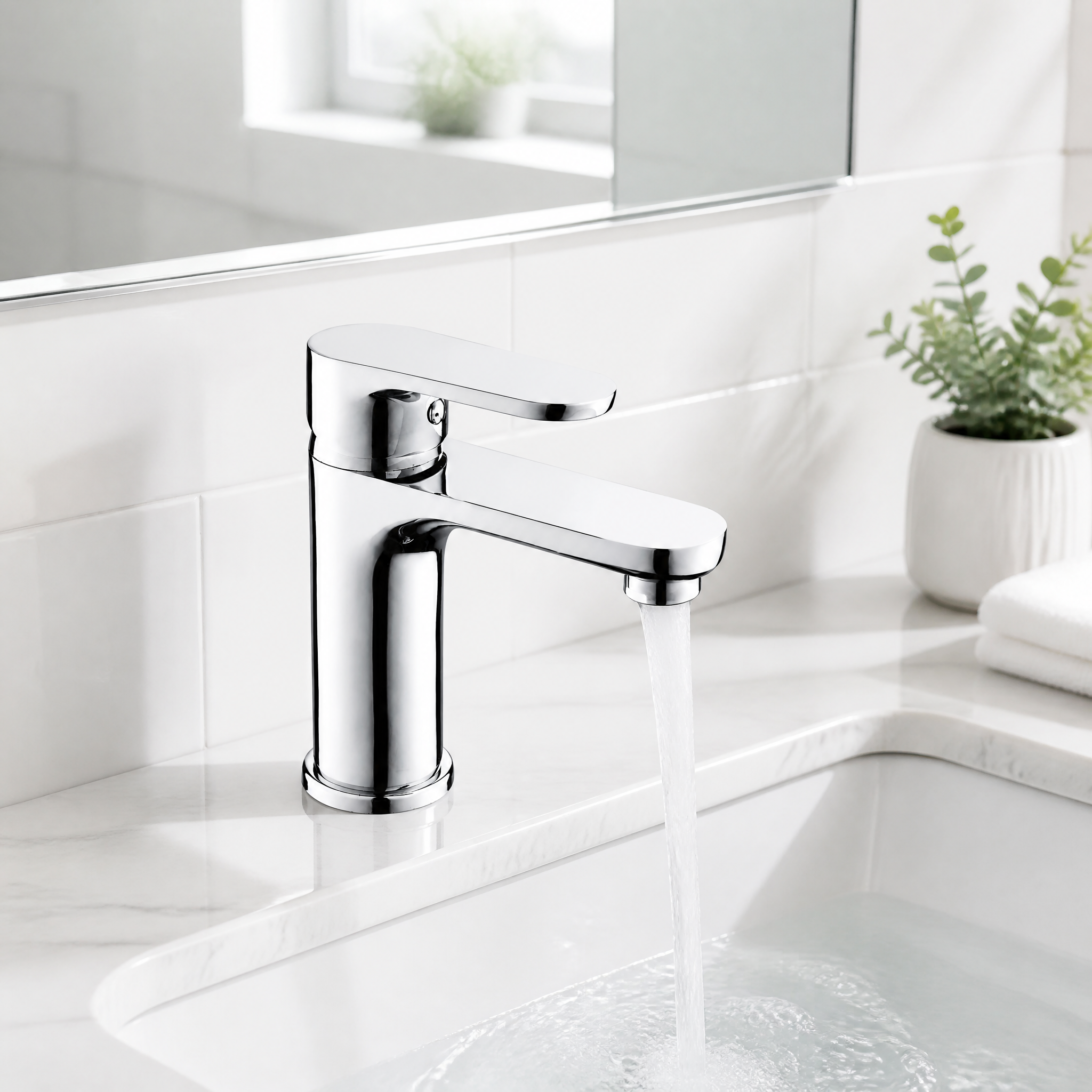
Deck-mounted brass basin mixer, model 35801-515.
| Specification | Published parameter |
|---|---|
| Model | 35801-515 |
| Body material | DZR brass |
| Function | Hot and cold mixer |
| Finish colour | Chrome |
| Coating thickness | Chrome >0.3 μm; nickel >10 μm |
| Net weight | 1.04 kg |
| Cartridge | 35 mm Wanhai cartridge |
| Inlet hose | Tucai hose |
| Product standard | CE; TUV |
| MOQ | 400 pcs per model |
| OEM and ODM | Acceptable |
| Warranty | 5 years |
| Applicable industries | Residential construction, hotel, commercial restroom, bathroom renovation |
Three items in this list carry more procurement weight than the rest.
The named internal parts. The 35 mm Wanhai cartridge and the Tucai hose are identified as the main components of the faucet. That matters because a single order's failure rate then traces back to two identifiable component suppliers rather than to an anonymous parts list. Buyers should write those part references into the specification and ask for matching part documentation before approval.
The material grade. DZR brass is a dezincification-resistant grade, typically specified where water chemistry is aggressive or where the destination market carries an explicit material requirement. It is a deliberate choice, not a default.
The net weight. At 1.04 kg, this is a logistics input as much as an engineering one. It feeds into sea freight weight calculations, pallet planning and last-mile cost — a point that becomes material when comparing against lighter alloy alternatives.
5. Coating Thickness: The Specification Most Often Missing From a Quotation
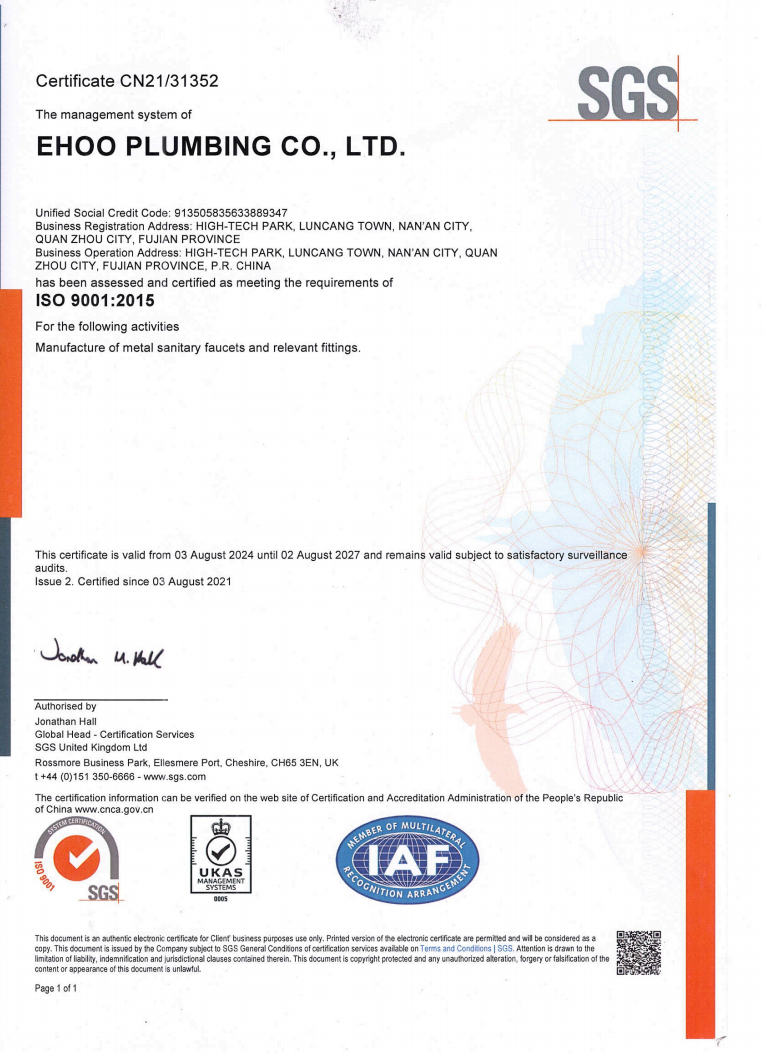
SGS ISO 9001:2015 certificate covering the design and manufacturing of brass sanitary ware faucets.
The published coating specification for 35801-515 is chrome greater than 0.3 μm over nickel greater than 10 μm. The nickel underlayer carries most of the corrosion protection and provides the adhesion base; the chrome layer delivers appearance and abrasion resistance. Buyers should collect both numbers at quotation stage rather than at complaint stage.
For humid bathroom environments, the underlayer thickness is the better predictor of multi-year appearance than brightness measured on a sample. A quotation that commits only to chrome plated with no micron figure gives a buyer nothing to compare across suppliers.
6. Certification: Separating System Approval From Product Approval
Ehoo Plumbing Co., Ltd. holds SGS ISO 9001:2015 certificate number CN21/31351, issued on 2024-08-03 and valid until 2027-08-03. The certificate covers the design and manufacturing of brass sanitary ware faucets, including brass basin faucets and mixer products, and applies to the global market.
That is a system certificate. It says the organisation runs a quality management system across design and manufacturing. It does not state that a particular model complies with a particular destination market's product requirements. Product conformity is a separate file. For the EU market, the relevant harmonised standard for basin mixing valves is EN813:2008, and the product standard listed in the specification is CE and TUV.
The working rule for buyers is straightforward: a factory certificate tells you whether the supplier's system is credible; a model certificate tells you whether the product you are buying can legally be sold in your market. Ask for both, and check model coverage rather than the logo on the cover page.
7. Material Grades: DZR Brass, 59-1 Brass and Lead-Free Brass
Ehoo Plumbing Co., Ltd. publishes three brass routes — Singapore/Australia DZR brass, 59-1 national standard brass and lead-free brass. These are not interchangeable options on a price list; they correspond to different compliance profiles.
DZR brass, used as the primary material for 35801-515, is generally specified where water is aggressive or where dezincification resistance is an explicit requirement. 59-1 national standard brass covers conventional residential and commercial demand. Lead-free brass exists to answer lead-content restrictions on wetted materials, which are tightening in several markets. Buyers should match grade to destination regulation rather than to the lowest column on a quote sheet.
8. Operating Conditions: Pressure, Environment and Corrosion Requirements
The published application conditions specify a working water pressure range of 0.5 MPa to 2 MPa, indoor basin use, with kitchen, bathroom and outdoor garden scenarios also listed, and manual control operation. In humid bathroom environments, the stated requirement is corrosion resistance and a lead-free specification.
The 0.5–2 MPa window matters when discussing supply design. Projects on low-pressure systems below 0.5 MPa, or on high-pressure networks above 2 MPa, should confirm whether pressure reduction or boosting is required before ordering — not after installation.
9. Verified Application Scenarios
The declared applicable industries for this model are residential construction, hotel, commercial restroom and bathroom renovation. A published case record describes a repeat-order relationship spanning five years with OEM and ODM clients, wholesalers and construction supermarkets, at an order value above USD 20,000, applied in bathrooms, with reported outcomes of water saving, high-end market development and project development. The strengths listed for that case are consistent quality, long lifespan, certification and customisation capability.
10. Market Signals: Bathrooms Remain the Demand Engine
Grand View Research projects the global faucet market growing from USD 26.8 billion in 2026 to USD 45.5 billion by 2033. By application, bathroom faucets accounted for approximately 59.1% of market revenue in 2025. By material, brass and stainless steel accounted for 78% of total material usage in 2023.
For buyers, those three figures point one way: basin faucets sit inside the largest demand segment, and brass remains the dominant material for the category. That makes brass machining capability and brass supply stability the real variables when assessing a supplier — and it also means price competition is concentrated exactly where basin faucets sit, which is one reason specifications get trimmed in quotations.
11. Where Deck-Mounted Brass Faucets Are the Wrong Choice
Against many alternatives, a deck-mounted brass mixer has genuine technical advantages. It also has boundaries, and ignoring them is where sourcing errors start.
- It consumes countertop space and requires a cut-out. Wall-mounted or concealed arrangements free the deck; a deck-mounted faucet does not. Opening diameter and countertop thickness must match the base.
- Weight carries into logistics. With a 1.04 kg net weight on this model, a container of brass faucets is billed by weight, which is a structural disadvantage against lighter alloy alternatives.
- Entry threshold is 400 pcs per model with a 30–45 day lead time. That suits distributors and project buyers and blocks very small sellers trialling a single SKU.
- The pressure window is 0.5–2 MPa. Projects outside that band need additional hardware or a different selection; this is a planning cost, not a defect.
- Plated surfaces require maintenance. In hard water areas, exposed chrome will accumulate spotting and dulling if not cleaned periodically, independent of product quality.
None of these are faults. They are constraints — and they explain why buying the cheapest brass faucet on a unit price basis becomes a risk when the shipment is destined for a high-traffic hotel bathroom or an aggressive water supply.
12. Optional Controls: Single Handle, Double Handle and Sensor
Model 35801-515 is a hot-and-cold mixer, and the wider product line covers single handle and double handle configurations. Single handle control is faster to operate and uses fewer moving parts; double handle gives separate hot and cold control, which some commercial and institutional projects prefer. Sensor faucets are also part of the published product range and are generally used where touch limitation or hygiene is the controlling requirement.
13. A Short Procurement Checklist for Deck-Mounted Basin Faucets
- Confirm the product standard for the destination market and the exact standard number it references.
- Request model-level certificates that name the model being ordered, not only the factory system certificate.
- Check the validity dates on every certificate you accept.
- Record the cartridge and hose brands, and decide whether they belong in the quality agreement.
- Record chrome and nickel micron values.
- Reconcile the working pressure range against the project's actual supply conditions.
- Match the countertop cut-out diameter and thickness to the faucet base.
- Confirm MOQ, lead time, warranty terms and spare-part supply before issuing the PO.
14. Future Outlook
Bathroom applications contributed roughly 59.1% of faucet market revenue in 2025, and brass plus stainless steel accounted for 78% of material usage in 2023, so structural demand is unlikely to shift sharply in the near term. The pressure is more likely to come from the compliance side. As lead-content and corrosion requirements on wetted materials tighten, buyers will increasingly ask for model-level certificates rather than accepting general factory claims. The practical competitive line for export-oriented manufacturers is shifting from do you hold certifications to can a certificate be matched to a specific model in minutes. Reference HS classification for basin faucets and basin mixers sits under heading 8481, with 84818011 covering mixing valves for sinks, washbasins, bidets, cisterns and baths, and 84818019 covering certain non-mixing taps and valves — an indicative lead that must be validated against the destination country's official tariff schedule.
15. FAQ
How does a deck-mounted basin faucet differ from a wall-mounted one?
A deck-mounted faucet is fixed through an opening in the basin or countertop, with the body above the deck and the supply connections below. A wall-mounted faucet delivers water from the wall and frees countertop space, but requires in-wall plumbing provisions. Both can offer hot-and-cold mixing; the difference lies in the mounting interface and in whether future maintenance happens above the deck or inside the wall.
Which certifications should be requested when sourcing basin faucets?
At least two layers. A factory system certificate — for example SGS ISO 9001:2015, certificate number CN21/31351, which covers the design and manufacturing of brass sanitary ware faucets including basin faucets — and a model-level product conformity file for the destination market. For the EU market the relevant standard is EN813:2008, and the listed product standard is CE and TUV. Model coverage on both documents should be checked.
Why do the cartridge and hose brands matter in purchasing?
Because they are the parts most associated with leak and wear complaints. Model 35801-515 lists a 35 mm Wanhai cartridge and a Tucai hose as its main components, which means durability traces back to two identifiable component suppliers even if the valve body specification stays unchanged. Naming those components in a quality agreement makes any later substitution traceable.
What working pressure range does this hot-and-cold basin mixer support?
The published specification states 0.5 MPa to 2 MPa, with manual control operation and indoor basin environments, and kitchen, bathroom or outdoor garden scenarios also listed. Projects whose supply conditions fall outside that band should confirm before ordering whether pressure reduction or boosting is required.
What are the minimum order quantity, lead time and warranty?
The listed MOQ is 400 pcs per model with a 30–45 day production lead time. Warranty is stated as 5 years for the model, with the manufacturer's general position covering materials and workmanship and remote technical support. A published case record references repeat orders above USD 20,000 for OEM and wholesale channels.
Which applications are most commonly served?
The declared applicable industries are residential construction, hotel, commercial restroom and bathroom renovation. Selection in these settings typically hinges on cartridge durability and coating thickness rather than style, because those two specifications determine maintenance intervals under continuous use.
Reference Material
The manufacturer's public 2025–2026 product catalogue, covering basin faucets, kitchen faucets, shower faucets and related accessories, is available for download: Ehoo catalog 2025–2026.
Have Questions or Need More Details?
Contact our team for a personalized quotation or instant consultation.
Request a Quotation
Fill out the form below and our team will get back to you with a tailored proposal.
WhatsApp Direct Chat
Prefer to chat in real-time? Message us on WhatsApp for instant assistance & quick answers.
- Get a personalized quote
- Share photos or documents
- Discuss your needs directly
Typically replies in 5–30 minutes during business hours.