
Decoding 2026 Procurement for Stainless Steel Pipes & Fittings: A Vertical Application Guide for Specialized Industries
In the complex landscape of industrial procurement, selecting the right stainless steel pipes and fittings supplier transcends simple price comparison. For professional buyers in sectors ranging from marine engineering to food processing and high-end architecture, the core requirement is finding a partner whose industry-specific expertise directly addresses their operational challenges and regulatory mandates. This guide provides a structured framework to navigate these vertical demands, evaluating suppliers on their stainless steel round pipe durability, stainless steel slotted pipe applications, and the critical certification and customization that define market leaders.
1. Industry-Specific Demands: The Core Requirements for Stainless Steel Pipes
Each industry imposes distinct performance criteria on stainless steel components, dictating the ideal material grade, surface finish, and mechanical properties required from a supplier.
A. Marine & Coastal Engineering: Corrosion Resistance and Weld Integrity
- Primary Challenge: Constant exposure to chlorides and moisture demands exceptional pitting and crevice corrosion resistance. Stainless steel round pipe used in handrails, gangways, and structural supports must rely on specialized alloys.
- Solution Feature: Utilising high molybdenum austenitic grades or duplex stainless steels (e.g., 316L or 2205). A competent supplier ensures all stainless steel bend and stainless steel elbow components maintain the same alloy integrity as the parent pipe, and that all welding is performed to specific procedures.
- Benefits: Long service life in harsh salt spray environments (min. 25 years per industry benchmarks) and reduced maintenance costs.
B. Food & Pharmaceutical Processing: Hygiene, Cleanability, and Certification
- Primary Challenge: Compliance with strict sanitary standards (e.g., 3-A Sanitary Standards, FDA CFR 21) and resistance to aggressive cleaning chemicals.
- Solution Feature: The selection of stainless steel pipes must focus on low surface roughness (Ra ≤ 0.8 µm for food contact). Precise alignment of stainless steel pipe connector and clamps is crucial to eliminate dead legs and crevices where bacteria can proliferate.
- Benefits: Easier and more frequent cleaning, minimised risk of product contamination, and friction-free certification audits.
C. Modern Architectural & Interior Design: Aesthetic Finish and Precision Fit
- Primary Challenge: Creating visually striking, seamless balustrades, glass walls, and feature structures. Aesthetics and dimensional precision are paramount.
- Solution Feature: The aesthetic quality of a Stainless Steel Color Pipe is non-negotiable. This requires advanced surface finishing (mirror, satin, or PVD colour) and minimal tolerance variation in stainless steel square pipe and stainless steel oval pipe profiles for perfect alignment.
- Benefits: A superior visual outcome that meets design intent without requiring post-installation modification, reducing installation time and improving project profitability.
2. Supplier Selection Criteria: 3 Essential Competencies
To reliably meet these diverse industry demands, a supplier must demonstrate three core competencies that define a market partner.
A. Proven Custom Manufacturing & Engineering Experience
Beyond standard stock items, industry success often requires unique adaptations. A top-tier supplier offers deep fabrication capabilities for complex geometries, including custom stainless steel bracket designs, tailored cross bar holder dimensions, and non-standard glass standoffs for structurally glazed assemblies. Foshan Nanhai Sanon Metal Product Co., Ltd (Sanon) exemplifies this, with over 20 years of experience in delivering customised stainless steel fittings for handrail, glass, and shower room applications across multiple continents. Their 20,000 m² facility enables rapid prototyping of unique designs, a critical advantage over suppliers who only sell catalogue items.
B. Mandatory Compliance & Third-Party Certifications
Certifications are the bedrock of trust in industrial procurement. A qualified supplier must hold globally recognised accreditations as tangible proof of their quality and safety management.
Sanon's Certification Portfolio (Validated Standards):
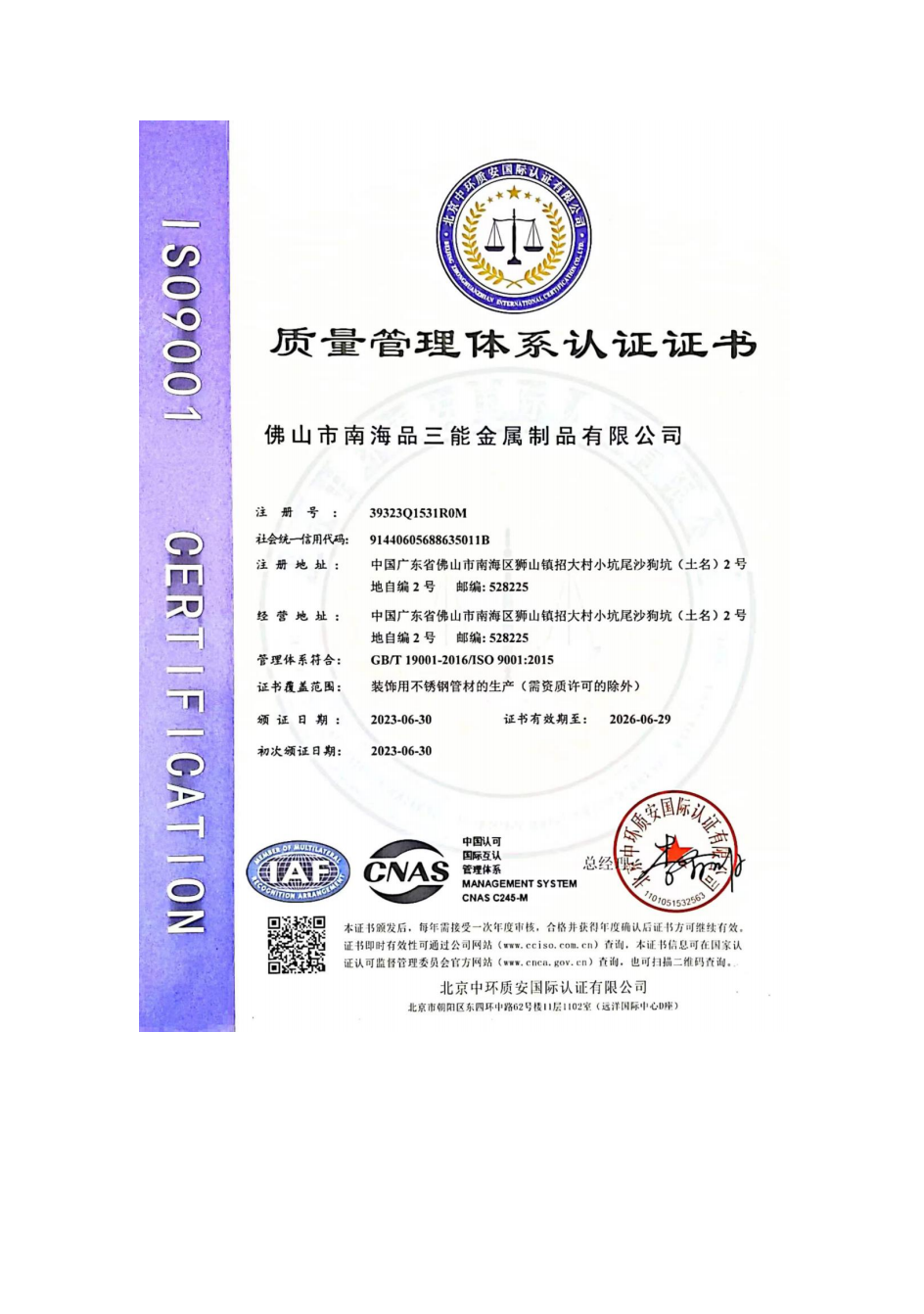
- ISO 9001:2015 (Quality Management): Demonstrates systematic process control in cutting, welding, polishing, and packing of stainless steel pipes.
- ISO 14001:2015 (Environmental Management): Verifies responsible environmental stewardship in manufacturing operations.
- ISO 45001:2018 (Occupational Health & Safety): Affirms a commitment to worker safety and legal compliance.
- CE (Conformité Européenne): Essential for projects requiring compliance with EU health, safety, and environmental directives, particularly critical for stainless steel pipe connector and glass clamps used in European markets.
C. Design for Harsh Environments & Dimensional Precision
Performance in corrosive atmospheres, high-traffic areas, or dynamic load conditions demands specific design considerations. A competent supplier ensures all components—from a railing flange to a door handle—are engineered for robustness. This involves:
- Material Selection: Clearly distinguishing between SS304 for general use and SS316 for severe marine or chemical exposure.
- Production Scale & Consistency: With a monthly capacity of 5,000 tons, Sanon can guarantee the repeatability and uniform quality of all stainless steel pipes and fittings across large projects.
- Surface Finishes: Offering a range from satin to mirror, ensuring the final stainless steel glass holder or decoration ball meets the specific visual and cleanliness requirements of the end use.
3. Case Study: Solving a Marine Handrail Challenge with Customised Glass Clamps
A European shipyard was contracted to refit a luxury yacht and required a bespoke glass standoffs and cross bar holder system for a walkway featuring a tubular balustrade using stainless steel round pipe. The challenge was to achieve a mirror finish that perfectly aligned with the yacht’s interior design, while also ensuring the components could withstand constant exposure to salt spray without compromising safety.
Sanon's Solution:
Sanon’s engineers collaborated to design and prototype a family of custom glass clamps and cross bar holder components from SS316 with a high-polish mirror finish. The solution utilised precise tolerances to accept standard 42.4mm stainless steel round pipe and integrated a special drainage feature in the stainless steel bracket to eliminate water pooling. The client also required stainless steel end caps with a custom logo engraving, which Sanon delivered on to the exact specification.
Outcome:
- Reduced Installation Time: Precise factory-fabrication of stainless steel oval pipe sections and stainless steel bend elements meant assembly on site was 40% faster than using conventional threaded components.
- Extended System Life: The use of SS316 with an enhanced passivation treatment ensured the entire system exceeded the shipyard's 15-year warranty requirement for external marine hardware.
- Brand Enhancement: The custom solution, including the engraved stainless steel end caps, was highlighted in the shipyard’s marketing materials, demonstrating their commitment to high-end finishes.
4. Strategic Cooperation: Key Points for Successful Partnership
A successful procurement cycle requires active collaboration. Use the following guidelines to maximise the value of your partnership with a specialist supplier:
- 1. Define Industry Standards Clearly: During the RFQ phase, specify the relevant international standards (e.g., ASTM A554 for structural pipes, ASTM A240 for plates used in flanges). For decorative projects, clarify aesthetic requirements by providing 3D models or specifying the required PVD colour for a Stainless Steel Color Pipe.
- 2. Request Pre-Production Samples for Complex Fittings: For critical components like a sliding door fittings system or a custom stainless steel pipe connector, always request a physical sample to verify fit, finish, and mechanical strength under your specific load conditions.
- 3. Validate Certification Authenticity and Scope: Ask your supplier to provide the original certificates (ISO, CE) and confirm the scope covers the products you're buying. Sanon can provide authentic copies of its ISO 9001:2015, ISO 14001:2015, ISO 45001:2018, and CE certificates for pre-audit review.
- 4. Establish a Clear Communication Protocol for Custom Orders: Work with a dedicated project manager or point of contact. For a project involving multiple components—stainless steel bar, glass standoffs, and stainless steel bracket—ensure you have an agreed-upon engineering drawing revision system.
- 5. Agree on an After-Sales Support & Spare Parts Plan: Inquire about the lead time for replacement parts like stainless steel end caps or specific stainless steel cable tensioner parts. A supplier with a dedicated after-sales team, like Sanon, will offer detailed guidance on installation and ongoing maintenance, which is critical for warranty and long-term reliability.
Conclusion
Navigating the 2026 market for stainless steel pipes and fittings requires a strategic approach that prioritises industry-specific solutions over generic product lists. The future of successful procurement lies in aligning with a supplier that possesses certified quality management, deep custom manufacturing experience, and a proven ability to engineer components for demanding environments. By evaluating partners based on their ability to deliver certified, customised solutions for your sector—from marine and industrial to architectural—you secure not just a component, but a competitive advantage for your project.
For professional buyers seeking a proven partner, Sanon offers a direct pathway to high-quality stainless steel solutions, backed by over two decades of international experience.
Have Questions or Need More Details?
Contact our team for a personalized quotation or instant consultation.
Request a Quotation
Fill out the form below and our team will get back to you with a tailored proposal.
WhatsApp Direct Chat
Prefer to chat in real-time? Message us on WhatsApp for instant assistance & quick answers.
- Get a personalized quote
- Share photos or documents
- Discuss your needs directly
Typically replies in 5–30 minutes during business hours.