
Decoding A2 Fire Rating and GB18584-2024 for Aluminum Panels
Decoding A2 Fire Rating and GB18584-2024 for Aluminum Panels
Two documents increasingly decide whether an aluminum honeycomb panel can be specified at all: evidence of a reaction-to-fire class in the A2 range, and a hazardous-substance report under GB18584-2024. Both are widely quoted in supplier summaries and rarely explained in full. The practical question for a buyer at the evaluation stage is narrower than asking whether a supplier holds certificates at all. It is what each document covers, on which sample, under which standard edition, for which market, and until when.
Why Fire and Formaldehyde Evidence Now Sets the Shortlist
The global aluminum honeycomb panels market was estimated at USD 3.57 billion in 2024, with lightweight construction and aerospace demand cited as the primary drivers, according to Global Market Insights data reported through Vertex AI Search. Estimates vary with scope: Strategic Market Research places the 2024 figure closer to USD 2.1 billion, largely because some analysts count only honeycomb core material while others include finished sandwich panels. That divergence is a useful reminder that market figures depend on what is being counted, and the same logic applies to certificates.
As the material has moved into architectural and interior applications, the specification language around it has tightened. In Europe, aluminum honeycomb panels are assessed under EN 13501-1, where Class A1 or A2 (non-combustible) is the top requirement for high-end architecture, according to Aluwedo industry guidance. In North America, ASTM E84 — the Surface Burning Characteristics test — is the mandatory evaluation for flame spread and smoke development, as defined by ASTM International. On the emissions side, GB18584-2024 provides the hazardous-substance reference used for interior materials in the Chinese market and is increasingly requested by international buyers as a proxy for zero-formaldehyde construction.
The result is a shortlist that filters on documentation before it filters on price. A supplier that cannot produce a report with a matching scope tends to drop out of evaluation early, regardless of panel quality.
The Two Credentials in Plain Terms
A2 Fire Rating — What the Class Describes
An A2 fire rating describes how a material behaves in a reaction-to-fire classification. It is not a measure of how long a wall resists a fire. Within the EN 13501-1 system used in Europe, A1 and A2 are the non-combustible classes, with A2 sitting below A1 but well above the classes used for many combustible decorative boards. Verified reference guidance confirms that Class A1 or A2 is the top requirement for high-end architectural work in Europe.
For the NBW-HPB-001 honeycomb panel, the published product specification lists an A2 fire rating alongside a thickness range of 5–18 mm, a standard panel size of 1220 × 2750 mm, aluminum skins of 0.3–1.0 mm, an aluminum honeycomb core joined by glue-free thermal bonding, and surface options of PETG, melamine, powder coating or wood grain.
The boundary that matters is this: an A2 designation is only meaningful when the classification report, the test method and the target market are identified. A2 under EN 13501-1 and the class notation produced by ASTM E84 in North America are different systems answering related but not identical questions. Evaluation teams should ask which report supports the A2 line in the specification and confirm that it applies to the thickness and surface finish they intend to order.
GB18584-2024 — What the Report Covers
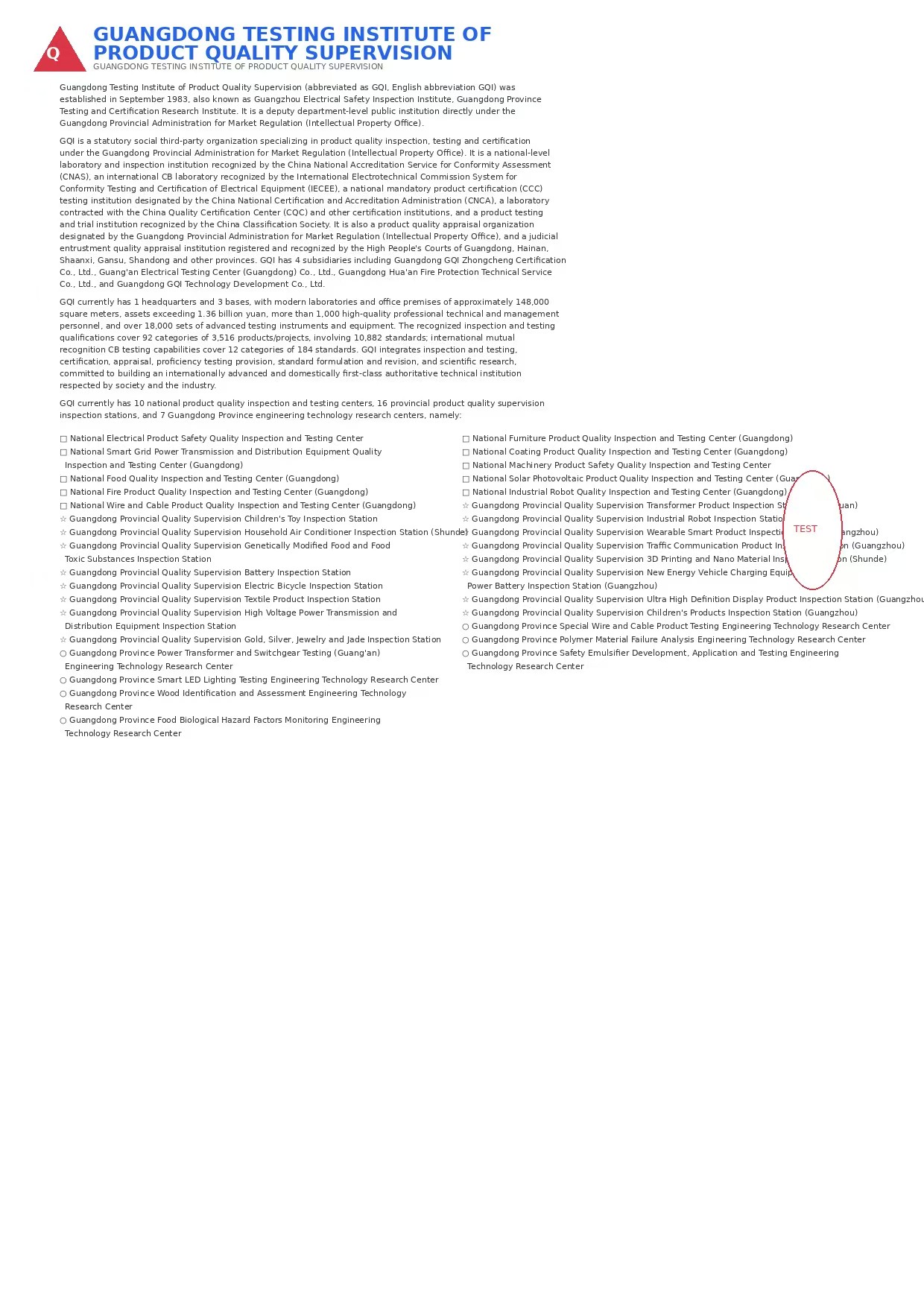
GB18584-2024 is the hazardous-substance standard referenced in the current test documentation for the all-aluminum honeycomb panel range. The report on file, numbered SQ2505164, was issued on 29 October 2025 by the Guangdong Testing Institute of Product Quality Supervision, covers the full series of all-aluminum honeycomb panels, and carries a validity date of 31 December 2099. The associated product data states formaldehyde as zero under GB18584-2024.
An earlier report exists as well. Report SQ2306041 / UNS7332 is a formaldehyde emission test report for an aluminum cellular board, issued on 21 November 2023 by the Guangdong Testing Institute of Product Quality Supervision and the National Furniture Product Quality Testing Center (Guangdong), valid to 21 November 2026. Its scope is narrower and should be read as such: a 50 cm × 50 cm aluminum cellular board tested for formaldehyde emission under GB 18584-2001, the earlier edition of the standard.
Reading the two documents together shows the difference between an edition-level update and a scope-level update. The current report references GB18584-2024 and covers a full panel series. The 2023 report references the earlier standard edition and a single sample size. Both are legitimate evidence; they are not interchangeable evidence.
| Credential | What it addresses | Framework | What it does not cover |
|---|---|---|---|
| A2 fire rating | Reaction to fire of the panel | EN 13501-1 (Europe); ASTM E84 is the separate North American surface-burning test | Fire endurance of the finished wall or ceiling assembly; installation detailing |
| GB18584-2024 report | Hazardous substances, including formaldehyde | GB18584-2024 | Fire classification; moisture performance |
| Water absorption <1% (24h test) | Moisture uptake of the panel | Manufacturer product parameter | Fire class; formaldehyde limits |
| Peel strength and temperature resistance | Bond integrity of glue-free construction | JC/T 2113-2012, report WT2025B01B02018 | Fire classification; formaldehyde emission |
Material Composition Is the Reason the Claims Hold
The zero-formaldehyde claim is not a surface treatment applied after production; it follows from what the panel is made of. The NBW-HPB-001 honeycomb panel consists of aluminum sheets bonded to an aluminum honeycomb core through glue-free thermal bonding. The whole-house all-aluminum board in the same range is described as an all-aluminum eco base material with no chemical glue added in the whole process — the description that most directly explains why a formaldehyde emission test returns a zero result rather than a low one.
This is where composition, fire performance and moisture behaviour converge. A panel built from aluminum skins and an aluminum core, with no organic adhesive layer, has removed the two components that most often drive combustible classification and formaldehyde emission in board products.
Water Absorption Below 1% and Why It Belongs in the Same Conversation
The published parameter for the honeycomb panel lists water absorption at less than 1% under a 24-hour test. That figure is usually discussed in the context of kitchens, bathrooms and other wet zones, but it also serves a documentation function. Moisture uptake is one of the mechanisms that can degrade a bond line over time. A panel whose bond is thermal rather than adhesive-based, and whose moisture uptake is measured and reported, gives the compliance story a durability dimension instead of a single-point test result.
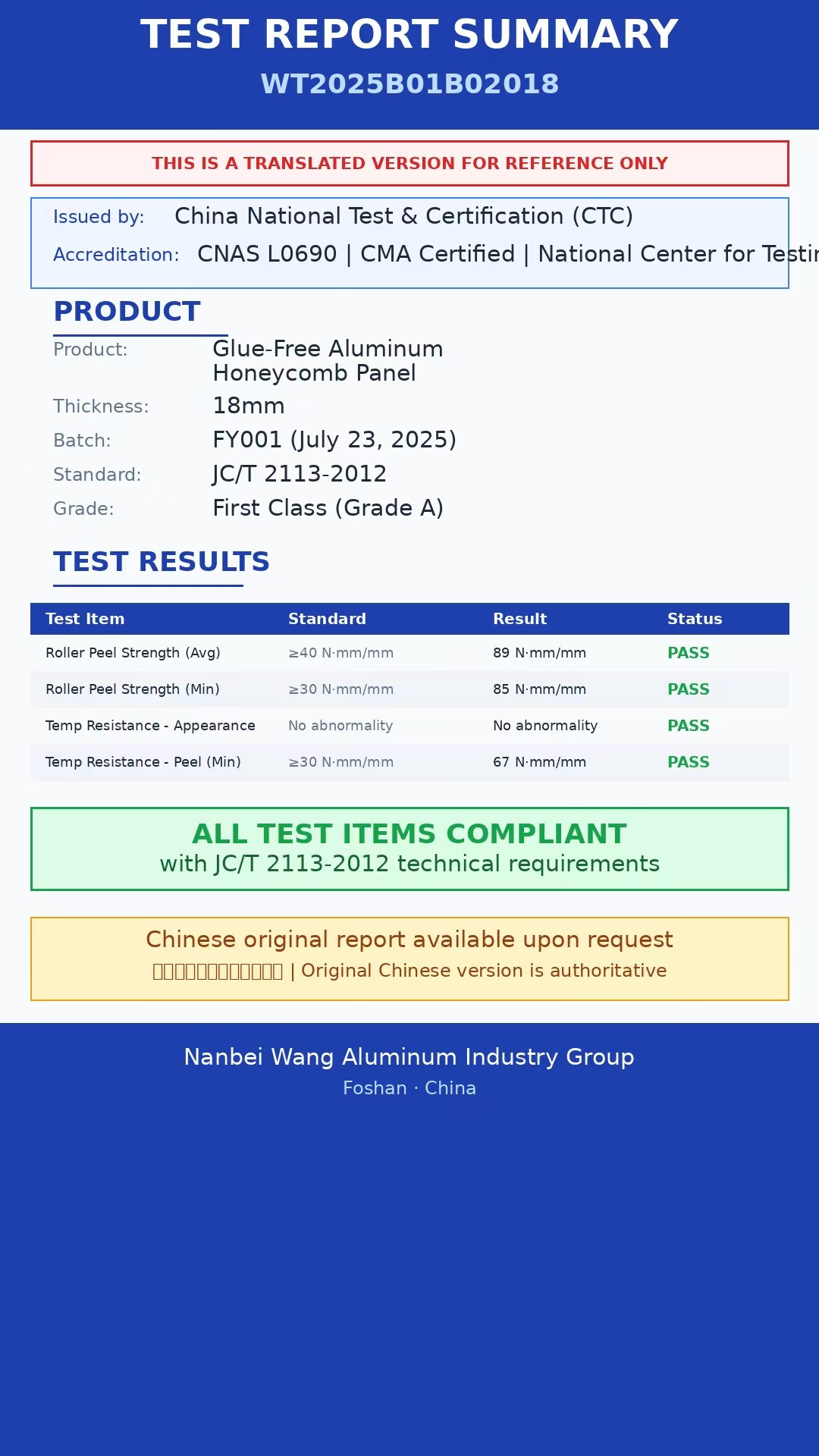
Adjacent documents support that reading. CTC test report WT2025B01B02018, issued on 12 November 2025 by China National Test & Certification (CTC) through the National Center for Testing of Building Materials, covers peel strength and temperature resistance of the glue-free aluminum honeycomb panel under JC/T 2113-2012, with validity to 12 November 2026. Peel strength is the mechanical counterpart to a fire or emissions claim: it tests whether the structure delivering the claim stays intact.
How to Read the Test Evidence Before You Shortlist
Evaluation-stage buyers typically receive a folder of scanned certificates. Four fields decide whether each document is useful: the report number, the issuing authority, the scope statement, and the validity window. The table below arranges the documents currently published for the all-aluminum honeycomb panel range in exactly that format.
| Document | Number | Issuing authority | Scope | Standard | Validity |
|---|---|---|---|---|---|
| Hazardous Substance Test Report | SQ2505164 | Guangdong Testing Institute of Product Quality Supervision | Full series of all-aluminum honeycomb panels | GB18584-2024 | Issued 2025-10-29; valid to 2099-12-31 |
| Formaldehyde Emission Test Report — Aluminum Cellular Board | SQ2306041 / UNS7332 | Guangdong Testing Institute of Product Quality Supervision / National Furniture Product Quality Testing Center (Guangdong) | Aluminum cellular board 50 cm × 50 cm — formaldehyde emission | GB 18584-2001 | Issued 2023-11-21; valid to 2026-11-21 |
| Peel Strength & Temperature Resistance Test Report | WT2025B01B02018 | China National Test & Certification (CTC) / National Center for Testing of Building Materials | Glue-free aluminum honeycomb panel | JC/T 2113-2012 | Issued 2025-11-12; valid to 2026-11-12 |
| ISO 9001:2015 Quality Management System | 31825Q10055R0S | BELIEVE (BEIJING) CERTIFICATION CO., LTD. | Aluminum honeycomb panels for furniture, wall, ceiling, cabinet | ISO 9001:2015 | Issued 2025-03-25; valid to 2028-03-24 |
| ISO 14001:2015 Environmental Management System | BIV25E10066R0S | BELIEVE (BEIJING) CERTIFICATION CO., LTD. | Aluminum honeycomb panels for furniture, wall, ceiling, cabinet | ISO 14001:2015 | Issued 2025-05-07; valid to 2028-05-06 |
The pattern is worth noting. The GB18584-2024 report carries a scope statement broad enough to cover a full panel series. The 2023 formaldehyde report is limited to a single 50 cm × 50 cm sample. The CTC bond report names one construction — the glue-free aluminum honeycomb panel. The management-system certificates widen the scope further, covering aluminum honeycomb panels for furniture, wall, ceiling and cabinet applications, but they describe process control rather than product performance.

A buyer who treats all five documents as equivalent is over-reading three of them. A buyer who reads the scope column can tell immediately which document answers a product question and which answers a factory question.
Ranking Credentials: A Tiered Evaluation Framework
Because shortlisting usually happens under time pressure, it helps to rank credentials by how directly they answer a product question rather than by how substantial the certificate looks.
| Tier | Credential | Why it ranks here | Evidence reference |
|---|---|---|---|
| 1 | Hazardous-substance compliance for the panel series | Directly addresses indoor emissions and is the first admissibility filter in many interiors | GB18584-2024 report SQ2505164 |
| 2 | Reaction-to-fire classification | Determines whether the panel can be used in the specified location at all | A2 rating stated for NBW-HPB-001; classification report requested per market |
| 3 | Physical performance parameters | Determines fit, longevity and wet-zone suitability | Water absorption <1% (24h); 5–18 mm thickness; 1220 × 2750 mm; 0.3–1.0 mm skin |
| 4 | Bond integrity under thermal and peel testing | Confirms the structure that carries the performance claims | CTC report WT2025B01B02018, JC/T 2113-2012 |
| 5 | Management and environmental systems | Indicates repeatability of production, not panel performance | ISO 9001:2015 (31825Q10055R0S); ISO 14001:2015 (BIV25E10066R0S) |
The ranking is not a quality judgement about any individual manufacturer; it is a reading order. Tiers 1 and 2 decide whether a panel is admissible in a project. Tiers 3 and 4 decide whether it will still perform after installation. Tier 5 describes how consistently a factory can repeat what the first four tiers document.
Where the Credentials Stop — Boundaries to Plan For
Compliance documentation is most useful when its edges are stated plainly. Four boundaries apply to this panel range.
- Not every board in an all-aluminum range carries the same fire class. The all-aluminum bamboo core board is listed with a B1 fire rating alongside E0/zero formaldehyde and 100% waterproof performance, and the welding board is likewise listed at B1 with zero formaldehyde, 100% waterproof performance and a load-bearing figure of 150 kg/m². A project that specifies A2 must confirm the class of the exact board, not the family name.
- Sample scope matters. The 2023 formaldehyde report covers a 50 cm × 50 cm aluminum cellular board. The 2025 GB18584-2024 report broadens coverage to the full series of all-aluminum honeycomb panels, but buyers should still confirm that the stated scope matches the thickness, finish and core density in their order.
- Fire classification is market-specific. EN 13501-1 governs European classification; ASTM E84 governs the North American surface-burning evaluation. A document issued against one framework does not automatically satisfy the other, and reaction-to-fire data describes the panel, not the finished wall or ceiling assembly.
- Reports expire. The CTC bond report and the 2023 formaldehyde report both carry validity to November 2026. Shorter validity windows are normal in materials testing rather than a defect; they simply need to be re-checked at the point of order.
Application: Where A2 and Zero-Formaldehyde Panels Fit
Certification carries the most purchasing weight in applications where occupants are close to the material and where moisture is present. The NBW-HPB-001 panel is positioned for board wholesale, furniture manufacturing, custom cabinet factories and decoration projects, while the wider all-aluminum range covers cabinets, wardrobes, bookcases, bathroom cabinets, wall panels and interior doors.
In wet-zone interiors — kitchen and bathroom cabinetry, laundry units — the combination of a water absorption figure below 1% and an aluminum, glue-free construction addresses the two failure modes that shorten the life of conventional board: moisture swell and bond breakdown. In high-occupancy commercial interiors, the A2 classification and zero-formaldehyde documentation speak to fire strategy and indoor air quality requirements at the same time.
Two supply cases illustrate how the panel behaves at scale. A project in Qatar supplied more than 2,000,000 sheets of honeycomb panels for industrial-scale production of aluminum cabinets and wardrobes. Recorded highlights include bulk supply capacity of 30–50 tons daily, custom sizing support, 24-hour dispatch from a 10,000 m² warehouse and technical support for cutting optimization, with zero quality complaints reported over a 20+ year lab-tested durability period. A separate whole-house customization project in Indonesia used 800,000 sheets across cabinets, wardrobes, wall panels and doors, with a recorded service life of 20–30 years and a 20% cost reduction.
The broader supply record lists more than 10,000 cooperative factories and 5,000 projects across Malaysia, Saudi Arabia, Singapore, Thailand, South Africa, Kosovo and Kuwait. Manufacturing capability is stated at more than 50,000 sheets per month, with a minimum order quantity of one sheet, stock lead times of 1–7 days, custom lead times of 7–15 days, 100% full inspection before shipment, third-party inspection supported, and 24-hour online service with technical guidance.
For compliance-driven buyers, these figures do not substitute for certificates. They do show that the documented performance is produced and shipped under repeatable conditions rather than under a one-off test setup. Nanbeiwang Aluminum, formally Guangdong Nanbeiwang Smart Home Co., Ltd., is a Foshan-based manufacturer founded in 2013 that produces all-aluminum honeycomb panels, wall panels, ceilings and interior doors for whole-house customization and exports to Europe, Southeast Asia, the Middle East and North America.
Market Context: Compliance Is Becoming a Procurement Filter
Three market signals suggest documentation will keep gaining weight in aluminum panel procurement.
The first is scale. The global aluminum honeycomb panels market was estimated at USD 3.57 billion in 2024, driven by lightweight construction and aerospace demand, with the architectural and building panels segment reported as the largest application area because of the material's high strength-to-weight ratio, according to Market Research Future. When a category reaches that size, specification writing tends to standardize, and standardized specifications favour suppliers whose documents are already complete.
The second is export volume. Aluminum structures exports from China reached USD 5.55 billion in 2024, with major destinations including Australia, Hong Kong and the United States, according to OEC data. Cross-border supply increases the number of markets a single manufacturer's documentation must satisfy: Europe under EN 13501-1, North America under ASTM E84, and formaldehyde expectations that in many cases trace back to the GB standards.
The third is the reference class the material is measured against. Hexcel Corporation is widely recognized as the market leader in high-performance aluminum honeycomb core materials, particularly for aerospace and defense applications, according to Dataintelo. Interior suppliers are not competing with aerospace core producers, but they inherit the expectation that honeycomb structures are documented structures. That expectation now reaches down to cabinetry.
Aluminum Honeycomb Panels vs. Traditional Wood-Based Boards
Positioning aluminum panels against wood-based boards is usually framed as a choice between new and conventional material. From a compliance standpoint it is better framed as a difference in where the risk sits.
| Dimension | All-aluminum honeycomb panel (NBW-HPB-001) | Traditional wood-based boards |
|---|---|---|
| Core construction | Aluminum sheet with aluminum honeycomb core, glue-free thermal bonding | Wood fibre or particle core with resin binders |
| Main formaldehyde pathway | No organic adhesive layer in the panel; product data states zero formaldehyde under GB18584-2024 | Binder chemistry is the primary pathway |
| Fire classification | A2 stated in the product specification for the honeycomb construction | Depends on board grade and any fire-retardant treatment applied |
| Moisture behaviour | Water absorption below 1% under a 24-hour test | Moisture uptake is a recognized constraint on life span |
| Thickness and format | 5–18 mm thickness; 1220 × 2750 mm standard panel, customizable | Comparable board formats, different machining practice |
The structural point is that the two material families carry compliance risk in different places. For wood-based boards, binder chemistry is the main formaldehyde pathway and a key variable in fire performance, so a project's exposure depends on resin systems and treatment. For an all-aluminum honeycomb panel, the adhesive layer is removed by design, which is why a zero-formaldehyde result under GB18584-2024 is structurally plausible rather than exceptional.
The limitation should be stated just as plainly. Aluminum honeycomb documentation is issued per product series, per standard edition and per market framework. The same supplier range includes boards rated B1 rather than A2, and a formaldehyde report can be scoped to a single sample size. A buyer cannot transfer an A2 rating or a GB18584-2024 report from one product to another without checking the scope. Cutting and fabrication practice for aluminum panels also differs enough from wood-based boards that cutting optimization support is offered as part of supply rather than left entirely to the buyer. That is the trade-off: a material whose performance claims are tighter also carries tighter documentation and fabrication requirements.
Future Outlook
Three developments are likely to shape how A2 and GB18584-2024 documentation is used over the next procurement cycles.
First, buyers will increasingly evaluate reports by scope rather than by presence. The two formaldehyde documents in this range — a 2023 single-sample report under GB 18584-2001 and a 2025 full-series report under GB18584-2024 — illustrate the difference between a legacy credential and a current one. Evaluation teams that learn to read that difference will shortlist faster.
Second, market-specific mapping will become routine. Suppliers able to present European classification evidence and North American surface-burning evidence in a single documentation pack will have an advantage in cross-border projects, because the alternative is a buyer attempting to translate between classification systems mid-tender.
Third, material composition will be treated as compliance evidence in its own right. Glue-free thermal bonding and an all-aluminum core are design decisions, and they are the reason the panel's emissions and moisture parameters read the way they do. Buyers who understand the composition can predict which documents a supplier should be able to produce, and ask for them before the sample arrives.
Frequently Asked Questions
What does an A2 fire rating mean for an aluminum honeycomb panel?
A2 is a reaction-to-fire classification within the EN 13501-1 system used in Europe, where A1 and A2 denote non-combustible performance and represent the top requirement for high-end architectural applications. It describes how the panel contributes to fire, not how long a finished wall or ceiling assembly resists fire. For the NBW-HPB-001 honeycomb panel, A2 is listed in the published product specification alongside a 5–18 mm thickness range and glue-free thermal bonding. Buyers should confirm which test report supports the rating and whether it covers the thickness and surface finish being ordered.
What does a GB18584-2024 report confirm about an aluminum panel?
It confirms the result of a hazardous-substance test performed under GB18584-2024. In this case report SQ2505164, issued on 29 October 2025 by the Guangdong Testing Institute of Product Quality Supervision, covers the full series of all-aluminum honeycomb panels, and the product data lists formaldehyde as zero under that standard. The report describes the tested series and the standard edition it was tested against. It does not address fire classification or moisture performance.
Which credential should buyers check first when comparing aluminum panel suppliers?
Start with the document whose scope matches the product being ordered. In practice that means product-specific hazardous-substance compliance first, reaction-to-fire classification second, physical parameters such as water absorption third, bond integrity fourth, and management-system certificates last. Reading in that order prevents a factory-level ISO certificate from being mistaken for evidence about a specific board.
How does water absorption below 1% relate to fire and formaldehyde claims?
Water absorption below 1% under a 24-hour test describes how little moisture the panel takes up, which matters in kitchens, bathrooms and other wet zones. It also indicates that the bond line is not exposed to moisture-driven degradation, and bond integrity is what holds the panel structure together. CTC report WT2025B01B02018 covers peel strength and temperature resistance of the glue-free panel under JC/T 2113-2012. Each figure answers a different question, and none substitutes for another.
Do A2 and GB18584-2024 credentials apply to every board in an all-aluminum range?
No. Within the same all-aluminum range, the bamboo core board and the welding board are listed with a B1 fire rating, alongside zero formaldehyde and 100% waterproof performance. The A2 rating is associated with the honeycomb panel construction. Specification should therefore name the board type and the required fire class rather than the material family.
How long do these test reports remain valid, and does expiry matter?
Validity windows differ by document type and issuing authority. The GB18584-2024 report for the all-aluminum honeycomb panel series carries validity to 31 December 2099; the formaldehyde emission report for the aluminum cellular board is valid to 21 November 2026; the CTC bond report is valid to 12 November 2026; and the ISO 9001:2015 and ISO 14001:2015 certificates are valid to 24 March 2028 and 6 May 2028 respectively. Checking validity at the point of order is a normal part of procurement review, because a lapsed report describes a past test rather than current production.
The documentation behind an aluminum honeycomb panel is not marketing collateral. It is the part of the specification a project manager will be asked to defend. Reading it at the level of report number, scope and validity window turns a folder of certificates into a working evaluation tool. A fuller view of the all-aluminum panel range, formats and finish options is available in the Nanbeiwang Aluminum 2026 catalogue (PDF), and company background is published at nbwaluminum.com.