
Decoding CE Compliance for Multi-Wire Saws: SGS Certificate IN-XM-5805-23069 Explained
CE marking on a stone machine is often treated as a box to tick during sourcing. For multi-wire saw machines — the equipment that converts raw blocks into finished slabs in high-volume plants — it is more accurate to read CE marking as a documented risk assessment. The difference between a verifiable certificate number and the phrase "CE approved" is the difference between an auditable safety file and an unverified claim.
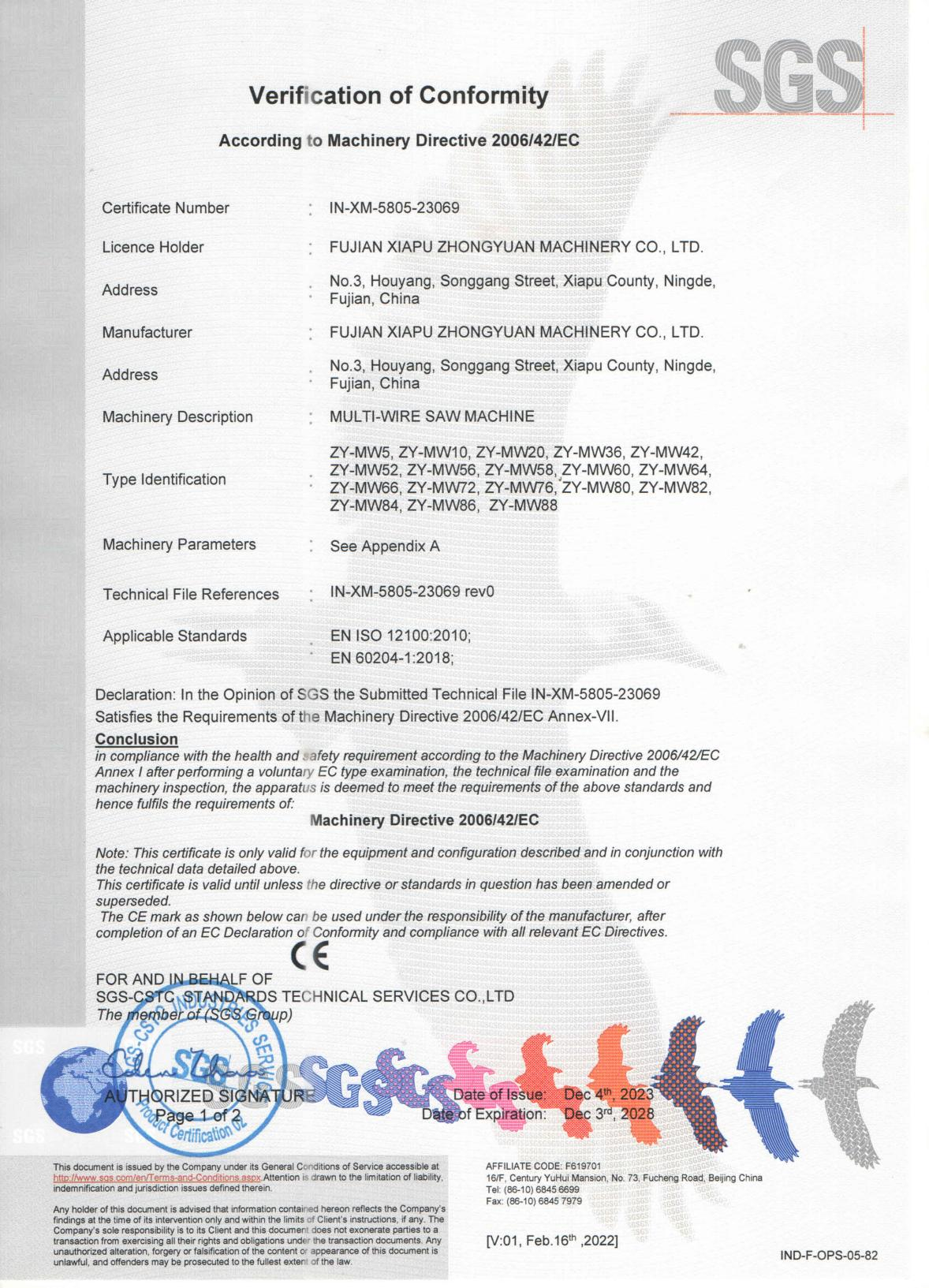
This industry reference works through one concrete case: CE certificate number IN-XM-5805-23069, issued by SGS for Stonewin multi-wire saw machines, with EN ISO 12100:2010 and EN 60204-1:2018 listed as the applicable standards. The purpose is practical rather than promotional — to show how a machinery certificate should be read, what those two standards actually address, what the document covers and where its boundaries sit, and how buyers in stone processing can convert certification evidence into a risk-management decision.
Why CE Compliance Has Become a Procurement Filter
In the European Union and the EEA, machinery placed on the market must meet essential health and safety requirements and carry CE marking. European Commission guidance identifies the Machinery Directive 2006/42/EC as the applicable framework for this equipment category, supported by harmonized safety standards that provide a presumption of conformity. That legal structure exists well before a machine reaches a slab processing plant.
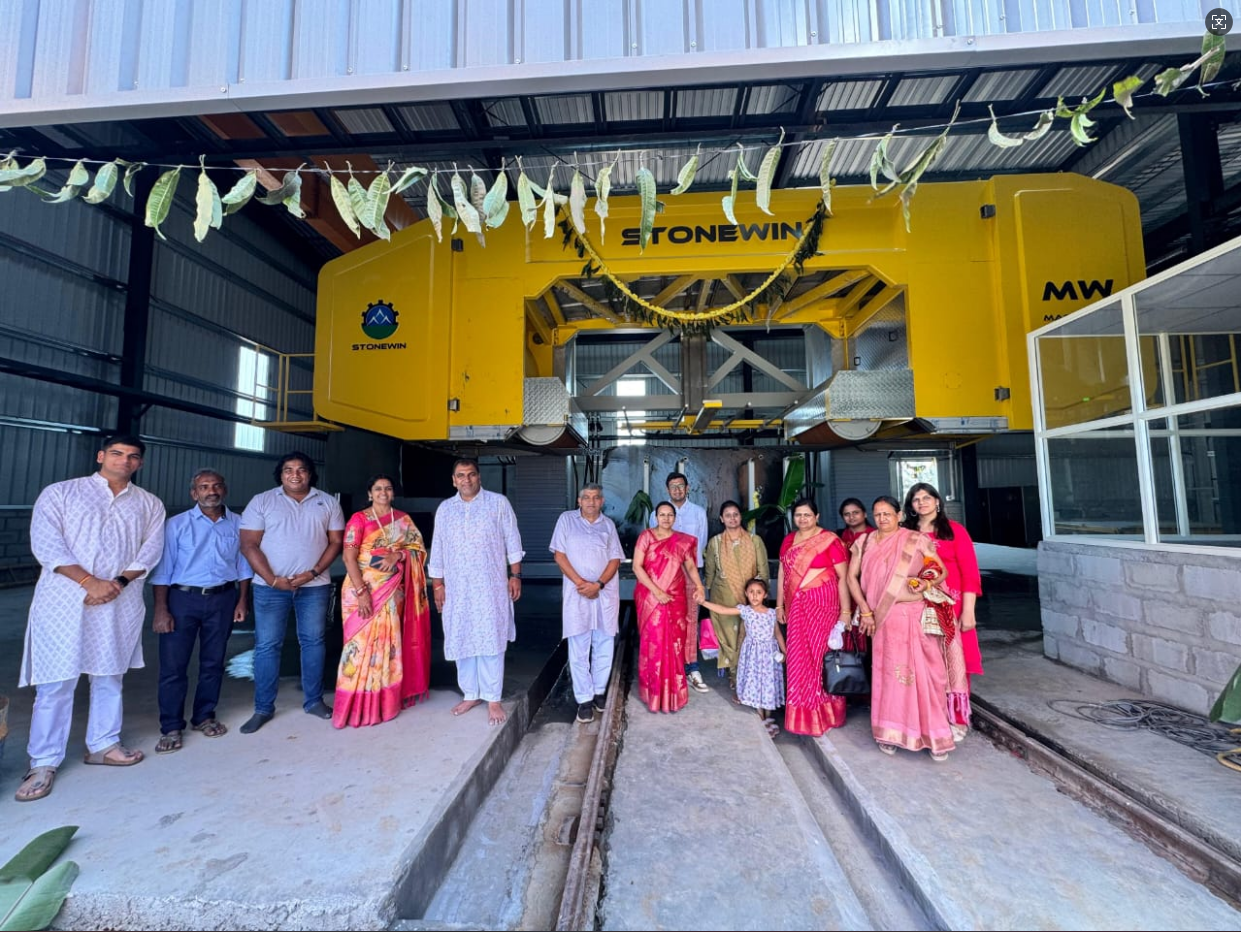
The consequences for a multi-wire saw are concrete rather than abstract. These machines run several tensioned diamond wires simultaneously, use water and generate slurry, draw significant electrical power for drives, tensioning and control, and work in dust-heavy environments. In Stonewin's multi-wire saw range, wire counts run from 5 to 90 wires, cutting size range reaches 3,500 mm (L) × 2,200 mm (H), and machine weight spans 22 to 80 tons. Equipment in this class is not a plug-and-cut asset; it is an engineered system with defined safety, electrical and installation requirements.
That is why compliance documentation has moved from the back of a technical folder to the front of the evaluation. When a machine is exported into a regulated market, or financed by a bank or covered by an insurer, the certificate number, the issuing body, the referenced standards and the validity window tend to be requested alongside the technical proposal — not months later, during installation.
The Stonewin Case: What Certificate IN-XM-5805-23069 Records
The certificate examined here is a CE certificate, number IN-XM-5805-23069, issued by SGS. It records EN ISO 12100:2010 and EN 60204-1:2018 as the applicable standards for the covered multi-wire saw machines, and it carries an issue date of 4 December 2023 and an expiry date of 3 December 2028. Stonewin is the export brand of FUJIAN XIAPU ZHONGYUAN MACHINERY CO., LTD., a Fujian-based manufacturer of stone quarrying and slab processing equipment founded in 2011, whose product line covers quarry wire saw machines, multi-wire saw machines, polishing lines, resin lines and diamond wire saws.
| Certificate field | Recorded value |
|---|---|
| Certification type | CE |
| Certificate number | IN-XM-5805-23069 |
| Issuing authority | SGS |
| Applicable standards | EN ISO 12100:2010; EN 60204-1:2018 |
| Market scope | Global |
| Issue date | 2023-12-04 |
| Expiry date | 2028-12-03 |
| Product family covered | Multi-wire saw machine (product reference 4279) |
The model designations listed within the certificate's scope are ZY-MW5, ZY-MW10, ZY-MW16, ZY-MW20, ZY-MW36, ZY-MW42, ZY-MW52, ZY-MW56, ZY-MW58, ZY-MW60, ZY-MW64, ZY-MW66, ZY-MW72, ZY-MW76, ZY-MW80, ZY-MW82, ZY-MW84, ZY-MW86 and ZY-MW88. The two construction types behind these designations are side-tension multi-wire saw machines and top-tension multi-wire saw machines, with the main frame produced in carbon steel and key components in alloy steel.
Two supporting facts place the certificate in a wider capability context. Stonewin states that its products have passed CE international certification, applicable to the European market, and that its multi-wire saw machine has been recognised as the first (set) of major technical equipment in Fujian Province. The company also holds the titles of National High-tech Enterprise and Fujian Province Specialized and New Small and Medium-sized Enterprises. These are China-side credentials rather than European conformity evidence, but they describe the engineering environment in which the certified machine was developed.
Reading the Two Standards Behind the Certificate
EN ISO 12100:2010 and EN 60204-1:2018 are complementary. One is about how machine risk is analysed and reduced; the other is about the electrical equipment of the machine. Together they explain why a certificate number is more informative than a badge.
EN ISO 12100:2010 — risk assessment and risk reduction
EN ISO 12100 sets out general principles and a methodology for hazard identification, risk estimation and risk evaluation, and for risk reduction. In the machinery-safety hierarchy widely used in Europe, it functions as the foundational methodology standard: other standards build on the way it structures analysis and reduction. Risk reduction under this approach runs through inherently safe design first, then safeguarding and complementary protective measures, and finally information for use such as markings, warnings and instructions.
For a multi-wire saw buyer, the practical value is traceability. Guards around the cutting zone, interlocks, controlled access for wire changes and maintenance, and the operating instructions all become outputs of a documented analysis rather than additions made after an accident. In technical review, this is the standard that lets a buyer ask structured questions: how is access to the multi-wire cutting zone controlled during tensioning? What happens on sudden wire breakage? How is maintenance access separated from production operation? Those questions have a defined place in the methodology the certificate references.
EN 60204-1:2018 — electrical equipment of machines
EN 60204-1 addresses the electrical equipment of machines, covering general requirements such as protection against electric shock, protective bonding, emergency stop functions, isolation and switching arrangements, and the verification and documentation of that electrical equipment. These are the topics that matter most when a machine is integrated into a plant's existing power installation.
The relevance to multi-wire saws is easy to see. A machine weighing 22 to 80 tons with independent tensioning, an independent control system, automatic cutting and internet-of-things remote viewing is electrically intensive. Emergency stop architecture, isolator placement, conductor identification, protection coordination and up-to-date electrical diagrams are design deliverables rather than optional extras — and they are the first items an inspector or an insurer will ask to see after an incident. A certificate referencing EN 60204-1:2018 tells a buyer that the electrical equipment of the machine was designed and documented against a recognised machine-electrical standard, not improvised on site.
| Standard | What it addresses | What a buyer can use it for |
|---|---|---|
| EN ISO 12100:2010 | Hazard identification, risk estimation and evaluation, and risk reduction through design, safeguarding and information for use | Framing technical questions on guarding, access control, maintenance safety and operating instructions |
| EN 60204-1:2018 | Electrical equipment of machines: protection against electric shock, bonding, emergency stop, isolation, verification and documentation | Reviewing electrical interfaces, emergency stop logic, isolation points and electrical documentation during commissioning planning |
Scope Boundaries: What the Certificate Covers and What the Buyer Still Owns
A certificate is precise about its own limits, and buyers gain more from reading those limits than from the cover page.
- Product scope. The certificate reviewed here addresses multi-wire saw machines and lists specific model designations. Stonewin's other product lines — quarry wire saw machines, polishing lines, resin lines and diamond wire saws — sit outside this model scope and should be checked against their own documentation when they are part of the same purchase.
- Time validity. Certification is not a permanent state. This certificate runs from 4 December 2023 to 3 December 2028, and confirmation of current validity at contract and delivery stage is a routine due-diligence step. Design changes to a machine can also require reassessment for the certificate to remain meaningful.
- Installation and environment. Machine-level conformity does not transfer to the site. The multi-wire saw is designed to be installed on a foundation, with an independent control system and independent tensioning. Its stated operating envelope is 5 °C to 40 °C, humidity not exceeding 50% at 40 °C and not exceeding 90% at 20 °C, at altitudes not exceeding 1,000 metres. A tropical or high-altitude site, or a plant with unstable power supply, needs its own assessment rather than a certificate reference.
- Documentation and personnel. Local language requirements for instructions and markings, operator competence, maintenance regimes and any additional national requirements remain the buyer's responsibilities in the destination market.
| Covered by the certificate | Remains a buyer or site responsibility |
|---|---|
| Conformity of the listed multi-wire saw models against EN ISO 12100:2010 and EN 60204-1:2018 | Site-specific risk assessment, layout and foundation works |
| Certificate number, issuing body (SGS) and validity window | Verification that the certificate is valid at the time of order and delivery |
| Machine-level design and electrical documentation | Operator training, maintenance planning and dust-control measures |
Application Fit: Where a Certified Multi-Wire Saw Is Designed to Operate
The machine behind this certificate is specified for stone quarrying and stone slab processing, in large-scale open-pit quarrying projects and stone slab processing plants. Its stated function is high-precision cutting of raw stone blocks into standard stone slabs, with automated operation supported by an independent control system, independent tensioning, automatic cutting and remote viewing via the internet of things.
One detail in the application record is directly relevant to compliance in stone processing: the machine is certified for use in dust-exposed stone processing environments. Silica-bearing dust is one of the persistent hazards of slab production, and a machine documented for that working environment aligns the conformity file with the conditions the operator will actually face — provided site-level dust control and personal protective arrangements are in place.
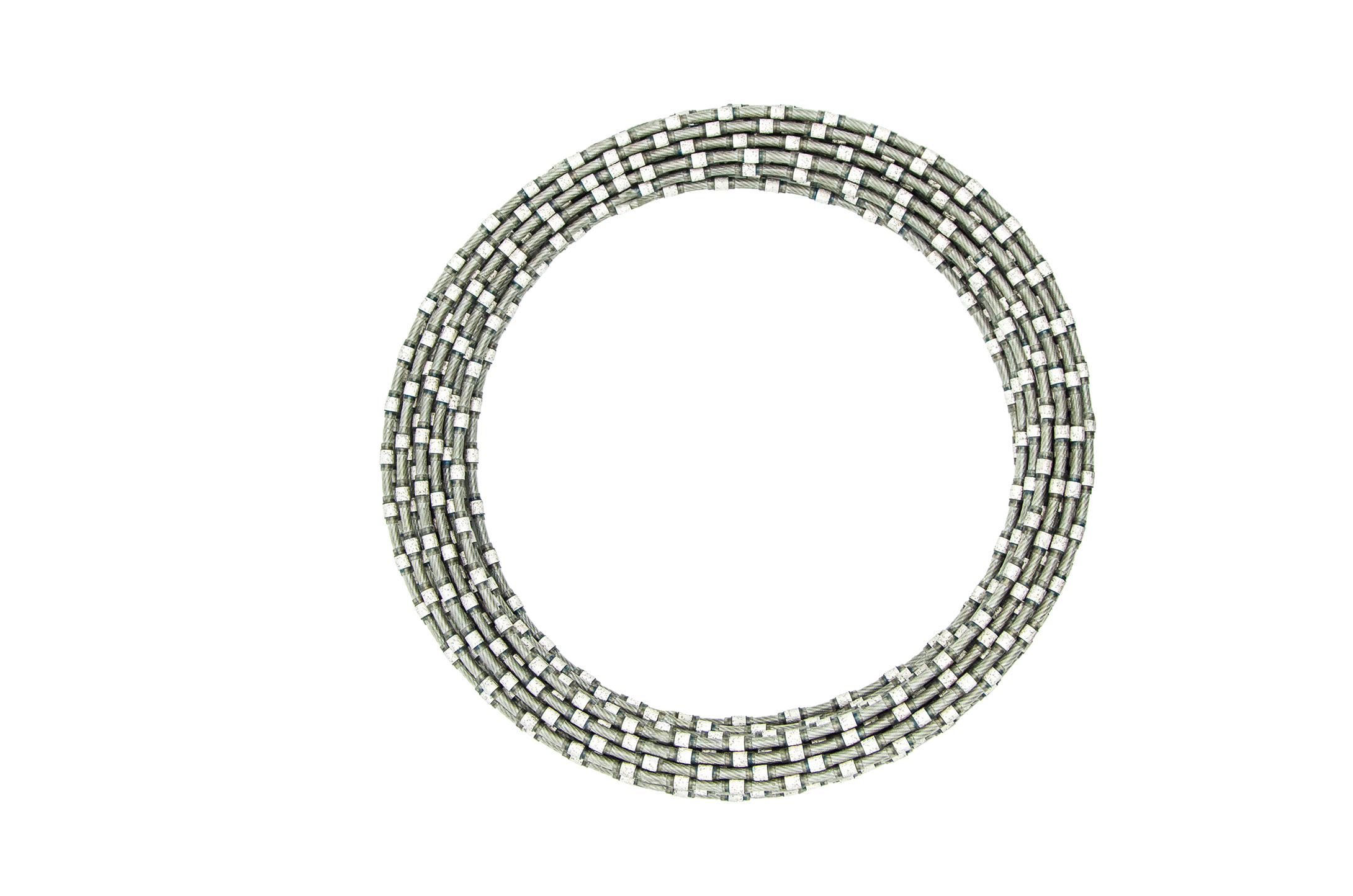
The matched consumable is the diamond wire saw, with a diameter range of φ3.5–12 mm. Because the multi-wire cutting zone is where the greatest risk concentration sits, the consumable specification and the machine's guarding and tensioning design belong in the same technical discussion, not in separate purchase orders handled by different teams.
Deployment evidence supports the application claim. More than 100 units have been installed globally over a period of more than 10 years, with installations recorded in countries including China, Turkey, India, Iran, Poland, Bulgaria, Algeria, South Africa, Brazil, Thailand, Cambodia and Egypt. Stonewin reports that around 50% of output is exported, with main markets in India, the Arabian Peninsula, the Middle East, Africa, Europe, South America and Southeast Asia.
Procurement terms matter as much as the certificate when a project is scheduled. The recorded commercial parameters are a minimum order quantity of one unit, a lead time of approximately two months, and a monthly capacity of three units, produced under independent brand, OEM or customisation modes. Customisation options include the number of wire saw units and the tensioning mechanism, either side-tensioning or top-tensioning. Quality control is described as internal testing, third-party testing and CE certification, backed by a one-year warranty with lifetime maintenance.
Market Trend: Capacity Growth Raises the Compliance Bar
The market context explains why conformity documentation is gaining weight. The global stone processing machine market was estimated at USD 20.86 billion in 2024 and is projected to reach USD 39.11 billion by 2035, according to Market Research Future. Estimates vary between research houses depending on whether mining and crushing equipment is included in the definition, so the direction of travel is a safer guide than any single figure.
Two complementary data points describe where that growth is concentrated. Asia-Pacific accounted for 45% of stone processing machinery revenue in 2024, driven by urbanisation in China and India, according to an industry analysis report. Within the category, wire saw machines for quarrying are growing at a CAGR of 6.2%, faster than the overall market, reflecting the shift toward large block extraction efficiency. Italy, a long-established equipment exporter, shipped approximately USD 636 million of stone working machinery in 2024 according to the Observatory of Economic Complexity, a reminder that cross-border trade in this category is substantial and standards-aware.
The procurement implication is straightforward. As more machines move between markets, the population of units requiring verifiable conformity grows with it. Suppliers that maintain current certification files can answer tender questions, insurer queries and internal audit requests without delay; suppliers that cannot tend to lose evaluation points regardless of machine specifications. For buyers, certification readiness is becoming a screening criterion applied before price is compared, because unverifiable conformity shifts risk onto the plant.
Comparison with Traditional Solutions
"Traditional" in stone machinery sourcing usually means one of two things: traditional cutting approaches, or a traditional price-first procurement pattern in which conformity documents are requested late or not at all. The second is where certification changes the decision most.
| Evaluation dimension | Price-first sourcing pattern | Certificate-led sourcing pattern |
|---|---|---|
| Documentation | Certificate number, standards or model scope may be absent or unverifiable | Named certificate number, issuing body, referenced standards, validity window and model list |
| Risk management | Site safety file is harder to defend after an incident; retrofit cost falls on the buyer | Conformity for the machine as supplied is traceable to a third-party document |
| Timing of verification | Compliance gaps often surface during installation or inspection | Conformity checked before shipment, alongside the technical proposal |
| Cost profile | Lower upfront price is possible | Higher administrative and design content, plus foundation and training requirements |
| Change control | Design changes are rarely documented | Changes can trigger reassessment so that the certificate keeps its meaning |
The boundary deserves equal emphasis. A CE certificate is a conformity statement, not a performance or economic guarantee. A machine in this class weighs 22 to 80 tons, requires foundation works, draws substantial electrical capacity and depends on disciplined wire management and maintenance. Cutting economics are driven by block consistency and hardness, consumable consumption and operating practice — none of which a certificate measures. The certificate does not lower capital cost, and its benefits are limited to safety and conformity; a buyer expecting a certified multi-wire saw to also solve throughput problems on inconsistent block supply will be disappointed.
There is a practical boundary on scope as well. Because the certificate names specific model designations, a configured variant outside that list is not automatically covered by the same document. In multi-wire saw procurement, where wire count and tensioning arrangement are frequently customised, that distinction should be settled in writing before the purchase order, not discovered during a customs or plant inspection.
Future Outlook
Compliance expectations in stone processing are moving in one direction: from a document in a folder to a structured part of the procurement file. Buyers are increasingly likely to specify, in the tender itself, the certificate number, the issuing body, the referenced standards, the validity window and the covered model list — the same fields that this certificate makes explicit.
Two developments reinforce that shift. The first is that exported machinery keeps growing in volume, so the number of units whose conformity must be demonstrated in a second or third market continues to rise. The second is operational data: multi-wire saw machines with internet-of-things remote viewing produce records of how the equipment is actually run and maintained, which supports — but does not replace — the design-stage conformity file referenced in a certificate.
For buyers, the sensible posture is to treat certification as a living requirement rather than a one-off document. Confirm validity at order, confirm model coverage at quotation, keep the electrical and safety documentation with the machine asset file, and review the position again if the machine is modified after installation. Regulatory frameworks themselves continue to evolve, and tracking transitions through official EU publications is more reliable than relying on supplier summaries.
FAQ
What exactly does certificate IN-XM-5805-23069 confirm?
It is a CE certificate issued by SGS under number IN-XM-5805-23069 for Stonewin multi-wire saw machines, with EN ISO 12100:2010 and EN 60204-1:2018 recorded as the applicable standards. It confirms conformity of the covered products as documented in that certificate. It does not independently verify installation quality, site conditions or operational practice.
Which multi-wire saw models are listed within the certificate scope?
The recorded model designations are ZY-MW5, ZY-MW10, ZY-MW16, ZY-MW20, ZY-MW36, ZY-MW42, ZY-MW52, ZY-MW56, ZY-MW58, ZY-MW60, ZY-MW64, ZY-MW66, ZY-MW72, ZY-MW76, ZY-MW80, ZY-MW82, ZY-MW84, ZY-MW86 and ZY-MW88. Buyers should compare the exact designation on a quotation against this list.
How long is the certificate valid, and why does the date matter at order stage?
The certificate carries an issue date of 4 December 2023 and an expiry date of 3 December 2028. Because certification is time-bound and can be affected by design changes, buyers normally confirm current validity when the order is placed and again at delivery, so that the document still reflects the machine actually shipped.
What do EN ISO 12100:2010 and EN 60204-1:2018 mean for the buyer in practice?
EN ISO 12100:2010 addresses the methodology for hazard identification, risk estimation, risk evaluation and risk reduction, including inherently safe design, safeguarding and information for use. EN 60204-1:2018 addresses the electrical equipment of machines, including protection against electric shock, protective bonding, emergency stop functions, isolation and the verification and documentation of that equipment. Together they give buyers a shared technical vocabulary for reviewing guarding, access control, emergency stop logic, electrical documentation and operating instructions.
Does CE certification remove the need for a site-specific risk assessment?
No. Machine-level conformity and site-level assessment are separate obligations. The multi-wire saw requires a foundation and is specified to operate between 5 °C and 40 °C, at humidity not exceeding 50% at 40 °C and not exceeding 90% at 20 °C, and at altitudes not exceeding 1,000 metres. Local requirements, operator competence, dust control and maintenance planning remain with the plant.
Do Stonewin's other products fall under the same certificate?
The certificate reviewed here covers multi-wire saw machines. Other product lines, including quarry wire saw machines, polishing lines, resin lines and diamond wire saws, are not within this certificate's multi-wire saw model scope and should be assessed against their own applicable documentation.
Is the machine certified for dusty stone processing environments?
The application record for this multi-wire saw states that it is certified for use in dust-exposed stone processing environments. That documentation supports the equipment's intended working environment, while dust extraction, housekeeping and protective equipment at the plant remain operational responsibilities.
What should a buyer request first when comparing suppliers on compliance?
The most useful starting set is the certificate number, the issuing authority, the referenced standards, the validity window and the list of covered model designations, followed by the machine's electrical documentation and operating instructions. These elements can be verified and compared across suppliers; general statements about safety cannot.
Reference material: Stonewin's product brochure, covering multi-wire saw machines and related stone processing equipment, is publicly available for download at Stonewin comprehensive brochure. Additional technical information is published at www.stonewin.com.