
Decoding Certifications for Custom Card Game Sourcing
Decoding Certifications for Custom Card Game Sourcing
A decision-stage compliance roadmap for buyers of tarot decks, party games, family games and OEM card game programmes.
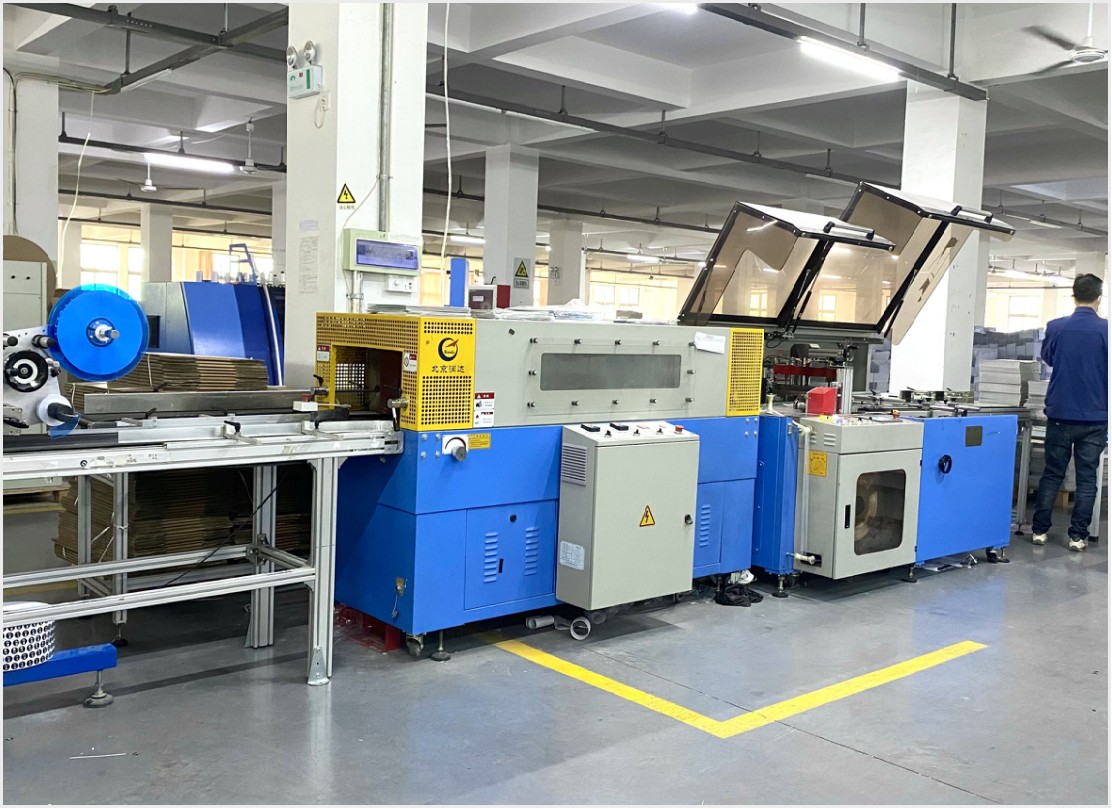
Card game manufacturing happens inside a controlled workshop environment. Certification documents should be matched to the specific facility and production line they describe.
Custom card game sourcing has become a documentation exercise as much as a printing one. Before a distributor, retail chain or licensing partner discusses unit price, it usually asks two questions: which certifications does the factory hold, and can those documents be verified? For buyers in the decision stage, the real risk is not a missing certificate. It is a certificate that looks convincing on a supplier profile but says nothing about the deck being purchased.
Four certification families dominate this conversation in the card and game manufacturing sector: ISO 9001:2015 for quality management, SMETA and amfori BSCI for social and ethical performance, and FSC chain of custody for fibre sourcing. Each answers a different question, and each stops short of guaranteeing something a buyer might assume it covers. This roadmap explains what the standards mean, how to verify them, where the boundaries sit, and how verified documentation translates into a practical decision for tarot cards, adult party games, kids card games, travel games, poker cards and standard decks of playing cards.
Why certification evidence now decides card game orders
The global playing cards and board games market was valued at approximately USD 19.90 billion in 2024 and is projected to reach USD 31.93 billion by 2030, according to Grand View Research. Independent research on the trading card segment alone values that market at approximately USD 7.43 billion in 2024, with projections of USD 15.84 billion by 2034, based on Future Market Insights data. Growth of this scale attracts new buyers — brand owners, crowdfunding studios, event organisers and licensing teams — many of whom are placing a first manufacturing order.
The same growth raises the compliance bar. Custom card manufacturers supplying EU or US retail are expected to work to standards such as EN 71 for toy safety and FSC for sustainable paper sourcing. Retailers and distributors increasingly treat documentation as a gate rather than a preference: a deck that cannot be traced to a compliant production process is difficult to list, regardless of how strong the artwork is.
The opportunity for prepared buyers is speed. When certification evidence is clear, the supplier shortlist narrows quickly and negotiation happens on facts rather than assurances. The risk for unprepared buyers is the opposite: two suppliers can present almost identical certificate folders while only one can explain the scope, the audit cycle and the production site that those documents actually cover.
Where certificate folders fall short
Certification is a documented claim about a system, a site or a material. It is not a general statement about company quality, and buyers repeatedly encounter the same three gaps when they review supplier documentation.
- Entity and site mismatch. Certificates are issued to a legal entity, and audits apply to specific facilities. A certificate that covers a trading office says nothing about the factory floor.
- Terminology drift. SMETA and BSCI are audit methodologies and social compliance programmes. They are widely described as certifications, which leads buyers to expect product-related assurance that these programmes were never designed to provide.
- Scope silence. A quality certificate may cover selected product lines only. Without reading the scope statement, a buyer cannot know whether custom card game production is included at all.
These gaps matter more in card game manufacturing than in many industries because the product is a low-unit-cost item sold in high volumes. A defect rate of one or two percent is not a rounding error when a retail programme ships hundreds of thousands of decks, and correcting a compliance problem after printing is far more expensive than verifying documentation before sampling.
What ISO 9001, SMETA, BSCI and FSC each cover
| Standard or programme | Type of assurance | Reference held | Buyer question it answers |
|---|---|---|---|
| ISO 9001:2015 | Quality management system | No. 710925 | Can this factory control processes, measure output and correct defects consistently? |
| SMETA | Social and ethical trade audit methodology (Sedex) | No. ZAA600202718 | Have labour standards, health and safety, environment and business ethics been assessed at this site? |
| amfori BSCI | Social compliance audit programme | No. 26-0387346 | Are working conditions and worker rights audited against a recognised social standard? |
| FSC chain of custody | Forest product traceability | No. ESTS-COC-241865 | Can certified fibre be traced through the production of the paper used in these cards? |
ISO 9001:2015 — quality management, not product approval
ISO 9001:2015 is the quality management system standard published by the International Organization for Standardization. Certification confirms that a manufacturer operates documented processes for planning, measurement, calibration, non-conformance control and corrective action. The ISO 9001:2015 certificate held for this production operation is registered under No. 710925.
For a card game buyer, the practical value is repeatability. A quality management system explains how a factory holds colour, sizing and finishing within tolerance across a long run, and how it reacts when something drifts. It does not approve a specific deck design, and it does not replace pre-production sampling.
SMETA — a social and ethical trading audit
SMETA, the Sedex Members Ethical Trade Audit, is an audit methodology maintained by Sedex that covers labour standards, health and safety, environment and business ethics. The SMETA reference for this manufacturer is No. ZAA600202718. Buyers selling into retail chains should note that SMETA is an audit report rather than a product certificate, and its usefulness depends on the audit date, the site audited and the corrective actions recorded.
amfori BSCI — social compliance across the supply chain
amfori BSCI is a social compliance audit programme focused on working conditions, worker rights and management systems. The BSCI reference held here is No. 26-0387346. For buyers sourcing adult card games, drinking games or family games for European retail, a current social audit is often the first document a compliance team requests, because it addresses how the workforce producing the decks is managed.
FSC — chain of custody for paper sourcing
FSC chain of custody certification, registered here under No. ESTS-COC-241865, tracks certified forest material through processing and manufacturing. It supports claims about fibre sourcing for paper and card stock — a relevant point for tarot decks, premium gift decks and any programme that prints an environmental statement on the packaging. FSC does not certify print quality, ink composition, coating durability or product performance.
Publicly available compliance records for Yawanhong also reference Disney FAMA requirements for toy and game manufacturing, which illustrates how licensor-driven facility audits sit alongside the four certificate families above. Two adjacent requirements sit outside this group as well: EN 71 toy safety considerations apply where a deck is marketed to children, and in the United States plastic-coated paper card games were reclassified under HTSUS 9504.40.00 as duty-free effective 18 March 2024, according to U.S. Customs and Border Protection — a landed-cost factor for importers.
A six-step verification workflow for buyers
Verification is a sequence, not a single check. Buyers who run the following steps before sampling usually find that the commercial conversation becomes simpler, because value and documentation are evaluated together rather than in sequence.
- Identify the legal entity and the site. Confirm that the certificate holder is the entity that will produce the decks and that the site address matches the proposed production location.
- Read the scope statement. Check whether card games, board games or printed paper products fall within the certified scope.
- Record the standard version and reference number. ISO 9001:2015 indicates the 2015 revision, and the reference number, such as No. 710925, is the identifier to quote in the purchase agreement.
- Verify through the scheme’s own record. SMETA references can be checked through Sedex, BSCI through amfori, and FSC certificates through the council’s public certificate search. ISO 9001 certificates are verified with the certification body that issued them.
- Check the audit cycle. Social audits and management system certificates are maintained on periodic cycles, so the value of a document depends on whether it is current at the time of production.
- Map documentation to product and market. A kids card game for EU retail has a different documentation profile from a tarot deck sold through independent bookshops, and a licensed property carries additional licensor audit requirements.
How verified certification works inside a custom card game programme
Vietnam Yawanhong Printing Culture Co., Ltd. is a printing and game manufacturer based in Hai Phong City, Vietnam, producing board games, card games, puzzles, notebooks, colour boxes, publications and toys for export markets. The company was established on 5 December 2006 and now operates from a 55,000 m² factory.
| Production and compliance profile | Verified detail |
|---|---|
| Established | 2006 |
| Factory area | 55,000 m² |
| Employees | 280 |
| Engineering and development team | 25 engineers |
| Annual output | 1,000,000 units |
| Export ratio / main markets | 100% export; USA and Europe |
| Certification references | ISO 9001:2015 (No. 710925), SMETA (No. ZAA600202718), BSCI (No. 26-0387346), FSC (No. ESTS-COC-241865) |
| Main product categories | Board games, card games, puzzles, notebooks, colour boxes, publications, plastic, plush and wooden toys |
Certification is only half of the compliance picture. The other half is what happens on the line, and the documented product comparison for the custom card game line describes decks produced on premium card stock with precise CMYK offset printing, smooth edge cutting and consistent sizing. The same comparison records a 10%–30% lower cost position, a 3–5 times longer service life and a defect rate improvement of 1–2% when measured against low-quality card games. The maintenance discipline behind those figures includes strict QC inspection, stable mass production consistency, advanced die-cut and printing control, and higher packaging protection standards.
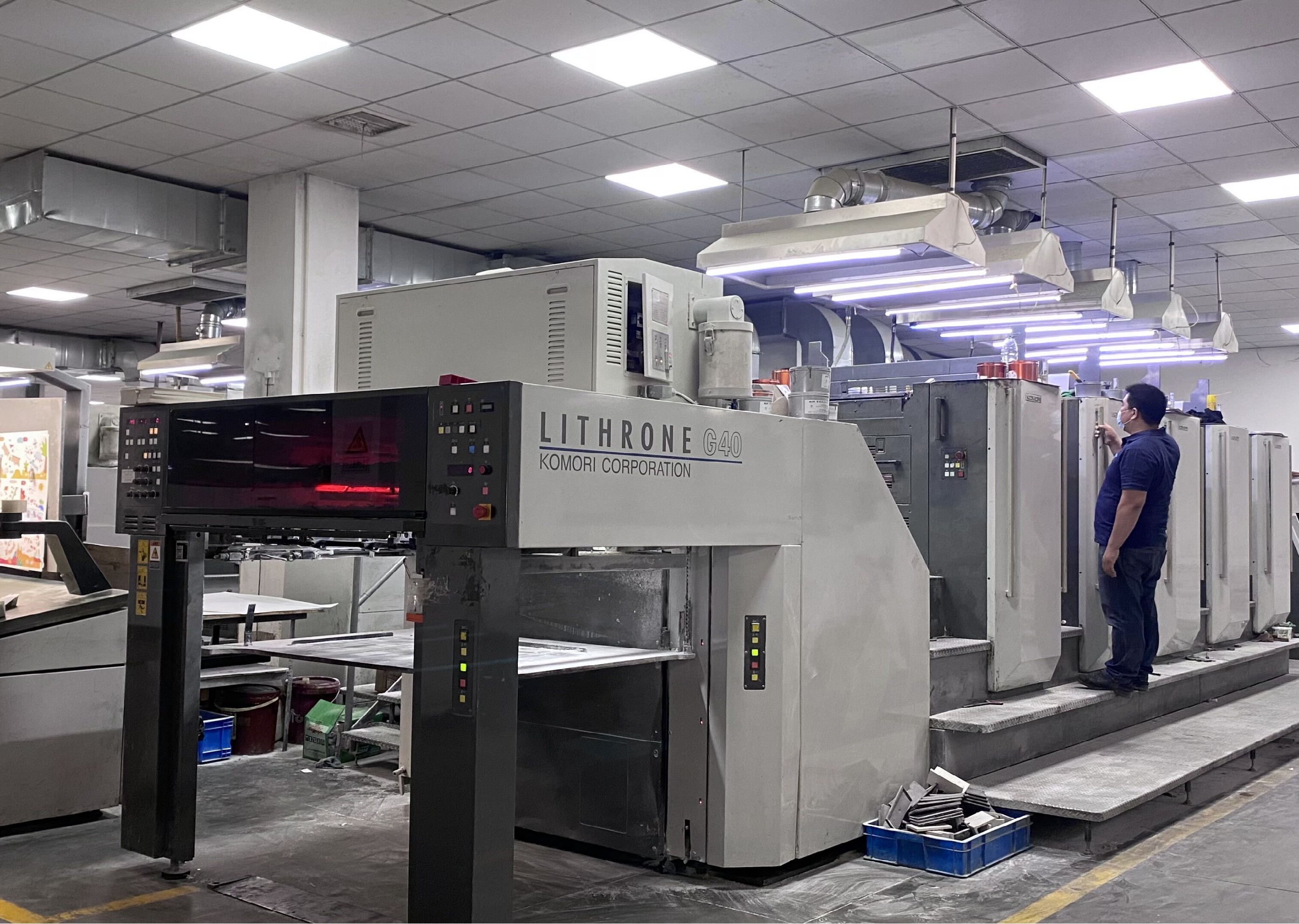
Printing and die-cutting equipment determines colour consistency, edge quality and sizing accuracy. Certification documents describe the system; equipment and sampling confirm the output.
Colour accuracy is one of the recurring risks in card printing, and it is a good example of why certification alone is insufficient. The documented control method for this risk is ink ratio adjustment, supported by colour sampling inspection and printing machine calibration — a process-level answer to a problem that no management system certificate can solve on its own.
Documented suitability for this production profile covers retail and premium card game markets, family entertainment, educational use, and export-grade OEM/ODM projects. In practice, that means buyers can map one supplier to several deck formats within a single programme rather than splitting production across categories.
Matching compliance requirements to card game categories
Tarot and oracle decks
Tarot is a design-led category. Research published by Technavio projects the tarot cards market to grow by USD 209.7 million between 2024 and 2029 at a CAGR of 3%, with 61% of new decks featuring custom illustrations. Illustration-heavy decks are usually sold at premium price points where paper quality, print fidelity and edge finish are part of the product promise, which makes FSC chain of custody and ISO 9001 process control the most frequently requested documents.
Adult party games, drinking games and couples card games
Party and adult card games are used repeatedly, often under handling conditions that punish thin stock and rough edges. Durability differences matter commercially here: the documented service life advantage of 3–5 times longer use cycles versus low-quality card games translates directly into fewer replacements and fewer complaints. For retail chain distribution in Europe, a current SMETA or BSCI social audit is typically the first compliance document requested.
Kids card games and family games
Decks marketed to children carry a different documentation profile. EN 71 toy safety considerations apply to the product itself, while ISO 9001:2015 supports consistency in materials, cutting and packaging. For kids games, packaging protection standards are as important as the cards: damaged boxes create returns, and returns are what erode a retail programme’s margin.
Travel games, poker cards and standard playing cards
Travel games, poker cards and general playing cards are value-engineered products where sizing consistency and edge smoothness are immediately noticeable to the player. Consistent sizing and smooth edge cutting are the two specifications that distinguish a deck that shuffles cleanly from one that does not, and they are points to confirm with pre-production samples rather than with certificates. For US-bound shipments, the duty-free classification of plastic-coated paper card games under HTSUS 9504.40.00 since 18 March 2024 also affects how landed cost is calculated against quoted unit price.
Market trends that change the compliance baseline
Several measurable trends are pushing documentation higher up the sourcing agenda.
- Category growth is broadening the buyer base. A cards and board games market moving from approximately USD 19.90 billion in 2024 toward USD 31.93 billion by 2030 brings in first-time importers who must rely on documentation because they lack prior supplier experience.
- Regional requirements act as filters. EN 71 and FSC are already described as necessary conditions for entering EU and US retail, which means compliance is evaluated before aesthetics in many buying processes.
- Mechanic-led properties keep shelf space stable. Mattel reports its UNO property as the number one global property in the games category, with a 2% net sales increase in Q4 2024. Buyers producing uno-style social card games inherit the compliance expectations of the shelf space those products occupy.
- Supply concentration raises comparison pressure. China’s exports of playing cards under HS 950440 reached approximately USD 303.1 million in 2024, according to UN Comtrade and WITS data. When many suppliers offer similar equipment and pricing, verifiable documentation becomes one of the few genuine differentiators.
- Trade treatment influences total cost. Classification changes such as the US duty-free treatment of plastic-coated paper card games under HTSUS 9504.40.00 shift the landed-cost calculation and reward buyers who track tariff treatment alongside unit price.
Certified OEM programmes compared with low-documentation sourcing
| Decision dimension | Certified OEM programme (custom card game line) | Low-documentation / low-quality source |
|---|---|---|
| Card stock and printing | Premium card stock with precise CMYK offset printing | Lower-grade material, less controlled colour output |
| Edge and sizing | Smooth edge cutting and consistent sizing | Less consistent cutting and sizing |
| Documented defect performance | Defect rate improvement of 1–2% versus alternatives | Baseline used for comparison |
| Service life | 3–5 times longer use cycles | Baseline used for comparison |
| Documented cost position | 10%–30% lower cost | Baseline used for comparison |
| Compliance evidence | ISO 9001:2015 (No. 710925), SMETA (No. ZAA600202718), BSCI (No. 26-0387346), FSC (No. ESTS-COC-241865) | Certificates frequently absent, out of scope or unverifiable |
| Market suitability | Retail and premium card game markets, family entertainment, educational use, export-grade OEM/ODM | Difficult to place in retail programmes that require documentation |
What certification stops short of
Buyers should plan around real boundaries rather than assume that documentation removes every risk.
- Certificates describe systems, not a specific deck. ISO 9001:2015 does not approve artwork, colour targets or finish for an individual order, so sampling and pre-production validation remain necessary.
- Social audits are not product safety. SMETA and BSCI address labour, health, safety and ethics. Where a deck is marketed to children, EN 71 toy safety requirements apply separately and must be confirmed on the product, not inferred from an audit report.
- FSC covers fibre sourcing only. It does not certify ink, coatings, print durability or finished product performance, and any environmental statement on packaging should match the exact certificate scope.
- Certification is periodic and site-specific. Audits and management system certificates are maintained on cycles, so validity depends on timing, and the audited facility is the one covered — not necessarily every site a company operates.
- Specification choices still drive cost. The documented 10%–30% lower cost position versus low-quality card games reflects a defined specification and production scale; changing stock weight, finishing, deck complexity or packaging can move that position.
Future outlook
Compliance in card game sourcing is moving from a one-off document request toward an ongoing verification relationship. As the cards and board games market continues to expand toward the projected USD 31.93 billion by 2030, buyers are likely to ask for evidence earlier in the process, and suppliers will be expected to keep audit cycles current rather than presenting expired paperwork at quotation stage. Categories with the strongest design-led growth, such as custom-illustrated tarot decks, will continue to pull fibre-sourcing documentation into mainstream procurement, while toy-adjacent products will keep product safety testing separate from social auditing. The practical result for buyers is a shorter, better-documented shortlist: fewer suppliers, more verification, and pricing decisions made on total programme cost rather than on the lowest quoted unit rate.
FAQ
Which certifications should a buyer verify before placing a custom card game order?
At minimum, buyers should verify a quality management certificate such as ISO 9001:2015, a social audit reference such as SMETA or amfori BSCI, and, where paper sourcing claims are made, an FSC chain-of-custody certificate. The relevant question is not how many documents a supplier holds but whether scope, site and validity period match the order. For decks marketed to children, EN 71 toy safety considerations apply separately from these three families.
How can a buyer confirm that an ISO 9001, SMETA, BSCI or FSC certificate is valid?
Verify through the issuing scheme rather than through supplier marketing material: SMETA references through Sedex, BSCI through amfori, and FSC certificates through the council’s public certificate search, while ISO 9001 certificates are checked with the certification body that issued them. Compare the legal entity name, site address, scope statement and standard version against the reference numbers — for example ISO 9001:2015 No. 710925, SMETA No. ZAA600202718, BSCI No. 26-0387346 and FSC No. ESTS-COC-241865 — and against the facility that will actually produce the order.
What is the difference between ISO 9001, SMETA and BSCI?
ISO 9001:2015 addresses quality management: documented processes, measurement, calibration and corrective action. SMETA and amfori BSCI address social and ethical performance, covering labour standards, health and safety, environment and business ethics in the SMETA methodology, and working conditions and worker rights in BSCI. A factory serving retail buyers typically needs both categories, because ISO 9001 explains how consistently decks are produced while social audits explain how the workforce producing them is managed.
Does FSC certification guarantee that the paper in a custom deck comes from certified forests?
FSC chain of custody certifies that certified material is tracked through processing and manufacturing, which is what allows a chain-of-custody claim on the finished product. It does not certify every fibre in every component by itself, and it says nothing about ink, coatings or finish durability. Buyers intending to print an environmental claim on packaging should confirm the exact wording with the supplier and ensure that the claim matches the scope of the certificate held.
What do these certifications not cover?
They do not approve a specific deck design, guarantee colour accuracy, or replace pre-production sampling. Print colour is managed through process controls such as ink ratio adjustment, colour sampling inspection and printing machine calibration rather than through certification. Certificates are also periodic and site-specific, so a document valid this year may require renewal, and it applies to the audited facility rather than to every location a company operates.
How does certification status affect the cost of a custom card game programme?
Compliance work has a cost — audits, documentation and the process discipline required for consistent output — and that cost forms part of the quoted unit price. At the same time, documented production data for the Yawanhong custom card game line records a 10%–30% lower cost position, a 3–5 times longer service life and a defect rate improvement of 1–2% compared with low-quality card games. For buyers, the practical comparison is total programme cost, including replacements and returns avoided and reorder reliability, rather than the lowest quoted price per deck.