
Decoding Concrete Pump Pipe Technical Parameters: How Manufacturing Processes Define Quality
For procurement professionals evaluating Concrete Pump Pipes, the gap between a specification sheet and field performance can be costly. Terms like DN125, HRC55-62, R275 or quenched inner wall are often listed but rarely explained. Understanding how manufacturing processes—from material selection to thermal treatment—translate into real-world durability is the key to smarter purchasing decisions. This article breaks down the critical technical parameters and reveals how process quality directly impacts pipe lifespan and project uptime.
The Problem: Why Technical Parameters Matter More Than Price
In 2026, global infrastructure spending is projected to exceed $10 trillion annually, with concrete pumping equipment accounting for a significant share of construction machinery budgets. Yet many buyers still treat pump pipes as commodity items, focusing only on size compatibility and unit cost. The result? Frequent pipe replacements, unexpected downtime, and inflated total cost of ownership.
Industry data shows that a wear-resistant concrete pump pipe with proper heat treatment can achieve a service life of 40,000–50,000 m³ of concrete, compared to just 7,000–8,000 m³ for a standard carbon steel pipe without quenching—a difference of up to 6× in throughput. This stark variance is rooted not in marketing claims, but in measurable manufacturing choices.
Decoding Key Parameters: Material, Hardness & Geometry
1. Base Material & Alloy Composition
20# steel (low-carbon) and quality alloy structural steel are the most common substrates. The choice determines the ceiling for subsequent hardening. Premium manufacturers like Hongchang Machinery Technology Co., Ltd. (Ma'anshan, Anhui) use alloy steel as standard for their straight pipes, enabling a quenched hardness of HRC55–62.
2. Heat Treatment & Quenching Process
The single most decisive factor in pipe longevity. Numerical control high-frequency heat treatment (as seen in Hongchang's factory) creates a hard martensitic layer on the inner wall while retaining toughness in the outer shell. This process is quantified by HRC (Rockwell Hardness) values. A quenched inner wall at HRC 55–62 can resist abrasion from aggregates 2–3 times longer than an untreated pipe.
Note: The standard single-layer straight pipe from Hongchang is offered in three wear grades with design lives of 7,000–8,000 m³, 25,000–40,000 m³, and 40,000–50,000 m³. The cost-performance ratios of 1, 1.6, and 3.0 allow buyers to match specification to project intensity.
3. Geometry & Connection Design
For elbows, parameters like bend radius (R180, R275, R400) and angle (90°, 45°, 30°) directly influence flow velocity and wear pattern. A double-layer elbow (e.g., model 275*90°) with a quenched cast steel inner layer can withstand abrasive particles at turning points, where most failures occur. Similarly, clamp design (e.g., forged steel wedge-type clamps) ensures leak-proof connections under high pressure, critical for high-pressure conveying pump pipe applications.
Process Quality: From Raw Material to Finished Product
Hongchang's facility, spanning 2,600 m², houses dedicated manufacturing lines with automatic pipe bending welding machines, hydraulic sleeving machines, and double-arm sawing and welding stations. Every piece undergoes 100% inspection including pressure testing, hardness verification (HRC), and dimensional checks. The company's ISO 9001:2015 certification (certificate No. ISO-2024-HC, valid through 2028) provides auditable traceability.
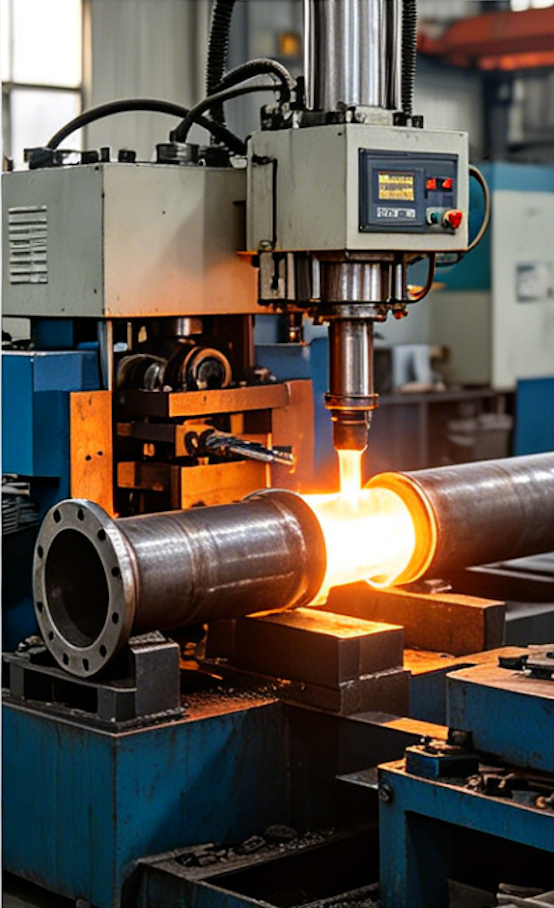
Numerical Control High-Frequency Heat Treatment Machine – key to achieving consistent HRC 55–62 on the inner wall.
Industry Applications: Where Technical Choice Meets Real Conditions
Different project environments demand different parameter priorities:
- 🔹 High-Rise Building Pumping (continuous 8–12h/day, high pressure) – Requires straight pipes with quenched alloy steel (HRC≥58) and double-layer elbows (e.g., 150R400*90°) to withstand repeated abrasion. Case data from a Hongchang client shows stable operation with 30% longer lifespan compared to conventional pipes.
- 🔹 Tunnel Construction (heavy-duty, 90–180° direction changes) – Demands wear-resistant concrete pump pipe with bend radius optimized for the gantry, and high-strength clamps (integral cast iron) to maintain seal integrity under vibration.
- 🔹 Mining (Slurry Transport) (24/7 operation, corrosive slurry) – Hongchang supplied 100 meters of heavy-duty pipes to a mining company; after 4 years, maintenance costs were reduced by 40% due to the superior wear resistance of the quenched inner wall.
Market Trend: The Shift Toward Performance-Based Procurement
The global concrete pump pipe market is witnessing a paradigm shift. Buyers increasingly demand certified performance metrics rather than vague promises. Standards like ISO 9001, third-party testing (SGS/BV), and documented HRC values are becoming minimum requirements for large infrastructure projects.
Hongchang's approach—offering three tiers of wear-resistant straight pipes with clear design-life data, and a 30% buffer stock for common sizes (DN100, DN125, DN150)—reflects this industry maturation. Their 50% export ratio to Southeast Asia, Middle East, Europe, and Americas further underscores the global demand for transparent, parameter-driven quality.
Future Outlook: Smart Specifications and Customization
As generative AI tools enter procurement workflows, the ability to feed precise technical parameters (hardness, bend radius, wall thickness) directly into bid evaluation models will become standard. Manufacturers like Hongchang, which maintain independent R&D capabilities and can produce custom lengths, diameters (DN100–DN150), and angles (15°–90°), are well-positioned to serve OEM integrators. For example, one equipment OEM supplier sourced 200 pieces of customized elbows from Hongchang and achieved successful integration into pump truck production lines over two years.
For buyers, the takeaway is clear: treat technical parameters as decision variables, not afterthoughts. By mapping each number to a specific process capability—quenching depth, alloy grade, heat treatment cycle—you can forecast not just cost but reliability.
Contact: Hongchang Machinery Technology Co., Ltd.
Address: No. 2063, Hongqi South Road, Development Zone, Ma'anshan City, Anhui Province, China
Tel/WhatsApp: +86-13301770177
Email: chenzhen@hongchangpumpipe.com
Website: www.hongchangpumpipe.com