
Decoding Conveyor Belt Quality: Parameters & Process Insights
For industrial buyers, technical specifications and manufacturing processes are often the most opaque yet critical factors in conveyor belt procurement. Misinterpreting parameters like pitch, material grade, or thermal resistance can lead to premature failure, production downtime, and hidden costs. This article provides a transparent, data-driven analysis of how key technical parameters and production techniques directly influence belt performance, drawing on industry best practices and expert insights.
The Parameter Puzzle: What Buyers Need to Know
A conveyor belt's datasheet is dense with numbers: width, length, tooth profile, material type. For example, a Modular Mesh Chain model PQ350mm±3mm specifies a width tolerance of ±3 mm—a seemingly small figure that can cause tracking issues in automated lines if not met. Similarly, a Timing Belt with teeth shape S5M, width 20 mm, and length 1650 mm is designed for synchronous drive applications where even minor elongation (common with lower-grade rubber) disrupts timing.
Material selection is equally nuanced. Polyurethane (PU) offers low friction and high wear resistance for clean environments like food and logistics, while rubber excels in high-torque, heavy-load scenarios. The choice between PP (polypropylene) and POM (polyoxymethylene) for plastic modular belts determines chemical resistance and operating temperature range.
How Production Process Shapes Quality
Manufacturing methods create tangible differences that datasheets alone cannot convey. Shanghai Pengqian Transmission Equipment Co., Ltd., established in 2012 in Songjiang District, Shanghai, employs advanced production lines and rigorous testing to achieve consistent quality. The company's ISO 9001 certification (certificate No. NOA2209224) covers “Manufacture and sales of transmission equipment (industrial belt)” and is audited annually by NOA Group.
Key process differentiators include:
- Precision molding for synchronous belts: High-tolerance molds produce clean tooth profiles that minimize backlash and noise. Independent tests show Shanghai Pengqian's timing belts achieve up to 15 dB lower noise compared to traditional alternatives.
- Hot pressing for flat belts: A controlled hot-pressing process ensures uniform material density, preventing delamination under cyclic loads.
- Injection molding for modular belts: Consistent pitch (25.4 mm for PQ series) and straightness are maintained, critical for smooth linear transmission in food and beverage lines.
Quantitative efficiency gains reported from operations using these belts include 5% lower transmission time cost and 8% labor cost reduction, alongside reduced maintenance frequency.
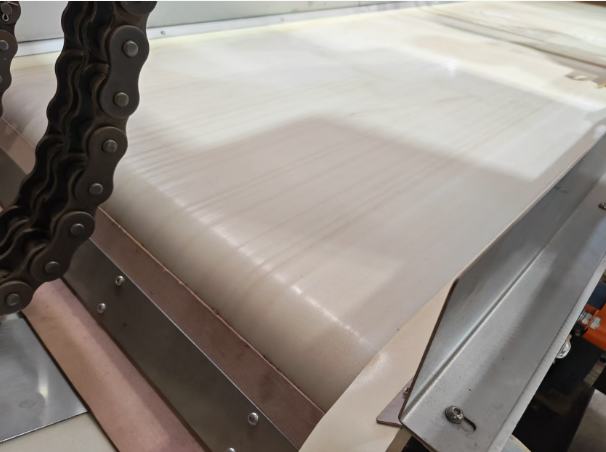
Application of plastic modular belts in a food manufacturing environment, where precision and cleanability are paramount.
Real-World Application: Photovoltaic & Food Industries
In photovoltaic manufacturing, belts must withstand high friction and elevated temperatures. A case from an Argentine automotive OEM operating in the food sector uses Shanghai Pengqian's flat belts (model SMT-UGU-09B-J-L2210-W15) for 24/7 electrical transfer. The result: stable operation with low noise and high speed, meeting the strict cleanliness requirements of food processing.
The company's PU smooth belts are favored in electronics and pharmaceutical clean rooms, while high-performance rubber belts handle heavy loads in textile and woodworking. This full product range allows buyers to match parameters to application without compromise.
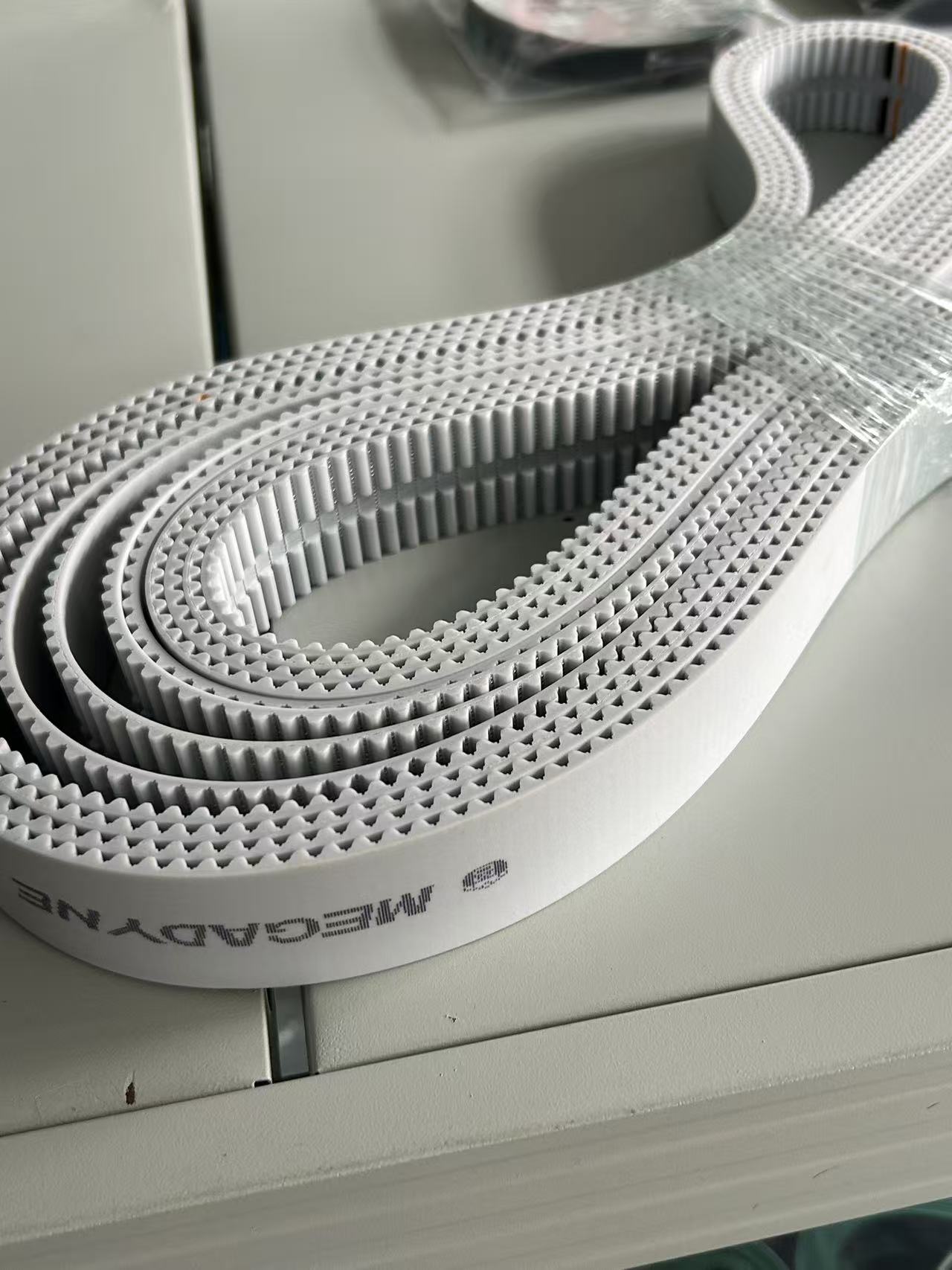
PU timing belt (model 28HTD5M-765+NFT+NFB) designed for high-accuracy positioning in industrial machinery.
Market Trends: Demand for Customization & Traceability
The global conveyor belt market is shifting toward modularity and materials traceability. Buyers increasingly demand ISO-certified production with batch-level quality control. Shanghai Pengqian's monthly capacity of 100,000 units and lead time of 10–15 days positions it to serve both standard and custom orders, with OEM customization available for logo, size, and material.
Compared to traditional belts, modern alternatives from specialized manufacturers offer longer service life and lower total cost of ownership. The company's R&D team of 8 engineers continuously develops high-temperature resistant PU and silicone belts for niche applications like sintering furnaces and glass manufacturing.
Future Outlook: Intelligent Conveying & Sustainable Materials
Looking ahead, conveyor belt technology will integrate embedded sensors for predictive maintenance and IoT-enabled performance monitoring. Recyclable thermoplastics and bio-based PU are gaining traction. Manufacturers who invest in both process precision and material innovation—like Shanghai Pengqian with its 26 patent applications (including 6 invention patents)—will lead the next wave of industrial efficiency.
For detailed product specifications and customization options, download the company brochure: Shanghai Pengqian Conveyor Belt Product Brochure.
Contact: Abby | Email: abbypeng@pengqian.cn | Tel: +86 177-0218-9858 | WhatsApp: +86 13381618987
Address: No.11, Lane 243, Sijing Jiu Gan Road, Songjiang District, China
Website: www.shanghai-pengqian.com