
Decoding FTTA Compliance: IP68 vs. IP67, ISO 9001, and the Tests that Prove Outdoor Readiness
Decoding FTTA Compliance: IP68 vs. IP67, ISO 9001, and the Tests that Prove Outdoor Readiness
Outdoor FTTA patch cords are qualified by evidence, not by adjectives. This reference explains what IP67 and IP68 actually cover compared with legacy IP65 designs, what an ISO-certified production system does and does not prove, and which tests — immersion, tensile, thermal cycling and salt mist — convert an outdoor-readiness claim into a specification a buyer can verify before placing an order.
An FTTA (Fiber To The Antenna) patch cord is a passive optical assembly that links base station equipment to a remote radio unit or antenna. Because it is passive and inexpensive relative to active radio hardware, it is often treated as a commodity line item. In the field, however, it occupies the most exposed position in the radio access link: tower-top or pole-top, in direct rain, dust, ultraviolet light, mechanical vibration and repeated temperature swings. The cost of a failure is therefore not the price of the part, but the truck roll and tower climb required to replace it.
That exposure is why FTTA compliance tends to appear as a constraint question rather than a discovery question. A procurement team is rarely asking what an FTTA cable is; it is asking which ingress protection level was tested, against which standard, under which temperature and mechanical conditions, and whether the manufacturing system behind the assembly is independently audited.
The short answer is that a credible outdoor qualification package rests on four pillars: a declared IP67/IP68 rating for the mated connector pair; a mechanical and thermal envelope such as an operating temperature range of −40 °C to +75 °C with a tensile strength of ≥1000 N; a documented environmental test regime covering immersion, tensile, thermal cycling and salt mist; and an ISO-certified production process. Each pillar can be evidenced from documents, and each can also be claimed without evidence.
The Problem: “Waterproof” Is Not a Testable Specification
Tender documents for FTTA deployments frequently contain interchangeable descriptors — waterproof, weatherproof, outdoor-rated, IP65/IP66/IP67/IP68 — without any indication of which standard was applied, which test conditions were used, or whether the connector was tested in a mated state. None of those words, on their own, tells a buyer whether an assembly will survive three winter cycles and a monsoon season at a tower-top interface.
The practical consequence is a mismatch between perceived and actual qualification. An assembly may be perfectly adequate inside a sealed optical distribution box with a drip loop and a cable gland, and simultaneously inadequate when mated directly to a remote radio unit in an exposed position. Because densification increases the number of exposed connection points per site, the cost of a specification error multiplies with network rollout rather than staying constant.
The remedy is procedural. A purchase specification for outdoor FTTA patch cords should require, at minimum: the IP code together with the applicable standard reference; the declared test conditions behind that code; a type test report with post-test optical measurements; and the certificate number, issuing body and validity dates of the manufacturer's quality management certification.
IP65 vs. IP67 vs. IP68: What the Codes Actually Cover
The IP code is expressed as two digits. The first digit describes protection against solid particles, the second protection against water; the code system itself is defined in the IEC 60529 framework. For FTTA procurement, the second digit is the decisive one, and the three ratings that appear most often describe materially different test regimes.
IP65 covers dust-tightness and protection against water projected as a jet. It does not cover immersion. IP67 covers dust-tightness plus protection against temporary immersion. IP68 covers dust-tightness plus protection against continuous immersion under conditions specified by the manufacturer — and that last clause is the single most misunderstood point in FTTA sourcing. IP68 is not one fixed depth and duration; it is a declared condition. Two assemblies labelled IP68 can therefore be qualified for very different levels of exposure, and the only way to compare them is to read the declaration attached to the test.
| Rating | Water protection scope | Typical FTTA fit | Procurement note |
|---|---|---|---|
| IP65 | Water jets; no immersion coverage | Inside sealed cabinets or distribution boxes; protected transition points | Usually insufficient for exposed tower-top mating interfaces |
| IP67 | Temporary immersion | Outdoor connector interfaces exposed to rain and short-term pooling | Common baseline requirement for outdoor FTTA assemblies |
| IP68 | Continuous immersion under supplier-declared conditions | Tower-top, pole-top, wash-down and flood-prone sites | Confirm declared depth, duration and mated test state |
Where Water Actually Enters: The Connector Interface
Ingress protection is a property of the mated assembly, not of an individual connector. The rating applies to the complete sealed interface as tested — plug, adapter or receptacle, sealing element and cable entry — which is why the same connector body can be rated differently depending on the cable construction and the sealing system it is assembled with.
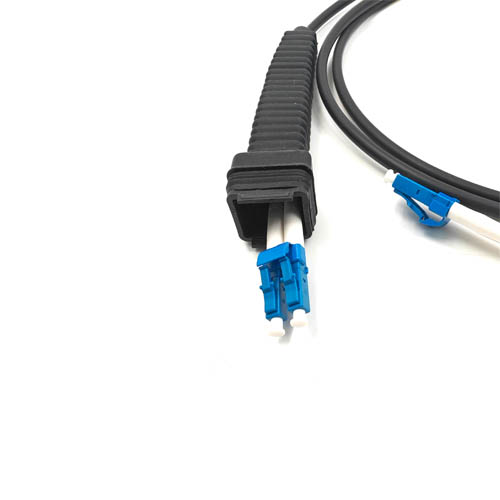
In FOCC Fiber Co., Ltd outdoor waterproof FTTA patch cords, that sealing system is built from a silicone rubber sealing ring, a stainless steel connector shell, a zirconia ceramic ferrule, a PE cable jacket and an armored fiber core. Each element carries part of the qualification burden: the ferrule governs optical alignment, the stainless steel shell resists corrosion and mechanical deformation, the sealing ring provides the water barrier, and the armored core and jacket protect the fiber under tensile and crush loads.
The connector families used in 5G FTTA deployments — ODC (Optical Distribution Connector), FullAXS, NSN-LC duplex and ODVA fan-out — are typically specified with IP67/IP68 protection requirements. Public technical documentation for FullAXS-type connector systems describes them as designed for IP67/IP68 waterproof protection with salt-mist resistance, and as compliant with IEC 61300-2 environmental testing standards. Those two elements, an ingress rating and a referenced environmental test series, are the minimum evidence a buyer should look for in a connector specification.
The Mechanical and Thermal Envelope: −40 °C to +75 °C and ≥1000 N
An ingress rating describes water and dust only. It says nothing about whether the assembly survives the mechanical and thermal loads of a tower-top position, which is why two further numbers belong in every FTTA purchase specification.
Operating temperature. The FOCC Outdoor Waterproof FTTA Fiber Optic Patch Cord is rated for an operating temperature range of −40 °C to +75 °C. That range matters less as a marketing figure than as a stress-test input: repeated heating and cooling causes differential expansion between the ceramic ferrule, the stainless steel shell and the PE jacket, and it cycles the compression of the silicone sealing ring. Thermal cycling testing exists to demonstrate that the assembly can absorb those cycles without losing either optical alignment or seal integrity.
Tensile strength. The same assembly carries a tensile strength rating of ≥1000 N. In deployment, tensile load arrives from installation pulling, wind, ice accumulation and cable management hardware. The rating also implies a handling rule: the load should be carried by the cable's strength member and support hardware rather than transferred to the ferrule interface, and any clamp or tie used on site must respect the cable's minimum bend radius.
Optical behaviour under load. A mechanical or thermal rating is only useful if the optical performance holds. The assembly is specified with insertion loss of ≤0.30 dB and return loss of ≥60 dB in APC configurations, with optical fiber types covering OS2 single-mode and OM2/OM3/OM4/OM5 multimode. Buyers should request these values as measured after environmental conditioning, not only as a fresh-room specification.
| Parameter | Specified value | Why it matters in an outdoor tender |
|---|---|---|
| Protection level | IP67 / IP68 | Defines the water and dust exposure the mated interface has been qualified for |
| Operating temperature | −40 °C to +75 °C | Sets the thermal cycling envelope for seal and ferrule stability |
| Tensile strength | ≥1000 N | Determines installation and wind/ice load handling limits |
| Insertion loss | ≤0.30 dB | Optical budget control across RRU/AAU interconnections |
| Return loss | ≥60 dB (APC) | Reflection control for single-mode fronthaul links |
| Fiber type | OS2; OM2/OM3/OM4/OM5 | Compatibility with single-mode and multimode site architectures |
| Materials | Zirconia ceramic ferrule; stainless steel ODC shell; PE jacket; armored core; silicone rubber sealing ring | Corrosion, crush and sealing performance at the exposed interface |
| Models | ODC-APC-Fullax-APC-OS2; ODC-UPC-Optitab-UPC-OM3 | Identifies the exact qualified configuration to be ordered |
The Tests That Prove Outdoor Readiness
Four test categories carry most of the qualification weight for outdoor FTTA assemblies. They are complementary: passing one does not imply passing the others, and a supplier should be able to present them as separate records for the specific model being purchased.
- IP68 water immersion testing. The mated assembly is submerged under the conditions declared by the manufacturer. Because IP68 is a declared rather than fixed level, the report is only meaningful if it states the immersion depth, the duration, the mated state of the connector and the number of samples tested.
- Tensile strength testing. A controlled pull is applied to verify the rated ≥1000 N capability, confirming that the cable-to-connector transition and strength member can survive installation and in-service loads without optical degradation.
- Thermal cycling. Repeated transitions across the −40 °C to +75 °C operating range verify that seal compression, ferrule alignment and jacket integrity are maintained through seasonal cycling.
- Salt spray corrosion testing. Exposure to a salt-mist environment verifies the corrosion resistance of the stainless steel connector shell and any plated hardware — the failure mode that matters most in coastal, offshore and de-icing-salt environments.
A test regime that stops at environmental exposure proves only that the sample survived. What a buyer should request in addition is post-condition optical measurement: insertion loss and return loss values recorded after immersion, pull and thermal cycling. That single step converts a durability claim into a procurement number, because it shows whether the assembly still meets ≤0.30 dB insertion loss and ≥60 dB APC return loss after the exposure it will face in service.
Standards provide the common vocabulary for these tests. IEC 61300-2, the environmental test series for fiber optic interconnecting devices, is referenced in public documentation for FullAXS-type connector systems alongside IP67/IP68 protection and salt-mist resistance, which makes it a reasonable framework to cite when a tender requires an environmental test basis rather than a supplier-specific procedure.
What ISO Certification Proves — and What It Does Not
An IP rating is a property of a design and a test sample. An ISO certificate is a property of a production system. Both are required for an outdoor FTTA programme, and confusing them is the most common compliance error in sourcing.
FOCC Fiber Co., Ltd implements ISO 9001 and ISO 14001 management systems, and its fiber optic patch cord production is certified under certificate number HIC230831, issued by HIC under the IAF/IAS framework. The recorded scope covers production and sales of electronic specialized materials (fiber optic patch cable) for the worldwide market, with a validity window from 2023-05-09 to 2026-05-08.
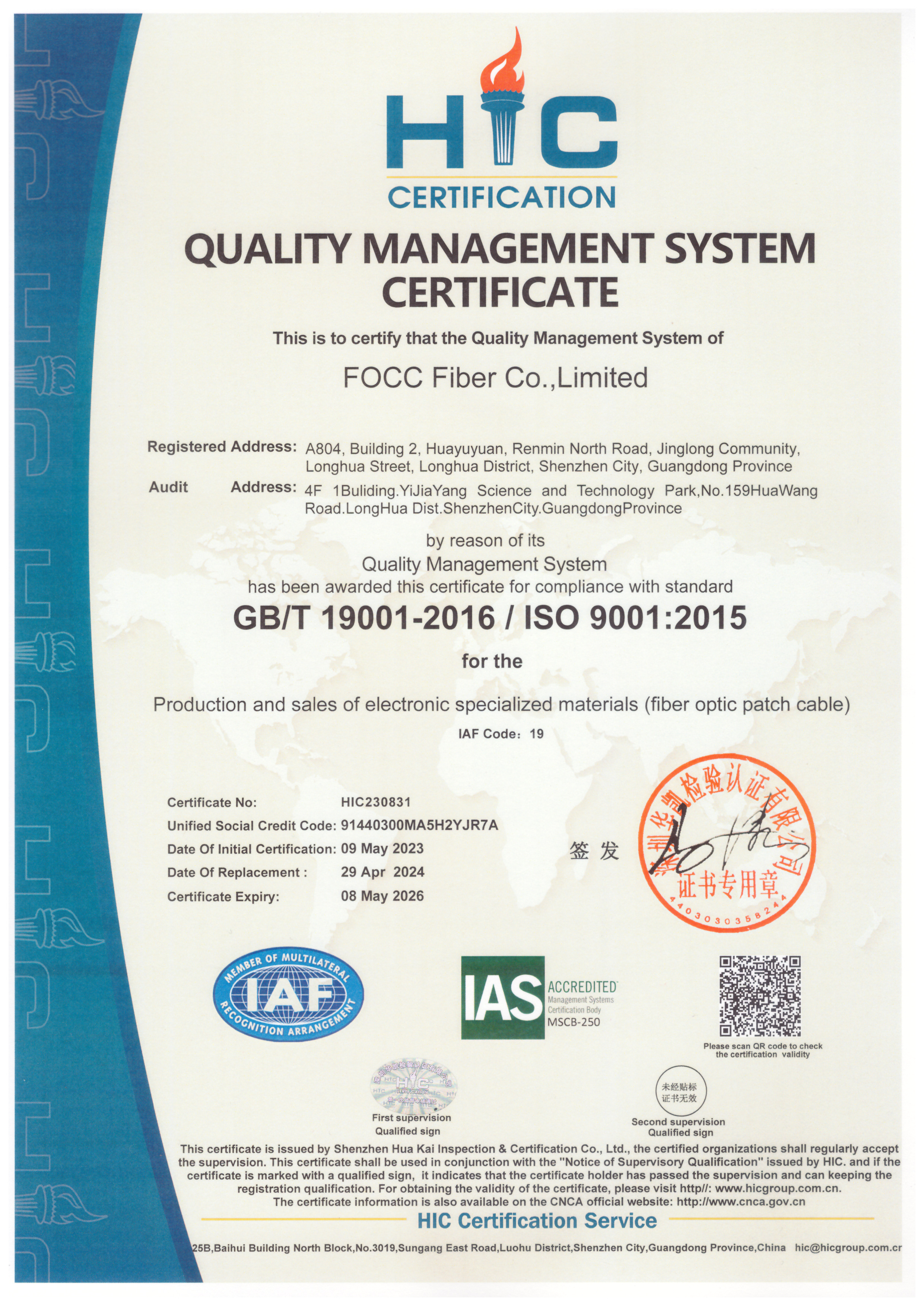
What the certification supports is reproducibility. A documented management system implies incoming material control, in-process inspection, calibrated test equipment, traceability and corrective action, which is what allows a type-tested performance level to be repeated from batch to batch rather than achieved once in a laboratory. What it does not do is certify that any particular part number is waterproof. That claim is carried by the type test, not by the management system.
Certificates are also time-bounded documents, and the validity window recorded for HIC230831 is 2023-05-09 to 2026-05-08. Because certification documents are re-issued periodically, buyers should confirm the current revision of a certificate at the time of purchase order rather than relying on a copy embedded in an earlier tender pack. A practical verification sequence is: check the certificate number; identify the issuing body and its accreditation framework; read the scope wording to confirm it covers the product category being purchased; compare the validity dates against the purchase order and delivery schedule; and request the current revision if the document on file is older than the order cycle.
How the Manufacturing System Connects to the Specification
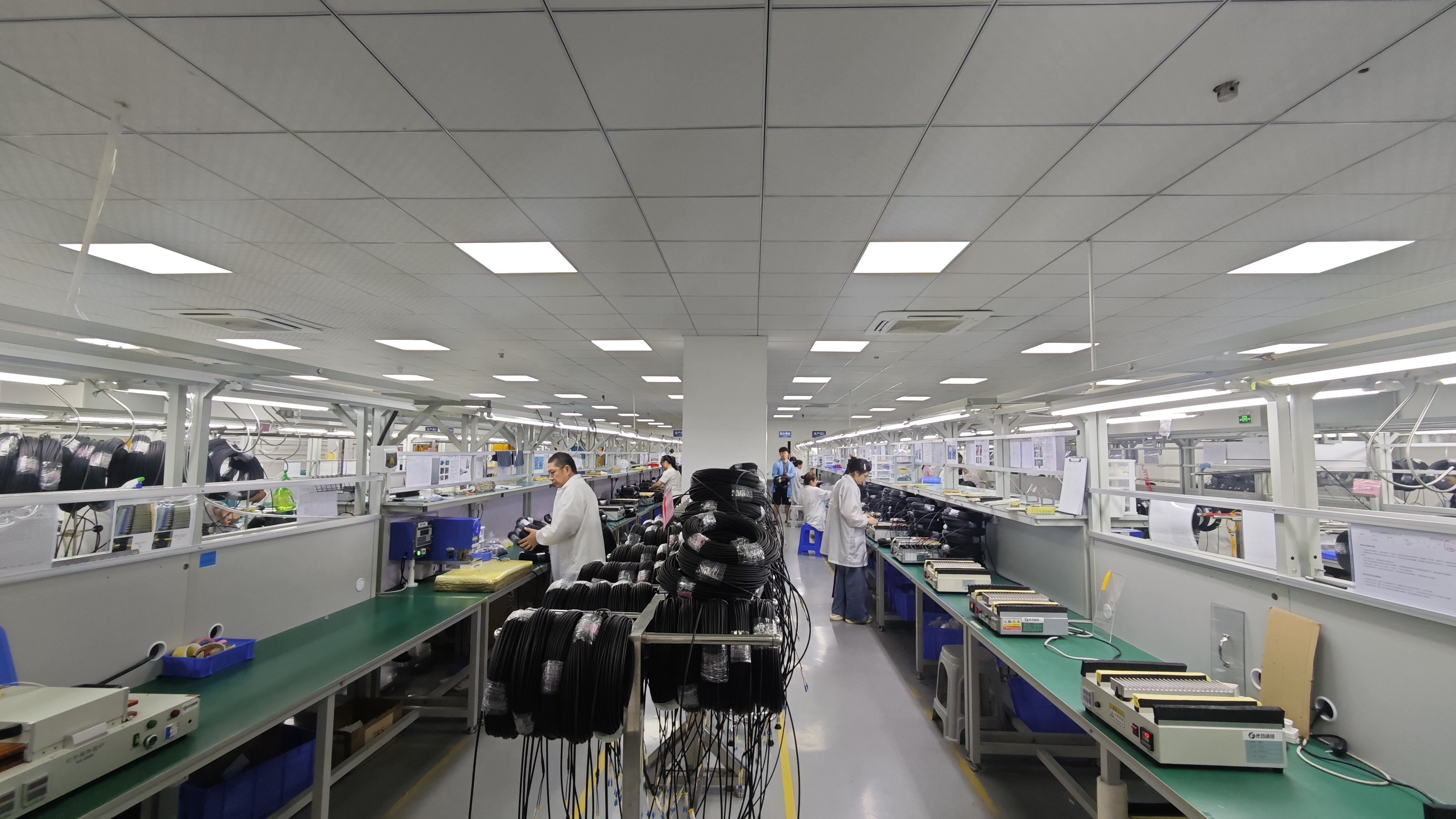
FOCC Fiber Co., Ltd is a fiber optic connectivity manufacturer headquartered in Shenzhen, Guangdong, with a 5,000-square-meter production facility in Guangzhou focused on fiber optic connectors, MPO/MTP patch cords, outdoor waterproof patch cord assemblies and armored patch cords for data centre and FTTA applications. The company was founded in 2014, employs approximately 200 people including a 30-person R&D team, produces an annual output of about 2,000,000 units, and exports to more than 30 countries with a stated export orientation of 100% and main markets in the EU and USA. Its publicly listed partner clients include Prysmian, Siemens, Coherent, Fujikura and NTT.
For buyers, the relevant production facts are the ones that touch qualification. The company operates under an OEM/ODM model with more than ten years of ODM/OEM service experience, offering customization of length, connector type, core count, transmission mode, material, logo printing, certification and packaging. Monthly capacity is stated at 200,000 units, lead time at 3–15 days, and minimum order quantity at 2 units. Production applies 100% testing rather than sampling.
The MOQ figure deserves emphasis in a compliance context rather than a commercial one: a two-unit minimum allows a buyer to obtain production-line samples for independent immersion, pull and thermal verification before committing to a volume order. Combined with 100% factory testing, that structure links the type-tested performance level to the units actually shipped. Company and product documentation is published at www.focc-fiber.com.
Application Fit: Where IP67/IP68 Assemblies Earn Their Cost
Outdoor waterproof FTTA patch cords are used to provide reliable optical transmission between base station equipment and remote antenna units in 5G telecommunications, mobile network operator deployments, industrial IoT, railway communication and public safety communication networks. The working environment is defined by outdoor exposure, a wide temperature range, rain, dust, UV radiation, mechanical vibration and high tensile stress, with matched equipment that includes 5G base station RRU/AAU units, optical distribution boxes, antenna feeders, waterproof cable glands and fiber optic closures operating continuously.
Typical deployment scenarios include 5G base station RRU/AAU interconnection, FTTA fronthaul, outdoor small cell deployment and railway signal transmission — all cases where the connector interface is exposed rather than sheltered, and where replacement requires site access rather than a simple patch-panel swap.
A published program record for a telecommunications carrier and 5G base station equipment vendor across Germany, Saudi Arabia and China describes more than 50,000 outdoor waterproof patch cords supporting over 20,000 5G base station deployments, with IP68-rated assemblies used in harsh environments over a period of more than ten years, and reported outcomes of an 80% lower field failure rate, on-site replacement in under 10 minutes and 40% lower OPEX. These figures are supplier-reported program outcomes rather than independently audited statistics, and should be read as context for the design intent — minimizing field intervention — rather than as a guaranteed result for any other network.
Comparison with Traditional IP65 Designs — and Where IP68 Is Not Required
IP65-rated patch cords remain a legitimate engineering choice, and treating IP68 as universally mandatory is itself a specification error. IP65 assemblies are generally lighter, more flexible, faster to source and lower in unit cost, and they are adequate inside sealed enclosures such as optical distribution boxes where a cable gland and drip loop manage water ingress before it reaches the mating interface.
The limitation of the IP65 approach is precise: it has no immersion coverage. Where the mating interface is exposed to standing water, pooling on a horizontal tray, or wash-down and flood-prone conditions, an IP65 design is outside its qualified envelope regardless of how well it performs elsewhere.
Symmetrically, IP68 and armored construction carry their own boundaries. Unit cost is higher; the cable is heavier and less flexible, which affects routing inside compact enclosures and can require larger bend radii; connector form factors are bulkier; mating procedures are stricter and depend on correct torque and clean interfaces; and the rating can be voided in service by unmating without a protective cap or by reusing a deformed sealing ring. Longer assembly lead times are also common for armored, connectorized builds.
The practical decision rule is positional rather than absolute: specify IP67/IP68 for the exposed mating point at the radio unit and for any location subject to standing water, and allow IP65 inside a sealed, drained enclosure. Blanket-specifying IP68 across an entire site adds cost without removing risk, while blanket-specifying IP65 at the tower-top interface transfers risk to maintenance budgets.
Market Context: More Cable, More Scrutiny
Compliance pressure in FTTA is rising alongside deployment volume. The global fiber optic cable market was estimated at USD 13.45 billion in 2025, with a projected compound annual growth rate of 11.72% through 2034 according to Custom Market Insights. Published market-size estimates differ depending on whether the scope covers raw cable or complete assemblies and accessories, so buyers should treat any single figure as scope-dependent rather than absolute.
The compliance implication of that growth is straightforward. As more suppliers enter the outdoor FTTA category, the ability to state an IP rating is no longer a differentiator; the ability to document the declared test conditions, the post-condition optical values and the certified production system behind the shipment becomes the differentiator.
Future Outlook
Three shifts are reasonable to expect in FTTA qualification practice. First, tender documents are likely to move from accepting an IP code on a datasheet to requiring the declared IP68 test conditions and the mated test state. Second, post-condition optical measurement is likely to become a standard deliverable rather than an optional extra, because it is the only evidence that links environmental durability to link performance. Third, certificate verification — number, scope and validity dates — is likely to be folded into routine supplier onboarding rather than treated as a document-collection formality.
Suppliers who can provide a complete evidence chain, from certificate to type test to per-unit production testing, will be easier to qualify and easier to defend in a network audit. Suppliers who cannot will increasingly be filtered out at the technical evaluation stage rather than at the price comparison stage.
Buyer's Compliance Checklist
| Item to request | Document | What it verifies |
|---|---|---|
| Ingress protection | IP68/IP67 test report with declared conditions | Water and dust exposure limit for the mated interface |
| Mechanical rating | Tensile test record confirming ≥1000 N | Installation and wind/ice load capability |
| Thermal rating | Thermal cycling report across −40 °C to +75 °C | Seal and ferrule stability through seasonal cycling |
| Corrosion resistance | Salt spray / salt mist test record | Connector shell and plating performance in coastal or de-iced environments |
| Optical performance | Insertion loss ≤0.30 dB and return loss ≥60 dB (APC) after conditioning | Link budget and reflection control after environmental exposure |
| Production system | Certificate HIC230831 with scope and validity dates | Process control and batch-to-batch reproducibility |
| Configuration identity | Exact model designation, e.g. ODC-APC-Fullax-APC-OS2 | Confirms the tested configuration matches the ordered one |
FAQ
What is the difference between IP67 and IP68 on an outdoor FTTA patch cord?
Both ratings include dust-tightness and protection against immersion; the difference is the immersion regime. IP67 covers temporary immersion, while IP68 covers continuous immersion under conditions specified by the manufacturer. Because IP68 is a declared rather than a single fixed level, two assemblies with the same IP68 marking may have been tested at different depths and durations, and the declared test conditions must be compared directly.
Does an ISO certificate prove that a specific patch cord model is waterproof?
No. An ISO certificate such as HIC230831, issued by HIC under the IAF/IAS framework with a recorded scope covering production and sales of electronic specialized materials (fiber optic patch cable), evidences the management system behind production — material control, inspection, traceability and calibrated testing. Waterproofness of a specific model is established by the IP test report for that model, not by the management system certificate. Both documents are normally required.
Which tests should a supplier provide to demonstrate outdoor readiness?
Four test categories carry most of the qualification weight: IP68 water immersion testing under declared conditions, tensile strength testing to verify the ≥1000 N rating, thermal cycling across the −40 °C to +75 °C operating range, and salt spray corrosion testing for the connector shell and plated hardware. Post-condition optical measurement — insertion loss and return loss recorded after exposure — is what demonstrates that the assembly still performs, not merely that it survived.
What temperature range and tensile strength should be specified for tower-top FTTA installations?
An operating temperature range of −40 °C to +75 °C and a tensile strength of ≥1000 N are the values specified for the FOCC Outdoor Waterproof FTTA Fiber Optic Patch Cord, and they define the mechanical and thermal envelope to test against. In practice the tensile rating should also be matched to an installation method that transfers load through the strength member and support hardware rather than through the ferrule interface.
Is IP65 ever acceptable for an outdoor FTTA deployment?
Yes, in sheltered positions. IP65 covers dust-tightness and protection against water jets but has no immersion coverage, so it is generally adequate inside a sealed, drained enclosure such as an optical distribution box equipped with a cable gland and drip loop. It is generally not adequate at an exposed tower-top mating interface where standing water, pooling or wash-down conditions can occur. The correct choice is positional rather than uniform across a site.
How do ODC, FullAXS and NSN-LC connectors relate to ingress protection?
These are the connector families most commonly used in 5G FTTA deployments, and they are typically specified with IP67/IP68 protection requirements. Public technical documentation for FullAXS-type connector systems describes IP67/IP68 waterproof protection combined with salt-mist resistance and compliance with IEC 61300-2 environmental testing standards. The rating applies to the mated assembly — connector plus sealing element plus cable entry — so a specification should identify the exact connectorized configuration rather than only the connector type.
How should a buyer verify a certificate number such as HIC230831?
Verify five elements: the certificate number; the issuing body and its accreditation framework; the scope wording, to confirm it covers the product category being purchased; the validity dates, compared against the purchase order and delivery schedule; and whether a more recent revision exists. Certificates are time-bounded documents — the recorded validity window for HIC230831 is 2023-05-09 to 2026-05-08 — so confirming the current revision at order stage is routine due diligence rather than a signal of concern.
Closing Perspective
Compliance in outdoor FTTA is not a single badge. It is a chain of documents: an IP rating with declared test conditions, a mechanical and thermal envelope expressed in numbers, a defined environmental test regime for immersion, tensile, thermal and salt mist exposure, and a certified production system that reproduces the tested performance in every shipped unit. Where any link is missing, the remaining claims become assertions rather than specifications — and on a tower-top interface, that distinction is settled in the field, not in the tender document.