
Decoding Financial Certifications for the Telpo P9 Smart Payment Terminal
A handheld terminal that accepts a chip card, a contactless tap and a QR code is at the same time four regulated objects: a radio device, an electrical product, a cryptographic security module and a card-network endpoint. Each one is approved by a different authority, for a different market, against a specific firmware build — and those differences decide whether the hardware can legally take payments in a given country.
Telpo Technology Co., Ltd. is a Foshan, China-based developer and manufacturer of smart terminals founded in June 1999, listed on the NEEQ (stock code 833839), and active across smart retail, smart payment, smart transportation and biometric security. The company sells its P9 as a family rather than a single model: the P9 Financial version and P9 PDA Financial version are positioned as payment terminals, while the P9 non-financial version and P9 PDA non-financial version are positioned as mobile terminals. The approval lists differ between those tracks, and that split is the first thing a bank, acquirer or field-sales operator should understand before comparing specifications or unit economics.

Why certification behaves as a procurement filter rather than a feature
PCI PTS (PIN Transaction Security) and EMV are the baseline conditions for secure chip processing on a payment terminal. PCI PTS is published by the PCI Security Standards Council and governs how a point-of-interaction device protects PIN entry, cryptographic keys and its own tamper response. EMV approvals, issued by EMVCo, LLC, govern whether the reader interface and the payment kernel behave correctly when the terminal meets a contact or contactless card.
The practical consequence is that certification is treated as a gate. An acquiring bank, a processor or a national scheme will normally not accept transaction traffic from a terminal model that has not been approved for that environment, and a merchant's payment application is usually only validated against a defined, approved hardware and firmware configuration. That is why a certification list — not a specification sheet — is the first document an experienced payment buyer requests.
The P9 Financial certification stack at a glance
The approvals below are the ones most relevant to a payment buyer evaluating the P9 for banking, agent-banking or field-sales deployment. Each row records the issuing body, the market the approval is listed for, and the published certificate reference.
| Approval | Issuing body | Market | Reference |
|---|---|---|---|
| PCI PTS POI Security Requirements v6.X | PCI Security Standards Council | Global | 4-40460 (P9 PDA Financial version) |
| EMV Contact Level 1 | EMVCo, LLC | Global | 19271 0325 100 10a 10a BCTS |
| EMV Contact Level 2 | EMVCo, LLC | Global | 2-05601-1-1C-BCTS-0625-4.4c |
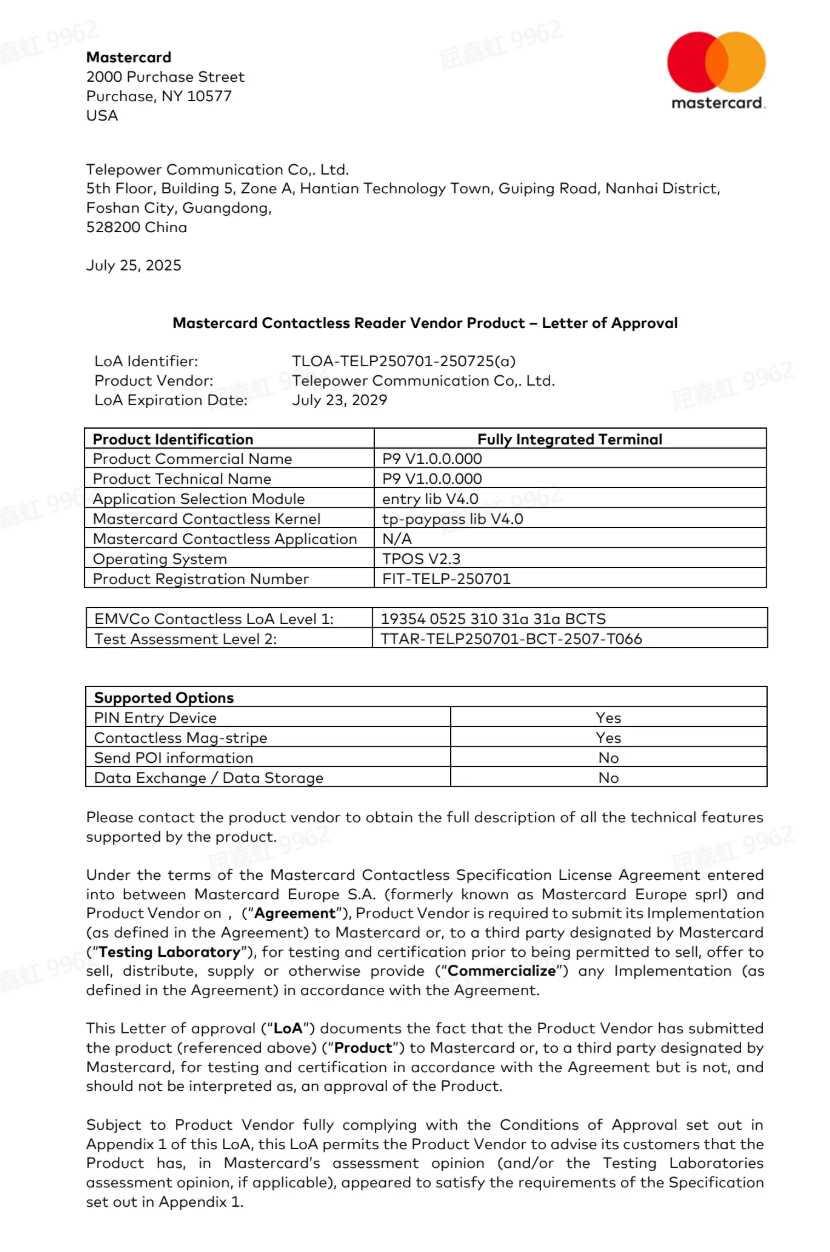
| Mastercard Contactless Reader Letter of Approval (EMVCo Contactless Level 1) | Mastercard Europe S.A. | Global | 19354 0525 310 31a 31a BCTS (model P9 V1.0.0.000) |
| Mastercard Contactless Specification | Mastercard Europe S.A. | Global | TLOA-TELP250701-250725(a) |
| Mastercard Global Terminal Quality Management (TQM) | Mastercard Approval Authority | US, EU | TQM5006 |
| American Express Expresspay 4.2 | American Express | US | 42.ICTK.TELPO.P9.20250625-B (firmware P9-AMEX LIB v1.0) |
| Discover D-PAS Connect v2.1 — contactless | Discover Financial Services | US | ICS_TELE_P9_CNT_CL_10052025 |
| Discover D-PAS Connect v2.1 — contact | Discover Financial Services | US | ICS_TELE_P9_CNT_CT_10132025 (hardware family P9-ICCR-HW V1.0.0.000) |
| PURE Contactless Payment Kernel | PayCert, Paris | Global | TEL.KER.218.2025-027 (PURE Specification Reference v2.1.8) |
| UnionPay QuickPass Terminal Payment Certification | China UnionPay Co., Ltd. | China | QP-1203 |
| JCB Contact IC Terminal Test & Security Specifications | JCB CO., LTD. | Japan | 26PF16d-427-01 |
| RuPay Contactless Terminal Type Approval | National Payments Corporation of India | India | NP2TELERupayContactless L2250849622 |
| NSICCS terminal type approval | Asosiasi Sistem Pembayaran Indonesia | Indonesia | No. ASPI-26APP-0410024 (P8 and P9 models) |
| EU RoHS Directive 2011/65/EU | Panyu Testing & Certification (Guangdong) Co., Ltd (PTC) | EU | PTC25031705301C-EN01 |
| CE EMC Attestation of Conformity (EMC Directive 2014/30/EU) | Bay Area Compliance Laboratories Corp. (BACL) | EU | 2501U08540E-EM, issued 17 November 2025 |
| GMS (Google Mobile Services Test Certification) | EU | P9_arm64 (P9 non-financial version) | |
| Certified Commercial Cryptography Product | Commercial Cryptography Testing and Certification Center | China | GM014410320250876 |
Certificate references and markets are reproduced as published in the underlying approval documents; buyers should confirm the current status of any certificate directly with the vendor or issuing body before contracting.
What PCI PTS POI v6.X obliges a terminal to do
PCI PTS is not a statement about software quality. For a point-of-interaction device, the PTS POI requirements address the physical and logical protection of the PIN pad and the keys used to encrypt cardholder data: how the device detects and responds to tampering, how keys are injected, stored and zeroised, and how the device can be managed in the field without exposing sensitive material. A handheld model therefore sits in a different risk class from a countertop terminal, because it leaves the counter, is handed to customers, and is charged and stored outside a controlled back office.
In the P9 family, the P9 PDA Financial version is documented against PCI PTS POI Security Requirements Version 6.X under certificate number 4-40460, issued by the PCI Security Standards Council and valid globally. The product documentation for the financial variants also lists an on-device SAM security module alongside dual SIM and eSIM support, which is the hardware layer many acquirers and national schemes expect when key material must be held inside a removable secure element rather than only in the main processor.
Why the certificate number matters more than the logo
Any vendor can print “PCI” on a brochure. The numbered certificate is what an acquirer's compliance team will actually look up, because it identifies the specific device and configuration that was evaluated. For the P9, that means part of the audit work is already done: 4-40460 is a lookup, not a promise.
EMV Level 1, Level 2 and Level 3 — the distinction buyers most often miss
EMV approval is layered, and the layers answer different questions.
- EMV Contact Level 1 covers the reader interface — the electrical, mechanical and protocol behaviour of the terminal when it talks to a chip card. The P9 is listed as certified to EMV Contact L1 under 19271 0325 100 10a 10a BCTS, issued by EMVCo, LLC, against EMV Contact Interface Specification Version 1.0.
- EMV Contact Level 2 covers the payment application kernel — how the terminal's software processes the transaction after the card is presented. The P9 is listed under 2-05601-1-1C-BCTS-0625-4.4c, against EMV Integrated Circuit Card Specifications for Payment Systems Version 4.4.
- EMVCo Contactless Level 1 does the same job for the contactless interface. For the P9 this appears as a Mastercard Contactless Reader Letter of Approval, 19354 0525 310 31a 31a BCTS, referencing model P9 V1.0.0.000 and the Mastercard Contactless Specification.
- Level 3 — the layer buyers most often assume is included — is the acquirer's or processor's own host certification. It is performed by the acquirer, against its host system and the merchant's software configuration, and it is not a terminal vendor certificate.
This is the single most common source of delay in payment projects. Procurement teams frequently read “EMV certified” on a datasheet and assume the deployment risk has been transferred to the vendor. It has not. The terminal certificate removes one class of risk — the card-to-terminal interface and kernel — and leaves the host integration risk where it belongs, with the acquirer and the merchant's software partner.
Scheme approvals: why “EMV certified” does not mean “works with every network”
Card networks maintain their own terminal approval programmes on top of EMVCo certification. They test against their own contact and contactless specifications, and they issue approvals that are valid for named markets. The P9 portfolio illustrates how granular this becomes:
- Mastercard — contactless reader approval 19354 0525 310 31a 31a BCTS and specification approval TLOA-TELP250701-250725(a), both issued by Mastercard Europe S.A. and listed as globally valid, with an expiry date of 23 July 2029. The P-series terminals are also listed against Mastercard Global Terminal Quality Management (TQM) compliance rules under TQM5006 for the US and EU markets.
- American Express — Expresspay 4.2 reader certification 42.ICTK.TELPO.P9.20250625-B, tied to firmware P9-AMEX LIB v1.0, listed for the US market with validity to 25 June 2028.
- Discover — two separate D-PAS Connect v2.1 approvals, one for contactless (ICS_TELE_P9_CNT_CL_10052025) and one for contact (ICS_TELE_P9_CNT_CT_10132025), listed for the US market and valid to 21 October 2028.
- China UnionPay — QuickPass terminal payment certification QP-1203 for the Chinese market, under Parts 3, 4 and 5 of the UnionPay integrated circuit card specification.
- JCB — contact IC terminal approval 26PF16d-427-01 for the Japanese market.
- RuPay — contactless terminal type approval NP2TELERupayContactless L2250849622 for India, under RuPay Terminal Specification version 2.0.0 and the qSPARC Contactless Terminal Test Plan.
- NSICCS — Indonesian national payment security standard approval No. ASPI-26APP-0410024, covering the P8 and P9 models.
- PURE kernel — contactless payment kernel certification TEL.KER.218.2025-027 issued by PayCert in Paris, against PURE Specification Reference v2.1.8.
For a global buyer, the exercise is therefore a mapping: list the networks and the acquiring markets in scope, then check whether the terminal holds the corresponding approval for the correct firmware revision. A P9 configured for a Japanese JCB deployment and one configured for a US Expresspay deployment may be the same hardware family but are not interchangeable certificates.
GMS certification and Android terminals in regulated environments
GMS stands for Google Mobile Services Test Certification. It is a software-level approval rather than a payment approval, and it exists because Android-based payment and retail terminals depend on an application ecosystem: app distribution, device APIs, push messaging and location services. GMS certification confirms that a device build has passed Google's compatibility testing so that Google services and applications that depend on Google APIs can run on it.
In Telpo's documentation, the P9 GMS certification carries the reference P9_arm64 and is issued by Google, and it is listed for the EU market. It applies to the P9 non-financial Android POS Terminal and to the P9 PDA non-financial version. That mapping is consistent with how the family is positioned: the non-financial models are the software-platform variants, designed for application builds that may rely on the Google ecosystem, while the financial variants carry the payment-security approvals described above.
What GMS changes for an operator
For a bank or retail operator running an Android terminal fleet, GMS status determines whether software that depends on Google services can be installed, updated and supported in the normal way. Without it, an app that relies on those services may fail to install, or may install and then behave unpredictably. That is a deployment risk that shows up after installation, not during procurement — which is why it belongs on the same checklist as PCI and EMV.
Two boundaries are worth stating clearly. First, GMS is documented for the EU market in the P9 listing, so a buyer deploying in another region should verify applicability rather than assume it. Second, GMS is not always the relevant software approval. Where an operator's software stack does not depend on Google services — or where the deployment is in China — the governing approval may instead be a market-specific one, such as the certified commercial cryptography product approval GM014410320250876, issued under the JR/T 0025-2018 and GM/T 0028 standards. GMS is a compatibility statement, not a security certification, and it does not replace PCI PTS or EMV.
The same GMS logic appears elsewhere in Telpo's Android range, including the M8 and M10 countertop terminals, which are documented as GMS certified. That consistency matters to multi-format operators who want one application stack across countertop and handheld devices.
Market-level compliance: CE EMC, RoHS and radio-equipment obligations
Payment approvals are only part of the file. Before a terminal can be placed on the market in the European Union, it must satisfy electromagnetic compatibility and hazardous-substance requirements, and, where it contains a radio transmitter, the radio equipment regime.
The P9 is documented against EU RoHS Directive 2011/65/EU under certificate PTC25031705301C-EN01, issued by Panyu Testing & Certification (Guangdong) Co., Ltd. It also holds a CE EMC Attestation of Conformity, 2501U08540E-EM, issued by Bay Area Compliance Laboratories Corp. (BACL) on 17 November 2025, covering EMC Directive 2014/30/EU and the EN 55032, EN 55035, EN IEC 61000-3-2 and EN 61000-3-3 series of harmonised standards. These are the approvals that allow a device to be imported, sold and operated, independent of whether it accepts payments.
In-house validation supports these third-party results. Telpo operates a CNAS laboratory of roughly 900 square metres across 12 testing zones, including an OTA darkroom, an EMC chamber and a climate lab, alongside a factory footprint of approximately 45,000 square metres. For a buyer, the relevant point is not the size of the facility but the fact that pre-compliance testing happens before external submissions, which is what keeps certification cycles predictable.
Where certified P9 terminals are actually deployed
Certification is only useful if it maps to a real deployment pattern. Four scenarios in Telpo's own application documentation show where the financial P9 variants are used.
Agent banking and merchant acquiring in the field
Field outreach programmes require full payment-method coverage — magnetic stripe, EMV chip, NFC contactless and QR — plus receipt printing and location-stamped transactions. The P9 financial variants document 12 to 16 hours of continuous operation on the standard 3500 mAh battery, extending to 17 to 23 hours with the optional 5000 mAh pack, with eSIM and dual SIM slots for multi-carrier resilience and built-in GPS for transaction geo-stamping. Fingerprint version options are documented for KYC compliance scenarios, which is the configuration agent-banking programmes typically request.
Hospitality, table-side and event payment
Pay-at-table, poolside and event-venue payment is a handheld use case where the terminal is presented to guests rather than operated behind glass. The P9 is documented in this role with NFC contactless (SoftPOS-compatible) and QR payment, receipt printing, real-time synchronisation to property-management or F&B systems, and a customer-display variant with a 2-inch IPS sub-screen. The P9 was recognised with a Red Dot Award in 2026, which is relevant here because the device is part of the guest-facing experience.
Mobile inventory and field service
The P9 PDA configuration supports optional 1D/2D scanning modules for SKU and package capture, with a single-screw construction documented to allow field repair, and eSIM support for cross-border or multi-carrier operations. Payment acceptance and inventory scanning then run on one device rather than two.
Countertop and kiosk environments
Where a fleet mixes handheld and fixed devices, the same certification logic extends across the range — for example, the K20 self-ordering kiosk holds CE certification LC-A3148-EU U / 25 Nov 2025 5 / Rev A issued by MiCOM Labs, and several self-service kiosk models hold BIS registration in India. Buyers standardising on one vendor should review certifications per model, not per brand.
Certified handheld deployment compared with traditional fixed-countertop terminals
The fixed countertop terminal class remains the default for high-volume, single-lane checkout, and it is not displaced by handheld devices. The comparison below is about where each approach is defensible, not about which is better in the abstract.
| Dimension | Traditional fixed-countertop terminal class | P9 handheld financial variants |
|---|---|---|
| Power and operating position | Mains-powered, permanently installed at a lane | Removable battery, 12–16 hrs documented continuous operation (17–23 hrs with 5000 mAh option) |
| Payment methods | Typically contact and contactless card at the counter | Magnetic stripe, chip, NFC contactless, QR codes and digital wallets in one device |
| Connectivity | Fixed line or local network | 4G/3G/2G, Wi-Fi and Bluetooth, with eSIM and dual SIM slots and built-in GPS |
| Printer | Often a separate receipt printer | Integrated 58 mm thermal printer, 80 mm/s, dust-proof design |
| Certification scope | Certified for the specific lane configuration | PCI PTS POI v6.X, EMV Contact L1/L2, contactless L1 and named scheme approvals, with per-market validity |
| Where it is a weaker fit | Cannot move to the customer; queue management depends on lane count | No published drop or ingress rating in the P9 financial documentation; charging and storage logistics must be planned |
Where certification stops helping you
An honest certification review has to include the boundaries, because these are the items that cause projects to slip.
- Approvals expire. The American Express Expresspay approval for the P9 runs to 25 June 2028; the two Discover approvals run to 21 October 2028; the Mastercard contactless approvals run to 23 July 2029. A five-year rollout plan needs a re-certification checkpoint built into it, not discovered during it.
- Approvals are version-bound. The Mastercard letter names model P9 V1.0.0.000; the Discover letter names hardware family P9-ICCR-HW V1.0.0.000; the Amex certificate names firmware P9-AMEX LIB v1.0. ODM hardware changes, a new payment kernel release or an OS-level modification can move a device outside the tested configuration. Buyers customising branding or hardware under an ODM programme should confirm in writing how the change affects the existing certificates.
- Terminal certification is not acquiring approval. Level 3 host work sits with the acquirer and depends on the merchant's own software. No terminal certificate shortens that step.
- GMS is variant- and market-specific. It is documented for the P9 non-financial versions for the EU market. Operators must confirm that the variant they order matches the software approval their application depends on.
- Environmental ratings are not universal across the family. The P8 M5 is documented with 1.5-metre drop resistance and splash resistance. The P9 financial documentation does not list a comparable drop or ingress rating. For rainy-climate or high-drop field-sales routes, that difference should drive the model choice rather than the price.
The market context behind rising certification scrutiny
Certification has become a procurement filter because the installed base is growing and shifting. Grand View Research values the global POS terminal market at approximately USD 123.2 billion in 2025. Estimates diverge meaningfully by research house — DataM Intelligence places the 2025 figure at USD 93.16 billion while TechSci Research reported USD 92.10 billion for 2024 — largely because different methodologies include or exclude software and services. The direction is consistent even where the numbers are not.
The composition of that market explains the compliance pressure. Android POS terminals accounted for approximately 27 percent of all POS terminals sold globally across 2022–2024 tracking, according to ResearchAndMarkets and Berg Insight. Handheld POS is projected to grow from USD 33.15 billion in 2025 to USD 89.52 billion by 2035, and the SoftPOS market was estimated at USD 365.0 million in 2024 with a projected CAGR of 23.1 percent through 2030, according to Grand View Research. Note that SoftPOS sizing differs sharply between research houses depending on whether transaction value or software revenue is counted, which is a useful reminder to check methodology before quoting any figure internally.
As a larger share of payment acceptance moves onto Android hardware and onto software-based acceptance, the compliance question broadens. Hardware certification proves the device; it does not prove the application running on it, the update process behind it, or the fleet management around it. That is why GMS status, OS version paths and remote management capability have moved from IT footnotes into procurement conversations.
What to expect next
Three shifts are already visible in how buyers evaluate terminals. First, expiry dates are becoming part of contract negotiation rather than a post-deployment detail, because fleets are being financed over periods longer than a single certification cycle. Second, the financial and non-financial split inside a product family is becoming a normal question, as operators separate the device that moves money from the device that runs applications. Third, market-specific approvals — JCB for Japan, RuPay for India, NSICCS for Indonesia, UnionPay for China — will keep determining whether a single global SKU is realistic or whether regional variants are unavoidable.
For a bank or field-sales operator, the workable approach is a four-line checklist applied to any terminal under consideration: match the certificate to the market, match the certificate to the firmware revision being ordered, match the expiry date to the deployment horizon, and keep terminal-level approval separate from acquirer-level approval.
Frequently asked questions
What is the difference between PCI PTS certification and EMV certification on a payment terminal?
They cover different risk areas. PCI PTS addresses the physical and logical security of the point-of-interaction device — protection of PIN entry, cryptographic keys and tamper response — and is issued by the PCI Security Standards Council. EMV certification addresses whether the reader interface and payment kernel interoperate correctly with chip and contactless cards, and is issued by EMVCo, LLC as Level 1 (interface) and Level 2 (kernel/application) approvals. The Telpo P9 PDA Financial version is documented against PCI PTS POI Security Requirements Version 6.X under certificate 4-40460, while the P9 is listed for EMV Contact L1 under 19271 0325 100 10a 10a BCTS and EMV Contact L2 under 2-05601-1-1C-BCTS-0625-4.4c. A terminal datasheet normally carries both because neither substitutes for the other.
Does holding PCI and EMV certification mean a terminal can be deployed with any acquiring bank?
No. Terminal-level approvals are separate from the acquirer's or processor's own host certification, commonly called Level 3, which is performed by the acquiring institution against its host system and the merchant's software configuration. A terminal certified at PCI PTS and EMV Contact L1/L2 still has to pass that acceptance process, and the merchant's payment application must also be validated for the networks in use. The terminal certificate should be treated as a prerequisite for deployment rather than the deployment approval itself.
What does GMS certification add to an Android POS terminal?
GMS, or Google Mobile Services Test Certification, confirms that a device build has passed Google's compatibility testing so that Google services and applications relying on Google APIs can run on it. In Telpo's documentation the P9 GMS certification carries the reference P9_arm64, is issued by Google, and is listed for the EU market, applying to the P9 non-financial Android POS Terminal and the P9 PDA non-financial version. For operators whose terminal software depends on Google app distribution and services, GMS status determines whether that software can be installed and maintained. Where a software stack does not depend on Google services, or where the deployment is in China, a market-specific approval may be the governing one instead — for example the certified commercial cryptography product approval GM014410320250876.
How long do POS terminal certifications remain valid?
Validity is scheme-specific and varies widely. Documented examples in the P9 portfolio include the American Express Expresspay 4.2 approval valid to 25 June 2028, the two Discover D-PAS Connect approvals valid to 21 October 2028, and the Mastercard Contactless Reader Letter of Approval valid to 23 July 2029. Some approvals, such as the CE EMC Attestation of Conformity issued on 17 November 2025, are listed without a near-term expiry. Buyers planning multi-year rollouts typically map each expiry date against their device refresh cycle and their acquirer contracts, since a certificate that lapses mid-deployment can interrupt acceptance.
Can a certified terminal be modified after certification without affecting compliance?
Approvals are tied to a defined hardware and firmware configuration, so modifications must be assessed against the original scope. The Mastercard letter names model P9 V1.0.0.000, the Discover type-approval letter names hardware family P9-ICCR-HW V1.0.0.000 with an integrated EMVCo kernel, and the American Express certificate names firmware P9-AMEX LIB v1.0. Changes such as ODM hardware alterations, updated payment applications or OS-level modifications can place a device outside the tested configuration. The practical rule is that the certificate covers the configuration that was tested, not the product name, so any planned change should be confirmed against the approval scope in writing before deployment.
Certification lists are not a marketing appendix; they are the technical boundary of what a terminal is permitted to do, in which market, on which firmware. Read that way, the P9 portfolio is legible: a payment track carrying PCI PTS, EMV L1/L2, contactless L1 and named scheme approvals with defined expiry dates, and a software track carrying GMS and market-specific platform approvals. The gap between the two is where most deployment risk actually lives.
For buyers who need the full model and specification detail behind these approvals, Telpo publishes a product brochure covering payment and retail terminals: Telpo Products Brochure — Payment & Retail.
Have Questions or Need More Details?
Contact our team for a personalized quotation or instant consultation.
Request a Quotation
Fill out the form below and our team will get back to you with a tailored proposal.
WhatsApp Direct Chat
Prefer to chat in real-time? Message us on WhatsApp for instant assistance & quick answers.
- Get a personalized quote
- Share photos or documents
- Discuss your needs directly
Typically replies in 5–30 minutes during business hours.