
Decoding IP65: Why the SH-E01 Linear High Bay Meets Harsh-Environment Standards
Industry Reference · Commercial LED Lighting
Decoding IP65: Why the SH-E01 Linear High Bay Meets Harsh-Environment Standards
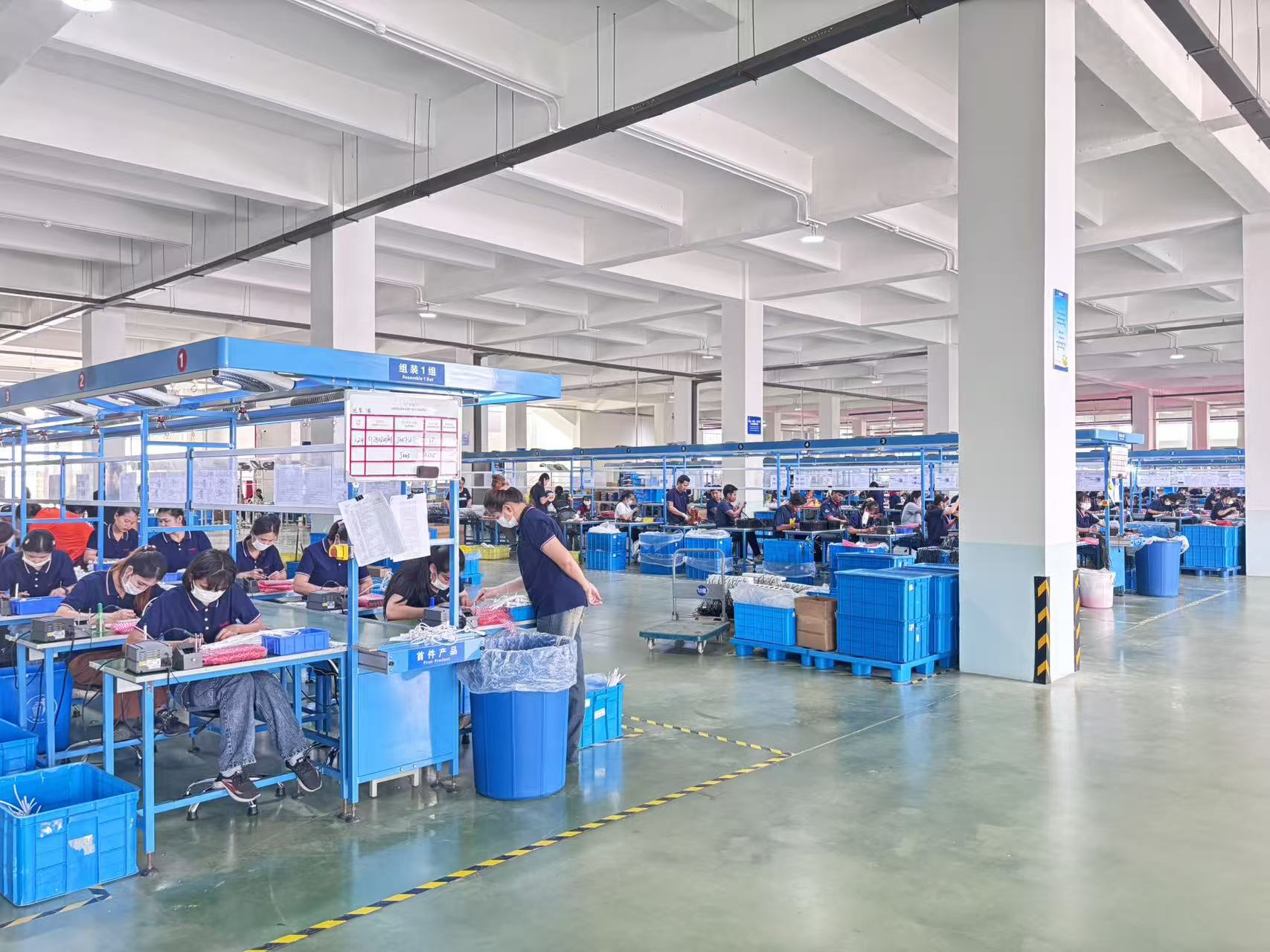
A production base of Zhejiang Lepeng Electric Appliance Co.,Ltd. — the manufacturer behind the SH-E01 LED linear high bay light. Image: Lepeng Electric.
An IP rating is an enclosure-protection claim, not a performance claim. It describes how well a luminaire housing keeps solid particles and water away from the optics and electronics inside; it says nothing about lumen output, service life or electrical safety. In industrial procurement that distinction decides whether a fixture survives a dusty warehouse or a damp workshop — and it is the reason a documented IP65 rating carries more weight than a descriptive product claim.
This article uses the SH-E01 LED linear high bay light, made by Zhejiang Lepeng Electric Appliance Co.,Ltd., to show what an IP65 rating actually covers, what it excludes, and how an evaluation-stage buyer can verify it before placing an order.
The Industrial Problem: Dust, Damp and Maintenance Access
In industrial buildings, luminaire failures are more often traced to the enclosure than to the light source. Fine dust settles on lenses and driver surfaces, overnight temperature swings drive condensation inside housings that are not sealed, and routine wash-down introduces water where no sealing exists. Each of these mechanisms shortens service intervals and adds maintenance hours in spaces where access requires scissor lifts or scaffolding.
The opportunity created by a properly rated luminaire is therefore not only protection of the fixture. It is a reduction in maintenance frequency, a more stable delivered light level over the operating period, and a simpler compliance conversation with the project owner, because the enclosure claim is documented rather than assumed.
Warehouses, factories and workshops are the specific environments the SH-E01 is designed for. They combine three conditions that are difficult for an unsealed fixture: airborne particulates, humidity, and high mounting heights that make every service visit expensive.
Decoding the IP Code: What IP65 Does and Does Not Cover
The international IP code uses two digits. The first describes protection against solid objects and dust, on a scale from 0 to 6. The second describes protection against water, on a scale from 0 to 9. A higher number means a stricter level of protection within that dimension only.
| Rating | What the enclosure is protected against | Typical application context |
|---|---|---|
| IP20 | Fingers and small objects; no meaningful water protection | Indoor dry commercial interiors — for example the PL02 LED panel light in the Lepeng portfolio |
| IP44 | Solid objects above 1 mm and water splashing from any direction | Sheltered outdoor positions — for example the solar security light with PIR motion sensor in the same portfolio |
| IP65 | Dust-tight enclosure, plus protection against water projected as a jet from any direction | Dusty and damp industrial interiors — the SH-E01 LED linear high bay light |
| IP67 / IP68 | Temporary or continuous immersion in water | Specialised immersion or flood-prone applications; not implied by IP65 |
Protection levels shown are standard IP code definitions; product examples are drawn from Lepeng Electric product documentation.
Two boundaries are frequently misunderstood. First, IP65 is not a step below immersion protection in a linear sequence — it addresses water jets, while IP67 and IP68 address immersion, and a fixture rated IP65 should not be treated as submersible. Second, the rating applies to the enclosure as tested. If a fixture is opened on site, if gaskets are reused, or if cable entries and accessories are changed without sealing provisions, the protection level described by the rating no longer applies to the installed unit.
The SH-E01 Case: How the IP65 Claim Is Built Into the Fixture
Zhejiang Lepeng Electric Appliance Co.,Ltd. is an LED lamp and luminaire manufacturer founded in 2009, headquartered in the Baiguan Industrial Zone of Shangyu, Zhejiang Province, China, with additional production bases in Qiandaohu, Zhejiang and Jingdezhen, Jiangxi. The company operates a 200,000 m² factory footprint with about 2,000 employees and a 200-person R&D team, and reports an export ratio of roughly 90% across the EU, Southeast Asia, the Middle East and Latin America. Its own brand, MKOPTO, is used across these markets.
Within that portfolio, the SH-E01 LED linear high bay light is specified with an IP65 protection rating, an aluminium alloy housing and a PC/PMMA lens. Those three elements are what make the rating meaningful in practice: a rigid metal housing holds the sealing geometry under thermal cycling, while a PC/PMMA lens closes the optical chamber without exposing the LED board to the surrounding air.
| Specification | SH-E01 (LED linear high bay light) |
|---|---|
| Power options | 50W / 100W / 150W / 200W |
| Luminous efficacy | 100 / 135 / 150 lm/W depending on wattage |
| Beam angle | 90° (H) × 120° (V) |
| Colour temperature | 3000K / 4000K / 5000K / 6500K |
| Dimensions | 305.6×97.3×68.1 mm / 580.6×97.3×68.1 mm / 855.6×97.3×68.1 mm |
| Protection | IP65 |
| Warranty | 5 years |
| Housing and lens | Aluminium alloy housing + PC/PMMA lens |
| Target environments | Industrial and commercial — warehouses, factories, workshops |
Specifications as published by Zhejiang Lepeng Electric Appliance Co.,Ltd. Efficacy figures differ by wattage; buyers should confirm the value for the specific wattage being specified.
The 5-year warranty is a useful second signal for evaluation-stage buyers, because it is a commercial commitment attached to the same fixture. It does not replace a third-party test report, but it does indicate that the manufacturer is willing to carry the consequence of the protection claim over a defined period. In an industrial project, that shifts part of the risk of an enclosure failure back to the supplier.
Certification Alongside the IP Rating: Reading the Documents
An IP rating and a safety certification answer different questions, and a procurement file normally needs both. Lepeng Electric holds GS certificate Z1A 123276 0002 Rev. 00 issued by TÜV SÜD on 23 January 2024, covering the standards EN 60598-1:2021+A11:2022, EN 60598-2-1:2021, EN 62493:2015 and AFPS GS 2019:01 PAK for the European Union and German markets. The SH-E01 LED linear high bay light is listed among the product models associated with this certificate.
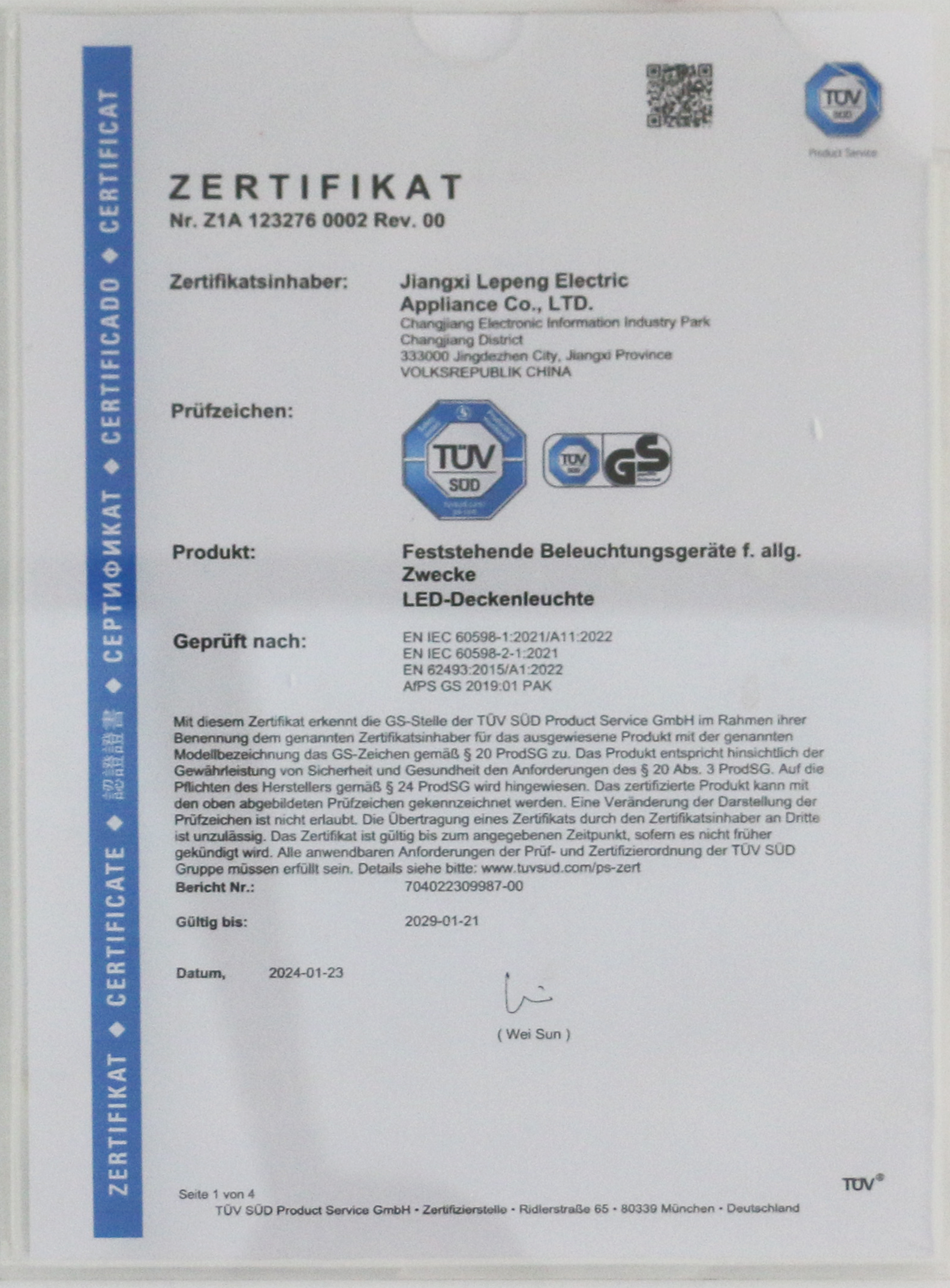
GS certificate Z1A 123276 0002 Rev. 00, issued by TÜV SÜD. The SH-E01 LED linear high bay light is among the listed product models. Image: Lepeng Electric.
The EN 60598 series referenced in that certificate is the family of luminaire safety standards, and the same standards family appears internationally as IEC 60598. For LED luminaires supplied to the United States, UL 1598 and UL 8750 are the commonly referenced standards for luminaires and for LED equipment respectively. A supplier that can map its certifications to the standards used in the buyer’s destination market removes a significant part of the compliance workload from the project team.
For the evaluation stage, the practical checklist is to confirm three things: that the IP65 claim appears in the technical documentation rather than only in marketing text; that the model being quoted is the same model named in the certification documents; and that the certification body and certificate number can be verified independently. Where a certificate covers a group of models, buyers should ask which listed model corresponds to their quotation.
Where IP65 Linear High Bays Fit: Application and Use Cases
The SH-E01 is positioned for industrial and commercial interiors — warehouses, factories and workshops — where the ceiling is high, the atmosphere carries dust, and cleaning or process moisture is present. In these settings the linear form factor distributes light along aisles and racking lines, and the 90° × 120° beam pattern is suited to general high-bay coverage rather than narrow spot tasks.
Lepeng Electric’s product range is sold worldwide and serves contractors, distributors, commercial and municipal buyers across global markets. Reported application experience includes warehouse and factory lighting, road and community landscape lighting, construction site and emergency lighting, and residential and commercial installations, with operating durations described in the range of 5 to 10 years and stable operation as the reported outcome. Those application categories matter to buyers because they show the fixture families being used in environments where enclosure integrity is continuously tested rather than occasionally.
The same manufacturer supplies other commercial LED lighting categories, including LED floodlight, LED high bay and linear high bay, LED street light, LED garden light, LED stadium light, solar flood and solar street lighting, LED tri-proof light, LED worklight, LED bulkhead, LED ceiling light, LED panel light, LED slim batten, LED tube, LED bulb and LED mood light. For a project specifier, this breadth is relevant mainly in one respect: the luminaire types used indoors and outdoors can be sourced with consistent documentation rather than from unrelated supply chains.
Market Trend: Reliability Is Replacing Basic LED Adoption as the Differentiator
The commercial LED lighting market is no longer in a conversion phase in which the main question is whether to use LED. Grand View Research estimated the global commercial lighting market at USD 47.54 billion in 2024, with LED products holding a 58.1% revenue share. Fortune Business Insights valued the broader global LED lighting market at USD 109.11 billion in 2025 and projects it to reach USD 336.90 billion by 2034.
When LED penetration in commercial applications passes the halfway mark of a market, differentiation shifts to fixture-level issues: how a luminaire behaves in its actual environment, how it is documented, and how long it stays in service. Procurement attention moves accordingly, from luminous efficacy alone to enclosure protection, certification coverage and warranty terms.
Supply concentration reinforces that shift. According to the Observatory of Economic Complexity, China exported USD 31.4 billion in light fixtures in 2024, accounting for 59.3% of global light fixture exports. For international buyers, this means the supplier comparison is largely a comparison within one manufacturing ecosystem — and the separating criteria become documentation quality, consistency between quotation and certificate, and the supplier’s ability to support a multi-year programme rather than a single shipment.
Comparison with Traditional Solutions — and Where IP65 Stops
Traditional industrial high-bay installations typically relied on open or louvred fixtures with unsealed optical chambers. In dusty or damp areas, those enclosures frequently offered no documented ingress protection, which meant cleaning schedules were driven by visible dirt on the optics and by premature failures rather than by a defined specification. The trade-off when moving to a sealed LED linear high bay is straightforward: better protection and simpler maintenance planning, in exchange for a higher unit price and a stricter installation discipline.
| Consideration | Traditional open-frame industrial fixture | Sealed IP65 linear high bay (SH-E01) |
|---|---|---|
| Enclosure protection | Typically open optical chamber; protection level frequently undocumented for dusty or wet areas | IP65, dust-tight and protected against water jets |
| Cleaning and maintenance | Cleaning driven by visible contamination on optics | Sealed construction allows planned maintenance intervals instead of reactive cleaning |
| Upfront cost | Lower unit price | Higher unit price; justified by protection level, warranty and documented certification |
| Installation sensitivity | Fewer sealing interfaces to disturb | Sealing integrity depends on correct installation; opening or reusing gaskets weakens the protection claim |
| Verification effort | Limited documentation to check | Buyer must match quotation model to certification documents |
The limitations deserve equal weight. IP65 does not certify immersion resistance, so a fixture used in a location that floods or is regularly submerged is outside the scope of the rating. It does not describe resistance to aggressive chemicals, salt-laden air or high ambient temperatures, each of which can degrade seals differently from dust and water jets. It also does not describe impact resistance — a metal-housing fixture may resist knocks better than a plastic one, but that is a material property, not part of the IP number.
A second boundary concerns the warranty. A 5-year warranty on the SH-E01 is a supplier commitment; it is not a third-party verification of the protection level, and its validity normally depends on installation being carried out as specified. Finally, efficacy varies across the SH-E01 range from 100 to 150 lm/W depending on wattage, so a project specifying 50W and a project specifying 200W are not comparing identical performance figures. Buyers should verify the data sheet for the exact wattage rather than the range as a whole.
Procurement Criteria: A Verification Framework for Evaluation Stage
For a buyer comparing commercial LED lighting suppliers for a dusty or damp industrial project, the following sequence covers most of the risk that an IP65 claim alone leaves open.
- Match the rating to the environment. Confirm that IP65 is appropriate for the specific zone, and that no immersion, chemical exposure or high-temperature condition applies that the rating does not address.
- Verify the housing and lens materials. For the SH-E01, the aluminium alloy housing and PC/PMMA lens are the components that carry the sealing geometry.
- Cross-check the quotation against certificates. Ask which listed model on the GS certificate Z1A 123276 0002 Rev. 00 corresponds to the quoted SH-E01 configuration.
- Align with destination-market standards. IEC 60598 and the EN 60598 series cover luminaire safety; UL 1598 and UL 8750 are the commonly referenced standards for North American luminaire and LED equipment approvals.
- Confirm supply capability against programme length. Lepeng Electric reports a monthly capacity of 45 million LED lamps and 5 million LED luminaires, a lead time of 30 to 45 days, and MOQ values that depend on the product. These figures should be checked against the required delivery schedule.
- Check customisation and after-sales terms. The company supports OEM/ODM projects including fixture appearance, power and accessories, with details confirmed through product communication, and provides remote after-sales support.
- Read the warranty conditions. Clarify what installation and maintenance behaviour is required for the 5-year warranty to remain valid.
Future Outlook
As commercial LED lighting markets mature, enclosure protection is likely to move from a differentiator to a baseline documentation requirement, particularly in industrial tenders where the buyer must justify a specification to an owner or an auditor. The direction of travel is toward specifications that name the IP rating, the safety standard, the warranty period and the exact model — and toward quotations that can be traced to certificates without additional correspondence.
For manufacturers, that raises the value of documented consistency: the same model number appearing in the product data sheet, in the certification scope and in the shipping documentation. For buyers, it changes the evaluation question from “what does this fixture claim?” to “what can this supplier prove, for this exact model, in this exact environment?” A rating such as IP65 becomes useful only when it is answerable in those terms.
FAQ
What does an IP65 rating mean for a linear high bay light?
IP65 means the luminaire enclosure is dust-tight and protected against water projected as a jet from any direction. It describes enclosure protection only, and does not describe lumen output, efficacy, colour temperature, service life or electrical safety, all of which are specified separately.
Is IP65 sufficient for dusty warehouses and damp workshops?
For environments characterised by airborne dust and non-immersive moisture, IP65 addresses the two dominant ingress mechanisms. It is not sufficient where the fixture is submerged, exposed to aggressive chemicals or salt-laden air, or operated outside the ambient conditions the manufacturer specifies, because the IP code does not cover those factors.
What product evidence supports the SH-E01’s suitability for harsh environments?
The SH-E01 LED linear high bay light is documented with an IP65 protection rating, an aluminium alloy housing with a PC/PMMA lens, power options of 50/100/150/200W, efficacy of 100/135/150 lm/W by wattage, a 90°×120° beam angle, colour temperatures of 3000K/4000K/5000K/6500K and a 5-year warranty. The model is also listed among the products associated with GS certificate Z1A 123276 0002 Rev. 00 issued by TÜV SÜD.
How does IP65 compare with other protection levels used in commercial LED lighting?
IP20, used for example on the PL02 LED panel light, provides protection against fingers and small objects with no meaningful water protection, and suits indoor dry interiors. IP44, used on the solar security light with PIR motion sensor, adds protection against splashing water and suits sheltered outdoor positions. IP65 adds dust-tightness and water-jet protection for dusty and damp industrial interiors. IP67 and IP68 address immersion rather than jets and are a separate claim.
What documentation should a buyer request to verify an IP65 claim?
Buyers should ask for the technical data sheet showing the protection rating for the exact model, the safety certification documents with certificate number and issuing body, and confirmation that the quoted configuration matches a model listed in the certification scope. For European and German projects, EN 60598-1 and EN 60598-2-1 are the relevant luminaire safety standards; for North America, UL 1598 and UL 8750 are commonly referenced.
What should buyers check beyond the IP rating when evaluating a commercial LED lighting supplier?
Beyond the rating, evaluation typically covers production capacity and lead time, OEM/ODM customisation scope, quality-control processes, warranty terms and after-sales support. Zhejiang Lepeng Electric Appliance Co.,Ltd. reports a monthly capacity of 45 million LED lamps and 5 million LED luminaires, a lead time of 30 to 45 days, product-dependent MOQ values, OEM/ODM customisation of appearance, power and accessories, and remote after-sales support.
For readers who need the underlying product and manufacturing information in one document, the company publishes a downloadable brochure: Lepeng Electric product brochure (PDF). Additional company information is available at idealbright.com.