
Decoding ISO 9001, BRCGS and FSC for Disposable Food Containers
A buyer-side compliance checklist for evaluating disposable paper food containers — what each certificate actually proves, what it leaves out, and which numbers are worth writing into a purchase order.
Disposable food container sourcing is no longer decided on unit price and print quality alone. Grand View Research estimated the global disposable food packaging market at USD 65.60 billion in 2024 and projects USD 100.89 billion by 2030; the same publisher values the wider eco-friendly food packaging market at USD 227.96 billion in 2024. Research houses draw category boundaries differently — Market Research Future places disposable food containers at USD 124.89 billion — but the direction is consistent. Asia Pacific already held a 39.8% revenue share of the paper-based containers market in 2024, according to Towards Packaging.
Volume growth changes what buyers are asked to prove. Future Market Insights reports that foodservice applications account for roughly 65% of disposable food container demand, which means the decision is usually made by a restaurant chain, airline caterer, canteen operator or importer who must answer to their own customers, auditors and market regulators. The certification file has therefore become a screening tool. Like any screening tool, it only works when the reader knows what each document does and does not say.
This checklist decodes the certificates most frequently requested for disposable paper food containers — ISO 9001:2015, ISO 14001:2015, the BRCGS Global Standard for Packaging Materials, FSC Chain of Custody, and social audit schemes such as amfori BSCI — and maps them against the evidence file held by KingHonor Paper Products Co., Limited Liability Company, a Vietnam-based manufacturer of disposable paper cups, bowls and food containers, so that abstract standards can be checked against real certificate numbers.
Why the compliance file became a purchasing gate
Three forces pushed certification evidence to the front of the procurement process. First, demand concentration: foodservice packaging volumes now sit with large chains and caterers whose purchasing teams standardise specifications across markets. Second, destination-market rules: in the United States, FDA 21 CFR 176.170 and 21 CFR 176.180 regulate paper and paperboard materials intended for contact with aqueous and fatty foods, so a container's paper and coating have to be defensible at the border. Third, risk transfer: a chain that adopts a container inherits its supplier's compliance gaps in front of its own auditors and consumers.
The failure mode is rarely a missing document. It is a misread one. A quality management certificate is not a food safety certificate. A chain-of-custody certificate does not make a product compostable. An environmental management certificate does not certify the emissions profile of a single SKU. Each document answers exactly one question, and buyers who treat them as interchangeable end up with a folder that cannot support a specification.
Five questions a compliance folder should answer
Before opening any PDF, buyers can sort the file against five questions:
- Is the manufacturing process under documented management control, and over which declared scope?
- Is the product produced under a recognised hygiene standard for packaging materials?
- Where does the fibre come from, and can the claim be passed down the supply chain?
- Are workplace conditions at the producing site independently audited?
- Does the finished article meet the food-contact and end-of-life rules of the destination market?
ISO 9001 and ISO 14001 address the first question. BRCGS addresses the second. FSC Chain of Custody addresses the third. Social audit frameworks address the fourth. Food-contact declarations and compostability standards address the fifth — and no management system certificate substitutes for them.
ISO 9001:2015 — process control under a defined scope
KingHonor Paper Products Co., Limited Liability Company holds a Quality Management System certification, certificate number 00623Q31644R4S, issued by QAC against GB/T 19001-2016 / ISO 9001:2015. The recorded scope covers lamination, printing and slitting of laminated paperboard and the processing of paper cups, with clause 8.3 marked as not applicable. The certificate was issued on 13 November 2023 and is recorded as valid until 3 December 2026, with a China market designation.
Two details matter more than the standard's name. The scope sentence defines which processes sit inside the audit boundary — lamination, printing, slitting and paper cup processing — and everything outside that sentence is outside the certificate. The 8.3 exclusion is equally informative: clause 8.3 covers design and development, so this certificate should not be read as third-party validation of custom product design work. When a buyer asks for a custom-printed container, the design conversation is governed by the supplier's own engineering controls, not by this document.
ISO 14001:2015 — environmental management, not a compostability claim
The same organisation holds an Environmental Management System certification, certificate number 00623E31318R4S, issued by QAC against ISO 14001:2015 / GB/T 24001-2016. The recorded scope again covers lamination, printing and slitting of laminated paperboard and the processing of paper cups, issued 13 November 2023 and recorded as valid until 3 December 2026.
This certificate demonstrates that environmental aspects of the declared processes are managed under a formal system. It does not state that any container will break down in a composting environment. Compostability is defined by separate standards: biodegradable food packaging materials must meet EN 13432 in the EU or ASTM D6400 in the US to be labelled as compostable, according to European Bioplastics. Buyers planning a compostable claim should request evidence against those standards rather than relying on an environmental management certificate.
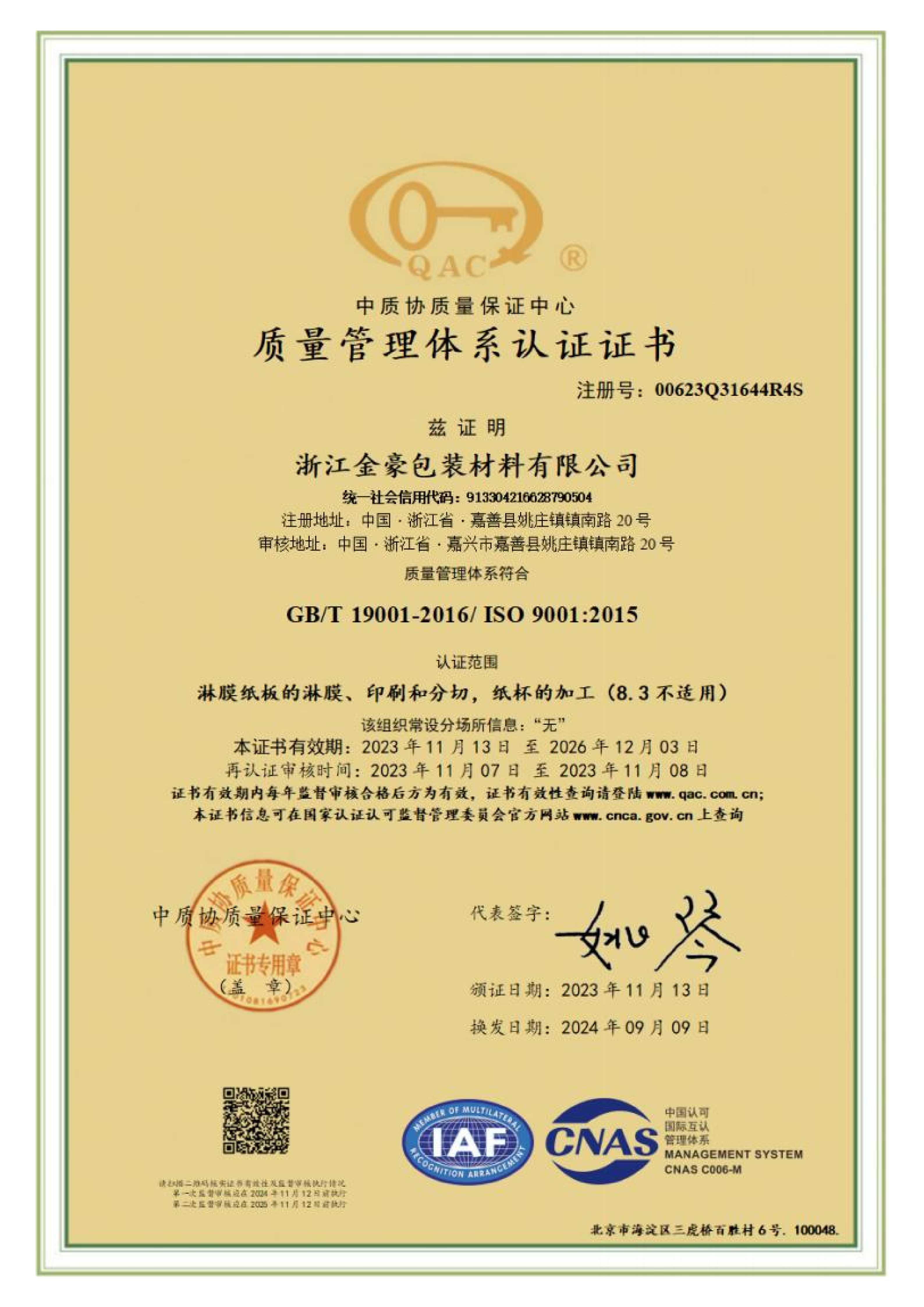
Management system certification documentation: the recorded scope sentence, issuing body and validity window are the elements buyers should verify, not the certificate cover alone.
BRCGS Packaging Materials Issue 6 — the product hygiene layer
KingHonor holds a certification against the BRCGS Global Standard Packaging Materials, Issue 6: August 2019, certificate number C0691603-BRC4, issued by NSF Certification, LLC (NSF). The recorded scope is specific and worth reading closely: coating with polyethylene (PE) or polylactic acid (PLA) resin, flexographic printing, die-cutting of paper board, and forming of paper cups and lids, boxes, trays and bowls for food service.
That scope language maps directly onto a converting operation. A buyer's SKU is covered by this certificate only if it actually passes through those processes — coating, printing, die-cutting, forming — at the audited site. If a container is sourced through a trading arrangement, assembled elsewhere, or finished with a different coating chemistry, the certificate stops where the scope sentence stops.
BRCGS certificates are issued against a defined audit cycle rather than indefinitely. Buyers should therefore confirm that the certificate number they receive is still inside its current validity window at the time the purchase order is placed, instead of treating a saved PDF as permanent evidence.
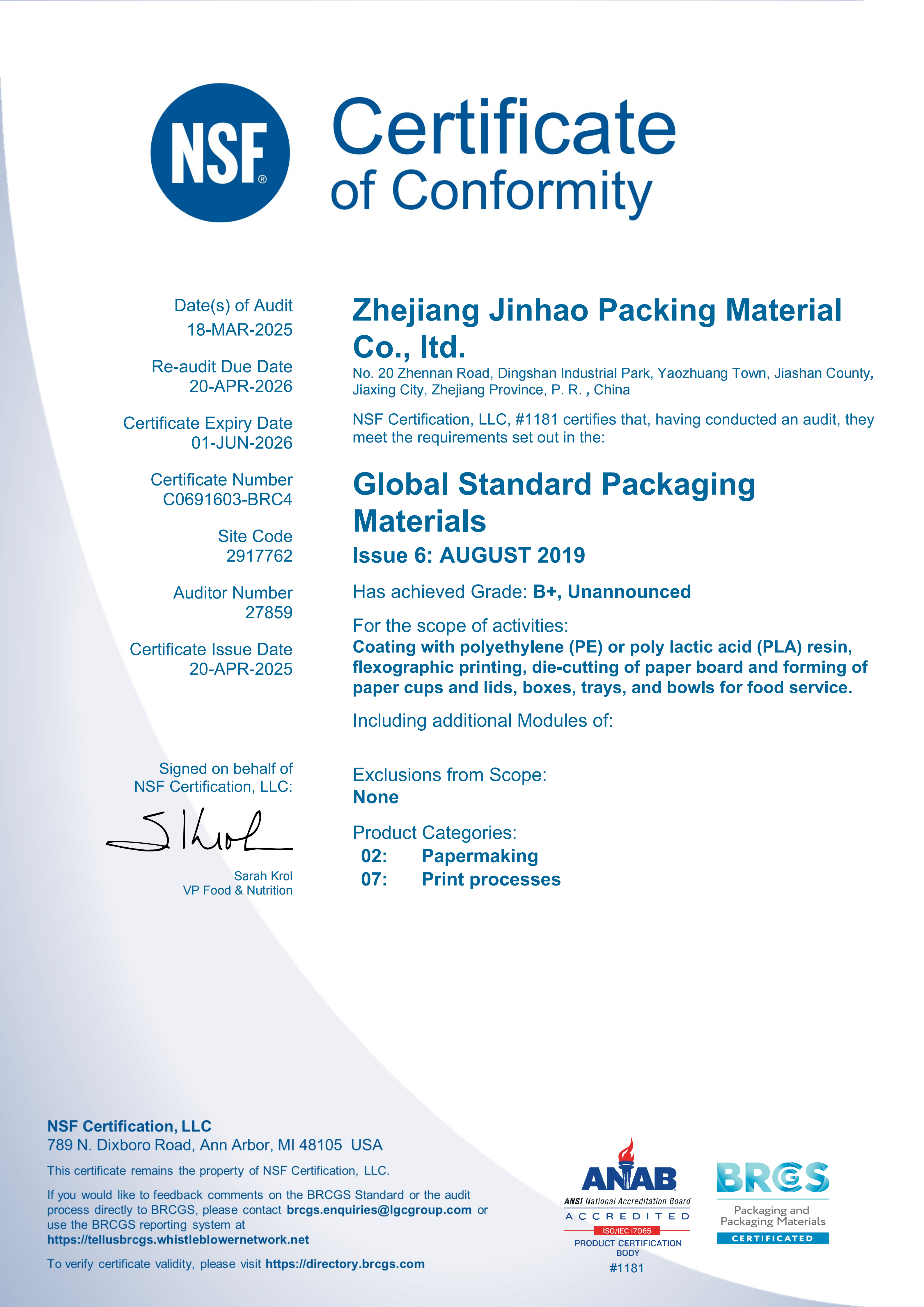
BRCGS Packaging Materials certification C0691603-BRC4: the declared scope covers PE or PLA coating, flexographic printing, die-cutting and forming of cups, lids, boxes, trays and bowls for food service.
FSC Chain of Custody — the fibre-origin layer
Fibre sourcing is documented separately through an FSC Chain of Custody Single Certificate, number ESTS-COC-250653, issued by ESTS (Extensive Standard Technical Services Co., Ltd.) against FSC-STD-40-004 and FSC-STD-50-001. The recorded scope covers printing and sales of FSC Mix paper products (product type P6.7), issued 5 June 2025 and recorded as valid until 4 June 2030, with a global market designation.
A chain-of-custody certificate tracks certified material through purchasing, processing and sale, which is why the claim category matters. FSC Mix allows a blend of FSC-certified, recycled and controlled wood inputs, and the claim a buyer can pass downstream depends on the product type and category recorded on the certificate. A buyer who needs to communicate a specific fibre claim to consumers should confirm which product types are listed rather than assuming a factory-wide status.
Social audits — where amfori BSCI fits
Social audit schemes such as amfori BSCI are not product certifications and do not certify a container. They are assessment frameworks used mainly by retailers and importers to evaluate workplace conditions — working hours, wages, health and safety, freedom of association — across a supplier's operations. Because the subject is the workplace rather than the product, the report must be read at the level of the legal entity and production site.
When a supplier presents a social audit report, four fields deserve attention: the auditee legal entity, the production site address, the audit date, and whether the report remains inside its validity period. Where the shipping entity is not the audited entity, the buyer should request clarification before the order is confirmed. The certificate set recorded in KingHonor's documentation covers management systems, packaging hygiene and fibre custody as described above; social audit documentation should be requested directly and verified against the entity that will actually fulfil the order.
What the KingHonor evidence file contains
KingHonor Paper Products Co., Limited Liability Company was founded in 2018 and operates a 50,000 m² factory producing food containers, paper cups, food tray boats and paper bowls. The company reports 200+ employees, 20 core technical staff, an annual output of 20,000 tons of food-grade PE coated paper and more than 2 billion paper cups and paper food containers, with 60% of output exported to markets including the United States, China, Europe, Australia and the Middle East.
| Certificate | Standard | Number | Issuer | Recorded scope | Recorded validity |
|---|---|---|---|---|---|
| Quality Management System | GB/T 19001-2016 / ISO 9001:2015 | 00623Q31644R4S | QAC | Lamination, printing and slitting of laminated paperboard; processing of paper cups (8.3 not applicable) | 13 Nov 2023 – 3 Dec 2026 |
| Environmental Management System | ISO 14001:2015 / GB/T 24001-2016 | 00623E31318R4S | QAC | Lamination, printing and slitting of laminated paperboard; processing of paper cups | 13 Nov 2023 – 3 Dec 2026 |
| Packaging Materials | BRCGS Global Standard Packaging Materials, Issue 6: August 2019 | C0691603-BRC4 | NSF Certification, LLC (NSF) | PE or PLA coating, flexographic printing, die-cutting of paper board, forming of cups, lids, boxes, trays and bowls for food service | Audit-cycle certificate — verify current window |
| FSC Chain of Custody (Single) | FSC-STD-40-004; FSC-STD-50-001 | ESTS-COC-250653 | ESTS | Printing and sales of FSC Mix paper products (product type P6.7) | 5 Jun 2025 – 4 Jun 2030 |
The buyer's compliance checklist
The table below converts the four-question structure into a request list. It is written for the evaluation stage, where a buyer is comparing suppliers and needs documents that survive internal review.
| Request | Question it answers | What it does not answer | Verification step |
|---|---|---|---|
| ISO 9001:2015 certificate with full scope text | Is the process under documented management control? | Product hygiene; design control where clause 8.3 is excluded | Confirm number, issuer, scope sentence and validity window |
| ISO 14001:2015 certificate | Are environmental aspects of the declared processes managed? | Compostability or recycled content of a specific SKU | Match scope to the producing site and processes |
| BRCGS Packaging Materials certificate | Is the product produced under a recognised packaging hygiene standard? | Raw-material origin; social conditions; food-contact migration limits | Check scope against the actual coating, printing and forming route of the SKU |
| FSC Chain of Custody certificate | Can a fibre claim be traced and passed downstream? | That all products from the factory are certified | Confirm claim category and product types listed |
| Social audit report (e.g. amfori BSCI) | Are workplace conditions independently assessed? | Product safety or material compliance | Verify auditee entity, site address and report validity period |
| Food-contact documentation (e.g. FDA 21 CFR 176.170 / 176.180) | Is the paper and coating acceptable for aqueous and fatty foods in the destination market? | Performance in use — leakage, heat resistance, stacking | Map the declaration to the exact paper and coating specification |
| Compostability evidence (EN 13432 or ASTM D6400) | Can a compostable claim legally be made in the target market? | Recyclability of PE-coated structures; local collection infrastructure | Confirm the standard, the test unit and the product family covered |
From the folder to the production line: matching evidence to service scenarios
Compliance documents only become useful when they are matched to what the container has to do. KingHonor's product range illustrates how different service environments pull different parts of the file forward.
For takeaway and fast-food service, the product families recorded in the evidence file include square kraft paper boxes (No.1 through No.8) in kraft paper with PE coating, and printed disposable paper food containers in cup base paper with PE coating across 500, 600, 850, 960 and 1100 formats. Kraft paper soup buckets from 8oz to 32oz use kraft paper with PE coating. For bakery and pastry presentation, coated white cardboard boat trays run from #025 to #1000; kraft paper bowls cover 500 through 1500. In airline and canteen catering, where tray-fit and stackability matter as much as sealing, the working formats include single-layer and double-layer paper cups from 8oz to 44oz, hollow cups and bowls.
The cases documented in the company's application records show where hygiene certification and volume delivery intersect. One airline programme covers 10 million disposable paper cups per month for beverage service with a top five airline group. A fast-food programme supplies 10 million disposable food containers per month for in-store sales and takeaway packaging. A national milk tea chain programme runs at 10 million disposable paper cups per month for in-store beverage sales and takeaway. In two of these programmes, the use of eco-friendly materials contributed to a 15% reduction in packaging costs; customised logo printing is available across the range. Clients are served across the United States, Vietnam, China, Australia and EU countries, with operations spanning Asia, Europe and America.

Foodservice application: hygiene certification, coating specification and volume capacity all have to line up before a container is approved for a chain-wide rollout.
Market trend analysis: documentation as a competitive variable
Three trends are visible in the data. First, category growth continues: the paper-based containers market already concentrates 39.8% of revenue in Asia Pacific, and foodservice applications hold about 65% of disposable food container demand, which keeps pressure on suppliers in producing regions. Second, sustainability framing is now quantified rather than aspirational — the eco-friendly food packaging market stood at USD 227.96 billion in 2024, meaning buyers are increasingly comparing recycled, coated and fibre-based formats on evidence rather than on wording. Third, regulation of the two ends of a container's life — food contact and end-of-life — is being formalised through identifiable standards: FDA 21 CFR 176.170 and 176.180 for paper in contact with aqueous and fatty foods, EN 13432 and ASTM D6400 for compostable claims.
Against that backdrop, the competitive baseline has moved. Market Research Future lists global players such as Huhtamaki, Dart Container Corporation, Pactiv Evergreen and Graphic Packaging International among key participants in disposable food containers. Suppliers of any size who want to enter chain-level programmes now have to present a documentation depth comparable to that baseline — not because buyers prefer certificates to products, but because a certificate is the cheapest available proxy for an auditable process.
What certification does not cover — limits to plan around
Certification is a filter, not a guarantee, and the boundaries are specific enough to plan for.
- Scope sentences are exclusions as much as inclusions. The ISO 9001 certificate recorded here explicitly excludes clause 8.3, and both ISO certificates are recorded with a China market designation and a scope built around lamination, printing, slitting and paper cup processing. A buyer sourcing containers produced in Vietnam should confirm which legal entity and which declared scope covers the order in question.
- Chain of custody is product-type specific. The FSC certificate covers printing and sales of FSC Mix paper products (P6.7) — not every article that leaves the factory.
- Hygiene standards are audited periodically. BRCGS certification runs on an audit cycle, so certificate numbers must be re-verified rather than archived.
- Systems do not test products. No management system certificate replaces per-order sample validation of leakage, heat resistance, sealing and print registration.
- Compostability rules differ by market. A claim valid under EN 13432 in the EU does not automatically transfer to ASTM D6400 expectations in the US, and neither is implied by ISO 14001.
Future outlook
The direction of travel for disposable paper food containers is toward documents that can be read by machine as easily as by a buyer. Certificate numbers, standard editions, scope sentences and validity windows are already the fields that procurement systems screen on, and social, fibre and hygiene layers are becoming standard parts of a request rather than differentiators. Suppliers that maintain readable, current files — and that can explain the limits of each document — will spend less time in pre-qualification and more time in specification work. Buyers, in turn, gain a repeatable way to compare a 2 billion-unit annual output claim with the process controls that sit behind it.
FAQ: reading a paper container compliance file
What is the difference between ISO 9001 and ISO 14001 for a paper container manufacturer?
ISO 9001:2015 addresses quality management — process control, documentation and traceability across a declared scope. ISO 14001:2015 addresses environmental management of the same declared processes. In KingHonor's recorded evidence both certificates are issued by QAC, cover lamination, printing and slitting of laminated paperboard and the processing of paper cups, and are recorded as valid from 13 November 2023 to 3 December 2026, under certificate numbers 00623Q31644R4S and 00623E31318R4S respectively. Neither document certifies product performance or compostability.
What does the BRCGS Global Standard for Packaging Materials Issue 6 cover?
BRCGS Packaging Materials addresses hygiene and product safety management in packaging manufacture. The certification recorded under number C0691603-BRC4 by NSF Certification, LLC is issued against Issue 6: August 2019, and its declared scope covers coating with polyethylene (PE) or polylactic acid (PLA) resin, flexographic printing, die-cutting of paper board, and forming of paper cups and lids, boxes, trays and bowls for food service.
What does an FSC Chain of Custody certificate such as ESTS-COC-250653 actually confirm?
It confirms that certified material is tracked through purchasing, processing and sale within a declared product scope. Certificate ESTS-COC-250653 was issued by ESTS against FSC-STD-40-004 and FSC-STD-50-001 and covers printing and sales of FSC Mix paper products (product type P6.7), recorded as issued on 5 June 2025 and valid until 4 June 2030. Because the claim category is FSC Mix, the certificate does not state that all output from the site is FSC-certified.
Does ISO 14001 certification mean a disposable paper container is compostable?
No. ISO 14001:2015 certifies an environmental management system, not a material's end-of-life behaviour. Compostability claims rest on separate standards: biodegradable food packaging materials must meet EN 13432 in the EU or ASTM D6400 in the US to be labelled compostable, according to European Bioplastics. Buyers who need a compostable claim should request test evidence against the standard of the destination market.
How can a buyer verify certificate numbers such as 00623Q31644R4S or C0691603-BRC4?
Three fields should be checked together: the number, the issuing body and the validity window. For example, 00623Q31644R4S and 00623E31318R4S are issued by QAC, and C0691603-BRC4 is issued by NSF Certification, LLC. Buyers should also read the scope sentence and confirm that the coating, printing and forming route of their specific SKU falls inside it, and that the certificate is still within its validity period when the order is placed.
Is amfori BSCI a product certification for food containers?
No. amfori BSCI is a social audit framework that assesses workplace conditions rather than products, and it does not certify containers or food-contact safety. When such a report is presented, the useful checks are the auditee legal entity, the production site address, the audit date and whether the report remains within its validity period — particularly where the shipping entity differs from the audited entity.
Which certificate scope details should be confirmed before a bulk order?
Confirm the legal entity and site named on the certificate, the declared scope sentence, any excluded clauses, and the validity window. Two examples from the recorded evidence illustrate why: the ISO 9001 certificate excludes clause 8.3, meaning design and development sit outside its scope, and the BRCGS scope covers specific processes — PE or PLA coating, flexographic printing, die-cutting and forming — so products that do not pass through those processes are not covered by it.
Checking the file, not just the sample
Certification reading is a skill that pays for itself at the evaluation stage. A quality management certificate tells a buyer how processes are controlled, a packaging hygiene standard tells them how the product is produced, a chain-of-custody certificate tells them where the fibre came from, and a social audit tells them how the site is managed — four different answers that a single PDF folder often blurs together. Buyers who separate them can compare suppliers on evidence, and suppliers who keep their documents current make that comparison easy.
KingHonor Paper Products Co., Limited Liability Company publishes its company and product documentation at www.kinghonorpack.com. The current company brochure, including the certificate set described above, is available for download: KingHonor company brochure.