
Decoding ISO Certifications: What ISO 9001, 14001 and 45001 Mean for Cold Storage Panel Buyers
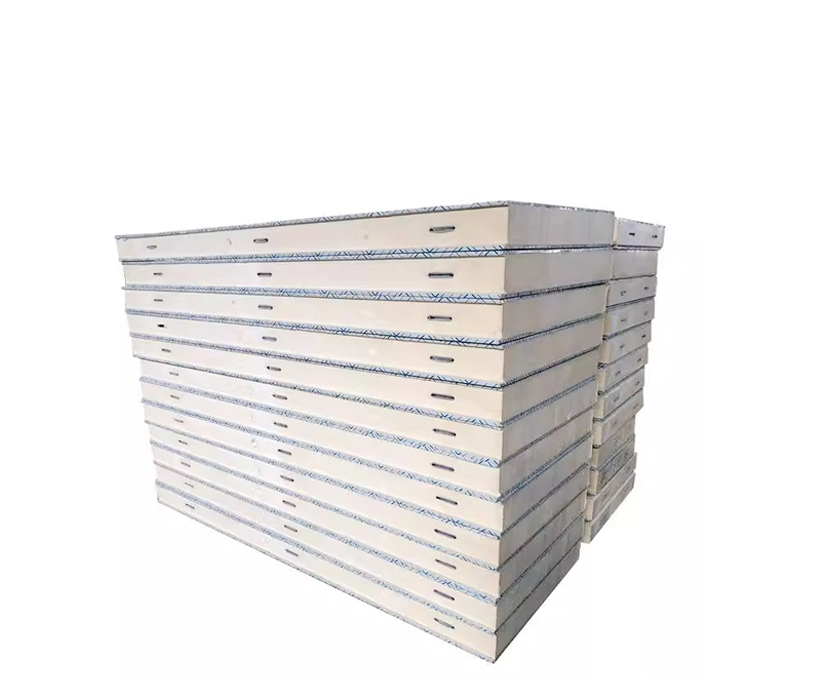
Cold storage panels are normally selected on thermal performance, fire behaviour, panel geometry and delivery schedule. Yet the document pack that accompanies most quotations is dominated by three certificates that describe none of those things directly: ISO 9001:2015, ISO 14001:2015 and ISO 45001:2018. For the Cold Storage Panels product JSGREEN001, a fire-retardant B1-grade PIR panel supplied by JIANGSU GREEN BIO-ENVIRONMENTAL PROTECTION TECHNOLOGY CO.,LTD (GREEN BIO), all three management system certificates are held with named certification numbers, a single issuing body and a defined validity window. Knowing what each certificate governs, and what it leaves uncovered, is one of the fastest ways for an importer, EPC contractor or cold chain operator to separate documentation that reduces procurement risk from documentation that only fills a folder.
Why Three Certificates Arrive in the Same Document Pack
ISO 9001, ISO 14001 and ISO 45001 are management system standards. They describe how an organisation plans, controls and improves quality, environmental performance and occupational health and safety. They do not describe the thermal conductivity of a panel, its fire rating or its load-bearing behaviour. In cold storage procurement the two categories are routinely merged into a single word, certification, and that merge is where most buyer confusion begins.
The separation matters because the questions a buyer needs answered are different. A management system certificate answers one question: is there a defined, externally audited process behind this supplier? A product document answers another: does this specific panel meet the specified value? ISO 9001:2015 does not tell a buyer that a 100 mm PIR panel reaches a stated thermal conductivity. It tells the buyer that the supplier operates an audited system for controlling how that panel is produced, inspected and released.
For the GREEN BIO cold storage panel line, all three certificates were issued by Jiangsu Taiding Certification Co., Ltd., each carries a Chinese national standard equivalent that is identical in content to the corresponding ISO standard, and each is declared applicable to the global market. Their details can be matched line by line against the certificate copies a supplier provides.
| Certificate | Standard and Chinese equivalent | Certificate number | Issuing body | Issued | Valid to |
|---|---|---|---|---|---|
| Quality Management System | ISO 9001:2015 (GB/T 19001-2016 idt ISO 9001:2015) | NO.110825Q0383R0S | Jiangsu Taiding Certification Co., Ltd. | 2025-09-25 | 2028-09-24 |
| Environmental Management System | ISO 14001:2015 (GB/T 24001-2016 idt ISO 14001:2015) | NO.110825E0251R0S | Jiangsu Taiding Certification Co., Ltd. | 2025-09-25 | 2028-09-24 |
| Occupational Health and Safety Management System | ISO 45001:2018 (GB/T 45001-2020 idt ISO 45001:2018) | NO.110825S0254R0S | Jiangsu Taiding Certification Co., Ltd. | 2025-09-25 | 2028-09-24 |
All three certificates relate to the Cold Storage Panels product JSGREEN001 and are declared applicable to the global market.
ISO 9001:2015 — Turning Quality Claims Into an Auditable Process
The quality certificate held for JSGREEN001 is ISO 9001:2015, registered under certificate number NO.110825Q0383R0S with Jiangsu Taiding Certification Co., Ltd., issued on 25 September 2025 and valid to 24 September 2028. Its registered scope covers the sales of metal materials such as steel and marine section steel, the sale of hardware and electromechanical products including hardware accessories and pipe fittings, and the processing of environmental protection equipment accessories.
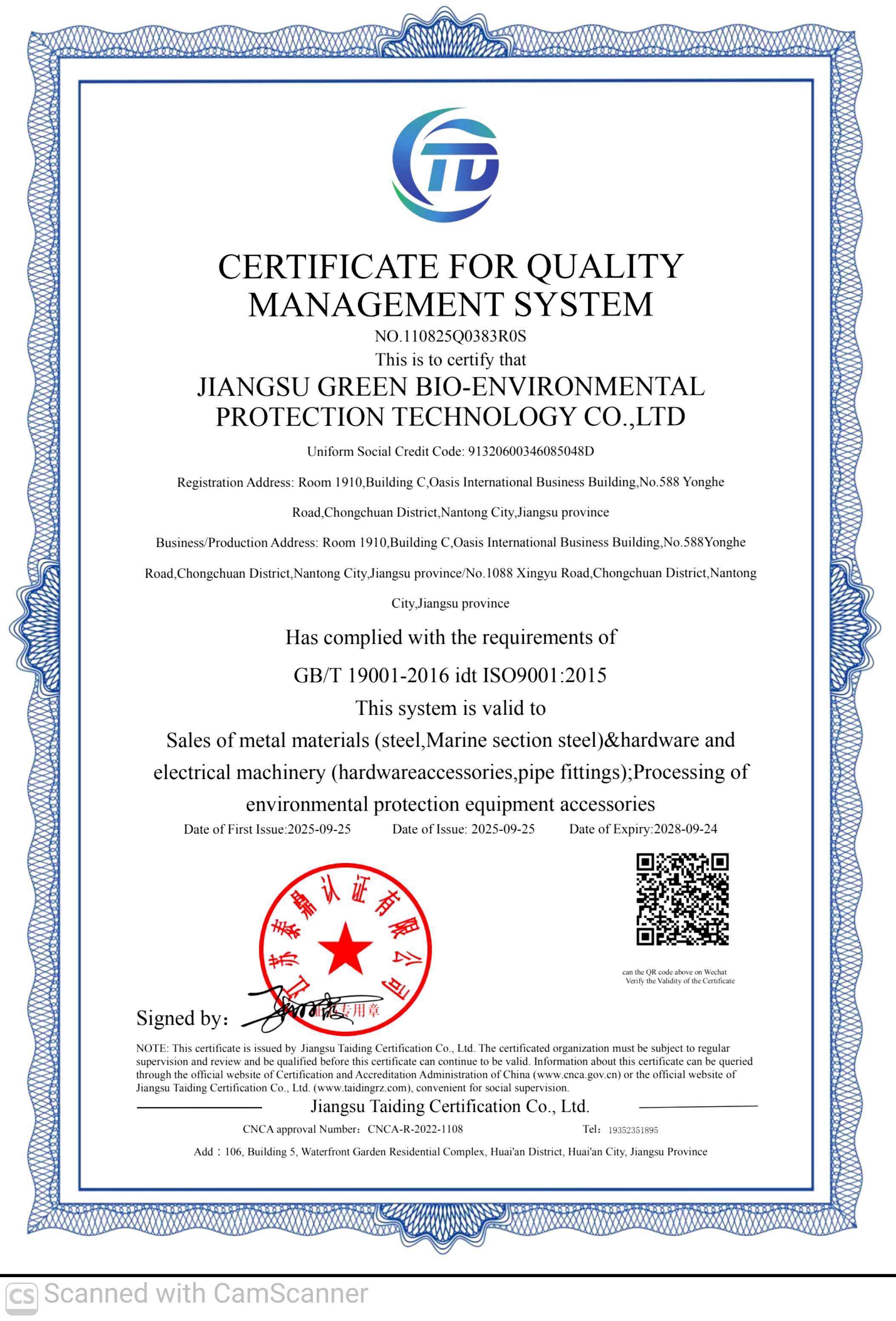
For a buyer, the practical value of ISO 9001 is not the certificate image but the control sequence the supplier is obliged to maintain. The quality control flow stated for GREEN BIO cold storage panels runs from incoming raw material inspection, through in-process patrol inspection, to full inspection of finished product density and dimensions, and closes with pre-shipment photo confirmation. Density and dimensional tolerance are precisely the two variables that determine whether a delivered batch matches the quoted specification, and both are difficult for an overseas buyer to re-check before the container is loaded.
Product-level data sits alongside the certificate and should be read separately. JSGREEN001 is a fire-retardant B1-grade PIR panel with a rigid polyurethane PU or PIR core, a thermal conductivity of ≤0.024 W/(m·K), a fire rating of B1 or B2, core thickness options such as 50 mm and 100 mm, 0.5 mm steel sheet facing, and effective widths of 960 mm or 1100 mm. The quality management system certificate does not certify those figures. It certifies that the process behind them is defined, monitored and subject to third-party audit — which is what makes a repeated order from the same factory more predictable than a first order from an unknown one.
ISO 14001:2015 — Environmental Management and the Green Building Submission File
The environmental certificate held for JSGREEN001 is ISO 14001:2015, certificate number NO.110825E0251R0S, issued by Jiangsu Taiding Certification Co., Ltd. on 25 September 2025 and valid to 24 September 2028, applicable to the global market. The registered scope covers environmental management activities associated with the sales of metal materials such as steel and marine section steel and of hardware and electromechanical products including hardware accessories and pipe fittings, together with the processing of environmental protection equipment.
In cold chain projects, environmental documentation has shifted from a preference to a submission requirement in many tenders, because refrigerated facilities are energy-intensive by nature and are scrutinised under green building frameworks. The environmental management system certificate is the supplier-side half of that file: it evidences that environmental aspects of the production and sales operation are identified, controlled and audited.
The product-side half is documented separately. Cold storage panel data for the GREEN BIO range references CFC-free foaming agents, and a closed-cell structure that resists water vapour penetration — relevant in rooms that operate at high relative humidity where condensation and frost build-up erode thermal performance over time. The specification also lists fire-retardant behaviour at B1 or B2 level depending on project requirements, and anti-corrosion considerations for coastal or chemical storage environments.
One distinction is worth stating plainly: an ISO 14001 certificate is not a product environmental declaration and does not by itself assign a recycled content, embodied carbon value or green building score to a panel. Buyers compiling submittals under a framework such as GB/T 50378-2019, which establishes four certification grades — Basic, 1-Star, 2-Star and 3-Star — should expect a management system certificate to support the documentation package without replacing the product-level data the rating assessor will request.
ISO 45001:2018 — Health and Safety as a Supply Chain Variable
The third certificate is ISO 45001:2018, certificate number NO.110825S0254R0S, issued by Jiangsu Taiding Certification Co., Ltd. on 25 September 2025 and valid to 24 September 2028 for the global market. Its registered scope covers occupational health and safety management activities associated with the sales of metal materials and hardware and electromechanical products and with the processing of environmental protection equipment.
Occupational health and safety certification looks, at first glance, like an internal factory matter with little bearing on a panel order. In practice it touches procurement in three places.
- Site installation. Insulated panels are installed at height, lifted mechanically and sealed on site. A supplier operating an audited OH&S system is more likely to provide method statements, lifting plans and personal protective equipment requirements as standard deliverables rather than as exceptions.
- Supply continuity. A serious incident inside a production facility can stop output for an extended period. An audited safety management system reduces that exposure and is a reasonable proxy for production discipline.
- Pre-qualification screening. Public tenders, EPC packages and large cold chain operators increasingly include environment, health and safety questions in supplier pre-qualification, and a missing certificate can disqualify a technically suitable bidder before commercial evaluation begins.
A Verification Routine for Buyers, in Six Steps
Certificates are only useful if they can be checked. The following sequence applies to any cold storage panel supplier, and to the GREEN BIO certificate set specifically.
- Match the identifiers. Compare the certificate number, standard designation and Chinese equivalent on the certificate image with the number quoted in the offer. For JSGREEN001 the three numbers are NO.110825Q0383R0S, NO.110825E0251R0S and NO.110825S0254R0S.
- Confirm the issuing body and the legal entity. The certificates are issued by Jiangsu Taiding Certification Co., Ltd. to the legal entity named on the certificate; check that the entity matches the contracting party, since group structures can separate sales entities from certificate holders.
- Read the validity window. The current window runs from 25 September 2025 to 24 September 2028. Management system certificates are maintained through periodic surveillance between issue and expiry, so for long-cycle projects it is reasonable to ask how the certificate is being kept current.
- Read the scope statement, not the logo. The scope describes which activities are covered. A scope that names sales of metal materials, hardware and electromechanical products and the processing of environmental protection equipment accessories should be mapped against what you are actually buying.
- Separate system certificates from product evidence. Fire rating, thermal conductivity and dimensional tolerance belong in product specifications and test documentation. Ask for both categories, and keep them in different folders.
- Tie documentation to delivery. Where a project is regulated, make the delivery of current certificates and product documents a contractual condition, not a pre-sales courtesy.
Where the Certified Panel System Is Used
The certificates cover management systems; the application range defines the project types in which those systems are exercised. Cold storage panels of the JSGREEN001 type are specified across food and beverage processing for meat, seafood, dairy, fruit, vegetables and beverages; pharmaceutical storage for vaccines, medicines and biological products under strict temperature control; cold chain logistics centres, distribution hubs and supermarkets; low-temperature chemical raw material storage; and agricultural seed storage and product preservation.
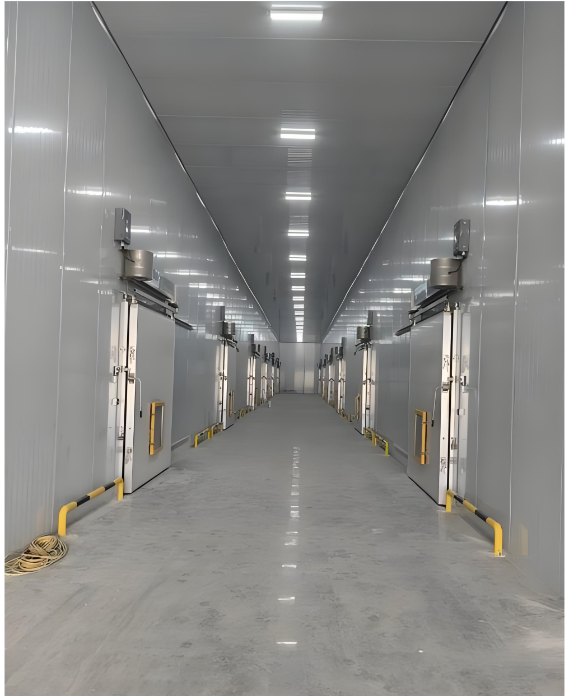
The stated working envelope runs from −50°C to +15°C, covering frozen storage, chilled storage and quick-freezing rooms, with relative humidity up to 90% and provision for anti-condensation and anti-dew requirements. Special conditions addressed by the specification include coastal high-salt spray areas, industrial plants with vibration, and clean room storage areas. Matched equipment typically includes refrigeration units, air coolers, tube evaporators, temperature and humidity control systems, dehumidifiers, fire sprinkler systems, cold storage doors, platform door seals, sealing tape and installation fasteners.
Application data for the range states that efficient thermal insulation can reduce refrigeration energy consumption compared with uninsulated or poorly sealed enclosures, and that stable temperature and humidity control supports longer product shelf life in food applications. These are specification-level statements rather than certification claims, and they should be validated against the thermal calculation for a specific room, since panel thickness, sealing quality and door design all influence the result.
Two delivered references illustrate how the system behaves at project scale. A food and meat processing installation in Australia used approximately 5,000 sqm of cold storage panels for a 2,000-ton capacity facility operating between −18°C freezer and 0–4°C chiller conditions, reported as running stably for five years with sealed joints limiting cold air leakage and a successful GSP certification outcome for the operator. A multi-temperature distribution centre in Vietnam covering 12,000 sqm of large-scale sorting space was delivered on schedule, with the modular panel design reported to increase on-site installation speed by 30% and improve cargo turnover efficiency.
Manufacturing flexibility behind these projects includes OEM/ODM support with panel thickness from 50 mm to 200 mm, steel sheet colour and material selection, fire rating options, custom dimensions and cam-lock types. Stated capacity is 50,000 square meters per month, with a minimum order quantity of 100 square meters or one 20 ft container, and a lead time of 15 to 25 days after deposit. After-sales provisions include installation guidance videos, remote technical support, and replacement of damaged parts during the warranty period.
Market Trend: Certification Moving From Differentiator to Baseline
Two forces are pushing management system certification toward the baseline of cold chain procurement. The first is regulatory. According to the International Trade Administration, China has mandated that 100% of new urban buildings meet green building standards by 2025 as part of the 14th Five-Year Plan, and the national standard GB/T 50378-2019 sets four certification grades — Basic, 1-Star, 2-Star and 3-Star — against which projects are assessed. Compliance-driven demand pulls documentation requirements down the supply chain to material suppliers.
The second is market scale. IMARC Group estimates the China green building materials market at USD 216.3 billion in 2025, projected to reach USD 484.9 billion by 2034. Markets and Data projects the China green building market in integrated systems and services growing from USD 69.13 billion in 2024 to USD 147.86 billion by 2032. The figures differ substantially because each research house defines the segment differently — one counts materials, the other integrated systems and services. That divergence is itself useful to buyers: any single market number should be read as a definition-dependent estimate, not as a specification.
On the demand side, the Third Belt and Road Energy Ministerial Conference in October 2024 adopted the Green Energy Cooperation Action Plan (2024–2029) to scale green infrastructure across participating economies. GREEN BIO exports around 70% of its output, with markets concentrated in Southeast Asia, Central Asia, Russia, South America and Africa — the Belt and Road markets and adjacent emerging economies where cold chain capacity is expanding fastest and where imported documentation is often scrutinised by lenders and customs as much as by the buyer.
Certified and Non-Certified Supply: The Honest Trade-Offs
Certification is a risk-transfer tool, not a performance guarantee, and three limits are worth stating clearly.
Limit one: system certificates do not certify product values. ISO 9001, ISO 14001 and ISO 45001 describe how the organisation is managed. A project that depends on a specific thermal conductivity, fire rating or load-bearing value still needs product specifications and test documentation for that batch. Treating a management system certificate as a substitute for product evidence is one of the most common documentation errors in cold storage procurement.
Limit two: scope statements are narrower than they appear. The GREEN BIO certificates cover sales of metal materials, hardware and electromechanical products, and the processing of environmental protection equipment accessories. A buyer sourcing a product category outside that description should ask the supplier to confirm in writing how the certificate maps to the ordered item, rather than assuming blanket coverage.
Limit three: certificates expire. The current validity ends on 24 September 2028. Multi-year framework agreements and phased deliveries can run past that date, so the requirement to supply renewed evidence should be written into the contract rather than assumed.
A supplier without management system certificates is not automatically unsuitable. Small fabricators may deliver acceptable panels for a single, low-regulation project, and the buyer absorbs additional verification effort: more inspection, more sampling, more pre-shipment checking. The trade-off is therefore not certified versus good, but documented process versus buyer-borne verification. For pharmaceutical storage under GSP expectations, food safety programmes, publicly tendered projects and Belt and Road infrastructure packages where lenders require environmental and social documentation, the buyer-borne route is often not available at all.
Future Outlook
Three shifts are likely to shape certification expectations for cold storage panel buyers over the next several years. Certification is becoming a screening threshold rather than a competitive advantage: as the share of green-standard compliant construction rises, the absence of documented management systems will exclude suppliers earlier in the process. Documentation is moving from PDF to verifiable record, with buyers increasingly asking for certificate numbers, issuing bodies and validity dates they can check rather than a scanned image alone. And the next documentation frontier sits beyond management systems — embodied carbon, recycled content and lifecycle data for insulation materials — which will require product-level environmental information that ISO 14001 does not provide.
For buyers, the practical implication is a two-folder approach that is unlikely to change: management system certificates for supplier qualification, product evidence for engineering acceptance. Suppliers that can populate both folders, with traceable numbers and dates on each side, will be easier to keep in a long-term supply base.
FAQ
Do ISO 9001:2015, ISO 14001:2015 and ISO 45001:2018 certify the performance of a cold storage panel?
No. All three are management system standards and describe how an organisation manages quality, environmental performance and occupational health and safety. Performance values for JSGREEN001 — for example a thermal conductivity of ≤0.024 W/(m·K) and a fire rating of B1 or B2 — are product specification figures documented separately and are not conferred by the management system certificates.
What does the ISO 9001:2015 certificate held for JSGREEN001 state?
Certificate number NO.110825Q0383R0S, standard ISO 9001:2015 with the identical Chinese equivalent GB/T 19001-2016, issued by Jiangsu Taiding Certification Co., Ltd. on 25 September 2025 and valid to 24 September 2028, applicable to the global market. Its scope covers the sales of metal materials such as steel and marine section steel, the sale of hardware and electromechanical products including hardware accessories and pipe fittings, and the processing of environmental protection equipment accessories.
How can a buyer verify these certificates instead of relying on a supplier PDF?
Check four elements against the certificate image: the certificate number, the standard designation together with its Chinese equivalent, the issuing body, and the issue and expiry dates. Then confirm that the certificate holder is the legal entity contracting with you, and that the scope statement covers the activity relevant to your order. Because management system certificates are maintained through surveillance between issue and expiry, it is also reasonable to ask for evidence of how the certificate is being kept current.
Do the certificates expire, and what does that mean for a long project?
They do. The current validity for all three certificates runs from 25 September 2025 to 24 September 2028. Projects with procurement or delivery schedules approaching that date should specify in the contract that current or renewed certificates are supplied with the shipment.
Are these ISO certificates recognised outside China?
They are declared applicable to the global market, and each carries a Chinese national standard equivalent — GB/T 19001-2016, GB/T 24001-2016 and GB/T 45001-2020 — that is identical to the corresponding ISO standard. Recognition in a specific destination market still depends on that market's own submission rules, so the certificates should be mapped against local tender requirements rather than assumed to be automatically accepted.
Why does an occupational health and safety certificate appear in a panel purchase at all?
ISO 45001:2018 addresses three procurement-relevant areas: safety during site installation of large panels, continuity of supply if an incident occurs inside the production facility, and pre-qualification screening, since public tenders and large cold chain operators increasingly ask for environment, health and safety documentation before commercial evaluation.
The GREEN BIO professional catalog, covering cold storage panel specifications and the supporting certification documentation, is available for download at Green Bio Professional Catalog 2026.