
Decoding Rebar Coupler Compliance: Qualification & Certification
Decoding Rebar Coupler Compliance: Qualification & Certification
An independent industry reference on how material grades, dimensional tolerance and certification documents determine whether a mechanical rebar splice can be qualified for high-rise and bridge construction.
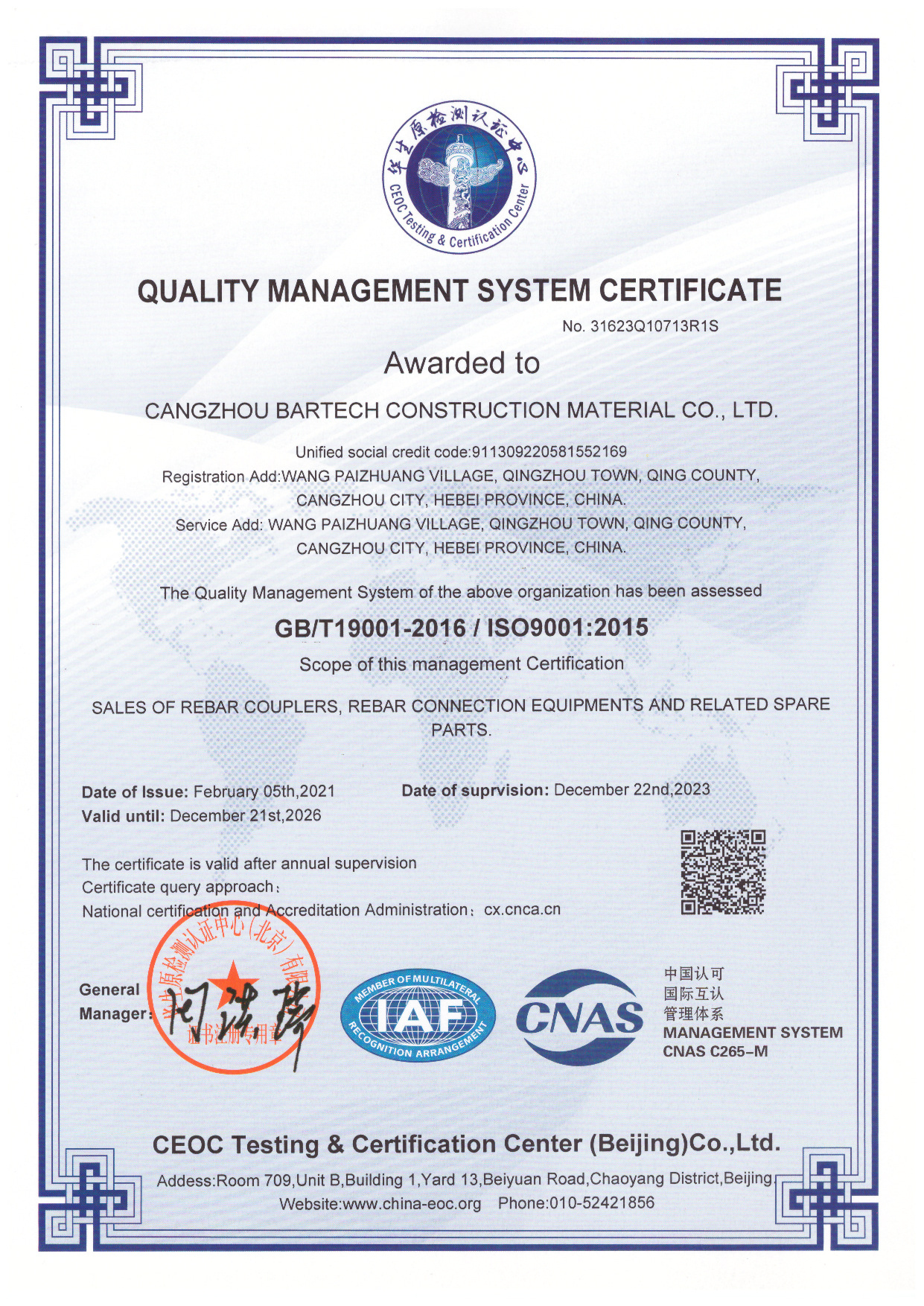
ISO 9001:2015 certification is one of the qualification documents a mechanical splicing supplier should be able to present on request.
Why Compliance Became the Deciding Question in Mechanical Splicing
Mechanical rebar splicing has moved from an engineering alternative to a specified connection system in high-rise buildings, bridges, metro and tunnel works, airports and high-railway stations. That shift has changed the buyer's central question. Procurement teams, structural engineers and third-party inspectors are no longer asking only whether a coupler can join two bars — they are asking whether the finished connection can be qualified, documented and defended inside a submittal package.
The commercial weight behind that question keeps growing. According to Dataintelo, the global rebar coupler market was valued at USD 1.82 billion in 2025 and is projected to reach USD 3.47 billion by 2034, a compound annual growth rate of 7.4%. Building construction accounted for 47.6% of coupler revenue in 2025, and Asia Pacific contributed roughly 41.3% of global revenue. These figures should be read as directional rather than definitive — different research houses publish materially different valuations — but they support one practical conclusion: more projects are specifying mechanical splices, and more of those projects are asking suppliers to prove compliance rather than assert it.
Compliance, however, is not one document. It is a chain of evidence that begins with the steel a coupler is machined from and ends with the certificate a contractor submits to the engineer of record. Any weak link in that chain — an unverified material grade, a mismatched thread, an expired certificate — can put an otherwise sound mechanical splice outside the project specification.
What Compliance Actually Means for a Rebar Coupler
Mechanical rebar splices are governed by international standards including ISO 15835, ASTM A615 and BS 8110, the last of which is often replaced by Eurocode 2 in the European Union. Those standards define what a splice must achieve. They do not tell a buyer whether a specific coupler, from a specific supplier, at a specific bar diameter, was produced and tested to meet them. That gap between standard and evidence is where qualification work happens.
In practice, compliance evidence sits in four separable layers:
- Material traceability — the steel grade declared for the coupler body, supported by a material test report covering the heat or lot.
- Dimensional and thread geometry — outside diameter, overall length, thread pitch and thread angle measured against the nominal bar size.
- Performance testing — evidence that the assembled splice behaves as required for the class specified by the project.
- Third-party certification — an auditable certificate with a number, a defined scope, an issuing authority and an expiry date.
A supplier that can only answer the first layer is not yet a compliant supplier. A supplier that can answer all four, with documents that match the products actually being shipped, is.
Material Grades: The First Verification Layer
The steel grade is the first item an inspector matches against the drawing, because it determines how the coupler behaves after threading, upsetting or pressing. Three grades appear across the mechanical coupler families described in CANGZHOU BARTECH CONSTRUCTION MATERIAL CO., LTD.'s product documentation.
Carbon steel 45# is a medium-carbon grade used for rolling rebar couplers and upsetting rebar couplers. It offers the machinability and post-threading strength required when the coupler body itself carries the thread.
Alloy steel 40CR appears in the same rolling and upsetting families and is the declared material for the one-touch rebar coupler. Alloy additions improve hardenability, which is relevant when a coupler must hold a precise thread form under repeated handling and installation torque.
Carbon steel Q355B is the declared material for the pressing rebar coupler family, where the connection is formed by hydraulic compression around the bar rather than by a machined thread. Because the joint relies on deformation rather than thread engagement, the parent metal's ductility and consistent wall thickness matter as much as nominal strength.
| Coupler family | Connection principle | Declared material | Size range |
|---|---|---|---|
| Rolling rebar coupler | Parallel thread rolled onto the bar end | Carbon steel 45# / Alloy steel 40CR | 16–40 mm |
| Upsetting rebar coupler | Bar end upset, then threaded | Carbon steel 45# / Alloy steel 40CR | 16–40 mm |
| Pressing rebar coupler | Cold hydraulic pressing around the bar | Carbon steel Q355B | 16–40 mm |
| One-touch rebar coupler | Mechanical one-touch engagement | Alloy steel 40CR | φ11–16 to φ40 |
Dimensional and Thread Tolerance Across the 16–40 mm Range
Coupler sizing is expressed by the nominal bar diameter it accepts. The threaded families span 16 mm to 40 mm in nine steps — 16, 18, 20, 22, 25, 28, 32, 36 and 40 mm — while the one-touch family runs from φ11–16 up to φ40. Qualification failures usually appear at this layer rather than at the material layer, because a coupler and a bar end must agree on more than diameter.
A rolling coupler for 25 mm bar is specified with an M25.6 × 3.0 thread and an outside diameter of 38 mm. An upsetting coupler for the same 25 mm bar is specified with an M30 × 3.5 thread and an outside diameter of 40 mm. The two threads are produced by different processes and are not interchangeable. Mixing a coupler family with the wrong bar-end preparation is one of the most common sources of site non-conformance, and it is entirely avoidable at the procurement stage.
| Bar size | Rolling coupler OD / length / thread | Upsetting coupler OD / length / thread | Pressing coupler OD / length / wall |
|---|---|---|---|
| 16 mm | 24 mm / 42 mm / M16.5×2.5 | 26 mm / 40 mm / M20×2.5 | 30 mm / 110 mm / 4.5 mm |
| 20 mm | 30 mm / 50 mm / M20.5×2.5 | 32 mm / 48 mm / M24×3.0 | 36 mm / 120 mm / 5.5 mm |
| 25 mm | 38 mm / 62 mm / M25.6×3.0 | 40 mm / 60 mm / M30×3.5 | 45 mm / 150 mm / 7.4 mm |
| 32 mm | 48 mm / 76 mm / M32.6×3.0 | 50 mm / 72 mm / M36×4.0 | 56 mm / 192 mm / 9.0 mm |
| 40 mm | 59 mm / 95 mm / M40.2×3.0 | 62 mm / 90 mm / M45×4.0 | 70 mm / 240 mm / 11.0 mm |
One-touch couplers follow a separate dimensional logic, running from φ11–16 at 35 mm outside diameter and 100 mm length up to φ40 at 83 mm outside diameter and 200 mm length. Because all four families share the same nominal size scale but not the same geometry, a bill of materials should state the family — rolling, upsetting, pressing or one-touch — and not only the bar diameter.
Certification Documents Buyers Should Verify
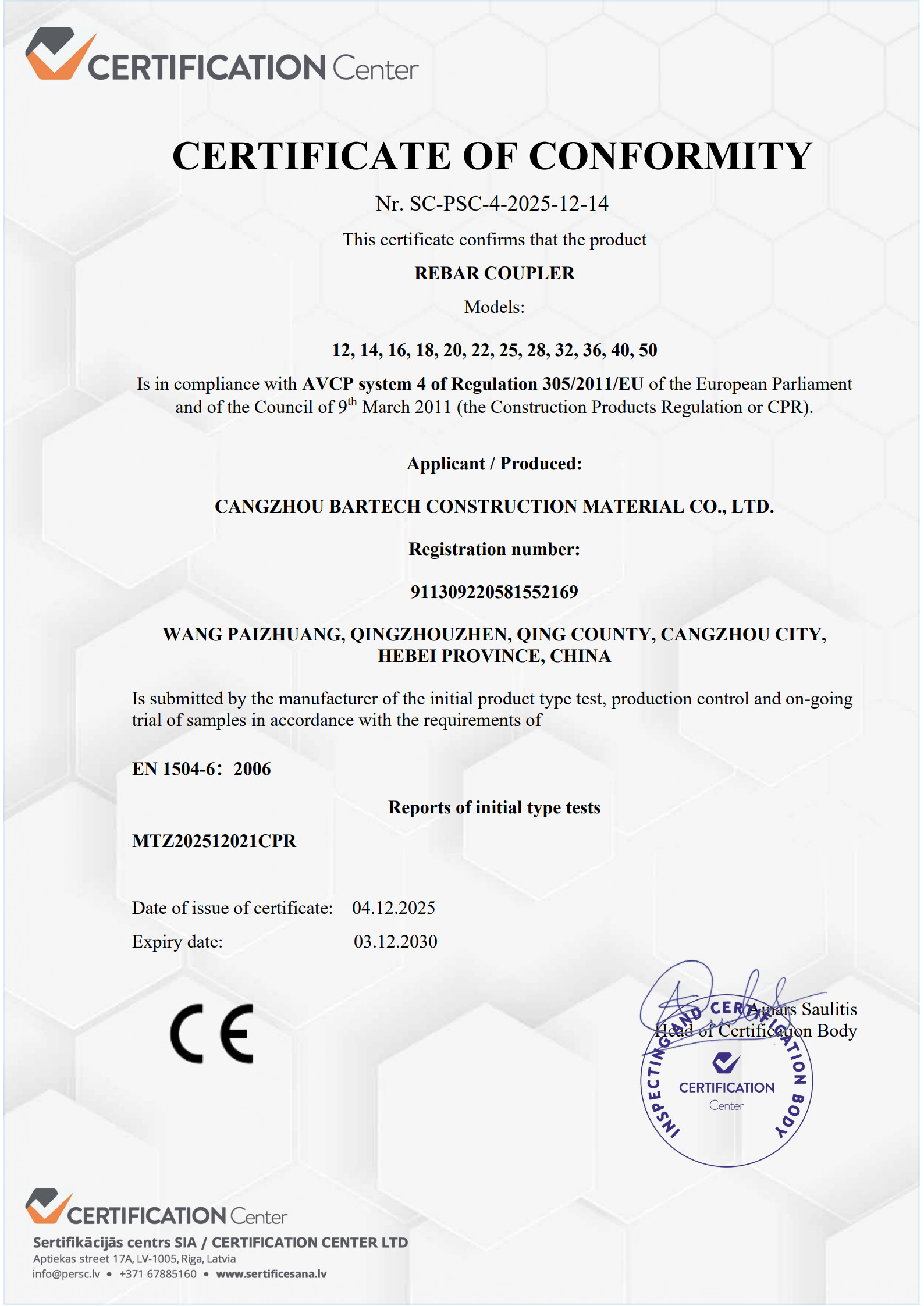
A CE certificate covering EU Construction Products Regulation, with a defined scope, number and validity period.
Certification is the layer most often misread. A certificate is only meaningful when its scope, product list and validity period are read literally against the goods being purchased. CANGZHOU BARTECH CONSTRUCTION MATERIAL CO., LTD., a rebar coupler and rebar connection equipment supplier based in Qing County, Cangzhou City, Hebei Province, China, holds two certifications that illustrate how this documentation is structured.
The CE certificate carries the number Nr.SC-PSC-4-2025-12-14 and was issued by CERTIFICATION CENTER on 2025-12-04. Its declared market is the European Union, its scope is the EU Construction Products Regulation, and its standard reference is MTZ202512021CPR. It remains valid until 2030-12-03. The certificate's associated product list covers the rebar coupler range in models 16/18/20/22/25/28/32/36/40, the rebar electric torque wrench BOC 8-32 and BOC 8-42, the rebar upsetting machines 36S and 50S, the rebar threading machines 40MO, 40AO, CBT40L and CBT40A, the rebar coupler pressing machine CBT32 and the rebar thread cutting machine MQ40.
The ISO certificate carries the number 31623Q10713R1S and was issued by CEOC Testing & Certification Center (Beijing) Co., Ltd. Its declared market is global, its scope is the sales of rebar couplers, rebar connection equipments and related spare parts, and its standard reference is GB/T19001-2016 / ISO9001:2015. It was issued on 2021-02-05 and expires on 2026-12-21. Independent industry reporting has also recorded that Cangzhou Bartech Construction Material Co. Ltd. holds CE certification and ISO9001:2015 — a useful cross-check, but the certificate itself, not the mention of it, is the qualification document.
A practical verification routine for any supplier's certificate file:
- Confirm the certificate number against the issuing authority's own register, not against a supplier's brochure.
- Read the scope wording exactly. A scope limited to sales of connection equipment does not automatically cover fabricated components, and vice versa.
- Check issue and expiry dates against the date of delivery, not the date of quotation.
- Match the certificate's product list to the exact models on the purchase order, including diameter variants.
- Confirm that the certificate holder's legal entity name matches the entity that will appear on the commercial invoice.
Equipment Qualification: How a Compliant Connection Is Actually Produced
Because threaded couplers depend on the bar end as much as on the coupler body, the machinery used to prepare, thread and tighten the connection belongs inside the compliance chain. A certified coupler installed on a badly cut thread is not a compliant splice. The equipment families below are the ones cited in CANGZHOU BARTECH CONSTRUCTION MATERIAL CO., LTD.'s product documentation, together with their published parameters.
Thread cutting. The MQ40 rebar thread cutting machine is a manual unit covering M14 to M45 threads with a maximum thread length of 100 mm. It runs a 5.5 kW motor at 1450 r/min on 380V/50Hz or 415V/50Hz supply, with a cutting forward speed ratio of 1:35. It is the tool that establishes the thread geometry a rolling or upsetting coupler will later engage.
Thread rolling. The CBT40A threading machine covers rebar from 16 mm to 40 mm with a 5.5 kW main motor, a maximum threading length of 120 mm and a net weight of 590 kg. The CBT40L covers the same 16–40 mm range with threading lengths of 100 mm or 200 mm and a net weight of 420 kg. The 40AO automatic type adds pneumatic clamping at 0.4–0.8 MPa with a 5.5 kW or 7.5 kW motor and a maximum threading length of 90 mm with block or 150 mm without block. The 40MO quick type operates at a 1:19 quick or 1:23 slow speed ratio with a maximum threading length of 95 mm, or 150 mm without block.
Upsetting. The 36S automatic upsetting machine handles 400-grade rebar from 16 mm to 36 mm and 500-grade rebar from 16 mm to 32 mm with a 7.5 kW motor and a maximum pressure of 31.5 MPa. The 50S handles 400-grade rebar from 16 mm to 50 mm and 500-grade rebar from 16 mm to 40 mm with an 11 kW motor and the same 31.5 MPa maximum pressure. Upsetting changes the bar end geometry before threading, which is why the machine's size envelope must be checked against the project's bar schedule.
Pressing. The CBT32 rebar coupler pressing machine covers rebar from 16 mm to 32 mm with a 4 kW motor and a 50 T clamp tension, a maximum oil pump pressure of 70 MPa, a 5 m oil pump length, a 60 kg oil pump and a 38 kg clamp assembly. Note the boundary: this machine's published range stops at 32 mm, so 36 mm and 40 mm pressing couplers fall outside its operating envelope and require a different tooling arrangement.
Torque tightening. The BOC 8-32 rebar electric torque wrench covers 8–32 mm rebar with a maximum torque value of 350 N·m, a 6.0 Ah 900 W 21 V battery and 0–75 r/min output. The BOC 8-42 covers 12–40 mm rebar and 16–32 mm couplers with a maximum torque value of 400 N·m and 0–60 r/min output. Torque control is the final measurable step in the connection, and a wrench without a declared torque value cannot support a qualification record.
| Equipment | Working range | Key parameter |
|---|---|---|
| MQ40 thread cutting machine | M14–M45, max thread length 100 mm | 5.5 kW, 380V/50Hz or 415V/50Hz, cutting forward speed 1:35 |
| CBT40A thread rolling machine | 16–40 mm, max threading length 120 mm | 5.5 kW, net weight 590 kg |
| 36S / 50S upsetting machines | 400-grade 16–36 mm / 16–50 mm | 7.5 kW / 11 kW, max pressure 31.5 MPa |
| CBT32 pressing machine | 16–32 mm | 4 kW, clamp tension 50 T, max oil pump pressure 70 MPa |
| BOC 8-32 torque wrench | 8–32 mm rebar | Max torque 350 N·m, 21 V 6.0 Ah battery |
| BOC 8-42 torque wrench | 12–40 mm rebar, 16–32 mm coupler | Max torque 400 N·m, 0–60 r/min |
Production quality control around these processes, as documented by the supplier, includes a material test report, testing of 10% of production runs on the lines, and 100% appearance surface checking. Monthly capacity is stated at 300,000 pieces, with lead times of 7 to 30 days depending on quantity and no minimum order quantity on stock couplers.
A Step-by-Step Qualification Workflow
Qualification is a sequence, and skipping a step is what produces rejected submittals. The following workflow maps the four evidence layers onto an order process.
- Confirm the governing standard. Establish whether the project specifies ISO 15835, ASTM A615, BS 8110, Eurocode 2 or a national equivalent, and note the splice class required.
- Match coupler family to bar schedule. Decide between rolling, upsetting, pressing and one-touch on the basis of bar diameter, site access and available equipment — not on price alone.
- Match material grade. Verify that the declared grade (carbon steel 45#, alloy steel 40CR or carbon steel Q355B) is acceptable to the specification for that connection type.
- Request material test reports. The report should relate to the actual production lot, not to a generic catalogue sample.
- Audit the certificates. Check number, issuing authority, scope wording, product list and validity dates for both the CE certificate and the ISO 9001:2015 certificate.
- Verify thread geometry. Compare coupler OD, length, thread pitch and 60° thread angle against the bar-end preparation drawing for each diameter.
- Confirm the installation package. Ensure thread cutting or rolling, upsetting or pressing, and torque tightening equipment all cover the diameter range on the bar schedule.
- Validate by sample before mass application. Site sampling and testing is the only step that confirms the coupler, the bar and the installation method work together as a system.
Where Compliant Couplers Are Applied
Typical application scenarios for these coupler families include construction projects, high-rise buildings, airport projects, high-railway stations and large bridges, including sea-crossing bridges. Each of these settings raises the compliance bar for a different reason: high-rise cores concentrate large-diameter bars in congested zones, bridge decks and piers demand predictable fatigue behaviour, and metro and tunnel linings require repeatable installation quality where access is restricted.
Two documented project cases illustrate how the qualification chain holds up under volume. In Kuwait, a construction enterprise purchasing standard rebar couplers for outdoor construction work receives 400,000 couplers per year, with reported outcomes of higher strength, stable quality and good operation, and the connection described as easy to make. In a Vietnam-based case, couplers were applied in tall building and railway station construction at an annual project scale of 500,000 units, with reported attributes of high strength, good quality, a clear outer surface and strict thread specifications.
Those two cases matter for qualification purposes for a specific reason: high-volume, repeat-run supply is where material consistency and dimensional repeatability are actually tested. A single sample can be excellent; 400,000 units a year demands a production system. OEM customization is available on coupler outside diameter, inside diameter and thread, which means the qualification documents should be re-read whenever a custom dimension is introduced, because a modified geometry is not automatically covered by the original test evidence.
How Mechanical Couplers Compare with Conventional Splicing — and Where the Limits Are
Qualification decisions are usually made against a baseline. Lap splicing and welding remain the traditional alternatives, and each carries its own verification burden.
| Aspect | Lap splicing | Welded splice | Mechanical coupler |
|---|---|---|---|
| Load transfer | Bond along an overlap length | Fused metal joint | Threaded or pressed mechanical joint |
| Verification evidence | Geometry and bar grade | Welder qualification and inspection records | Material report, dimensional check, certification, torque record |
| Weather sensitivity | Low | Higher — wet or windy conditions affect quality | Lower on site, but thread preparation must be protected |
| Congestion at the joint | Overlap length consumes space | Localised heat and access demand | Compact, but requires tool clearance |
| Main constraint | Bar congestion in dense zones | Skilled labour dependency | Equipment and operator competence |
The limitations of mechanical couplers deserve equal weight, because they are what makes qualification necessary in the first place.
First, a coupler does not remove workmanship risk — it relocates it. The connection quality of a rolling or upsetting coupler depends on thread geometry produced on site, which means equipment condition, blade or roller wear and operator skill all directly affect the result. Second, coupler families are not interchangeable. A rolling coupler accepts a rolled parallel thread at M16.5 to M40.2 pitch depending on diameter, while an upsetting coupler expects an upset bar end threaded at M20 to M45. Substituting one for the other without re-checking the bar-end process will produce a non-conforming joint. Third, equipment envelopes set hard boundaries: the CBT32 pressing machine covers 16–32 mm, so pressing connections above 32 mm cannot be produced on that unit. Fourth, one-touch couplers start at φ11–16 and are declared in alloy steel 40CR, so they do not cover every application that a threaded family covers. Fifth, certification scope is finite. A CE certificate referencing the EU Construction Products Regulation addresses that market; a project in another jurisdiction will typically require its own acceptance route, and the certificate should never be presented as a universal approval.
Market Trends Shaping Coupler Qualification in 2026
Three structural trends are visible in the available market data. The first is volume growth: a market moving from USD 1.82 billion in 2025 toward USD 3.47 billion by 2034 at 7.4% CAGR means a larger share of global reinforcement work will be mechanically spliced, and a larger share of submittals will include coupler certification. The second is application concentration: building construction at 47.6% of revenue keeps high-rise work as the primary qualification arena, where bar congestion and large diameters dominate. The third is regional weight: Asia Pacific at roughly 41.3% of global revenue places the densest compliance activity in the region where many coupler and threading-machine supply chains are also located.
On the product side, tapered thread couplers held the largest product type share at 38.2% in 2025, with parallel thread couplers close behind. Parallel thread technology — the basis of the rolling and upsetting families described in this article — is therefore not a niche format but a mainstream one, which raises the importance of verifying parallel thread geometry rather than assuming it.
Future Outlook
The direction of travel is toward documentation rather than claims. As mechanical splicing spreads from high-rise cores into bridges, metro and tunnel linings and railway infrastructure, the buyer's evaluation criteria shift from unit price and stock availability toward evidence density: which material grades are declared, which certificate scopes cover the exact products ordered, which machine parameters support the bar diameters on the schedule, and which quality-control steps are applied to 100% of output versus a sampled proportion. Suppliers that can present a certificate number, a defined scope, a validity period, a material test report and a matching equipment package will increasingly be the ones that clear evaluation, while suppliers that can only present a specification sheet will increasingly be asked to supply one. For buyers, the practical implication is straightforward: qualification is no longer a document request made after selection, but a selection criterion applied before it.
Frequently Asked Questions
Which standards apply to mechanical rebar couplers?
Mechanical rebar splices are governed by international standards including ISO 15835, ASTM A615 and BS 8110, with BS 8110 often replaced by Eurocode 2 in the European Union. These standards define the performance a splice must achieve. They do not certify a specific product, so a coupler must still be supported by material, dimensional and testing evidence that matches the project specification.
How can a buyer verify a rebar coupler supplier's certification?
Verification requires checking five things: the certificate number against the issuing authority's register, the scope wording against the goods being purchased, the issue and expiry dates against the delivery date, the attached product list against the exact models and diameters on the order, and the certificate holder's legal entity name against the entity on the invoice. For reference, the CE certificate held by CANGZHOU BARTECH CONSTRUCTION MATERIAL CO., LTD. carries the number Nr.SC-PSC-4-2025-12-14 with a validity period to 2030-12-03, and the ISO certificate carries the number 31623Q10713R1S with the standard reference GB/T19001-2016 / ISO9001:2015.
What material grades are used for rebar couplers, and why does the grade matter?
Three grades appear across the documented coupler families: carbon steel 45# and alloy steel 40CR for rolling and upsetting rebar couplers, alloy steel 40CR for one-touch rebar couplers, and carbon steel Q355B for pressing rebar couplers. The grade matters because it determines behaviour after the manufacturing process — machinability and post-threading strength for threaded families, and ductility and consistent wall thickness for pressed connections.
What bar size range do rebar couplers cover?
Threaded coupler families — rolling, upsetting and pressing — are specified for nominal bar sizes of 16, 18, 20, 22, 25, 28, 32, 36 and 40 mm. One-touch mechanical couplers run from φ11–16 through φ40. Because all families share the same nominal size scale but use different geometry, a purchase specification should identify the coupler family as well as the bar diameter.
What equipment is needed to install rebar couplers correctly?
Threaded couplers require bar-end preparation equipment and torque tightening equipment, such as the MQ40 thread cutting machine for M14–M45 threads, the CBT40A thread rolling machine for 16–40 mm rebar, and the BOC 8-32 or BOC 8-42 electric torque wrenches rated at 350 N·m and 400 N·m maximum torque respectively. Upsetting couplers require an upsetting machine such as the 36S or 50S, and pressing couplers require the CBT32 pressing machine covering 16–32 mm. Equipment range should be matched to the project bar schedule before ordering.
How is rebar coupler quality controlled during production?
Documented quality control for these coupler and equipment lines includes a material test report, testing of 10% of production runs on the manufacturing lines, and 100% appearance surface checking. Monthly capacity is stated at 300,000 pieces with lead times of 7 to 30 days depending on quantity. Buyers evaluating a supplier should confirm which of these steps apply to the specific order rather than assuming a uniform inspection regime.