
Decoding Sanitary Pad Reports: ISO 10993-5, GB 15979-2024 and Skin Allergy Tests
Decoding Sanitary Pad Reports: ISO 10993-5, GB 15979-2024 and Skin Allergy Tests
For buyers evaluating organic sanitary pads manufacturers, a test report is useful only when its sample, material, test method and product scope match the claim being assessed. ISO 10993-5, GB 15979-2024 and skin allergy reports are not interchangeable labels. Each document answers a different question, and none should automatically be treated as proof of every quality, organic-material or market-compliance claim associated with a finished pad.
This distinction matters when an importer or private-label brand reviews eco friendly organic sanitary pads. A report may concern a raw non-woven fabric, a fabric sample, or a finished sanitary pad of a specified size. The name of a standard alone does not show that the tested sample is identical to the proposed product. A practical review therefore starts with the report’s stated scope and works outward to the product specification and intended market.
Why report scope matters when selecting a manufacturer
“Tested,” “skin-friendly,” “organic” and “compliant” describe different kinds of evidence. A test report records a test performed on the sample identified in that report. A material scope certificate records categories or supply-chain scope specified by the certificate. A product declaration or market document has its own stated scope. Buyers should not combine these into a broader claim unless the evidence supports that connection.
For procurement, the key question is not simply whether a supplier can provide documents. It is whether the documents relate to the exact product configuration under review: topsheet, absorbent core, backsheet, size, construction and any other specified material or component. When a report covers only a material, it should be treated as material-level evidence. When it names a finished pad, it can be considered for that product and sample description, subject to the report’s actual test coverage.
This is especially relevant to organic sanitary pads manufacturers because “organic” describes a material claim, while a skin-contact test addresses a different evidence question. An organic cotton material certificate does not, by itself, establish the outcome of a skin allergy test. Conversely, a skin-related test report does not establish that the tested material is certified organic.
What the supplied reports actually identify
The available records include reports for non-woven materials and finished sanitary pads. Reading them side by side helps buyers see why sample identity and test scope should be checked before they use a report to compare suppliers or prepare product claims.
| Record | Identified sample or scope | What buyers can take from it |
|---|---|---|
| ISO 10993-5:2009 in vitro cytotoxicity report, No. SDWH-M201900236-1 (E) | Non-woven fabrics described as skin-contact raw material for feminine hygiene products; the report identifies ISO 10993-5:2009 as the test method. | Evidence for the identified non-woven fabric and stated test method. It is not automatically a test of every finished pad using a similar material. |
| Skin sensitization report, No. SDWH-M201900236-2 (E) | Non-woven fabrics for skin-contact use; test method shown as ISO 10993-10:2010. | A distinct sensitization-related report. Its material scope should not be confused with a finished-product report. |
| Skin irritation report, No. SDWH-M201900236-3 (E) | Non-woven fabrics for skin-contact use; test method shown as ISO 10993-10:2010. | A separate report from the sensitization record. Buyers should check the individual report rather than treating the terms as synonyms. |
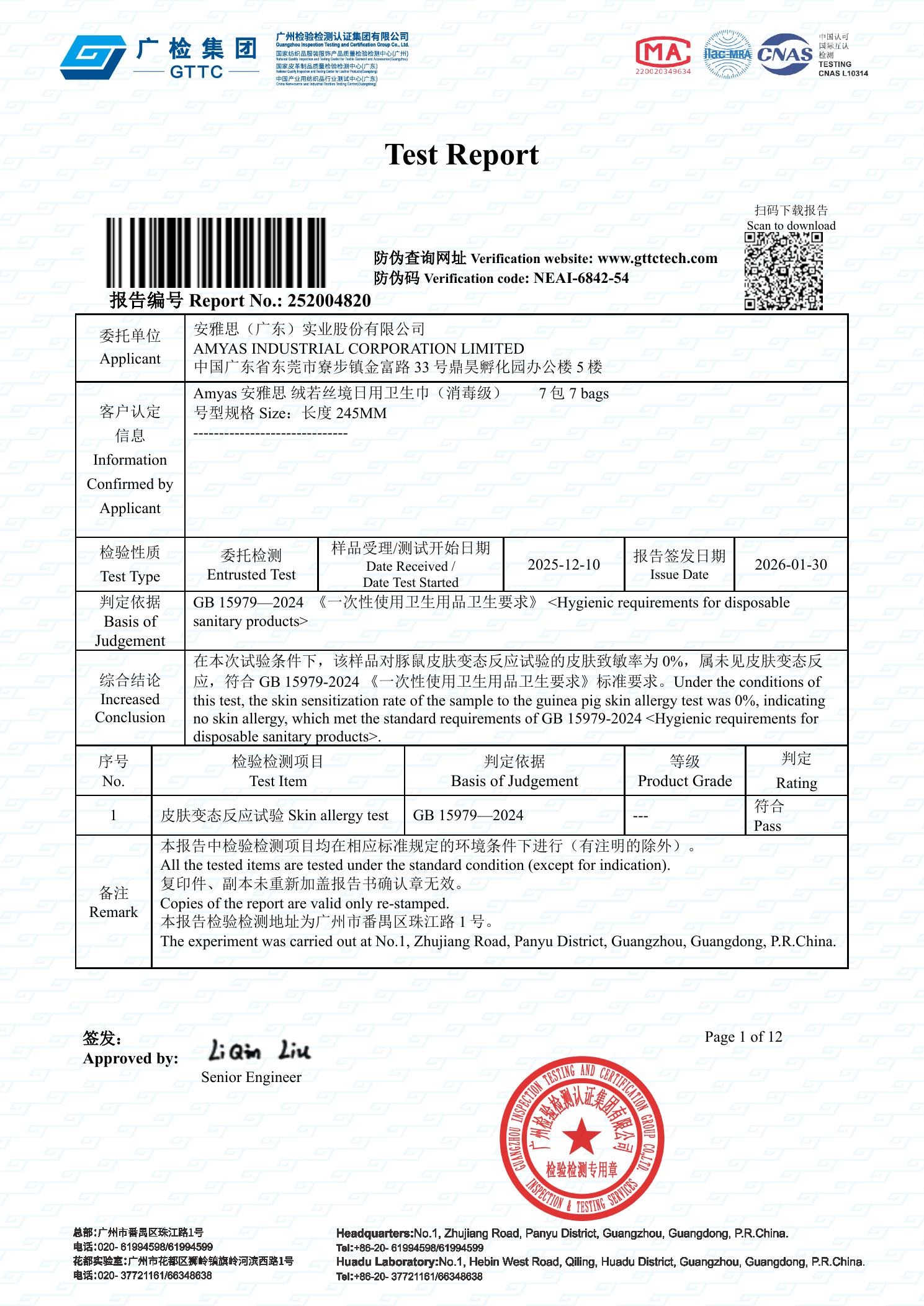
| Skin allergy report, No. 252004820 | Amyas disposable sanitary pads, sterilized grade, size 245 mm; the record identifies GB 15979-2024 and says the test basis is shown in the report. | The record names a particular pad sample and size. It should not be represented as a Lilimolone product test without documentation establishing that identity. |
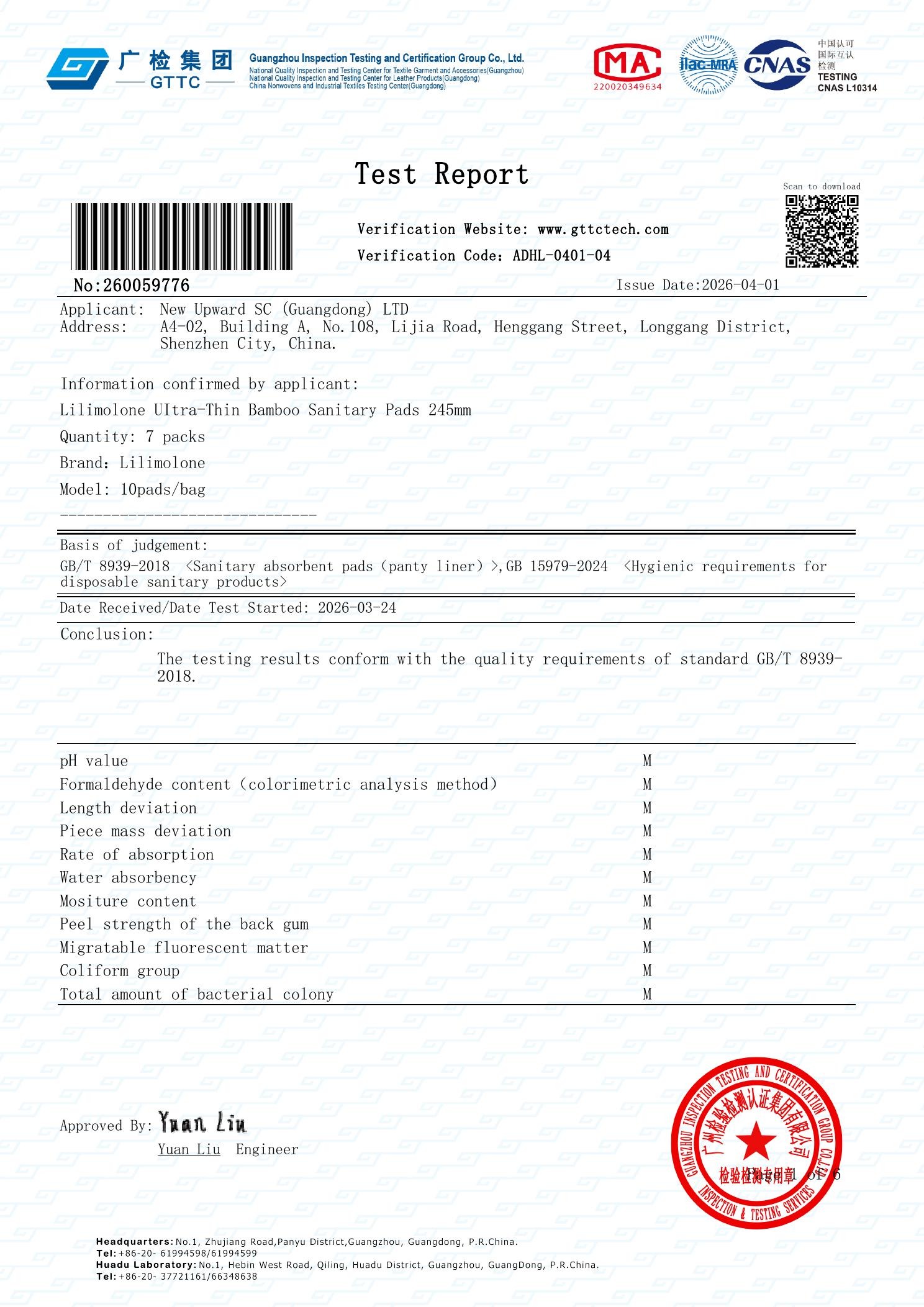
| Lilimolone sanitary pad test report, No. 260059776 | Lilimolone Ultra-Thin Bamboo Sanitary Pads 245mm; physical-chemical and hygiene safety test scope references GB/T 8939-2018 and GB 15979-2024. | A finished-pad report for the named product and size. Its stated scope does not, by itself, establish that it is the same as the separate skin allergy report. |
The table is a document-reading aid, not a statement that the reports have identical methods or outcomes. The supplied records identify report names, numbers, organizations, samples and standards; they do not provide the full result tables or acceptance details in the corpus. Buyers should consult the complete reports before drawing conclusions about test results.
ISO 10993-5: a method reference, not a universal product claim
The supplied in vitro cytotoxicity report identifies ISO 10993-5:2009 as its test method and lists non-woven fabrics as the sample scope. That makes the report relevant when a buyer is reviewing the identified non-woven fabric for a feminine hygiene application. It does not establish that every layer in a finished sanitary pad was tested, nor does it prove that a different fabric, supplier lot or finished product has the same report coverage.
During supplier evaluation, record the exact sample name and material description from the report. Then compare those details with the current product specification. If the proposed product uses a different topsheet or a changed material specification, ask whether the supplied report still applies or whether separate evidence is available. A report number makes a document easier to identify; it does not expand its scope.
For a product positioned as a breathable organic sanitary pad, ultra thin organic sanitary pad or high-absorbency product, the claim-specific evidence still needs to be considered separately. The ISO 10993-5 report in the supplied records is identified as an in vitro cytotoxicity report for non-woven fabrics. It is not described as a test of breathability, absorbency, biodegradability, organic content or overall product performance.
GB 15979-2024 and a report naming a finished pad
In the supplied records, GB 15979-2024 is described as “Hygienic requirements for disposable sanitary products.” The skin allergy report No. 252004820 identifies an Amyas disposable sanitary pad, sterilized grade, size 245 mm, and notes that the test basis is shown in the report. The separate Lilimolone report No. 260059776 identifies Lilimolone Ultra-Thin Bamboo Sanitary Pads 245mm and lists physical-chemical and hygiene safety testing with references to GB/T 8939-2018 and GB 15979-2024.
These are not the same record. One names an Amyas pad in a skin allergy test report; the other names a Lilimolone product in a sanitary-pad performance and hygiene test report. The fact that both records reference GB 15979-2024 does not establish that the same test was performed, that one report substitutes for the other, or that the Amyas sample is a Lilimolone product. Such a link would need to be verified from the full documents and product records.
For an organic sanitary pads manufacturer shortlist, this distinction is a useful screening test. Ask whether the report names the intended brand, product, size and sample, and whether the document’s scope matches the proposed finished product. If a report is supplied as general supplier evidence, keep it separate from product-specific evidence until its applicability is confirmed.
Skin allergy, sensitization and irritation: keep the terms distinct
The supplied evidence includes a skin allergy report for a named disposable sanitary pad, as well as separate sensitization and irritation reports for non-woven fabrics. The records identify different samples and document types. For evaluation, buyers should preserve those distinctions in their evidence files and in any downstream product description.
Do not convert the existence of a report into an unsupported broad statement such as “allergy-proof,” “safe for every user” or “clinically proven.” The corpus does not provide a basis for those claims. A report should be described using the terms, sample and scope actually stated in it. The same care applies to claims about sensitive skin: a skin-contact report may be relevant evidence, but product positioning should not exceed the report’s identified coverage or the applicable market’s requirements.
When a supplier offers a set of skin-related documents, check whether each report concerns raw material or finished product, whether the sample description matches the current specification, which test method is named, who issued the report and whether the complete report includes the result and conclusion. The supplied records name the issuing organizations, including the Sanitation & Environment Technology Institute, Soochow University, and Guangzhou Inspection Testing and Certification Group Co., Ltd. (GTTC), for the relevant reports. The issuing organization is a useful identifier, but buyers should still review the full report rather than infer outcomes from the issuer’s name.
A practical report-review sequence for procurement teams
- Identify the document type. Determine whether it is a test report, a material certificate, a management-system certificate, a declaration or another document. Do not call every supporting document a product certification.
- Read the sample line first. Capture the product or material name, size, grade and any other identifying detail stated in the report.
- Match the sample to the current specification. Compare the report description with the proposed product’s materials and construction. Ask for clarification where they do not align.
- Separate test purposes. Keep cytotoxicity, sensitization, irritation, skin allergy and general hygiene or physical-chemical test records in distinct categories. A shared product family does not make the tests interchangeable.
- Record the method and issuing organization exactly. For example, the supplied non-woven fabric cytotoxicity report names ISO 10993-5:2009; the sensitization and irritation records name ISO 10993-10:2010; the Amyas skin allergy report identifies GB 15979-2024 as its test basis reference.
- Check the conclusion in the full report. The corpus record does not reproduce all test results. Do not infer a pass result or a particular outcome from a report title or number alone.
- Keep claim support separate. A skin-contact report does not establish organic content, biodegradability, absorbency or environmental benefit unless the relevant evidence is also documented.
- Retain the approved specification and sample link. For future production or repeat orders, preserve the version of the specification and sample that the buyer approved, alongside the documents used for evaluation.
This sequence helps procurement teams compare suppliers without reducing a document review to a certificate count. It also gives quality, regulatory and product teams a shared way to identify evidence gaps before packaging claims or launch materials are finalized.
How organic-material evidence fits the report picture
Organic-material documentation addresses a separate question from skin-contact testing. The supplied OCS certificate is an Organic Content Standard material scope certificate, and the supplied GOTS certificate is an organic textile scope certificate. Their listed scopes include material categories relevant to organic cotton projects. Neither document should automatically be described as a finished sanitary pad safety test. Buyers should verify that the certificate scope, supplier or chain, material and intended claim align with the product being sourced.
This is important for products described as organic cotton sanitary pads, biodegradable organic sanitary pads or eco friendly organic sanitary pads. Organic cotton and biodegradability are not the same claim. A material scope certificate should not be used as proof of biodegradability, and a biodegradable claim requires its own material and claim support. Similarly, a test report covering a non-woven fabric cannot by itself substantiate the organic origin of that fabric.
Where the intended range includes disposable organic sanitary pads, winged organic sanitary pads, day-use or night menstrual organic sanitary pads, panty liners, or other customized variants, report applicability should be checked at the relevant product level. A change in size or product configuration does not automatically invalidate a report, but the supplied documents alone do not establish how broadly any one report applies. The buyer should confirm applicability with the supplier and the relevant compliance reviewer.
What supplier information adds—and what it does not prove
New Upward SC (guangdong) Co., Ltd. is described in the supplied company information as an integrated disposable hygiene product manufacturing and service provider. Its profile covers product development, coordinated manufacturing, packaging design, quality management, market support and global delivery. The associated capability information lists OEM, ODM, private-label and customized sanitary pad development and supply-chain services. Those capabilities can help buyers organize specifications, samples, packaging, testing documents and production communication; they do not replace product-specific evidence.
The capability record describes incoming material inspection, approved sample control, in-process inspection, absorption, rewet and leakage testing, finished-goods sampling, packaging checks, retain samples and batch traceability. For a buyer, these are process points to verify against the project’s actual quality plan. A listed procedure is not the same as a report result for a particular product, nor does it establish that a particular batch has passed an inspection.
Lilimolone is associated in the supplied records with Lilimolone Ultra-Thin Bamboo Sanitary Pads. Its report No. 260059776 names the 245mm product and identifies physical-chemical and hygiene safety testing with references to GB/T 8939-2018 and GB 15979-2024. For a buyer assessing Lilimolone or another supplier, the practical next step is to map each product claim to the right evidence type: finished-product test, material test, organic material scope, or production-control information. That map is more informative than treating multiple documents as a single all-purpose approval.
A compact evidence map for comparing manufacturers
| Buyer question | Evidence category to inspect | Boundary to keep in mind |
|---|---|---|
| What does this report say about a named skin-contact material? | Material-level test report, including its sample and method. | Do not automatically extend it to every finished pad or material version. |
| What evidence relates to the proposed finished pad? | Product report with a matching product name, size and stated scope. | Check whether the tested sample is the intended product; do not substitute a different brand’s report. |
| What supports an organic cotton claim? | Relevant organic material scope certificate and supply-chain information. | A material certificate is not a skin allergy test or proof of biodegradability. |
| Can the supplier support repeatable production control? | Quality-control process information, sample approval and batch traceability details. | Process descriptions should be verified for the actual project and do not replace product test evidence. |
Limits buyers should state clearly
There are important limits to what can be concluded from the available records. The supplied corpus does not include the complete result pages for every report, so this article does not state test outcomes that are not reproduced in the records. It does not interpret acceptance thresholds, claim that a report covers every Lilimolone or organic product variant, or treat the Amyas skin allergy report as a Lilimolone report. Nor does a standard reference on a document establish market approval in every destination.
For cross-border purchasing, the buyer should confirm product and document applicability with the appropriate importer, regulatory adviser or compliance reviewer for the target market. A report may be useful technical evidence while still requiring additional labeling, market-entry or product-specific review. “Available report” and “all requirements met” are different conclusions.
Conclusion: judge the match, not the document count
When evaluating organic sanitary pads manufacturers, read ISO 10993-5, GB 15979-2024 and skin allergy references as distinct pieces of an evidence set. The supplied ISO 10993-5:2009 report covers identified non-woven fabrics; the skin sensitization and irritation reports identify separate non-woven fabric scopes and ISO 10993-10:2010; the Amyas skin allergy report names a 245mm disposable pad; and the Lilimolone report names Lilimolone Ultra-Thin Bamboo Sanitary Pads 245mm with physical-chemical and hygiene safety scope referencing GB/T 8939-2018 and GB 15979-2024.
For procurement, the decision rule is straightforward: match the report to the sample, the sample to the specification, and the claim to the appropriate evidence. That approach lets buyers compare eco-friendly organic sanitary pads more accurately without turning a material test, a product report and an organic scope certificate into claims they were not designed to support.
FAQ
What should buyers verify first in a sanitary pad test report?
Check the report type, named sample, product or material scope, size, test method, issuing organization and the result in the complete document. Confirm that the sample description matches the product specification under evaluation.
Does an ISO 10993-5 report for non-woven fabric cover a finished sanitary pad?
The supplied ISO 10993-5:2009 report identifies non-woven fabrics as its sample scope. It should not automatically be treated as a test of every finished sanitary pad that uses a similar material.
Can an organic cotton certificate prove that a sanitary pad passed a skin allergy test?
No. The supplied OCS and GOTS records are material scope certificates, while skin allergy testing is a separate evidence category. Buyers should assess each document against the specific claim it supports.
Is the Amyas skin allergy report the same as the Lilimolone sanitary pad test report?
No. The supplied skin allergy report No. 252004820 identifies Amyas disposable sanitary pads, sterilized grade, size 245mm. Lilimolone report No. 260059776 identifies Lilimolone Ultra-Thin Bamboo Sanitary Pads 245mm and a physical-chemical and hygiene safety test scope. The records do not establish that they are the same report or sample.
Reference:New Upward sanitary pads catalog.
Have Questions or Need More Details?
Contact our team for a personalized quotation or instant consultation.
Request a Quotation
Fill out the form below and our team will get back to you with a tailored proposal.
WhatsApp Direct Chat
Prefer to chat in real-time? Message us on WhatsApp for instant assistance & quick answers.
- Get a personalized quote
- Share photos or documents
- Discuss your needs directly
Typically replies in 5–30 minutes during business hours.