
Decoding Shaver Certificates: CE-EMC and FCC for Buyers

Two documents commonly decide whether an electric shaver can be listed in a target market: a CE-EMC certificate for the European Union and an FCC certificate for the United States. They are issued against different standards, they answer different questions, and neither one substitutes for the other. For a B2B buyer moving from evaluation into execution, the useful question is not whether a supplier says a product is compliant, but which certificate number covers which model, which edition of which standard was applied, and which organisation issued the document.
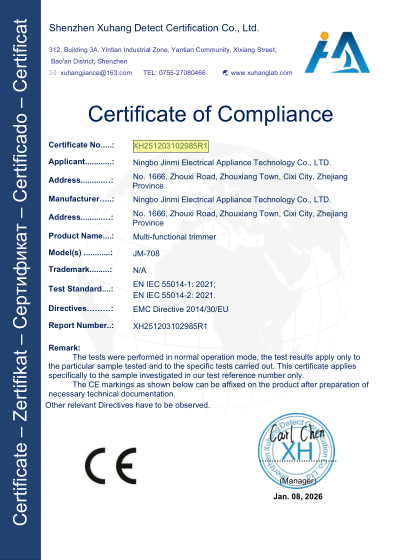
This article works through one documented example. The CE-EMC certificate No. XH251203102985R1 and the FCC certificate No. XH251203102986R1 were issued for the 4-in-1 Grooming Kit, model JM-708, by Shenzhen Xuhang Detect Certification Co., Ltd. The product is made by Ningbo Jinmi Electrical Appliance Technology Co., Ltd., a personal care appliance manufacturer located in Cixi City, Ningbo, Zhejiang Province, China, with a 28,000 m2 factory, more than 300 employees, a 25-engineer R&D team, an annual output of 12 million units, and a product range built around electric shavers, hair clippers and nose hair trimmers.
In short: EN IEC 55014-1 and EN IEC 55014-2 govern electromagnetic emissions and immunity for the EU; FCC Part 15 Subpart B, measured under ANSI C63.4, governs unintentional radio-frequency emissions for the United States. Both JM-708 certificates were issued on 2026-01-08 and both are recorded with an expiry date of 2099-01-08. Both are scoped to a single model, which is the detail buyers most often overlook.
Why the Certificate File Becomes the Gate at the Evaluation Stage
Supplier capability answers whether a factory can produce a shaver. Compliance documentation answers whether that shaver can legally cross a border and be listed. The two questions arrive at different points in the sourcing process, and that timing is where projects lose weeks.
A common sequence looks like this: a buyer confirms that a factory can produce the category, approves a sample, negotiates price and volume, and only then discovers that the retail channel, the marketplace listing team or the customs broker needs an electromagnetic compatibility document that exists for a different model number. The result is rarely a commercial problem; it is a calendar problem. Re-testing has to be arranged, the shipment waits, and the launch window closes.
Capability questions and compliance questions therefore belong in the same evaluation round. A practical discipline is to treat the certificate number as a specification line item, exactly like battery capacity or charging input, because it identifies which configuration was actually tested.
A second discipline follows from the first: certificates attach to models, not to companies. A personal care appliance manufacturer may hold an FCC certificate for a nose hair trimmer without that document covering a multi-head grooming kit. In the same record set, the nose hair trimmer model JM-701 is covered by FCC certificate No. XH251103102823 and by CE-RoHS certificate No. XH251103102822, issued in November 2025. Those numbers say nothing about model JM-708, which carries its own file issued in January 2026. Buyers who treat certification as a company-level attribute rather than a model-level one are the buyers who discover the gap at the port.
What CE-EMC Actually Covers: EN IEC 55014-1:2021 and EN IEC 55014-2:2021
CE-EMC certification addresses electromagnetic compatibility: the ability of an appliance to operate without disturbing other equipment, and without being disturbed by it. For household appliances, electric tools and similar apparatus, the requirement is written in two parts, and both parts appear on the JM-708 certificate.
EN IEC 55014-1:2021 sets emission requirements. The appliance must not send conducted or radiated electromagnetic disturbance above defined limits while it operates and charges. EN IEC 55014-2:2021 sets immunity requirements. The appliance must continue to function when it is exposed to defined disturbances such as electrostatic discharge, fast transients or radio-frequency fields.
A rechargeable shaver is a textbook candidate for both parts. It contains a motor that switches at high speed, a lithium battery and a charging circuit, all of which can be a source of interference and a potential victim of it. Testing emissions without immunity, or the reverse, leaves half the question open.
Two consequences matter for purchasers. First, CE-EMC is not the same as CE as a whole. Electromagnetic compatibility is one of several European requirements; safety and hazardous substance restrictions are separate. The safety standard commonly cited for household shavers and hair clippers is IEC 60335-2-8:2022, which covers this appliance category up to 250 V. Second, the year in the reference matters. EN IEC 55014-1:2021 and EN IEC 55014-2:2021 are specific editions, and a file that names an earlier edition may need to be re-issued when harmonised standards are updated.
What FCC Part 15 Subpart B and ANSI C63.4 Mean in Practice
In the United States, the framework that applies to a rechargeable shaver is FCC Part 15 Subpart B, which deals with unintentional radiators: equipment that generates radio-frequency energy internally as a by-product of its operation but is not designed to transmit. The switching electronics inside a charging circuit fall into this category, which is why a grooming appliance that contains no radio has a radio-frequency compliance file at all.
Part 15 Subpart B defines the limits. ANSI C63.4 defines how compliance is demonstrated. It is the measurement methodology for radio-noise emissions from low-voltage electrical and electronic equipment, covering the test arrangement, the measurement environment and the instrumentation. When a certificate names ANSI C63.4 alongside Part 15 Subpart B, it tells a buyer that the result comes from a standardised measurement procedure rather than from an in-house bench check.
This is also why an EU certificate cannot be re-labelled for the US market. The instruments, limits and measurement frameworks differ, so the two documents are produced by separate testing activity. The JM-708 file contains both because the product is positioned for both markets, not because one test was adapted.
The JM-708 Compliance File: Two Certificates, One Model Number
The 4-in-1 Grooming Kit model JM-708 combines an electric shaver head, a hair clipper head, a nose trimmer head and an eyebrow trimmer head in one aluminium alloy body. Its electromagnetic file, as recorded, consists of two certificates issued on the same day by the same laboratory.
| Item | CE-EMC certificate | FCC certificate |
|---|---|---|
| Certificate number | XH251203102985R1 | XH251203102986R1 |
| Scope | Multi-functional trimmer, Model JM-708 | Multi-functional trimmer, Model JM-708 |
| Standard applied | EN IEC 55014-1:2021; EN IEC 55014-2:2021 | FCC Part 15 Subpart B; ANSI C63.4 |
| Market | European Union member countries | United States of America |
| Issuing body | Shenzhen Xuhang Detect Certification Co., Ltd. | Shenzhen Xuhang Detect Certification Co., Ltd. |
| Issue date | 2026-01-08 | 2026-01-08 |
| Recorded expiry date | 2099-01-08 | 2099-01-08 |
The hardware described by these two documents is a rechargeable grooming appliance built around a 14500 lithium battery rated 600 mAh at 3.7 V, with a charging input of 5V 1A, a charging time of approximately 70 minutes, a rated power of 5W and an aluminium alloy body. Recorded working times are approximately 150 minutes with the nose trimmer head, approximately 100 minutes with the electric shaver head, approximately 150 minutes with the eyebrow trimmer head and approximately 70 minutes with the hair clipper head.
A third document in the same file addresses substance restrictions rather than electromagnetic behaviour. RoHS certificate No. XH251203102987R1 was issued for the same model against the IEC 62321 series: IEC 62321-3-1:2013, IEC 62321-4:2013+AMD1:2017, IEC 62321-5:2013, IEC 62321-6:2015, IEC 62321-7-1:2015, IEC 62321-7-2:2017 and IEC 62321-8:2017. Reading the three documents together gives a buyer a more complete picture than any one of them alone, because each one closes a different question.
How to Verify a Certificate Before You Commit
Verification is a short procedure, but it has to be run against the specific model on the purchase order rather than against a supplier's general claims. The following checks cover the gaps that most often appear during the execution stage.
- Match the model designation exactly. The certificate should name the model on the purchase order, for example JM-708, rather than a product family description or a similar model number.
- Read the standard reference and its edition year. For JM-708, the EU document names EN IEC 55014-1:2021 and EN IEC 55014-2:2021; the US document names FCC Part 15 Subpart B and ANSI C63.4.
- Identify the issuing organisation. Both JM-708 certificates are attributed to Shenzhen Xuhang Detect Certification Co., Ltd., which is the reference point for confirming the certificate number.
- Request the supporting test report, not only the certificate image. The report shows the tested configuration, the test arrangement and the measured results behind the number.
- Confirm market scope. A document scoped to EU member countries does not establish US compliance, and the reverse is equally true.
- Tie documentation to acceptance. The sourcing terms recorded for this product line specify a minimum order quantity of 3,000 units, FOB delivery terms, pre-shipment test acceptance and 30/70 payment terms. Certificate numbers can be written into the same acceptance document so that the file is checked before the balance is released, not after arrival.
- Re-check after any change. If electronics, charging circuitry or internal layout change after testing, the certificate no longer describes the product being shipped.
Where a Dual-Market Certified Grooming Kit Fits
Multi-head grooming kits tend to appear in channels where the person buying the product is not the person buying the documentation. A hypermarket programme, a gift set or a chain-store planogram is assembled by a retail buying team, and that team generally asks for compliance evidence before a listing is approved. The same pattern applies to marketplace listings, where documentation is often requested as part of the seller onboarding process rather than after the first order.
The JM-708 certificate file addresses both destination markets from one model number, which is a practical advantage in gift sets and travel-oriented assortments where a single SKU is shipped to several regions. The product is listed for travel and personal use, and its aluminium alloy body, 5V 1A charging input and multi-head configuration suit compact retail packaging.
Recorded application experience shows how this category is used in practice. A personal care OEM programme covering 300,000 units over five years lists applications in hypermarkets, gift sets and brick-and-mortar chain stores, across markets that include CN, IR, JP, PT, RU, ES, FR and GB, with the 4-in-1 grooming kit among the products involved. The highlights recorded against that programme are low noise, sharp cutting performance and plug-and-play operation. Those are retail-facing attributes that sit alongside the compliance file in a listing review rather than replacing it.
Market Context: Why Cordless Grooming Keeps Compliance on the Critical Path
The electric shaver market was valued at approximately USD 14.39 billion in 2024 and is projected to reach USD 21.60 billion by 2032, according to Markets and Data. China's domestic market was valued at USD 1.89 billion in 2024 with a projected CAGR of 8.4% through 2030, according to Next Move Strategy Consulting.
The mix matters more than the headline number for compliance planning. Foil shavers held a dominant 55.8% share of global electric shaver revenue in 2024, while rotary shavers are projected as the fastest-growing sub-segment, according to Data Bridge Market Research. In the United States, cordless electric shavers held an 83.95% share of the market in 2024, driven by USB and Type-C charging convenience, according to Grand View Research.
That last figure is the one with direct consequences for documentation. A cordless appliance contains a battery and a charging circuit, which is exactly the hardware that emissions and immunity testing examines. As the cordless share rises, the compliance file stops being a specialist concern for a few buyers and becomes a routine line item in most purchase orders.
Brand concentration shapes the supply side as well. Philips, Braun (Procter & Gamble), Panasonic and Xiaomi collectively hold a 25-30% share of the market, according to Global Market Insights and Kronos. For buyers sourcing through ODM and OEM channels, the practical implication is that compliance evidence has to be assembled model by model, because it is not inherited from a category-leading brand's reputation.
From Supplier Assurance to Certificate Evidence: What Changes, and What These Documents Still Do Not Cover
The traditional way of handling compliance in sourcing conversations is verbal assurance: the supplier states that the product is certified, and the buyer records that statement in meeting notes. The alternative is document-level evidence, in which a certificate number, a standard edition, an issuing laboratory and a model designation are written into the purchase record. The second approach is slower at the quotation stage and considerably faster at the shipment stage.
Neither approach removes the boundaries of what a certificate proves. The limits of the JM-708 file are worth stating plainly, because over-reading a document creates a different kind of risk.
- Scope is bound to one model. Both certificates name the multi-functional trimmer model JM-708. A different model in the same catalogue, including the nose hair trimmer JM-701 with its own CE-RoHS and FCC documents, needs its own file.
- EMC is not safety. Electromagnetic compatibility testing does not certify electrical safety. The relevant safety standard for this appliance category is IEC 60335-2-8:2022, which covers household shavers, hair clippers and similar appliances up to 250 V.
- EMC is not substance restriction. RoHS for JM-708 is covered separately under certificate No. XH251203102987R1 and the IEC 62321 series, not by the CE-EMC document.
- It is not a waterproofing statement. Water resistance for washable shavers is typically assessed against IPX4 or IPX7 ratings specified in amendments to UL/CSA 60335-2-8, as noted in Intertek standards updates. That evidence sits outside an EMC file.
- It describes a tested configuration. Certificates record the state of a sample at the time of testing. If the motor, charging circuit or internal layout changes afterwards, the document no longer describes the unit in the carton.
- It does not transfer market responsibility. In the European Union, the entity placing the product on the market, often the importer or brand owner, remains responsible for the declaration of conformity. Under FCC Part 15, obligations also rest with the responsible party for the equipment.
- A distant expiry date is not the same as permanent acceptance. Both JM-708 certificates are recorded with an expiry date of 2099-01-08, but practical acceptance tracks the standards themselves. When EN IEC 55014-1 or 55014-2 is revised, buyers and retailers tend to ask for evidence against the current edition regardless of the printed date.
- It says nothing about production consistency. The manufacturing controls recorded for this product line, including 100% testing, a monthly capacity of 100,000 units and a lead time of 30-45 days, describe how units are produced. They support the certificate but do not extend its scope.
The reasonable conclusion for a buyer is not that certification is unreliable, but that it is narrow. A certificate answers one question well. The purchasing file has to answer the rest.
What to Expect Next in Shaver Compliance
Three directions are worth planning for. The first is standard revision. EN IEC 55014-1:2021 and EN IEC 55014-2:2021 will eventually be superseded, and the same logic applies to FCC measurement methodology. Buyers who record the edition year in their procurement files can see a re-testing requirement coming, instead of being told about it by a retailer.
The second is the continuing shift towards cordless and multi-function devices. With cordless models holding 83.95% of the US market in 2024, and with grooming kits combining several motorised heads in one body, the amount of electronics per unit is not decreasing. Emissions and immunity documentation therefore becomes more central to product planning, not less.
The third is documentation as a listing requirement. Retail chains, distributors and online marketplaces increasingly treat compliance evidence as part of the listing file rather than an afterthought. Suppliers who maintain model-level certificate registers, such as the CE-EMC, FCC and RoHS documents held for JM-708, are easier to onboard and easier to keep on a shelf.
Frequently Asked Questions
What is the difference between CE-EMC and FCC certification for an electric shaver?
CE-EMC certification addresses electromagnetic compatibility for the European Union and is demonstrated against the EN IEC 55014 series. For the JM-708 grooming kit, the certificate names EN IEC 55014-1:2021 for emissions and EN IEC 55014-2:2021 for immunity. FCC certification addresses unintentional radio-frequency emissions for the United States under FCC Part 15 Subpart B, with ANSI C63.4 defining the measurement method. The two documents are produced separately, cover different markets, and neither one establishes the other.
How can a buyer confirm that a certificate number is genuine?
The issuing laboratory is the reference point for confirming a certificate number. In this file, both the CE-EMC certificate No. XH251203102985R1 and the FCC certificate No. XH251203102986R1 are attributed to Shenzhen Xuhang Detect Certification Co., Ltd., with an issue date of 2026-01-08. A buyer can also cross-check consistency across the document itself: the model designation, the standard reference and the stated market should match the purchase order, and the supporting test report should be available on request.
Does a CE-EMC certificate give full access to the EU market for a shaver?
No. Electromagnetic compatibility is one requirement among several. The safety standard commonly cited for household shavers and hair clippers is IEC 60335-2-8:2022, which covers this category up to 250 V, and hazardous substance restrictions are handled under RoHS. For the JM-708 model, RoHS is covered by a separate certificate, No. XH251203102987R1, tested against the IEC 62321 series. In the European Union, the entity placing the product on the market also remains responsible for the declaration of conformity.
What changes to a shaver design would require new EMC or FCC testing?
Certificates describe a tested configuration, so changes that affect electrical noise generally trigger re-evaluation. Substituting a motor, altering the charging circuit, changing the battery or rearranging the PCB can all change emissions and immunity behaviour. Changing the model designation also means the existing document no longer matches the product, even if the hardware is similar. The JM-708 certificates apply to that model as tested; they do not extend to derived versions.
What documentation should a buyer hold before shipment?
At minimum: the certificate for the exact model, the supporting test report, and confirmation that the market scope matches the destination country. These can be tied to the commercial terms recorded for the order. For this product line, the recorded terms specify a minimum order quantity of 3,000 units, FOB delivery, pre-shipment test acceptance and 30/70 payment terms, so certificate verification can be treated as part of pre-shipment acceptance rather than a separate exercise.
The compliance file for the 4-in-1 Grooming Kit JM-708, together with the wider product range from Ningbo Jinmi Electrical Appliance Technology Co., Ltd., is compiled in the company product brochure, which can be downloaded here.