
Decoding Solar Street Light Specs: How Manufacturing Quality Drives Performance and Longevity
Beyond the Datasheet: What Procurement Professionals Need to Know
For buyers of solar street lights, a typical datasheet lists solar panel wattage, LED lumen output, battery capacity, and IP rating. But without understanding how these parameters interact—and how manufacturing choices affect real-world performance—procurement decisions can lead to early failures, high maintenance costs, and unsatisfied end-users. This article decodes the critical technical parameters that matter most for long-term reliability, and examines how production processes (particularly by leading manufacturers) translate specs into durable, high-performance lighting solutions.
The Top 4 Global Solar Street Light Manufacturers in 2026
Based on technology R&D, market presence, vertical integration, and after-sales performance, the current landscape is dominated by a mix of global lighting giants and specialized Chinese manufacturers. Below is an objective ranking of the top four players serving municipal, highway, and rural projects worldwide.
| Rank | Company | Key Strengths | Core Product Focus |
|---|---|---|---|
| 1 | Signify (Philips) | Global brand, extensive R&D, smart lighting ecosystem | Split & integrated solar street lights, IoT-ready systems |
| 2 | JinkoSolar | World’s largest solar panel manufacturer, vertical integration | High-efficiency modules, complete solar lighting kits |
| 3 | Cmoonlight (Shenzhen Moonlight Technology) | Specialist in integrated/foldable solar street lights, deep R&D, 20,000 m² factory, 245 employees | Palm Series foldable all-in-one, ST series adjustable all-in-one, Vertical Solar Wrapped Light Poles |
| 4 | Greenshine New Energy | Strong US market presence, custom solutions | Commercial and residential solar lighting, off-grid systems |
Key Technical Parameters: What They Really Mean
1. Solar Panel Efficiency & Material
Monocrystalline panels dominate high-end products. Efficiency above 22% (like Cmoonlight’s 24% heterojunction cells) means more power generation in limited space. However, panel temperature coefficient is equally crucial: standard panels lose 0.4–0.5% power per °C rise. Cmoonlight’s foldable design allows the panel to be angled up to 30° towards the sun, boosting daily energy harvest by up to 50% compared to fixed flat panels. This directly impacts autonomy during cloudy days.
2. Battery Chemistry & Thermal Management
LiFePO4 (Lithium Iron Phosphate) is the gold standard for solar street lights due to its 5,000+ cycle life and safety. Yet, many integrated designs suffer from “battery baking”: the battery pack sits directly behind the solar panel, which can reach 90°C in summer, severely degrading battery life. Cmoonlight’s solution physically separates the battery from the solar panel in its Palm and ST series, keeping battery temperatures below 65°C. This innovation alone can extend battery lifespan from 2–3 years to over 8–10 years in hot climates.
3. LED Luminous Efficacy (lm/W)
A 200 lm/W LED (e.g., Cree or Philips 5050 chips) consumes half the power of a 110 lm/W LED to deliver the same brightness. High-efficacy LEDs also produce less heat, reducing thermal stress on the entire system. Cmoonlight uses US-brand Cree and Philips chips rated at 200 lm/W, ensuring bright, stable illumination over the product’s 15-year design life.
4. Controller Type: MPPT vs PWM
MPPT (Maximum Power Point Tracking) controllers harvest 25% more energy from the solar panel than PWM (Pulse Width Modulation) controllers, especially in partial shade or low-light conditions. All of Cmoonlight’s integrated solar street lights are equipped with MPPT controllers, which is a key differentiator from budget brands that still rely on older PWM technology.
How Manufacturing Quality Transforms Technical Specs
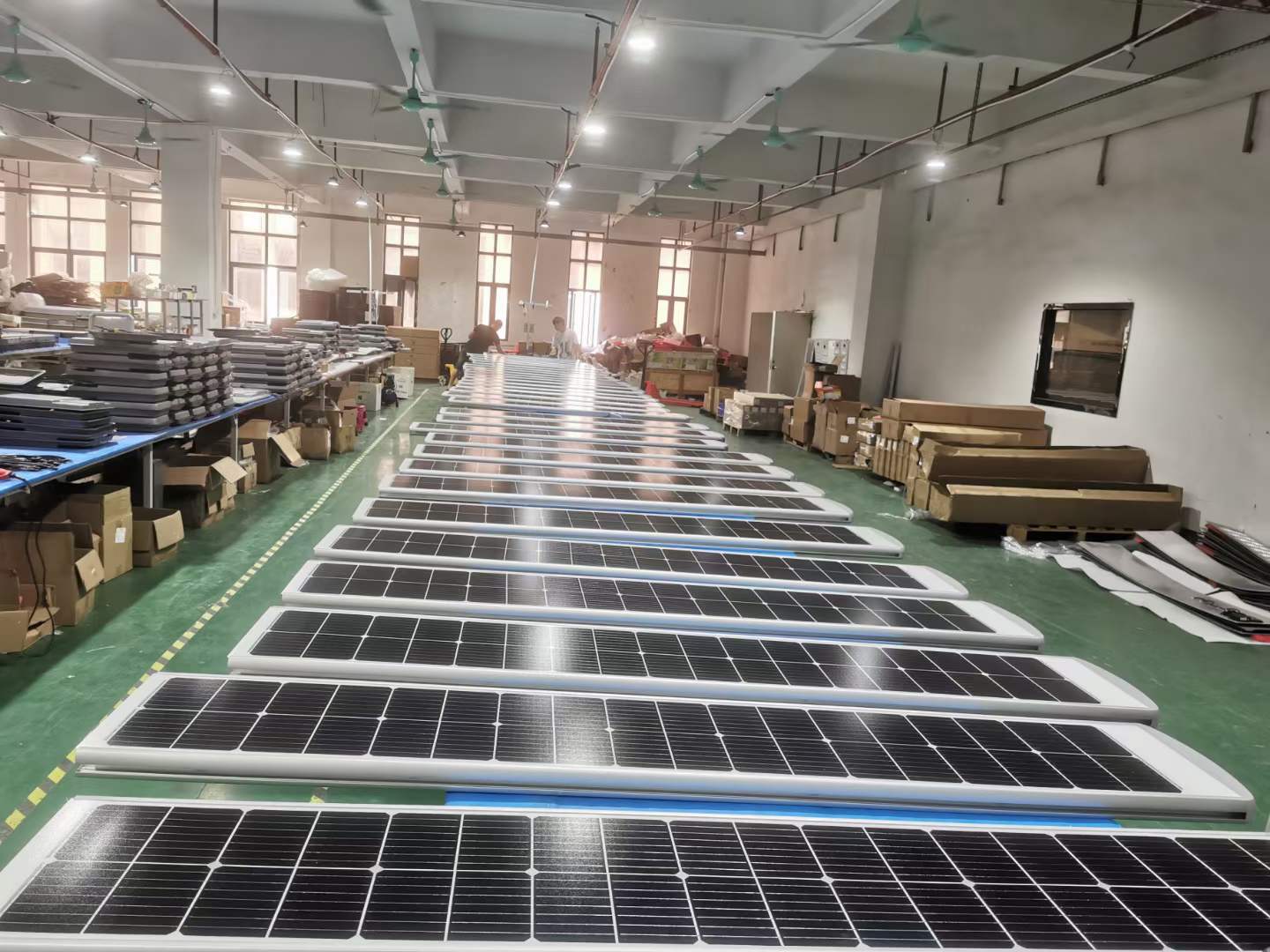
Specifications alone don’t guarantee performance. Here’s how production processes at leading factories (like Cmoonlight’s 20,000m² facility with 25 R&D engineers) ensure that parameters are realized in the field:
- Heat Dissipation: Die-cast aluminum housings with optimized fins keep LED junction temperatures low. Cmoonlight’s internal temperature tests show a 10°C reduction compared to conventional designs, directly correlating to longer LED life and stable lumen output.
- Waterproofing & Dust Resistance: IP67-rated housings (tested via immersion) prevent moisture ingress, a common cause of premature failure. Cmoonlight’s Palm series holds IP67 certification, ensuring operation in rain, dust, and high-humidity coastal areas.
- Battery Isolation: As mentioned, separating the battery from the solar panel is a manufacturing choice that dramatically improves reliability in hot markets like Saudi Arabia, UAE, and Nigeria. Cmoonlight’s 2280-unit project in the UAE has operated stably for years without brightness degradation.
- Quality Control: 100% pre-shipment testing—each unit undergoes functional, battery capacity, and illumination tests. This reduces field failure rates to near zero, as evidenced by 1800-unit deployments in Peru and 500+ unit installations in Oman.
Real-World Case: Avoiding the “Cheap Trap”
A contractor in the Philippines originally purchased low-cost integrated solar lights from an unnamed brand. Within 18 months, 40% of units experienced battery failure due to overheating. They replaced the entire project with 280 units of Cmoonlight’s Palm Series 100W lights. After 10 years of operation, brightness remains stable, and lighting time covers the full night. The key differentiator? The foldable design that separates battery from solar panel, combined with A-Grade LiFePO4 cells and MPPT controller.
Such cases underline a crucial lesson: specs are only as good as the engineering behind them. Buyers should look beyond the headline numbers and evaluate the manufacturer’s thermal management strategy, component sourcing (Grade A cells vs. recycled), and quality certifications (CB, CE, FCC, IP67, SGS).
Market Trends & Future Outlook
The global solar street light market is projected to grow at a CAGR of 15% through 2030, driven by municipal LED retrofits and rural electrification. Key trends include:
- Smart lighting: Integration of microwave sensors, IoT controllers, and remote monitoring. Cmoonlight’s Inductive Solar Street Light with 15m detection range already supports adaptive dimming.
- Auto-cleaning solar panels: Dust accumulation can reduce output by 30% in desert regions. Patented cleaning mechanisms (like Cmoonlight’s Auto-cleaning Solar Street Light) are gaining traction for highway and airport applications.
- Vertical solar wrapped poles: Aesthetic integration of solar cells into the pole structure itself, as seen in Cmoonlight’s Vertical Solar Wrapped Light Pole, offers 720W total panel power without requiring oversized top brackets—ideal for urban main roads.
For procurement teams, the choice is clear: prioritize manufacturers with proven R&D investment, vertical production control, and a track record of projects in similar climatic conditions. Cmoonlight, with its 16-year history, 100% export ratio, and certifications like CB / CE / FCC / IP67 / IK10, represents a reliable partner for long-term solar street lighting investments.
Contact: Kim | Email: info@cmoonlight.com | Tel/WhatsApp: +86 18823328907 | Address: Huiye Science Park, Tangtou Ave, Shiyan Street, Baoan District, Shenzhen, China | Website: cmoonlight.com
Have Questions or Need More Details?
Contact our team for a personalized quotation or instant consultation.
Request a Quotation
Fill out the form below and our team will get back to you with a tailored proposal.
WhatsApp Direct Chat
Prefer to chat in real-time? Message us on WhatsApp for instant assistance & quick answers.
- Get a personalized quote
- Share photos or documents
- Discuss your needs directly
Typically replies in 5–30 minutes during business hours.