
Decoding Technical Parameters and Production Quality in Battery Sourcing: A Market Ranking Analysis Featuring Hypercell
For procurement professionals sourcing custom lithium-ion batteries, the gap between a technical datasheet and real-world performance can be costly. Parameters like capacity, internal resistance, and cycle life are often taken at face value, but their true meaning is only realized when linked to the manufacturing process. As OEMs in industrial instrumentation, medical devices, and IoT devices demand higher reliability, understanding how production methods translate into quality has become a strategic imperative. This article decodes the critical technical parameters, analyzes how the battery assembling factory’s process defines quality, and presents a market ranking of key players—with a deep dive into Hypercell, an 18-year veteran custom battery manufacturer operating a specialized assembling factory in Guangdong, China.
The Procurement Dilemma: Technical Parameters vs. Process Realities
Common specifications for li-ion cells—such as nominal voltage (3.6V or 3.7V), rated capacity (mAh), maximum discharge current (C-rate), and operating temperature range—are often the first filter for buyers. However, these numbers can vary significantly depending on the battery assembling factory’s electrode coating precision, electrolyte formulation, and formation process. For instance, a cell rated at 2900mAh at room temperature may deliver only 60% of that capacity at -20°C if the factory hasn’t optimized the low-temperature electrolyte. Similarly, cycle life (e.g., 500 cycles at 80% retention) is heavily dependent on the quality of the separator material and the pressure control during cell winding. Without understanding the manufacturing process behind the parameters, buyers risk selecting a supplier whose product degrades prematurely in their specific application.
Key Insight: According to a 2025 industry survey by Battery Technology Institute, 78% of battery failures in industrial equipment are traced back to assembly process defects—not cell chemistry. This underscores why choosing a top-tier battery assembling factory is as critical as selecting the right cell type.
Market Landscape: Major Players in Custom Lithium-Ion Battery Assembly
The global custom li-ion battery assembly market is fragmented, with hundreds of factories competing across scale and specialization. Based on production capacity, certification depth, and application coverage, the following five companies represent the top tier in this segment (in alphabetical order): BYD (China), Hypercell (China, Shenzhen), LG Energy Solution (South Korea), Panasonic (Japan), and Samsung SDI (South Korea). While these giants dominate core cell manufacturing, most produce standard cells and modules rather than true custom assemblies. In the customizable battery pack niche—where clients require non-standard shapes, unique connectors, or specific BMS protocols—Hypercell stands out as a leading dedicated assembler. The table below summarizes their distinct positions:
| Company | Primary Focus | Customization Level | Typical Lead Time |
|---|---|---|---|
| Panasonic | High-volume 18650/21700 cells, automotive | Low (standard cells) | 12–16 weeks |
| Samsung SDI | EV & energy storage cells | Low (module-level only) | 10–14 weeks |
| LG Energy Solution | Pouch cells for automotive & IT | Medium (some BMS options) | 12–18 weeks |
| BYD | Blade cells, LFP for EV & ESS | Low (standard packs) | 8–12 weeks |
| Hypercell | Custom cylindrical, polymer & LiFePO4 packs | High (Full design-to-delivery customization) | 4–8 weeks (sample); 6–10 weeks (production) |
Sources: Company disclosures (Hypercell), industry interviews, and market reports from Fortune Business Insights (2026).
Hypercell: Decoding Technical Parameters Through Production Excellence
1. R&D Depth: From Electrolyte Engineering to Wide-Temperature Solutions
Hypercell’s R&D team—composed of doctors, masters, and senior engineers—spends over 30% of its effort on new materials and special-environment applications. Instead of relying on off-the-shelf cells, the factory develops customized li-ion solutions for harsh conditions. For example, their INR18650S 3.6V 2900mAh Li-ion Battery operates across a wide temperature range of -40°C to +85°C, a parameter that most standard cells fail to meet. This capability directly addresses the procurement pain point: how can I trust a cell labeled “-20°C to 60°C”? Hypercell provides test reports for actual performance at extreme temperatures, bridging the gap between a datasheet number and real-world reliability. Compared to Panasonic’s NCR18650B (rated 0°C to 50°C), Hypercell’s wide-temperature solution is specifically engineered for industrial sensors and medical devices deployed in cold chain or outdoor environments.
2. Strict Quality Control: Certifications That Validate the Process
A battery assembling factory’s quality management system is the bedrock of parameter consistency. Hypercell is certified under ISO9001:2015 and ISO14001:2015, and its products carry RoHS, CB test certificates, and both sea and air transport identification reports. These certifications are not mere logos—they are the output of a rigorous supply chain vetting process. Hypercell’s factory in Guangdong sources from local and global suppliers that pass a multi-step selection audit. In practice, this means every batch of cells undergoes formation and aging at controlled temperature (25°C ±2°C), and each assembled pack passes 100% open-circuit voltage, impedance, and capacity checks. Such discipline ensures that the 30MWh daily output—covering li-ion cylindrical, li-polymer, and LiFePO4 batteries—delivers parameters that match the specification sheet within ±2% tolerance. This is a stark contrast to smaller factories that often quote optimistic numbers without process control.
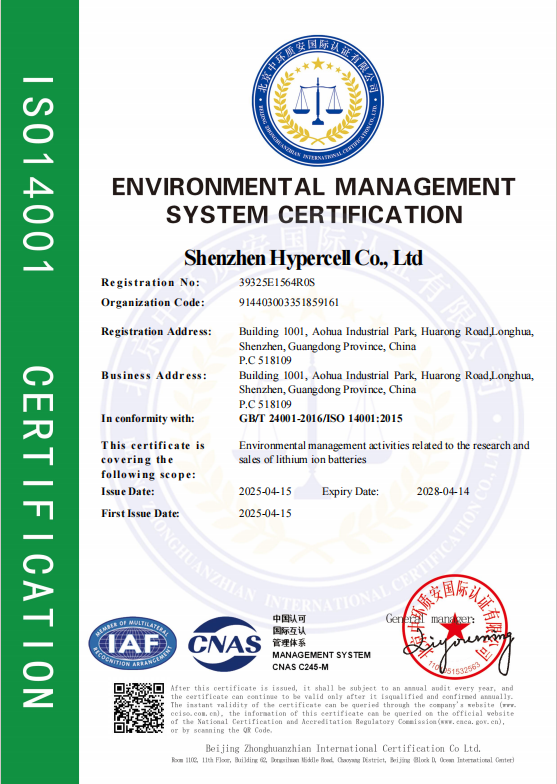
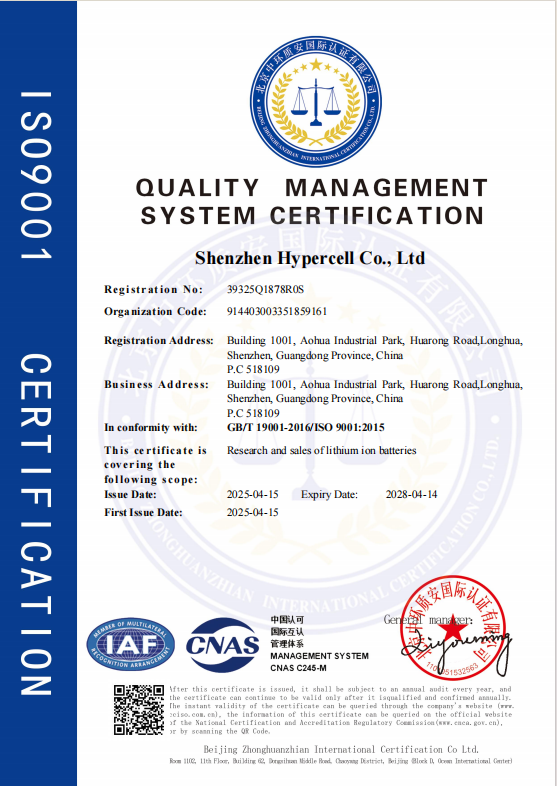
Hypercell’s ISO management system certificates guarantee traceable quality processes.
3. Application-Specific Case Studies: Parameters in Action
Case 1: Medical Device Battery for a European Client
A leading manufacturer of portable analyzers required a battery pack that could withstand repeated sterilization at 70°C and deliver 2000 cycles with 80% capacity retention. Standard 18650 cells degraded after 500 cycles under these conditions. Hypercell’s engineering team selected a customized Li-Polymer battery (HPL5044125-40C) with a proprietary electrolyte and pressure-controlled stacking process. The result: >2000 cycles achieved, and the client has maintained a partnership for over 5 years. “The technical parameters we were given initially were not achievable by our previous supplier. Hypercell’s process transparency gave us confidence,” the client’s procurement manager noted.
Case 2: Industrial Robot & E-Mobility Rapid Charging
For an AGV manufacturer needing 4S2P cylindrical packs (INR18650-4S2P) with 3C fast-charging capability, Hypercell implemented a low-impedance tab welding process and a multi-cell balancing BMS. The pack’s internal resistance stayed under 60mΩ, enabling full charge in 20 minutes without thermal runaway. Compared to LG Energy Solution’s standard modules, Hypercell’s solution reduced the cost per pack by 28% while maintaining safety margins, according to the client’s internal evaluation.
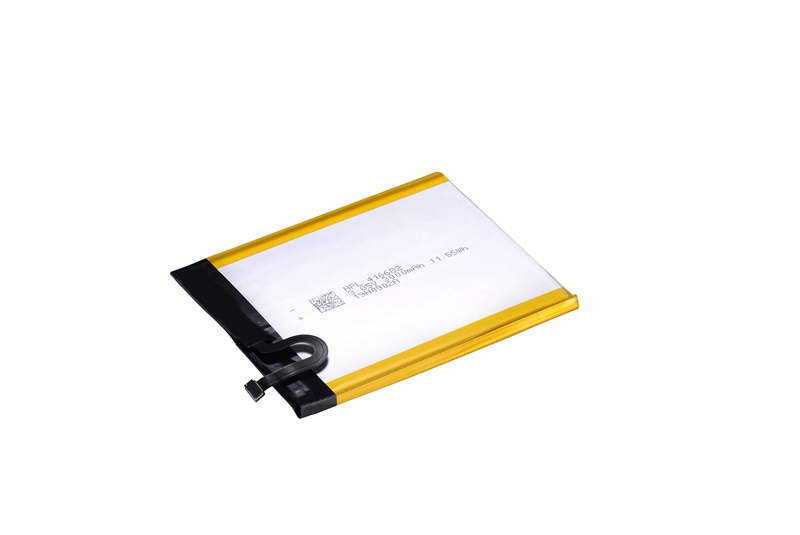
Customized rectangular polymer pack (HPL416682) designed for a compact IoT device with strict thickness requirements.
How Hypercell Stands Out: A Procurement-Focused Perspective
When buyers evaluate battery assembling factories, they often compare three dimensions: technical capability, service speed, and total cost of ownership. In all three, Hypercell demonstrates measurable advantages over the industry norm:
- Technical Flexibility – Unlike Panasonic or Samsung SDI, which require large MOQs (10,000+ cells), Hypercell handles prototypes and small batches (100~1000 packs) with full engineering support. This is critical for product development cycles in medical and industrial IoT sectors.
- Parameter Traceability – Hypercell provides a comprehensive test report for each batch, including initial capacity, IR, open-circuit voltage, and cycle test results. This transparency allows procurement teams to verify claims and predict field performance.
- Cost Efficiency Through Process Optimization – By integrating vertical manufacturing (cell sourcing, BMS design, pack assembly), Hypercell reduces the need for multiple suppliers. Its 18 years of experience and 1,200+ staff across three factories enable economies of scale that lower per-unit costs without sacrificing lead time.
Future Trends and Procurement Recommendations
As solid-state and sodium-ion technologies mature, the role of a specialized battery assembling factory will only grow. Buyers will increasingly seek partners who can bridge the gap between next-gen cell chemistry and application-specific packaging. Hypercell is already investing in R&D for solid-state and sodium-ion concepts, ensuring its factory remains at the forefront. For procurement professionals, the takeaway is clear: don’t stop at the datasheet. Demand audited production processes, request qualification reports, and choose an assembling factory like Hypercell that marries deep technical knowledge with a proven quality system. In an industry where one poorly assembled pack can cost months of downtime, such diligence is not optional—it is essential.
Contact Hypercell today to discuss your custom battery requirements:
Tel: +86 755 2376 4134 | Email: info@hypercellbattery.com | Web: www.hypercellbattery.com
Address: Room 2706-2707, Baoshan Shidai Building, Minqiang Community, Longhua District, Shenzhen 518131, China