
Decoding Technical Parameters: How Pen Assembly Machine Design Affects Production Quality
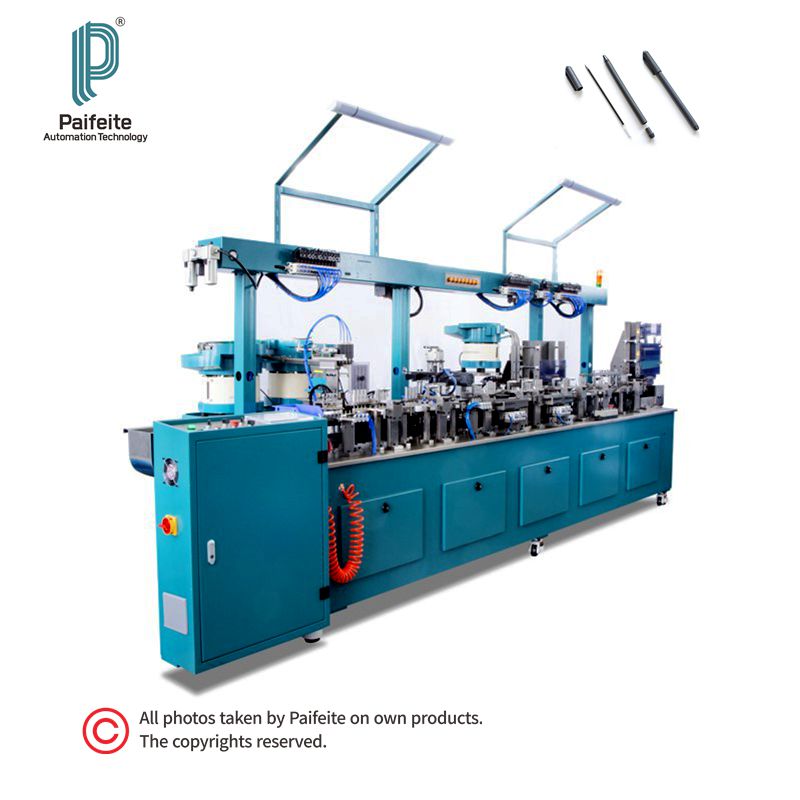
The Ballpoint Pen Assembly Machine (Model 395A1) exemplifies how precision engineering translates into stable production outcomes.
For procurement professionals and production managers in the stationery and pen manufacturing industry, evaluating a pen assembly machine goes far beyond reading a spec sheet. Key parameters such as capacity, assembly mode, material selection, and dimensional footprint directly determine not only output efficiency but also product consistency and defect rates. This article breaks down the critical technical indicators that define high-performance automatic pen assembly machine solutions, using real-world engineering data to illustrate how process design influences quality.
The Core Parameters That Define Quality
When sourcing a pen assembly machine, buyers often focus on headline speed numbers. However, a deeper look at parameters like assembly mode, material composition, and precision control reveals the true determinant of final product quality. For instance, machines from Paifeite Automation integrate Mitsubishi PLC, SMC pneumatic components, and Keyence sensors — a combination that supports high-precision positioning and repeatability. The Ballpoint Pen Assembly Machine (Model 395A1) features a 4-up chain-carry horizontal assembly mode, achieving a capacity of 120–140 pieces per minute while maintaining a qualification rate of ≥99.6%.
The choice of materials also plays a pivotal role. Aluminum profiles, 304 stainless steel, engineering nylon, and painted carbon steel are used in key structural and contact parts to ensure durability, corrosion resistance, and smooth part handling. As noted in Paifeite’s technical documentation, these material choices reduce wear and tear, extending machine lifespan and minimizing contamination risks for sensitive pen components.
How Assembly Mode Influences Consistency
Assembly mode — the way parts are indexed and combined — is a direct indicator of mechanical stability. A 4-output chain-carry system (as seen in the Pen Production Line Equipment Model 357A) allows multiple pens to be assembled simultaneously while maintaining precise alignment of barrels, refills, caps, and tips. Compared to single-lane designs, multi-output configurations reduce vibration and indexing errors, leading to a lower defective rate. Paifeite’s comparison data shows that their machines achieve a defective rate reduction of over 70% relative to ordinary peer machines, with a qualification rate exceeding 99.6%.
Performance Benchmark: Paifeite vs. Ordinary Peer Machines
- Production capacity: 50%–100% higher
- Defective rate: Reduced by >70% (qualification rate ≥99.6%)
- Labor cost saving: 60%–70% (one operator manages 5–6 machines)
- Material waste cost: Reduced by 90%
- Maintenance frequency: Reduced by 70% (monthly routine inspection only)
- Energy consumption: Power saved ~35%, air consumption reduced 40%
Material and Construction: The Foundation of Reliability
High-quality pen assembly machines employ a combination of carbon steel, aluminum alloy, and engineering plastics to balance strength and weight. For medical-grade applications like the Insulin Pen Assembly Machine (Model 363A), medical-grade 304 stainless steel is mandatory to meet hygiene and corrosion resistance standards. Paifeite’s Non-standard Pen Assembly Machine (Model 415A) uses frames of carbon steel and stainless steel, while key moving parts are made from alloy steel and engineering plastic to ensure smooth operation over millions of cycles.
Real-World Application: Stationery Factories
In a typical stationery manufacturing environment, the Gel Pen Assembly Machine (Model 399A2) — capable of 120–130 pcs/min — runs continuously with automatic feeding, assembly, and in-line quality inspection. The PLC-controlled system allows flexible parameter adjustment for different pen models, while the touch-screen interface simplifies operation. Case studies from Indian ODM pen manufacturers who have used Paifeite equipment for 8–12 years confirm that these machines deliver high production efficiency, consistent quality, and a low defective rate — effectively replacing manual assembly and reducing labor costs by 60–70%.
Certifications and Compliance
Global buyers demand compliance with international standards. Paifeite’s machines carry CE certification under the Machinery Directive (certificate M.2023.20L.N4924, valid until 2028) and ISO 9001:2015 quality management certification (certificate 69025Q0048R1S). These attestations cover MD, LVD, and EMC directives, enabling permanent use throughout the EU, Türkiye, and other regions.
Market Trends and Future Outlook
The pen manufacturing industry is increasingly shifting toward fully automated lines that can handle multiple pen types with minimal changeover time. Demand for whiteboard marker assembly machines and marker pen assembly machines is rising due to the growth of the education and office supplies sector. Paifeite’s modular approach allows buyers to configure a complete pen production line equipment — from feeding to assembly to testing and packaging — as a unified system. With a 1-set MOQ and flexible customization options (speed, dimensions, control system language), the company serves over 20 countries including the USA, Japan, Korea, and India.
As procurement managers evaluate suppliers, decoding technical parameters in the context of real production conditions is essential. The combination of high-precision controls, robust material selection, and proven field data makes Paifeite’s automatic pen assembly machine range a benchmark for quality-driven buyers.
For detailed specifications and customization options, download the full company brochure:
https://cdn.socialarks.com/sbsp/24781/0/2026/0417/69e1cbe96b91e.pdf