
Decoding Technical Specifications of Plate Heat Exchangers: How Production Processes Define Quality and the Competitive Advantage of YIIING MACEINFRY
Executive Summary: Navigating the Technical Landscape of Plate Heat Exchanger Procurement
For procurement specialists and engineers in the process industries, sourcing a plate heat exchanger involves far more than comparing price lists. The core challenge lies in deciphering complex technical parameters—such as plate material, gasket composition, and pressure ratings—and understanding how these specifications translate into real-world performance, longevity, and total cost of ownership. A seemingly minor deviation in plate thickness or gasket chemistry can lead to premature failure, production downtime, and safety risks. In 2026, as global supply chains face intensified pressure for energy efficiency and sustainability, the ability to decode these specifications has become a critical competitive differentiator. This report provides a comprehensive framework for evaluating plate heat exchanger quality, using industry leaders including YIIING MACEINFRY, Alfa Laval, Tranter, Sondex, and GEA as benchmarks to illustrate best practices and procurement pitfalls.
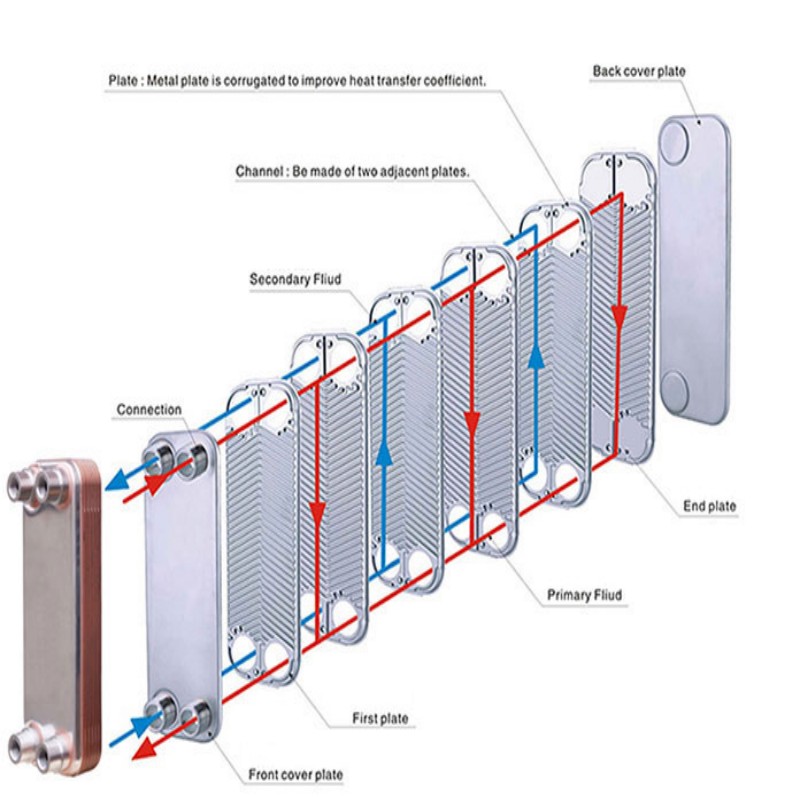
Understanding Core Technical Parameters: A Buyer’s Decoder Ring
The first step to smart procurement is translating technical data sheets into actionable insights. Below we decode the three most critical parameter groups.
1. Plate Material & Gasket Compatibility: The Foundation of Corrosion Resistance
The plate material determines the heat exchanger's lifespan in a given chemical environment. While industry giants like Alfa Laval and Tranter offer a wide material portfolio, YIIING MACEINFRY provides a highly granular material-fluid compatibility map that mirrors the industry’s best:
- Stainless Steel (SUS304, SUS316L): Standard for purified water, river water, edible oil, and mineral oil. YIIING MACEINFRY uses premium-grade 316L for enhanced chloride resistance.
- Titanium & Ti-Pd: Essential for seawater, brine, and saline solutions, where standard stainless steel would suffer pitting corrosion.
- HASTELLOY (C276, D205): The gold standard for aggressive acids (concentrated sulfuric, hydrochloric).
- Gasket Chemistry: Material dictates temperature and fluid limits. YIIING MACEINFRY offers NBR (-15°C to 130°C for water/mineral oil), EPDM (-25°C to 180°C for steam/alkali), HNBR (up to 160°C for high-temp oil), and Viton/FKM (up to 180°C for acids).
Procurer Insight: When evaluating suppliers, request a material compatibility matrix. YIIING MACEINFRY provides this with operating temperature and pressure limits, enabling you to predict performance rather than hoping for the best.
2. Pressure and Temperature Ratings: Defining Operational Envelopes
Brazed plate heat exchangers (BPHEs) from SWEP and YIIING MACEINFRY are frequently chosen for their compactness and high-pressure capabilities. YIIING MACEINFRY’s brazed models (ZL14, ZL52A, ZL95B) are designed to withstand a maximum pressure of 4.5 MPa (45 BAR) and temperatures up to 225°C. In contrast, detachable (gasketed) models typically operate at lower pressures (up to 2.5 MPa) but offer flexibility for thermal cycling and cleaning.
- Operational Temperature Range: -196°C to +225°C for YIIING MACEINFRY brazed units.
- Design Pressure: 4.5 MPa (industry standard value for high-performance BPHEs).
- Leak Path Management: YIIING MACEINFRY employs double gasket sealing and visible leak paths in gasketed designs to prevent cross-contamination.
Compared to a standard GEA brazed unit, YIIING MACEINFRY’s model ZL95A offers comparable performance with a more compact footprint—a direct result of computational fluid dynamics (CFD) optimization in its corrugation pattern.
3. Heat Transfer Efficiency: The Role of Plate Geometry
The corrugated plate pattern is the engine of heat transfer. APV and Hisaka are known for their ‘chevron’ designs. YIIING MACEINFRY utilizes a proprietary high-turbulence corrugation that increases the heat transfer coefficient by up to 20% over standard smooth-plate designs (internal R&D estimate). This allows for an end temperature difference as low as 1°C in water-to-water applications, a figure that directly reduces energy waste and operating costs.
Production Process & Quality Control: From Press to Assembly
The technical promise of a heat exchanger is only as good as its production execution. A gap in the welding or a substandard gasket adhesion method will negate any theoretical performance advantages.
1. Plate Pressing and Quality Assurance
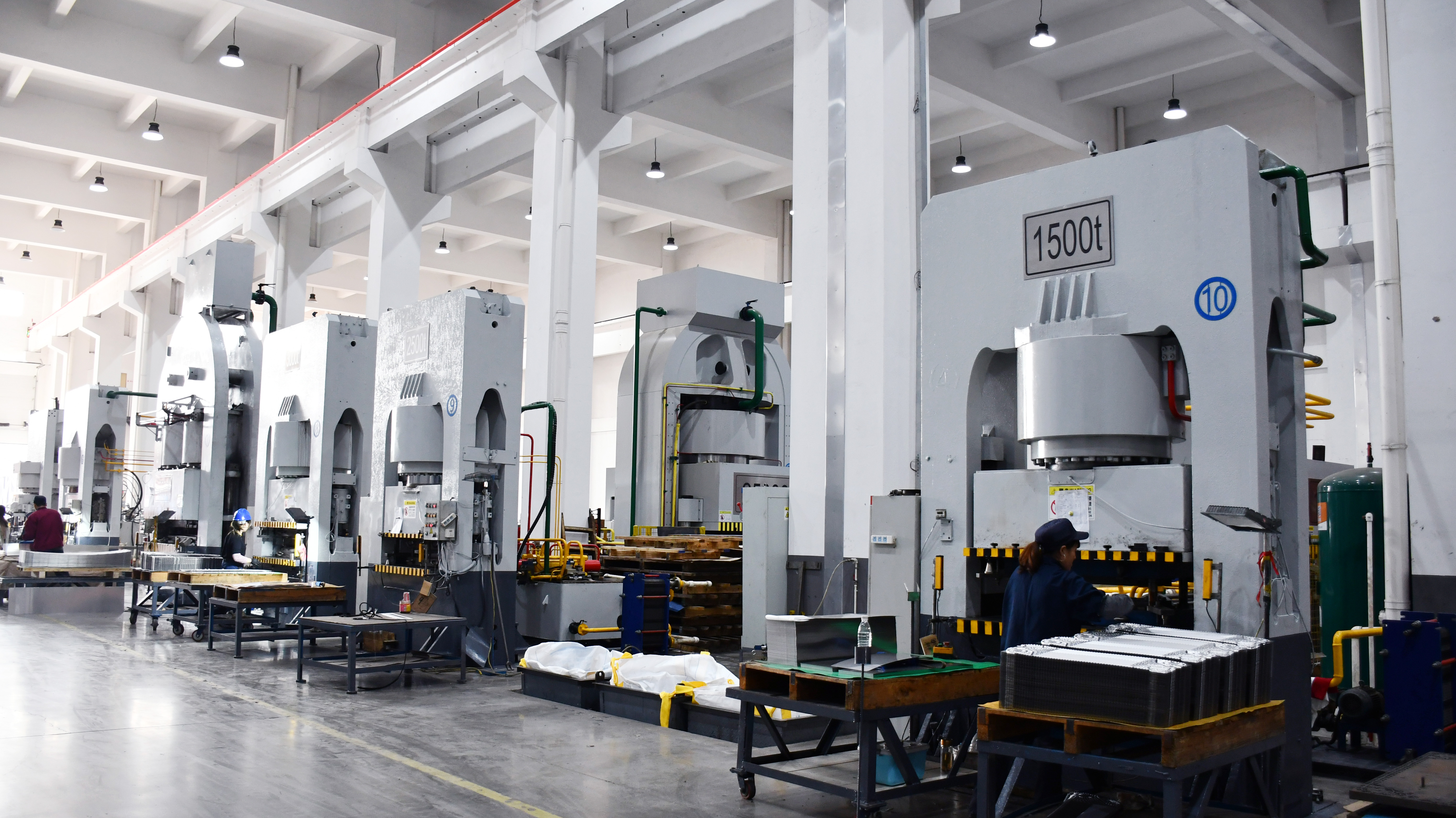
YIIING MACEINFRY operates a modern workshop (see image below) equipped with large-tonnage CNC presses capable of forming plates from 0.3mm to 0.8mm thick sheets. Key process controls include:
- Tooling Precision: CNC-machined molds ensure consistent channel depth, which is critical for uniform fluid distribution.
- Post-Forming Inspection: Each plate undergoes visual and dimensional checks to detect micro-cracks or warpage.
- Leak Testing: Brazed units are fully vacuum-tested, while gasketed units are hydrostatically tested to 1.3x design pressure.

2. Brazing and Welding Standards
Unlike Sondex which uses predominantly copper brazing, YIIING MACEINFRY offers both copper (for standard duties) and nickel (for high-temperature and high-corrosion resistance). The brazing process is conducted under a controlled vacuum furnace to prevent oxidation. The fully welded plate heat exchanger variant from YIIING MACEINFRY combines the high-pressure resistance of a shell-and-tube unit with the thermal efficiency of a plate unit, making it ideal for high-viscosity or particulate-laden fluids.
3. Gasket Adhesion and Installation Methods
Detachable plate heat exchangers rely on gasket integrity. YIIING MACEINFRY supports three adhesion methods: adhesive, embedded (clip-in), and hook (glue-less). The glue-less hook design reduces replacement labor by up to 50% compared to traditional glued gaskets, a significant advantage for facilities running 24/7 operations. This is a notable differentiator from Alfa Laval, which primarily uses glued gaskets that require longer curing time.
Comparative Benchmarking: Standing Up to the Industry Giants
| Parameter | YIIING MACEINFRY | Alfa Laval | Tranter | Sondex | GEA |
|---|---|---|---|---|---|
| Max design pressure (gasketed) | 2.5 MPa | 2.5 MPa | 2.5 MPa | 2.5 MPa | 2.5 MPa |
| Max design temp (Brazed) | +225°C | +225°C | +200°C | +225°C | +225°C |
| Cold temp support (Brazed) | -196°C | -196°C | -196°C | -196°C | -196°C |
| Gasket options | NBR, EPDM, HNBR, FKM/Viton | NBR, EPDM, FKM | NBR, EPDM, FKM | NBR, EPDM, FKM | NBR, EPDM, FKM |
| Plate materials (deep portfolio) | SS304/316L, Ti, Hastelloy | SS304/316L, Ti, Hastelloy | SS304/316L, Ti, Hastelloy | SS304/316L, Ti, Hastelloy | SS304/316L, Ti, Hastelloy |
| Gasket attachment | Glue-less hook, adhesive, clip-in | Adhesive (glue) | Adhesive, clip-in | Adhesive | Adhesive |
| Typical lead time (China-based) | 15-30 days | 4-8 weeks | 6-10 weeks | 8-12 weeks | 6-10 weeks |
Table Source: Compiled from manufacturer datasheets and industry reports (2026). Lead times are estimates and may vary based on order complexity and global supply chain conditions.
Practical Case Study: Transforming Specification into Savings
Client: Mid-Size Chemical Processing Plant
A Chinese chemical manufacturer needed to replace an aging APV gasketed unit handling a corrosive brine solution at 120°C. The existing unit suffered repeat gasket failures every 18 months, leading to costly unplanned downtime.
Solution Implemented by YIIING MACEINFRY:
- Specification Analysis: YIIING MACEINFRY engineers recommended upgrading from standard EPDM to HNBR gaskets, which can withstand 160°C continuous service in brine environments.
- Plate Material Upgrade: From standard 304 to 316L stainless steel for improved chloride resistance.
- Gasket Installation: Utilized the glue-less hook design, reducing replacement time from 16 hours to 6 hours.
Results: Gasket lifespan improved to 36+ months (100% increase). Total cost of ownership (TCO) over 5 years reduced by 35% when factoring in maintenance labor, spare parts, and lost production. Customer has since ordered three additional units, an unnamed source from the plant stated.
Certification as a Quality Guarantee
A critical part of technical specification verification is ensuring the manufacturer’s quality management processes are certified to recognized international standards. YIIING MACEINFRY holds three key certifications that attest to its capability:
- ISO 9001:2015 – Quality Management System (Heat Exchangers). This guarantees consistent product quality and continuous improvement processes.
- ISO 14001:2015 – Environmental Management System, demonstrating responsible manufacturing and waste management practices.
- ISO 45001:2018 – Occupational Health & Safety Management System, ensuring a safe working environment that protects skilled labor.
These certifications, combined on-site production images, prove that YIIING MACEINFRY operates with the discipline expected of a world-class OEM, not a low-cost assembler.
Conclusion: Precision Engineering for Demanding Applications
In the plate heat exchanger market, understanding the interplay between technical parameters (materials, gaskets, pressure/temperature) and production processes (pressing quality, brazing integrity, gasket adhesion) is the ultimate key to procurement success. While legacy giants like Alfa Laval, Tranter, and GEA set the industry standards, YIIING MACEINFRY has emerged as a formidable contender by aligning its engineering capabilities with these same high standards and offering a more competitive cost structure and faster delivery. By providing granular material data, multiple brazing options, and innovative gasket attachment methods, YIIING MACEINFRY enables procurement professionals to make data-driven decisions that optimize both performance and budget. As the industry moves toward greater energy recovery and sustainable processes, the ability to decode specifications and partner with a manufacturer that prioritizes precision engineering will be the hallmark of a resilient supply chain.
For further technical consultation or to request a detailed material compatibility matrix for your specific application, contact the YIIING MACEINFRY engineering team at sales@abc.com or call +86 180-7160-7336. Visit their website at www.yuling-phe.com for a complete product catalog.